
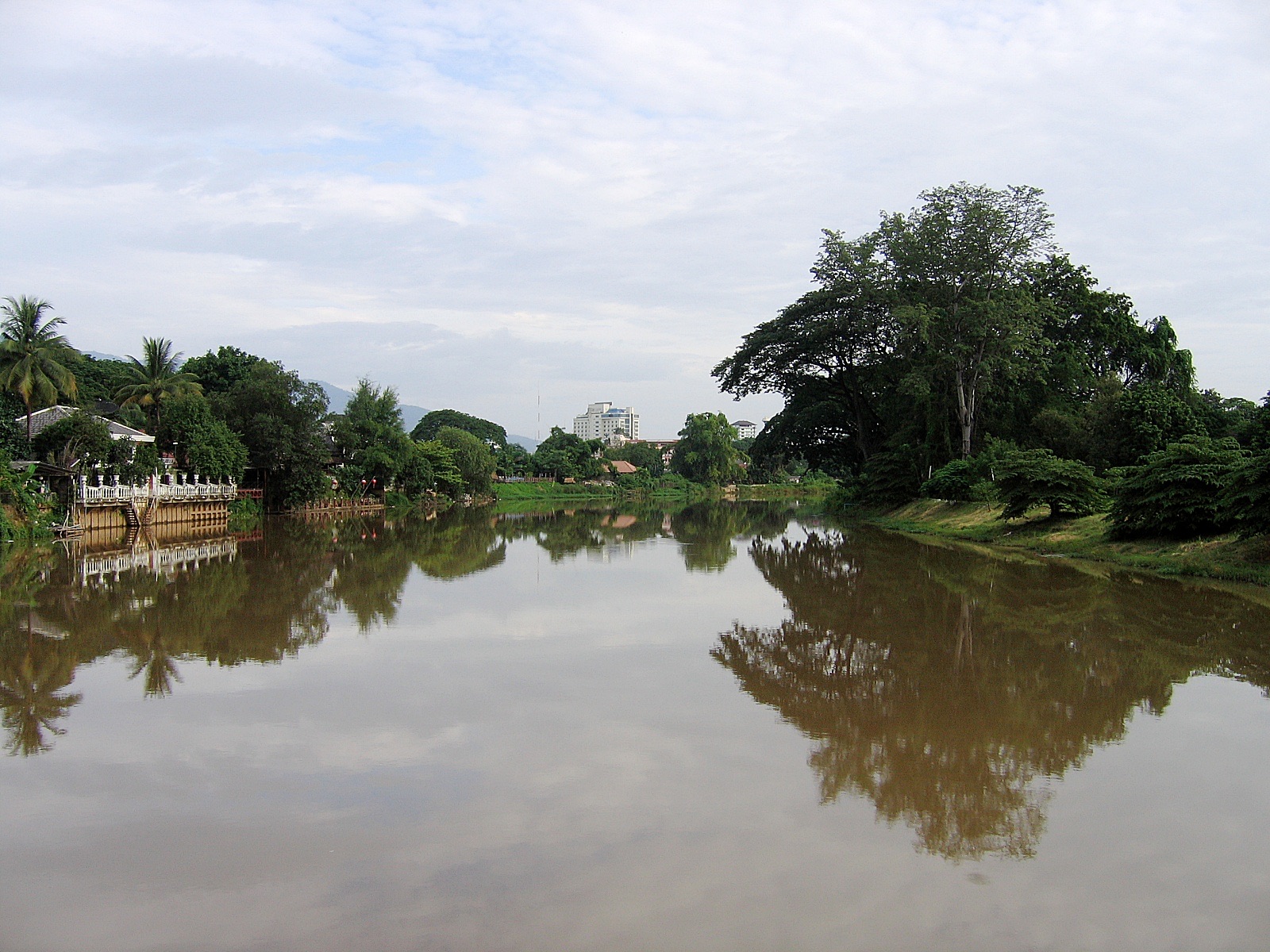
Photo: Vyacheslav Argenberg / Wikimedia Commons (CC BY 4.0)
Moon River in Kham Mueang: Telling the Song's Ideas
Moon River is a song people around the world know from the film Breakfast at Tiffany's. It is about a river that invites you to dream, to set out on a journey, and to remember an old friend. In this article we ask how a Northerner (khon mueang) would talk about a river, about crossing to the far bank, and about going off to see the world. Along the way we pick up several useful Kham Mueang words for water and travel.
A river in Kham Mueang is nam mae นาฯแม่, which the dictionary glosses as a river, a large waterway that gathers many streams. It brings to mind the picture of many small streams running together.
The song is still under copyright, so we do not translate it line by line, and we quote only three short phrases. What we take from it is its ideas, and then we try saying those ideas in Kham Mueang. This is one of the articles in the series World songs in Kham Mueang. If you have not read the first one, see My Way.
Where Moon River comes from
The writers. The music is by Henry Mancini and the words by Johnny Mercer. They wrote it for Audrey Hepburn to sing in Breakfast at Tiffany's (1961), directed by Blake Edwards, according to Wikipedia and Classic Song of the Day. In the film, Holly Golightly sits on a fire escape and sings it while playing a guitar. Mancini said in 1962 that the tune took him about half an hour, and that he wrote it to suit the character and the range of Hepburn's voice, as Songfacts records. It is reported that Paramount had considered dubbing another voice until Mancini wrote something that fitted hers.
The earlier title. Mercer first called it "Blue River." Wikipedia says the name referred to the colour of huckleberries; Songfacts says it had to change because another songwriter already had that title. The two accounts explain different sides of the story and do not conflict.
The river behind the words. Mercer grew up in Savannah, Georgia, in the United States. According to Wikipedia, the words recall his childhood by the water and picking huckleberries. Songfacts says the river was originally called the Back River and was later given the name Moon River in honour of the song; Wikipedia likewise says an inlet near Savannah was named after the song.
Nearly cut from the film. After a preview in Los Angeles, the Paramount executive Martin Rackin suggested cutting the song, according to Wikipedia and Songfacts. The accounts of Hepburn's reaction differ. She is said to have answered firmly with "Over my dead body", but Songfacts says "allegedly", so it cannot be confirmed. In the end the song stayed in the film.
Awards and recordings. The song won the Academy Award for Best Original Song and the 1962 Grammys for Record of the Year and Song of the Year. Mancini's instrumental recording was made on 8 December 1960, according to Wikipedia, and entered the Grammy Hall of Fame in 1999. The sources disagree on the month the single came out: Wikipedia says September 1961, Classic Song of the Day says October 1961. Jerry Butler released a sung version at the same time, and Danny Williams reached number 1 in Britain in late 1961. Andy Williams never released it as a single but put it on a 1962 album and used it as the theme of his television show, so many people remember the song in his voice. Hepburn's own recording was released only in 1993, after her death.
Listen to the song from Henry Mancini's official channel (the instrumental version), to compare with the ideas we go through next.

Nam mae duean: the river of the moon
The title means the river of the moon, so we tried calling it nam mae duean in Kham Mueang. This is a name we put together ourselves from two dictionary words, nam mae นาฯแม่ (a river) and duean เดิอฯร (the moon). It is not a single-word entry in the dictionary.
Kham Mueang rendering by MoradokLanna: น้ำแม่เดือน ("The river of the moon")
Crossing to the far bank: a river wider than expected
The opening phrase everyone remembers is "Moon River, wider than a mile" (Mancini–Mercer, "Moon River", 1961). The narrator sees a huge river and says that one day they will cross it. The idea fits Kham Mueang words directly. Kwang ก้วฯางฯ means not narrow, spread out. Lai หลฯายฯ means much, many. Kham ข้ามฯ means to pass from one side to the other, and fang ฝั่งฯ is the land at the edge of a river.
Kham Mueang rendering by MoradokLanna: น้ำแม่กว้างหลาย เฮาจะข้ามฝั่ง ("The river is so wide; I will cross to the other bank")
The word hao เรัา in the dictionary is "we", used for the speaker or a group of speakers.
Pan fan, pan sia chai: a river that gives both
The second idea is that the river in the song is both a maker of dreams and something that breaks the heart. Kham Mueang has pan ปันฯ, meaning to give or share out (hue also says it), and fan ฝันฯ, which the dictionary gives two senses: seeing a story-like scene while asleep, and imagining something one wants but which cannot come true. For sadness we use sia chai เสยฯไจ, "uneasy in the heart", and chai ไจ, "heart".
Kham Mueang rendering by MoradokLanna: น้ำแม่ปั๋นฝัน ปั๋นเสียใจ๋ ("The river gives dreams and gives sorrow")
Long tiao pai, pho lai ti: two travellers off to see the world
The third idea is two people setting out together to see the world. The song calls them "Two drifters, off to see the world" (Mancini–Mercer, "Moon River", 1961), the second phrase we quote.
Kham Mueang has several words that tell this well. Long ล่อฯง in the dictionary means to travel from north to south, down with the water (as in the song Long Mae Ping). Tiao ทยฯว means to walk or move along. Pho ผํอฯ means to look, to watch, to look after. Ti ที่ means a place, a locality, and phu ผู้ means a person. The number two is song สอฯง. To say "as far as the eye can see", the dictionary has kai choi woi ไกลฯชอฯยฯวอฯยฯ, "far to the limit of sight".
The dictionary has no word for "world" as Kham Mueang, so we use "lai ti" (many places), which suits the wide world well.
Kham Mueang rendering by MoradokLanna: สองผู้ล่องเตียวไป ผ่อหลายตี้ ("Two people travelling on, looking at many places")
Mit kaeo sahai kham: the childhood friend
The last idea is a friend you grew up with. The closing phrase people remember is "My huckleberry friend" (Mancini–Mercer, "Moon River", 1961), the third phrase we quote. Many people assume it means Mark Twain's character Huckleberry Finn, but Songfacts says that in Mercer's autobiography he explained it meant a childhood friend with whom he picked huckleberries.
The dictionary has two Kham Mueang terms for a dear friend. Mit kaeo sahai kham มิต์ตฯแก้วฯสหายฯฅำ means a true friend, a close friend, a friend to the death, and mu chum หู่ชุม means companions, friends. The dictionary has no standalone word for "friend" as Kham Mueang, so we use these two.
Kham Mueang rendering by MoradokLanna: ล่องไปกับมิตรแก้วสะหายคำ ("Travelling on with a true friend")
The words at a glance
| Idea | Kham Mueang words | Dictionary meaning |
|---|---|---|
| The river of the moon | nam mae นาฯแม่ · duean เดิอฯร · duang ดวฯง | river · the moon · word for round things |
| A wide river, crossing the bank | kwang ก้วฯางฯ · lai หลฯายฯ · kham ข้ามฯ · fang ฝั่งฯ | not narrow · much, many · to pass from one side to the other · river's edge |
| Gives both dreams and sorrow | pan ปันฯ · fan ฝันฯ · sia chai เสยฯไจ · chai ไจ | to give · seeing a scene in sleep / wanting what cannot come true · uneasy in the heart · heart |
| Setting out to see the world | long ล่อฯง · tiao ทยฯว · pho ผํอฯ · ti ที่ · kai choi woi ไกลฯชอฯยฯวอฯยฯ | down with the water · to walk · to look · a place · far to the limit of sight |
| A childhood friend | mit kaeo sahai kham มิต์ตฯแก้วฯสหายฯฅำ · mu chum หู่ชุม | a true friend · companions, friends |
All of these renderings are phrasings we put together from dictionary words. They are not a single standard version, and Northerners from different places may say the same idea in other words. We would also like a native speaker to check them.
Compared with Long Mae Ping: two rivers
Long Mae Ping by Jaran Manopetch also opens with a river, but uses it in a different way. The Ping flows from north to south through Chiang Mai, so the word long in the title matches the dictionary meaning exactly. Yet, as that article points out, the song is not about a boat trip; it uses mountain flowers and the Ping's water to describe a Chiang Mai girl.
Moon River uses the river as the road ahead in life, a place to dream, to set out, and to remember an old friend. Long Mae Ping uses the river as an image of home and of people who grew up beside the water. One song looks far ahead to where the river ends, the other comes back to the place where one was born. Read together, they show that a river, in Kham Mueang and in English, can carry thoughts in both directions.
Summary
- Nam mae is a river and duean is the moon; "nam mae duean" is a name we put together ourselves.
- Kwang, lai, kham and fang tell of a wide river and crossing to the far bank.
- Pan is to give, fan is to see a scene in sleep or to want what cannot come true, and sia chai is uneasy in the heart.
- Long, tiao, pho and ti tell of travelling to look at many places.
- Mit kaeo sahai kham is a true friend and mu chum is companions.
- The "Kham Mueang rendering by MoradokLanna" lines in this article tell the ideas; they are not a translation of the lyrics.
Look up the words in the Moradok Lanna dictionary (in Thai). Read on in the same series: My Way · Long Mae Ping or see the whole set at Kham Mueang through songs and literature (in Thai).
Copyright and courtesy
| Item | Details |
|---|---|
| Song | Moon River |
| Words | Johnny Mercer (English, 1961) |
| Music | Henry Mancini |
| Best-known recording | Audrey Hepburn in the film Breakfast at Tiffany's (1961) · Henry Mancini and his orchestra (instrumental) · Andy Williams (1962) |
| Status | Under copyright; all rights belong to the authors, publishers and record labels |
This article was made by Moradok Lanna, a non-profit website, for learning the Lanna language and culture. It is not an adaptation, translation or new version of the song. We quote only a few short lines, with credit, for study, criticism and review, as fair use allows (Thai Copyright Act B.E. 2537, section 32). The Kham Mueang lines are our own wording of the song's ideas, not a translation of its lyrics. Embedded videos come from the rights holders' official channels and remain their property.
With thanks and respect to the songwriters, performers and rights holders. If a rights holder would like anything changed or removed, please write to moradoklanna@gmail.com and we will act promptly.
References
- MoradokLanna Dictionary (dict2): nam mae, duean, duang, kwang, lai, kham, fang, pan, fan, sia chai, chai, long, tiao, pho, ti, kai choi woi, phu, song, mit kaeo sahai kham, mu chum, hao.
- Wikipedia. Moon River (used as a lead and checked against other sources).
- Songfacts. Moon River (Henry Mancini)
- Classic Song of the Day. “Moon River” (Henry Mancini & Orchestra / Jerry Butler / Andy Williams)
- Henry Mancini (official YouTube channel). Henry Mancini & His Orchestra – Moon River (Official Audio). YouTube
- Moradok Lanna articles My Way and Long Mae Ping.
Practise the words from this article
Flip through 21 flashcards of the Lanna words used in this article.


