
Photo: Chme82 / Wikimedia Commons (CC BY-SA 4.0)
Edelweiss in Kham Mueang: A Small White Flower
Edelweiss is a song many people take for an Austrian folk song, and some even think it is a national anthem. In fact it was written for the Broadway musical The Sound of Music in 1959. This article tells where the song comes from, with sources, and then invites you to learn Kham Mueang from its ideas: greeting one small white flower.
The word dok ดอฯก means, in the dictionary, the part of a plant that serves reproduction; the full form is dok mai ดอฯกไม้ ("flower"). When a flower starts to open, it ban บาฯนฯ (blooms).
This article belongs to the set World songs in Kham Mueang, within Kham Mueang through songs and literature. The song is still under copyright, so we do not translate it line by line. We quote only two short phrases, with sources, and then tell the song's ideas in Kham Mueang, in our own words.
Where Edelweiss comes from
Richard Rodgers wrote the music and Oscar Hammerstein II wrote the English words. The official Rodgers & Hammerstein website says the song was not part of the score when the show began its pre-Broadway tryout. The team decided in Boston that the character Captain von Trapp needed a song of his own, so Hammerstein wrote the lyric there to a melody Rodgers had already composed, which that site calls "one of the very few times" in their partnership that the music came first.
It was the last song the two wrote together. The Rodgers & Hammerstein website and Rick Steves both say so. Hammerstein died in August 1960, about nine months after the show opened, as Wikipedia summarises from The New York Times.
On stage, the Captain sings it at the concert scene. In the 1965 film, he picks up a guitar and sings it quietly when his children ask him to, as the Rodgers & Hammerstein website tells it. You can watch the film scene on the Rodgers & Hammerstein official channel.

A common myth: not a folk song and not an anthem
The Rodgers & Hammerstein website says the song is so well made that it "has often been mistaken as an actual Austrian folk song". Rick Steves, the European travel writer, says it is not a cherished Austrian folk tune or national anthem but, like the other "Austrian" music in the show, was "composed for Broadway" by Rodgers and Hammerstein.
Austria's national anthem is a different piece altogether. The Austrian Federal Chancellery (Bundeskanzleramt) records that the Council of Ministers decided on 25 February 1947 to introduce the present federal anthem, which is a different song from Edelweiss.
The real edelweiss flower
Edelweiss (Leontopodium nivale) is a small flowering plant in the same family as the sunflower. According to Wikipedia and Kew (Plants of the World Online), its leaves and flowers are covered in white hairs that make it look woolly. At the centre are small pale yellow florets, ringed by star-shaped white bracts. It likes rocky limestone ground at about 1,800 to 3,400 metres in the Alps, the Pyrenees and the Italian Apennines, and flowers from July to September. In the play, the flower stands for the Austria the Captain's family will keep in their hearts (as Wikipedia summarises from Laurence Maslon's The Sound of Music Companion).
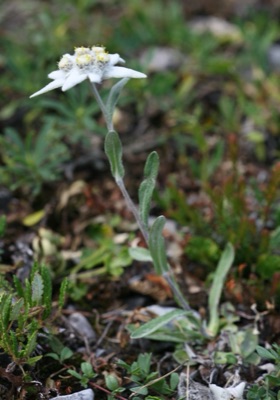
The Lanna dictionary has no word for this flower, because it is a high-mountain plant of Europe. We simply call it edelweiss and do not invent a Kham Mueang name.
Pho dok mai, yin di: a morning greeting
The song's first idea is greeting a flower every morning, as if greeting a friend. The song says the flower looks happy to meet the singer. In Kham Mueang, pho ผํอฯ means to look at, to watch, to look after. Phak khao ngai ผากฯเขั้างายฯ is the time from early morning until noon. Yin di ยินฯดี means to be pleased, to feel glad. Ban chai บาฯนฯไจ means cheerful, happy, heart full. For bright and fresh, the dictionary has chia ban เชิยฯบาฯนฯ.
We could not find a word for "greet" or "hello" in the dictionary, so we did not use one. We use "pho" instead, which is turning to look with a glad heart.
Kham Mueang rendering by MoradokLanna: ผากเข้างาย ผ่อดอกขาวหน้อย บานใจ๋ ("in the morning, looking at the little white flower, glad at heart")
Khao noi, sai ngam: small and clean
The second idea is that this flower is small and white, clean and bright. The writer describes it in one short phrase: "Small and white, clean and bright" (Oscar Hammerstein II, "Edelweiss", 1959).
Kham Mueang has noi ห้นฯอฯย, meaning not big, small, as in ma noi, a puppy. It has khao ขาวฯ, which the dictionary gives as the colour white and also as clear, clean, pure. Sai ไส means clear, bright, not murky, and ngam งา means beautiful, pleasing to look at.
Kham Mueang rendering by MoradokLanna: ดอกขาวหน้อย ใสงาม ("a little white flower, clear and lovely")
The dictionary has several shades of white. Khao phon ขาวฯผอฯร is a bright white, white all over. Khao pon ขาวฯพอฯร is a dull, greyish white. Si khao pon สีขาวฯพอฯร is a creamy white, and nuan นวฯร (second sense) is white tinged with a little yellow, like young tong leaves. We do not claim which word matches edelweiss, because the real flower has white wool and pale yellow florets at its centre. For more on colours, read Kham Mueang colours.
Ban saeng, hue yuen: may it bloom and last
The third idea is a wish for the flower to bloom and keep growing without end. In the dictionary, saeng แส่งฯ has the example "ban saeng", blooming fully. Yuen ยืนฯ, in one sense, means lasting, enduring. Hue หื้ means to give, and it can carry the sense of "may it be so".
Kham Mueang rendering by MoradokLanna: หื้อบานแส่ง หื้อยืน ("may it bloom fully, may it last")
(The dictionary has no word for "forever", so we use "yuen", which means lasting.)
Pan pon ban hao: blessing our home
The last idea is the heart of the song. The singer blesses his homeland. The song closes on the phrase "Bless my homeland forever" (Oscar Hammerstein II, "Edelweiss", 1959). In the show it is the Captain's love for Austria, and, as the Rodgers & Hammerstein website tells it, also a quiet protest against Nazi Germany's takeover of Austria.
Pan pon ปันฯพอฯร means to give a blessing (also hue pon). Ban บ้าฯนฯ is a house, a dwelling, and hao เรัา is "we, us". The dictionary has no single word for "homeland", so we use "ban hao", literally "our home". (Ban bloom above and ban home here sound the same; the context tells them apart.)
Kham Mueang rendering by MoradokLanna: ปั๋นปอนบ้านเฮา หื้อยืน ("bless our home, may it last")
Love of one's homeland is a sensitive matter in this song's history, so we tell only the core of the song as the sources describe it and do not go further into politics.
Compared with a Lanna flower: bua tong on the doi
If edelweiss is the white flower of Europe's high mountains, Lanna has a flower of the doi ดอฯย too. The dictionary defines doi as a mountain, a high mountain, and it has dok bua tong ดอฯกบ฿วฯทอฯง, a herbaceous plant with bright yellow flowers. The entry bua tong บ฿วฯทอฯง says it is most common on Doi Mae U Kho in Mae Hong Son, flowering in November and December.
The two flowers differ in many ways. Edelweiss is a small white flower of the Alpine summer. Bua tong is a bright yellow flower that spreads into fields in the cool season of Doi Mae U Kho. Yet both are flowers of the mountains.

Dozens more Lanna flower names, with Lanna script and real photos, are in Lanna flowers.
Summary of Kham Mueang from the song's ideas
| Idea | Kham Mueang words | Dictionary meaning |
|---|---|---|
| Greeting a flower in the morning | pho ผํอฯ · phak khao ngai ผากฯเขั้างายฯ · ban chai บาฯนฯไจ | to look at, to watch · early morning to noon · cheerful, happy |
| Small, white, clean | noi ห้นฯอฯย · khao ขาวฯ · sai ไส · ngam งา | small · white, clear, clean · clear, not murky · beautiful |
| May it bloom and last | saeng แส่งฯ · yuen ยืนฯ · hue หื้ | fully (ban saeng) · lasting, enduring · to give |
| Blessing our home | pan pon ปันฯพอฯร · ban บ้าฯนฯ · hao เรัา | to give a blessing · house, dwelling · we, us |
| Flowers of the mountain | doi ดอฯย · dok bua tong ดอฯกบ฿วฯทอฯง | high mountain · herb with bright yellow flowers |
All of these Kham Mueang lines are our own wording, assembled from dictionary words to tell the song's ideas. They are not the one standard way to say it. Northerners from different places may say the same ideas with other words, and every line should be checked again by a native speaker.
Compared with My Way: two world songs, two kinds of love
My Way tells of pride in a life lived one's own way. Edelweiss tells of love for one small flower and for one's home. The first song looks back at the self; the second looks out at the small things around us. Both invite you to learn Kham Mueang about "life and heart" from different angles.
Summary
- Edelweiss is a 1959 song written for the musical The Sound of Music by Richard Rodgers and Oscar Hammerstein II. It is not an Austrian folk song or anthem.
- It was the last song the two writers made together.
- Pho means to look at. Ban saeng means to bloom fully. Khao is both the colour white and "clean, pure".
- Pan pon means to give a blessing, and yuen, in one sense, means lasting.
- Bua tong on Doi Mae U Kho is a Lanna mountain flower we can compare.
- The "Kham Mueang rendering by MoradokLanna" lines tell ideas; they are not a translation of the lyrics.
Look up any word from this article in the Moradok Lanna dictionary. More in the same series: My Way, or see the whole set at Kham Mueang through songs and literature.
Copyright and courtesy
| Item | Details |
|---|---|
| Song | Edelweiss (from the musical The Sound of Music) |
| Words | Oscar Hammerstein II (English, 1959) |
| Music | Richard Rodgers |
| Best-known recording | The film version of The Sound of Music (1965) |
| Status | Under copyright; all rights belong to the authors, publishers and record labels |
This article was made by Moradok Lanna, a non-profit website, for learning the Lanna language and culture. It is not an adaptation, translation or new version of the song. We quote only a few short lines, with credit, for study, criticism and review, as fair use allows (Thai Copyright Act B.E. 2537, section 32). The Kham Mueang lines are our own wording of the song's ideas, not a translation of its lyrics. Embedded videos come from the rights holders' official channels and remain their property.
With thanks and respect to the songwriters, performers and rights holders. If a rights holder would like anything changed or removed, please write to moradoklanna@gmail.com and we will act promptly.
Sources
- Moradok Lanna Dictionary (dict2): the words dok, dok mai, ban, ban chai, chia ban, khao, khao phon, khao pon, si khao pon, nuan, noi, sai, ngam, phak khao ngai, pho, yin di, yuen, pan pon, ban, hao, hue, saeng, doi, bua tong, dok bua tong
- Rodgers & Hammerstein. Edelweiss (official website)
- Rick Steves. The Sound of Music Debunked
- UPI. (1984, 2 March). Austrians rankled at Reagan
- Bundeskanzleramt Österreich. Bundeshymne
- Kew, Plants of the World Online. Leontopodium nivale subsp. alpinum
- Wikipedia. Edelweiss (song) and Edelweiss (plant) (used as a lead and checked against other sources)
- Rodgers & Hammerstein (official channel). "Edelweiss" – The Sound of Music (1965). YouTube
- Moradok Lanna articles: Lanna flowers · Kham Mueang colours · My Way
Practise the words from this article
Flip through 26 flashcards of the Lanna words used in this article.


