
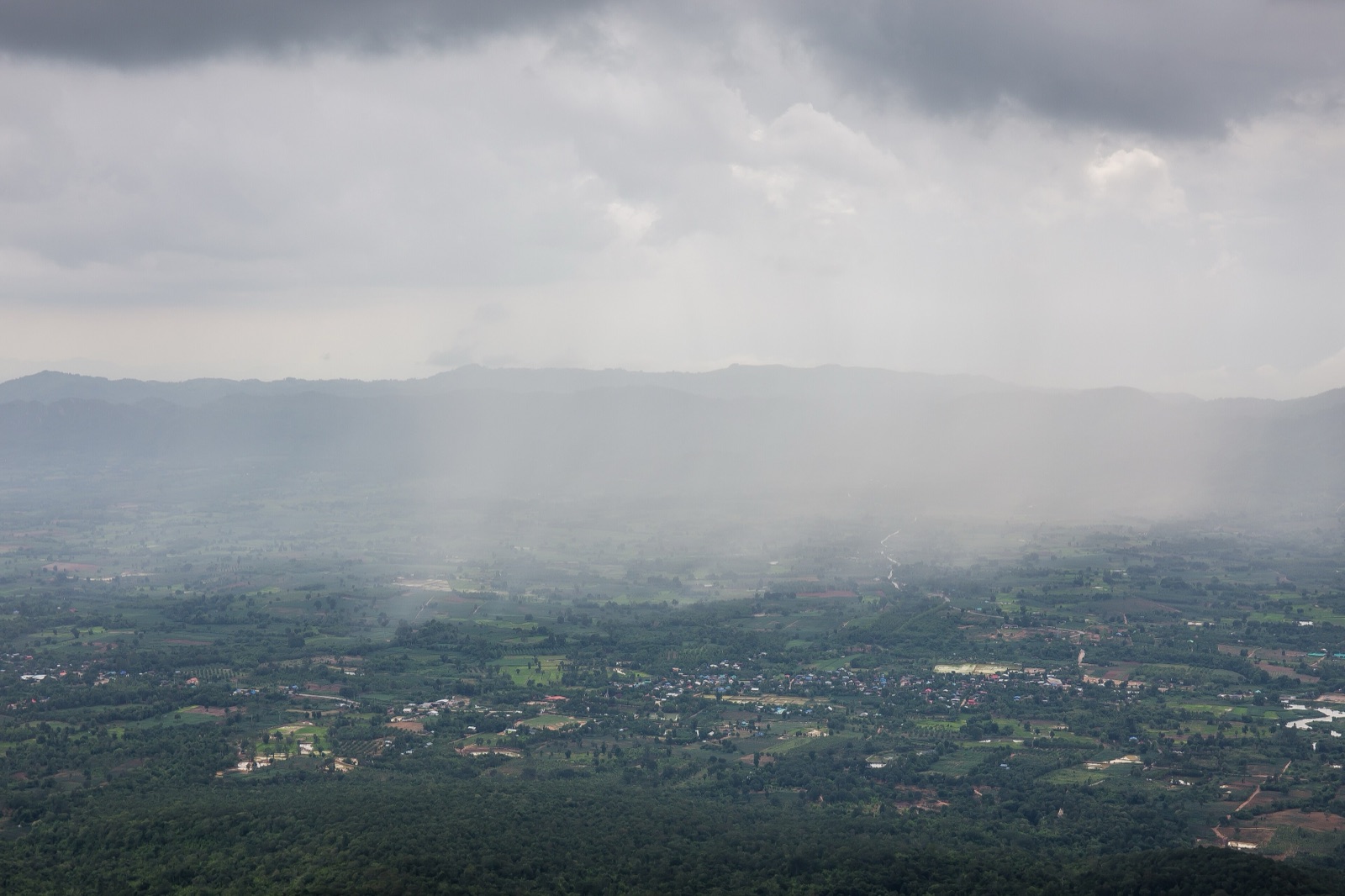
Photo: Frank Vincentz / Wikimedia Commons (CC BY-SA 3.0)
Rhythm of the Rain in Kham Mueang: Listening to the Rain
Rhythm of the Rain by The Cascades is an early-1960s pop song that many people recognise from the clap of thunder at its start. It is about a man sitting and listening to the rain after the person he loves has left. In this article we ask a playful question: how would a Northerner (khon mueang) talk about rain and this kind of sadness?
The word fon ฝ฿นฯ (Kham Mueang reading fon, "rain") is the same as in Central Thai. But when it comes to how the rain falls, Kham Mueang has several words of its own, which suits a song that listens to the rain from start to finish.
This article belongs to the set World songs in Kham Mueang, within Kham Mueang through songs and literature. The song is still under copyright, so we do not translate it line by line, and we quote only two short phrases. What we take from it is its ideas, and then we try saying those ideas in Kham Mueang.
Where Rhythm of the Rain comes from
The song was written by John Claude Gummoe, a member of The Cascades himself. According to American Songwriter, he was born in 1938 in Cleveland, Ohio, and served in the US Navy. The band's own history page says the group came together aboard the USS Jason in 1960.
There are two tellings of how the song began. American Songwriter says Gummoe wrote it while watching a thunderstorm on duty in the Navy. The blog Classic Song of the Day gives more detail: he was standing the midnight watch on the bridge of the USS Jason, on the way to Japan in heavy rain. The title came to him first, and the melody followed later, when he sat at a piano and ran his fingers over the black keys.
The record was produced by Barry De Vorzon and released on Valiant Records in November 1962. Wikipedia records that the arranger, Perry Botkin Jr., played the celesta (a keyboard instrument with a clear, bell-like sound), and that well-known session musicians took part, such as Hal Blaine (drums), Carol Kaye (bass) and Glen Campbell (guitar). Classic Song of the Day says the thunder at the start was De Vorzon's idea.
In the US the song reached No. 3 on the Billboard Hot 100 in March 1963 and spent two weeks at No. 1 on the Easy Listening chart, according to Wikipedia and American Songwriter. The band's history page gives No. 2, and Classic Song of the Day gives No. 2 on the Cash Box chart, so the sources are talking about different charts. In 1999 the music rights organisation BMI placed it ninth on its list of the century's most-played songs on radio and television.
This article has no embedded video, because we could not find an official rights-holder channel that publishes the original 1962 recording. You can hear the song on licensed music services.
Listening to the rain: fon tok si si to fon tok ba ba
The first idea of the song is sitting and listening to rain falling in a steady beat. The song opens with its own title line, "Listen to the rhythm of the falling rain" (John Gummoe, "Rhythm of the Rain", 1962).
Kham Mueang uses fang ฟังฯ just like Central Thai; the dictionary defines it as to receive sound with the ears, to listen carefully. Siang สยฯง ("sound") is also the same. But Kham Mueang splits rain finely. Light rain that keeps going is fon tok si si ฝ฿นฯต฿กฯซิๆ, a drizzle is fon tok sui sui ฝ฿นฯต฿กฯสุๆ, and heavy rain is fon tok ba ba ฝ฿นฯต฿กฯบัะๆ. The thunder that opens this song is fa hong ฟ้าร้อฯง in Kham Mueang.
Kham Mueang rendering by MoradokLanna: ฟังเสียงฝนต๋กซิๆ ("listening to the sound of the steady light rain")
The word for "rhythm" has no Kham Mueang entry in the dictionary, so we do not invent one. We chose fon tok si si instead: rain that is not heavy but does not stop, like the rain you can hear all night in the song.
Ngao: when the rain says you have been a fool
The second idea is that the sound of the rain seems to rub in a mistake. The narrator feels the rain is telling him "what a fool I've been" (John Gummoe, "Rhythm of the Rain", 1962).
Kham Mueang calls foolishness ngao ง่าวฯ; the dictionary gives "foolish, not clever, slow-witted", and a fool is khon ngao ฅ฿นฯง่าวฯ. To tell someone something is bok บอฯก, and wa ว่าฯ joins a clause after a verb, like "bok wa" ("tell that") in Central Thai.
Kham Mueang rendering by MoradokLanna: ฝนบอกว่าข้าง่าว ("the rain says I'm a fool")
Kha ข้า is a word for "I" which, the dictionary says, is used between people of a similar age or close friends. Here the speaker is talking about himself, so it insults no one.
Hai kang fon: tears nobody sees
The third idea is sadness you want to keep to yourself. The narrator wants the rain to leave him alone with his sorrow, so the rain is both a companion and a curtain over his tears.
Kham Mueang calls crying hai ไห้; the dictionary defines it as to cry, to weep in deep grief. Tears are nam ta นาฯตา, and tears flowing is nam ta ok นาฯตาออฯก. Kang กลฯางฯ means middle, in the midst of; phai ไผ means "who", and han หันฯ means to see.
Kham Mueang rendering by MoradokLanna: น้ำต๋าออก ไห้ก๋างฝน บ่มีไผหัน ("tears flowing, crying in the rain, with no one to see")
This uses bo บ ("not") with mi มี ("there is, to have"). The meaning is crying in the middle of the rain where nobody sees the tears. It is a general idea of the song, not a translation of any line.
The dictionary has another word that fits this mood very well: lam poeng ราเพิงฯ, to muse, to turn something over in your mind alone.
Nang paeng ni pai kai: the beloved has gone far away
The fourth idea is the cause of the sadness: the only girl he loved has gone far away to start a new life of her own.
Kham Mueang has a lovely word for a beloved woman: nang paeng นาฯงฯแพงฯ. The dictionary defines ni หีนฯ as to go away, to get away; pai ไพ ("to go") is the same as Central Thai, and kai ไกลฯ means far, distant.
Kham Mueang rendering by MoradokLanna: นางแปงหนีไปไก๋ ("my beloved has gone far away")
Love in Kham Mueang is hak รักฯ. As a verb the dictionary gives "to care for and be bound to, to be fond of with affection" (the same word is also the name of trees, such as the lacquer tree).
Fon hoei, go and tell her
The last idea is hope. The narrator asks the rain to go and tell her that he still loves her, and hopes their love can grow again. So the song ends on hope more than sadness.
Kham Mueang calls out fondly with hoei เหิยฯ ("O ..."). Yang ยังฯ means still, remaining; hue หื้ means to give, to let; and pik พิกฯ means to return, used with ma มา ("to come").
Kham Mueang rendering by MoradokLanna: ฝนเหย ไปบอกนางแปงว่ายังฮัก หื้อปิ๊กมา ("O rain, go tell my beloved I still love her, so she comes back")
When the rain stops, Northerners say fon uean ฝ฿นฯเอิ้อฯร, and sunshine is daet แดดฯ. Anyone who finishes this song still hopeful might feel un chai อุ่รไจ, which the dictionary explains as at ease, free of worry.
Kham Mueang rendering by MoradokLanna: ฝนเอื้อน แดดออก อุ่นใจ๋ ("the rain stops, the sun comes out, the heart is at ease")
The words at a glance
| Idea | Kham Mueang words | Dictionary meaning |
|---|---|---|
| Listening to the rain | fang ฟังฯ · fon tok si si ฝ฿นฯต฿กฯซิๆ · fon tok ba ba ฝ฿นฯต฿กฯบัะๆ · fa hong ฟ้าร้อฯง | to listen · light rain that lasts · heavy rain · thunder |
| Feeling you got it wrong | ngao ง่าวฯ · khon ngao ฅ฿นฯง่าวฯ · bok บอฯก | foolish · a fool · to tell |
| Crying alone | hai ไห้ · nam ta นาฯตา · lam poeng ราเพิงฯ | to cry · tears · to muse alone |
| A love gone away | nang paeng นาฯงฯแพงฯ · ni หีนฯ · kai ไกลฯ | beloved woman · to go away · far |
| Hope | hak รักฯ · pik พิกฯ · fon uean ฝ฿นฯเอิ้อฯร · un chai อุ่รไจ | to love · to return · the rain stops · at ease |
All of these renderings are phrasings we put together from dictionary words. They are not the one standard way to say it, and Northerners from different places may say the same idea with other words.
Compared with our weather words: rain in the song and rain in Kham Mueang
In this song the rain is like a person who can talk. It tells the narrator he made a mistake, and he sends it with a message to the one he loves. The rain stands for the feelings inside him.
In Kham Mueang, rain is a matter of watching nature closely. Our article Sky, Rain and Wind: Kham Mueang Weather Words gathers the words that sort rain by strength and length, from rain just starting, drizzle and rain that lasts for days, to rain stopping. There are also words like ham fon รำฝ฿นฯ, meaning to be out in the rain for a long time.
If this song makes you want to know what each kind of rain is called, read that article next. Its words will help you talk about the weather every day, both on days when the rain makes you sad and on days when the rain stops and the sun comes out.
Summary
- Fang and siang are the same as Central Thai, but rain has many words, such as fon tok si si (light but lasting) and fon tok ba ba (heavy).
- Ngao means foolish; fine about yourself, but careful with other people.
- Hai is to cry, nam ta ok is tears flowing, and lam poeng is musing alone.
- Nang paeng is a beloved woman, hak is to love, and fon uean is when the rain stops.
- The "Kham Mueang rendering by MoradokLanna" lines in this article retell ideas; they do not translate the song's lyrics.
Look up more of the words in the MoradokLanna dictionary. Keep reading in the same series: My Way in Kham Mueang or see the whole set at Kham Mueang through songs and literature (in Thai).
Copyright and courtesy
| Item | Details |
|---|---|
| Song | Rhythm of the Rain |
| Words | John Claude Gummoe (English, 1962) |
| Music | John Claude Gummoe |
| Best-known recording | The Cascades (1962, Valiant Records) |
| Status | Under copyright; all rights belong to the authors, publishers and record labels |
This article was made by Moradok Lanna, a non-profit website, for learning the Lanna language and culture. It is not an adaptation, translation or new version of the song. We quote only a few short lines, with credit, for study, criticism and review, as fair use allows (Thai Copyright Act B.E. 2537, section 32). The Kham Mueang lines are our own wording of the song's ideas, not a translation of its lyrics. This article does not embed a video of the song.
With thanks and respect to the songwriters, performers and rights holders. If a rights holder would like anything changed or removed, please write to moradoklanna@gmail.com and we will act promptly.
References
- MoradokLanna Dictionary (dict2): fon, fang, siang, fon tok si si, fon tok sui sui, fon tok ba ba, fa hong, ngao, khon ngao, kha, bok, wa, hai, nam ta, nam ta ok, kang, mi, phai, han, lam poeng, nang paeng, ni, pai, kai, hak, hoei, yang, hue, pik, ma, fon uean, daet, un chai, ham fon, bo.
- Wikipedia. Rhythm of the Rain (used as a lead and checked against other sources).
- Houghton, Cillea. (22 March 2023). Meet the Writer Behind "Rhythm of the Rain" by The Cascades. American Songwriter
- Miller, Michael. (13 May 2025). "Rhythm of the Rain" (The Cascades). Classic Song of the Day
- The Cascades. The Cascade Story (the band's history page on its own website)
- Moradok Lanna's article Sky, Rain and Wind: Kham Mueang Weather Words
Practise the words from this article
Flip through 35 flashcards of the Lanna words used in this article.


