
Photo: Utagawa Hiroshige / Wikimedia Commons (Public domain)
Stand By Me in Kham Mueang: Standing Side by Side
Stand By Me by Ben E. King is a song people all over the world can sing along to, from the short bass line that opens it. It is about a dark night in which the singer says he will not be afraid of anything, as long as someone stands beside him. In this article we ask a playful question: how would a Northerner (khon mueang) say these ideas?
The word closest to the heart of the song is fae kan แฟกันฯ (Kham Mueang reading fae kan), which the dictionary defines as side by side, close together.
This article belongs to the set World songs in Kham Mueang, within Kham Mueang through songs and literature. The song is still under copyright, so we do not translate it line by line, and we quote only two short phrases. What we take from it is its ideas, and then we try saying those ideas in Kham Mueang.
Where Stand By Me comes from
Before going solo, Ben E. King was the lead singer of The Drifters. An essay for the US Library of Congress says he left the group over a contract dispute, and Jerry Wexler of Atlantic Records then put him together with the songwriting pair Jerry Leiber and Mike Stoller. At his first solo session they recorded "Spanish Harlem", then used the time left in the studio on a song King had written while still with The Drifters, who had turned it down.
King said he was inspired by the gospel hymn "Stand by Me" by the Rev. Charles Albert Tindley, which Wikipedia says is based on Psalm 46 in the Bible. American Songwriter adds that the title was also inspired by "Stand by Me Father", a song by Sam Cooke and J.W. Alexander. The Library of Congress essay calls Tindley's hymn "Stand By Me Father", so the sources do not agree on the name of the source song.
Mike Stoller recalls that when he arrived, King was singing the melody unaccompanied, and that Leiber and King had the words nearly finished. Stoller then worked out the bass line that became the song's signature (as American Songwriter and Wikipedia record). The song is therefore credited to three writers: Ben E. King, Jerry Leiber and Mike Stoller. Wikipedia records that it was recorded in late 1960 and released on Atco in 1961.
It reached No. 4 on the Billboard Hot 100 and No. 1 on the R&B chart. In 1986 it was the theme of the film of the same name, "Stand by Me", which Rob Reiner adapted from a Stephen King short story (according to the Library of Congress essay). The song returned to the charts and reached No. 1 in the United Kingdom in early 1987, according to Wikipedia. In 1999 the music rights organisation BMI ranked it the fourth most-played song on radio and television of the 20th century, and in 2015 the Library of Congress added Ben E. King's recording to the National Recording Registry.
You can hear the song on the official channel of the label RHINO. The video shows a spinning record with the song from Ben E. King's album Don't Play That Song!, according to the video's description. Listen to the bass line at the start, and notice how the strings come in little by little.

Kham khuen muet tuek: a pitch-dark night
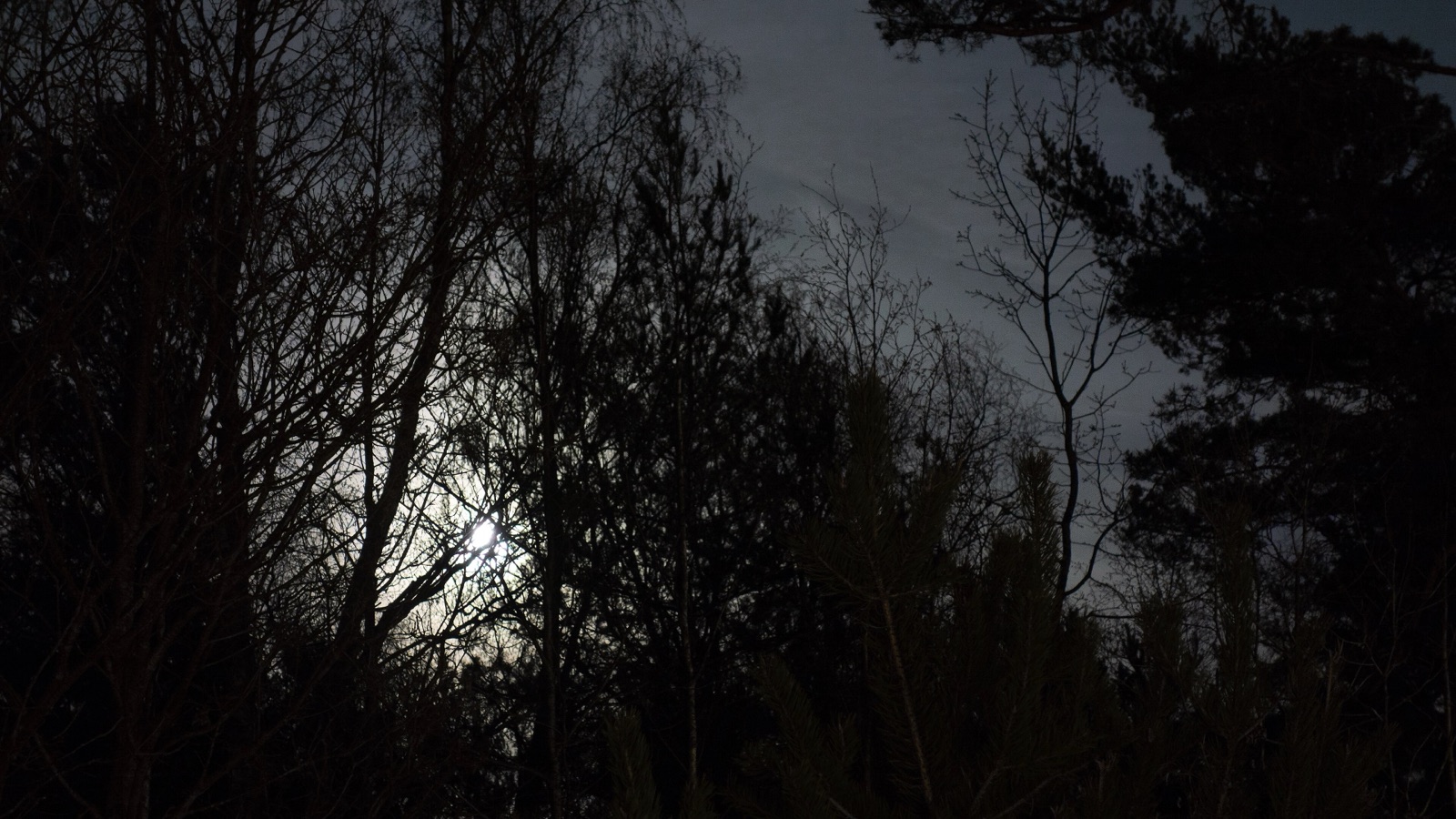
The first idea of the song is the darkness of night. It opens with "When the night has come" (Ben E. King, Jerry Leiber and Mike Stoller, "Stand By Me", 1961): night arrives and the land goes dark.
Kham Mueang calls the dark time as night begins kham ฅํา, and the time from dusk to dawn khuen ฅืนฯ. The dictionary also has yam kham ยามฯฅํา, the evening hours of about 16:30 to 18:00. Darkness is muet มืดฯ, and when it is so dark you cannot see anything, Northerners say muet tuek มืดฯตึกฯ.
Kham Mueang rendering by MoradokLanna: ค่ำคืนมา ฟ้ามืดตึ๋ก ("night comes, the sky is pitch dark")
Moonlight to show the way
The second idea is that the only light left that night is the moon. The singer says that even if that is all the light there is, it is enough.
Kham Mueang calls the moon duean เดิอฯร; a full moon is duean mon เดิอฯรม฿นฯ, and light is saeng แสงฯ. Mi มี ("there is, to have") is the same as Central Thai.
Kham Mueang rendering by MoradokLanna: มีแสงเดือนมนส่องทาง ("there is full-moon light to show the way")
"Song thang" ("to light the way") in this sentence is Thai, because we add the Lanna script only for words that are in the dictionary.
Bo kua, bo yan: not afraid
The third idea is fearlessness. The singer says he will not be afraid as long as someone is beside him.
Kham Mueang has two words for fear. The dictionary defines kua ก฿ลฯวฯ as to dread, to be fearful, apprehensive, and yan อยฯานฯ as to be afraid, timid, daunted, disheartened. Put bo บ in front and it becomes "not afraid".
Kham Mueang rendering by MoradokLanna: บ่กั๋ว บ่หย้าน ("not afraid, not scared")
Fa tok, doi lom: even if the sky falls, no tears
The fourth idea is staying steady even if the world falls apart. The singer says that even if the sky came down, or the mountains crumbled into the sea, he would not cry.
Kham Mueang calls the sky fa ฟ้า and a mountain doi ดอฯย. To fall to a lower place is tok ต฿กฯ, and the dictionary defines lom ห้฿ลฯม as to collapse, to break down, to crumble. To cry is hai ไห้, and tears are nam ta นาฯตา.
Kham Mueang rendering by MoradokLanna: ฟ้าจะต๋ก ดอยจะหล้ม ก็บ่ไห้ บ่มีน้ำต๋า ("though the sky falls and the mountains crumble, no crying, no tears")
The word for "sea" has no entry in the dictionary, so we left it out of the sentence and used the sky and the mountains, which are closer to a Northerner's everyday world.
Yuen fae kan: standing side by side
The fifth idea is the heart of the title, "Stand by me" (Ben E. King, Jerry Leiber and Mike Stoller, "Stand By Me", 1961): please be beside me.
Kham Mueang uses yuen อยฯนฯ ("to stand") just like Central Thai. Khang ข้างฯ means side, near, beside. Two words say "close together": fae kan, side by side as a pair, and mae kan แหมฯะกันฯ, near each other, close together, alongside. Tuai ทวฯยฯ also means to follow, to go along, together with.
Kham Mueang rendering by MoradokLanna: ยืนแฟกั๋น อยู่แหม๋ะกั๋น ("stand side by side, stay close together")
Yu อยฯู่ in this sentence means to stay, not to go anywhere.
Yam tuk, chao mu chuai: friends who help in hard times
The last idea is being together in hard times. The singer asks the other person to come and stand beside him whenever there is trouble. That is why the song is sung both as a love song and as a song of friendship.
Kham Mueang calls suffering tuk ทุก์ขฯ, and a troubled heart tuk chai ทุก์ขฯไจ. To help is chuai ช่วฯย. The dictionary has several words for friends: chao mu เจั้าหู่, companions, friends, comrades; mu chum หู่ชุม, one's group of friends; ku thu คู่ถู, a close companion, a best friend; and siao ส่ยฯว, a sworn friend, a close friend. Yam ยามฯ means a time, an occasion.
Kham Mueang rendering by MoradokLanna: ยามตุ๊กข์ใจ๋ เจ้าหมู่จ้วย ("when the heart is troubled, friends help")
The everyday word for "friend", which Northerners pronounce puean, has no headword in the dictionary, so we used chao mu, which is in the dictionary, instead.
The words at a glance
| Idea | Kham Mueang words | Dictionary meaning |
|---|---|---|
| A dark night | kham ฅํา · khuen ฅืนฯ · muet tuek มืดฯตึกฯ | the dark as night begins · dusk to dawn · too dark to see |
| Moonlight | duean เดิอฯร · duean mon เดิอฯรม฿นฯ · saeng แสงฯ | the moon · full moon · light |
| Not afraid | kua ก฿ลฯวฯ · yan อยฯานฯ | to dread · afraid, timid |
| Even if the world falls | doi ดอฯย · tok ต฿กฯ · lom ห้฿ลฯม | mountain · to fall · to collapse, crumble |
| Standing beside | yuen อยฯนฯ · fae kan แฟกันฯ · mae kan แหมฯะกันฯ | to stand · side by side · close together |
| Friends in hard times | tuk ทุก์ขฯ · chuai ช่วฯย · chao mu เจั้าหู่ · ku thu คู่ถู | suffering, hardship · to help · friends · best friend |
All of these renderings are phrasings we put together from dictionary words. They are not the one standard way to say it, and Northerners from different places may say the same idea with other words.
Compared with Kham Mueang family words: poen, tua and pi nong
Stand By Me never says who the "me" and "you" are, so it can be sung at a wedding or among friends. Kham Mueang has a pair of pronouns that works both ways too. Our article Kham Mueang Family Words explains that poen เพิ่นฯ ("I") and tua ต฿วฯ ("you") are the pair close friends use with each other, and couples use them as well.
Kham Mueang rendering by MoradokLanna: ขอตั๋วยืนแฟกั๋นกับเปิ้น ("please, you, stand side by side with me")
This sentence uses kho ขํอฯ, which the dictionary defines as to speak so that someone gives you what you want, to ask.
Another interesting word is pi nong พี่น้อฯง. The dictionary gives not only "older and younger siblings, relatives" but also "people who respect each other as if they were kin". A friend who has stood beside you through hard times until you regard each other as family can be pi nong in Kham Mueang, which fits the idea of this song exactly.
Summary
- Kham and khuen are for night time; when it is so dark you cannot see, say muet tuek.
- The moon is duean, and a full moon is duean mon.
- Kua and yan mean afraid; put bo in front for "not afraid".
- Fae kan and mae kan mean side by side, close together, and a friend can be chao mu, ku thu or siao.
- The "Kham Mueang rendering by MoradokLanna" lines in this article retell ideas; they do not translate the song's lyrics.
Look up more of the words in the MoradokLanna dictionary. Keep reading in the same series: My Way in Kham Mueang or see the whole set at Kham Mueang through songs and literature (in Thai).
Copyright and courtesy
| Item | Details |
|---|---|
| Song | Stand By Me |
| Words | Ben E. King, Jerry Leiber and Mike Stoller (English, 1961) |
| Music | Ben E. King, Jerry Leiber and Mike Stoller |
| Best-known recording | Ben E. King (1961, Atco) |
| Status | Under copyright; all rights belong to the authors, publishers and record labels |
This article was made by Moradok Lanna, a non-profit website, for learning the Lanna language and culture. It is not an adaptation, translation or new version of the song. We quote only a few short lines, with credit, for study, criticism and review, as fair use allows (Thai Copyright Act B.E. 2537, section 32). The Kham Mueang lines are our own wording of the song's ideas, not a translation of its lyrics. Embedded videos come from the rights holders' official channels and remain their property.
With thanks and respect to the songwriters, performers and rights holders. If a rights holder would like anything changed or removed, please write to moradoklanna@gmail.com and we will act promptly.
References
- MoradokLanna Dictionary (dict2): fae kan, kham, khuen, yam kham, muet, muet tuek, duean, duean mon, saeng, mi, kua, yan, bo, fa, doi, tok, lom, hai, nam ta, yuen, khang, mae kan, tuai, yu, tuk, tuk chai, chuai, chao mu, mu chum, ku thu, siao, yam, poen, tua, kho, pi nong.
- Wikipedia. Stand by Me (Ben E. King song) (used as a lead and checked against other sources).
- Uitti, Jacob. (21 February 2023). Who Wrote the Classic Song of Friendship "Stand by Me". American Songwriter
- Rodgers, Amanda. "Stand By Me" — Ben E. King (1961). National Recording Registry essay, Library of Congress
- RHINO (official channel). Ben E. King – Stand By Me (Official Vinyl Video). YouTube
- Moradok Lanna's article Kham Mueang Family Words
Practise the words from this article
Flip through 36 flashcards of the Lanna words used in this article.


