
Photo: Omber Pit / Wikimedia Commons (CC BY-SA 4.0)
Shakespeare's Sonnet 18 in Kham Mueang
Shakespeare's Sonnet 18, which opens "Shall I compare thee to a summer's day?", is one of the best-known love poems in English. It praises a beloved as more ngam งา (beautiful) than a summer's day, then promises that this beauty will never be lost, because it lives on in the poem. This article renders all 14 lines in Kham Mueang (Northern Thai), using only words found in the dictionary.
The poem is not a song, but it belongs to the series World songs in Kham Mueang along with the world's famous songs. And unlike a song still under copyright, such as My Way, Shakespeare's poem is in the public domain, so we can print every line of the original and render the whole poem in Kham Mueang.
Where Sonnet 18 comes from
William Shakespeare (1564–1616), the English poet and playwright, wrote 154 poems in the form called the sonnet. They were first printed together in 1609 as Shake-speares Sonnets. Never before Imprinted. Representative Poetry Online at the University of Toronto records that the book was printed in London by G. Eld "for T. T.", that is, Thomas Thorpe, and sold by William Aspley. The Folger Shakespeare Library calls the 1609 edition the authoritative text. Whether Shakespeare himself oversaw the printing is a point on which sources disagree.
In the grouping scholars use, sonnets 1–126 are addressed to a young man, known as the Fair Youth, whose identity nobody knows for sure. Sonnets 1–17 urge him to marry and have children so that his beauty will live on. Sonnet 18 turns instead to the idea that the poem itself will keep that beauty. Wikipedia records that most scholars see Sonnet 18 as the start of a new group, while some think it still belongs to the first.
The form. An English sonnet has 14 lines: three groups of four lines and a closing couplet, rhyming ABAB CDCD EFEF GG. The thought of the poem turns at the third group (the word "But" in line 9). In a similar way, the Lanna verse form khao ระฯค่าฯวฯ links its rhymes in an ordered chain, though with a different rhyme pattern.
The text we use is the 1609 edition as transcribed on Wikisource, shown in the modern spelling of William J. Rolfe's edition (1883), which is also in the public domain. The original 1609 spelling is in the box below.
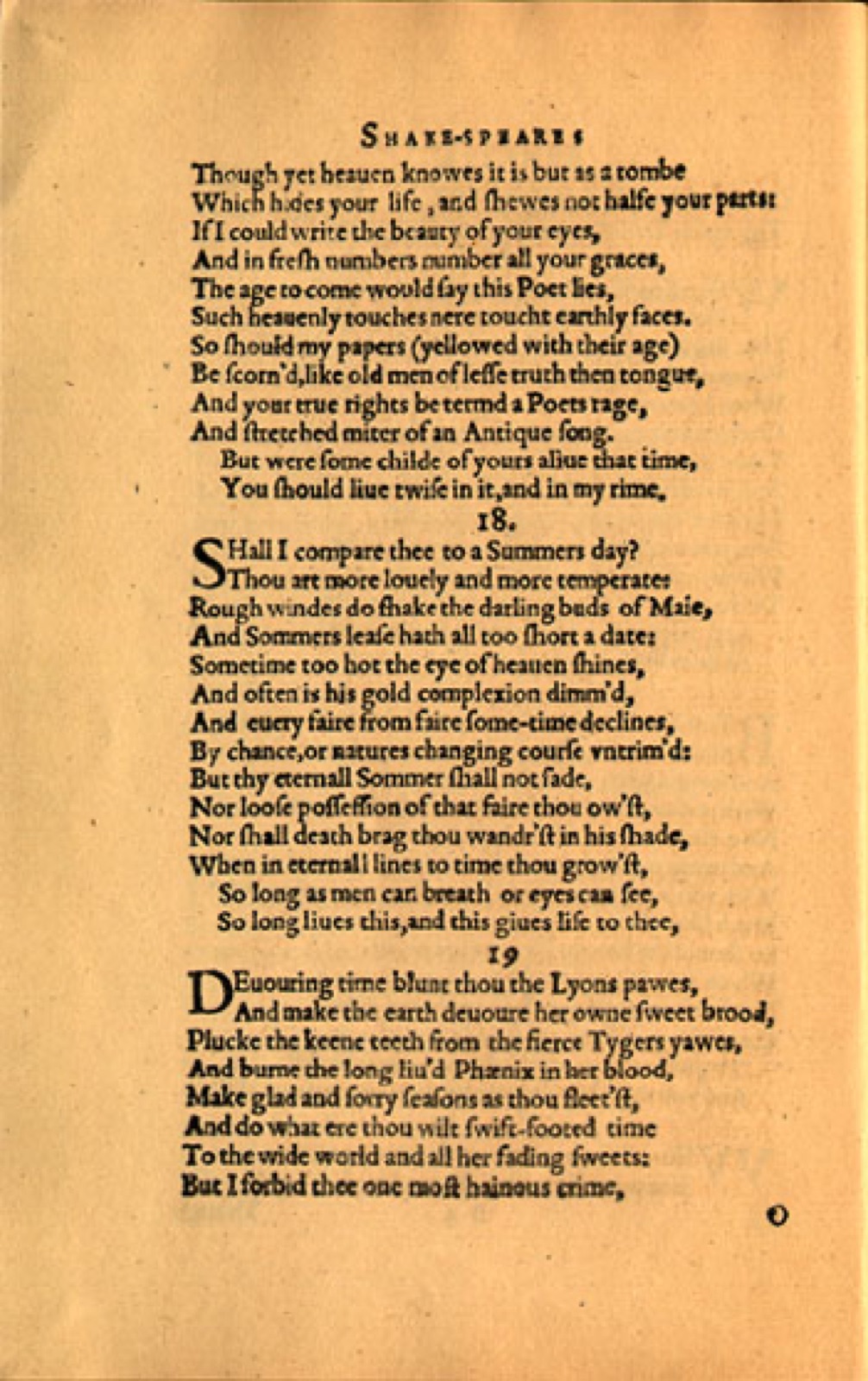
The original 1609 spelling (all 14 lines)
Shall I compare thee to a Summers day?
Thou art more louely and more temperate:
Rough windes do shake the darling buds of Maie,
And Sommers lease hath all too short a date:
Sometime too hot the eye of heauen shines,
And often is his gold complexion dimm'd,
And euery faire from faire some-time declines,
By chance, or natures changing course vntrim'd:
But thy eternall Sommer shall not fade,
Nor loose possession of that faire thou ow'st,
Nor shall death brag thou wandr'st in his shade,
When in eternall lines to time thou grow'st,
So long as men can breath or eyes can see,
So long liues this, and this giues life to thee,
(Transcribed from the 1609 edition on Wikisource. At that time the letters u and v were interchangeable, so louely = lovely.)
An explanation from Shakespeare's Globe
The official channel of Shakespeare's Globe, the Shakespeare theatre in London, has a short video on what a sonnet is, with an analysis of Sonnet 18 (in English). Listen to it to hear the rhythm of the poem before reading the Kham Mueang version below.

Lines 1–4: lovelier than a summer's day
Original (1609, modern spelling):
Shall I compare thee to a summer's day?
Thou art more lovely and more temperate:
Rough winds do shake the darling buds of May,
And summer's lease hath all too short a date;Kham Mueang rendering by MoradokLanna:
จะเผียบเตียมตั๋วกับวันหละดูฮ้อนดีก่อ
ตั๋วงามกว่า และเย็นใจกว่า
ลมแรงสั่นดอกจี๋ของเดือนพฤษภาคม
และสัญญาเช่าของหละดูฮ้อน ก็ก้อมนัก
(Shall I compare you to a hot-season day? / You are more beautiful, and calmer / Strong winds shake the buds of May / and the hot season's lease is far too short)
Phiap tiam ผยฯบทยฯม means "to compare" (the dictionary also has cha tiam). La du hon หลฯะดูร้อฯร is the hot season, summer, and wan วันฯ is "day". For "thee" we use tua ต฿วฯ, because the dictionary says it is used between close friends or lovers, which suits the voice of a love poem. Ko กํอฯ at the end of the line makes it a question, like the Thai mai.
"Temperate" means mild, neither too hot nor too cold. We use yen เอยฯันฯ (not hot, cooled) in yen chai, "calm, cool-hearted", which is our own choice of words. Lom ล฿มฯ is wind, san สั่นฯ is "to shake, to quiver", and "darling buds" are flowers not yet open, which Kham Mueang calls dok chi, from chi จี, "a young generation; in bud". The dictionary gives both dok chi, "a flower bud", and sao chi, "a young girl in her teens", so this one word carries both the first bloom of a flower and the first bloom of youth. Duean เดิอฯร in the dictionary means both the moon and a month of the year.
In line 4 Shakespeare uses the language of the law: a "lease" is a rental contract, and summer is a tenant whose contract is far too short. Kom ก้อฯม (short) and nak นักฯ (very, extremely) carry this idea. The word for "lease" is not in the dictionary as a Kham Mueang word, so we use the Thai word.
Lines 5–8: a sun too hot, and beauty that declines
Original:
Sometime too hot the eye of heaven shines,
And often is his gold complexion dimm'd;
And every fair from fair sometime declines,
By chance or nature's changing course untrimm'd;Kham Mueang rendering by MoradokLanna:
บางเตื้อต๋าวันก็ส่องฮ้อนแก่
หลายเตื้อผิวคำของมันก็หมองมัว
สิ่งงามทุกอย่าง สักวันก็เสื่อมจากความงาม
ด้วยเหตุบังเอิญ หรือด้วยธรรมชาติที่ผันแปร จนความงามหลุดหาย
(Sometimes the sun shines far too hot / and often its golden skin grows dim / every beautiful thing one day declines from its beauty / by chance, or by nature's changing course, until its beauty falls away)
"The eye of heaven" in line 5 is the sun. Kham Mueang calls the sun ta wan ตาวันฯ; the dictionary records this both under the word itself and under wan ("the sun is called ta wan"). What is striking is that the word begins with ta ตา, which means "eye". A Kham Mueang reader hears an "eye" in the name of the sun, much as Shakespeare calls the sun "the eye of heaven".
Song ส่อฯง means "to shine", and hon ร้อฯร means "hot". Add kae แก่ in its sense of "too much" and you get hon kae, which the dictionary itself gives as an example meaning "terribly hot", exactly "too hot". The tuea in these lines is tuea เทิ่อฯอ, "a time, an occasion".
"Gold complexion" is the golden skin of the sun. Gold in Kham Mueang is kham ฅำ, and phio ผิวฯ (skin, surface) is the same word as in central Thai. "Dimm'd" is mong หมฯอฯง (not clear, dim, cloudy) with mua ม฿วฯ (dull, hazy). "Declines" is sueam เสิ่อฯม, which the dictionary glosses as "gradually running out, lower in quality than before, coming to an end".
Scholars read "untrimm'd" in two ways. Representative Poetry Online explains it as "stripped of beauty", while Wikipedia records that some read it as the image of a ship whose sails are not trimmed to the wind. We follow the first reading, so we write "until its beauty falls away".
Lines 9–12: a summer that never fades
At the word "But" the poem turns from nature, which must decline, to a promise that the beloved will not decline with it.
Original:
But thy eternal summer shall not fade
Nor lose possession of that fair thou owest;
Nor shall Death brag thou wander'st in his shade,
When in eternal lines to time thou growest:Kham Mueang rendering by MoradokLanna:
แต่หละดูฮ้อนของตั๋วจะบ่มีวันฮวย
บ่เสียความงามที่ตั๋วมีอยู่
ความต๋ายก็จะอวดบ่ได้ว่าตั๋วเตียวอยู่ในเงาของมัน
เมื่อตั๋วเติบโตไปกับกาลเวลา ในบทกวีที่บ่มีวันเสี้ยง
(But your summer will never wither / nor lose the beauty you have / Death will not be able to boast that you walk in its shadow / when you grow on with time in a poem that never ends)
For "fade" in line 9 we use huai รวฯยฯ, which the dictionary explains as "to wilt, to wither slowly and drop from the stem, said of flowers", matching the buds of line 3. "Death" is tai ตายฯ (to die, to pass away), "brag" is uat อวฯด (to show off, to put on display), and "wander" is tiao ทยฯว (to walk). The word for "shadow" is not in the dictionary as a Kham Mueang word, so we use the Thai word.
"Eternal lines" are the lines of a poem that will last for ever. We write "a poem that never ends" with siang ส้ยฯง, "to finish, to end, to run out". As for "owest", Representative Poetry Online explains it as "own'st, owns", possibly playing on "owes", so we follow the first meaning: "the beauty you have".
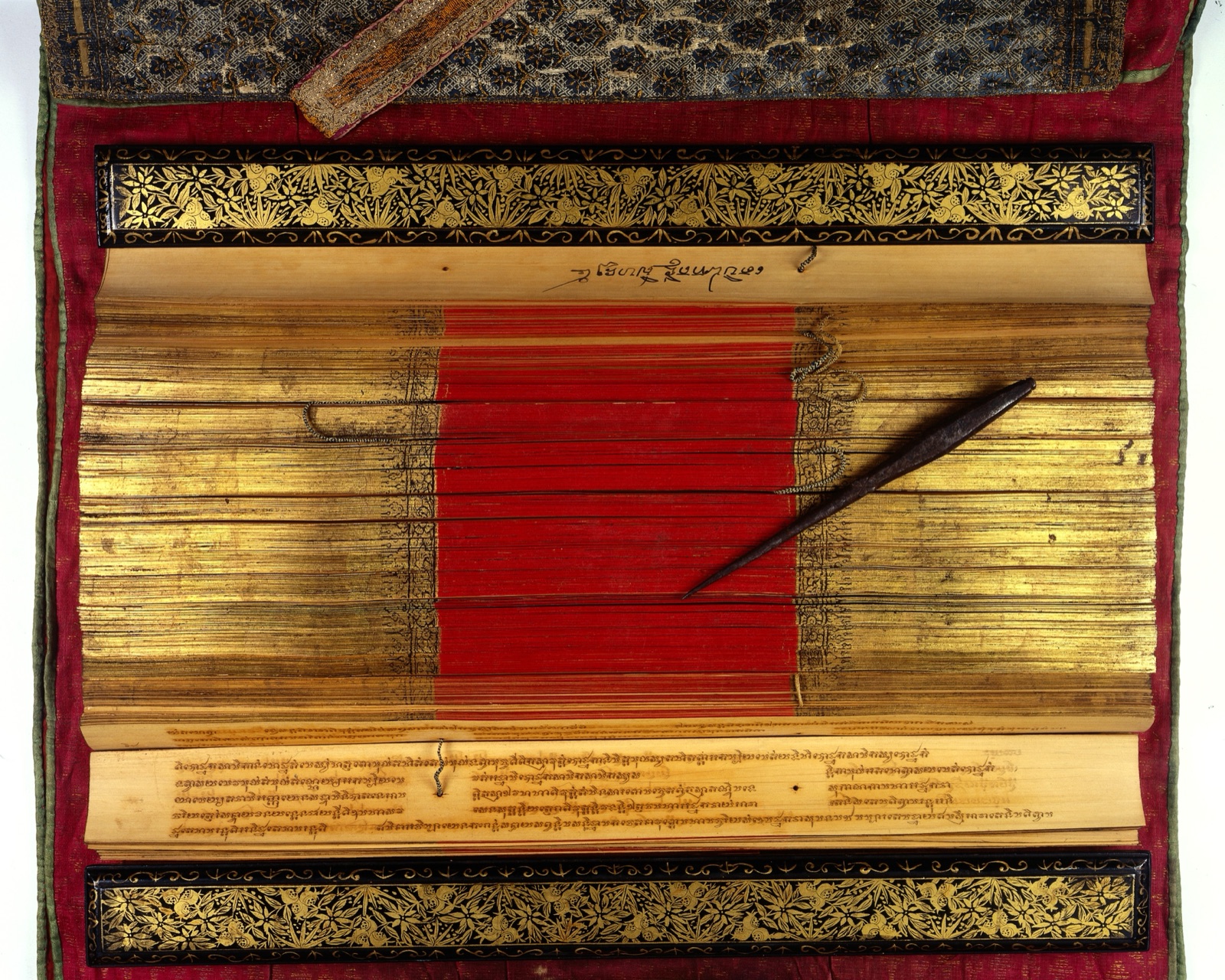
The idea that written words outlive the people who write them is familiar in Lanna. Important texts were chan จารฯ onto palm leaves, which the dictionary explains as "to write letters or patterns with a sharp iron point onto palm leaf or stone", and the manuscripts were kept and passed down for hundreds of years.
Lines 13–14: as long as people breathe
Original:
So long as men can breathe, or eyes can see,
So long lives this and this gives life to thee.Kham Mueang rendering by MoradokLanna:
ตราบที่คนยังหายใจ๋ ตราบที่ต๋ายังหันได้
บทกวีนี้ก็ยังอยู่ และหื้อชีวิตแก่ตั๋ว
(As long as people still breathe, as long as eyes can still see / this poem lives on, and gives life to you)
The closing couplet is short and clear. Hai chai หายฯไจ is "to breathe", han หันฯ is "to see, to find", yang ยังฯ is "still here, remaining, still alive", which in this line does double duty, "still breathing" and "still living", and hue หื้ is "to give". The word for "life" is not in the dictionary as a Kham Mueang word, so we use the Thai word.
The words at a glance
| Idea in the poem | Kham Mueang words | Meaning in the dictionary |
|---|---|---|
| Beauty and comparison | ngam · phiap tiam · tua | beautiful · to compare · you (close friend, lover) |
| Seasons and time | la du hon · wan · duean · laeng · kom · nak | hot season · day · month · dry season · short · very |
| Wind and flowers | lom · san · chi (dok chi) · huai | wind · to shake · in bud, young · to wither |
| The sun | ta wan · ta · song · hon · kae · kham · phio | the sun · eye · to shine · hot · too much · gold · skin |
| Decline | mong · mua · sueam · tai · uat · tiao | dim · hazy · to run down · to die · to show off · to walk |
| What lasts | siang · chan · khao · hai chai · han · yang · hue | to end · to inscribe on palm leaf · khao verse · to breathe · to see · still alive · to give |
All these Kham Mueang lines are MoradokLanna's own wording, mixing dictionary words with everyday Thai words that the dictionary does not list. The rendering does not keep the rhyme and metre of the original, because it aims to show the Kham Mueang word by word, and we would still like a native speaker to check it.
Compared with the song Sao Chiang Mai: praise, promises and time
The song Sao Chiang Mai by Jaran Manopetch tells a story from the other side. The singer is a young sao สาวฯ (unmarried woman) of Chiang Mai who calls herself kha chao. Every day bao บ่าฯวฯ (young unmarried men) from many towns come to visit and talk with her. One young man promises to come and ask for her hand, then disappears (our summary from our own article; listen to the full song on the official channel linked there).
| Sonnet 18 | Sao Chiang Mai | |
|---|---|---|
| Speaker | the poet (who praises) | the young woman (who is praised) |
| Praise | lovelier than a hot-season day | young men from many towns come to court her |
| Promise | the poem will keep the beauty as long as people breathe | a young man promises to ask for her hand but never returns |
| Time | summer is short, but the poem lasts | the young woman waits for a year |
So both speak of the same thing: praise and promises are worth something only when they last. Kham Mueang also has the word yo ยํอฯ, which the dictionary glosses in one sense as "to say words of praise to please someone", just what the young men in the song do. And kha ข้า is a pronoun for the speaker, while the young woman in the song uses the politer kha chao. For the words of Lanna courtship, read on in Kam U Bao U Sao.
Summary
- Shakespeare's Sonnet 18 was first printed in 1609. It is in the public domain, so we render all 14 lines in Kham Mueang.
- La du hon is the hot season, ta wan is the sun, and hon kae means terribly hot.
- Dok chi is a flower bud and sao chi a young girl: the one word chi brings the bud and the first bloom of youth together.
- Huai (to wither), sueam (to decline) and siang (to end) are words for beauty that passes, while poetry and chan (inscribing palm leaves) are ways of keeping words alive.
- The Kham Mueang lines are MoradokLanna's own wording and still need a native speaker's check.
Look up the words in this article in the MoradokLanna Dictionary (in Thai). Read on: Sao Chiang Mai · My Way, or see the whole series under Kham Mueang through songs and literature (in Thai).
Copyright and courtesy
| Item | Details |
|---|---|
| Poem | Sonnet 18 "Shall I compare thee to a summer's day?" |
| Author | William Shakespeare (English, printed 1609) |
| Text used | Shake-speares Sonnets (London: G. Eld for T. T., 1609) as transcribed on Wikisource; modern spelling after W. J. Rolfe (1883) |
| Video | Shakespeare's Globe, "What is a Sonnet? PLUS analysis of Sonnet 18" |
| Status | Public domain: the author died in 1616 |
This article was made by Moradok Lanna, a non-profit website, for learning the Lanna language and culture. The original poem is in the public domain, so we render every line in Kham Mueang. Modern Thai translations, readings and recordings remain under copyright; we do not use their particular wording. Embedded videos come from the rights holders' official channels and remain their property.
With thanks and respect to the poet, the editors of the printed texts and the rights holders. If a rights holder would like anything changed or removed, please write to moradoklanna@gmail.com and we will act promptly.
References
- MoradokLanna Dictionary (dict2): ngam, phiap tiam, la du hon, wan, tua, yen, lom, san, chi, duean, kom, nak, tuea, ta wan, ta, song, hon, kae, kham, phio, mong, mua, sueam, huai, tai, uat, tiao, siang, chan, khao, hai chai, han, yang, hue, yo, sao, bao, kha, ko, laeng.
- Shakespeare, W. (1609). Shake-speares Sonnets. Never before Imprinted. London: G. Eld for T. T. Sonnet 18. Transcription on Wikisource
- Rolfe, W. J. (ed.) (1883). Shakespeare's Sonnets. Sonnet 18. Wikisource
- Lancashire, I. (ed.). Shakespeare's Sonnets: Shall I compare thee to a summer's day? Representative Poetry Online, University of Toronto Libraries.
- Folger Shakespeare Library. Shakespeare's Sonnets
- Wikipedia. Sonnet 18 (used as a lead and checked against other sources).
- Shakespeare's Globe (official channel). What is a Sonnet? PLUS analysis of Sonnet 18. YouTube
- Moradok Lanna articles Sao Chiang Mai, Kam U Bao U Sao and My Way.
Practise the words from this article
Flip through 40 flashcards of the Lanna words used in this article.


