

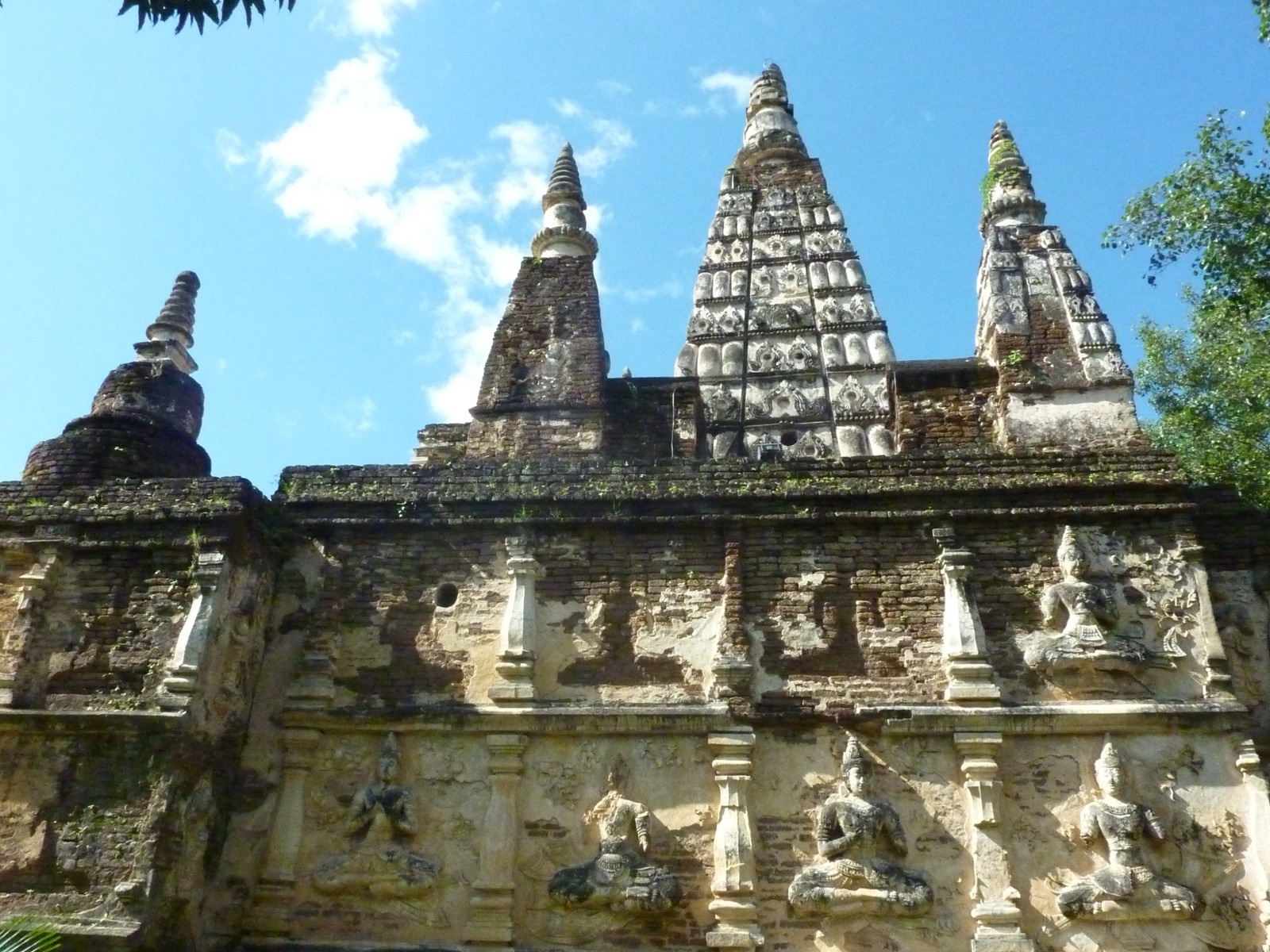
Photo: Photo Dharma / Wikimedia Commons (CC BY 2.0)
King Tilokarat: Lanna's Golden Age and Wat Chet Yot
King Tilokarat (Phra Chao Tilokarat) was the king of the Mangrai dynasty who ruled Chiang Mai from about 1441 to 1487. Scholars call his reign the golden age of Lanna, because the kingdom reached its greatest extent and Buddhism flourished so much that a council to revise the Tipitaka was held at Wat Chet Yot. His name is therefore tied to great temples, to Chedi Luang, and to scriptures Lanna people still refer to today.
His birth name was Thao Lok, and the word has a story of its own. The Moradok Lanna dictionary explains that lok (ล฿กฯ, Kham Mueang reading lok) was the old word for a sixth son.
Who was King Tilokarat?
King Tilokarat was the sixth son of Phaya Sam Fang Kaen. The word thao (ท้าฯวฯ, Kham Mueang reading tao) in his birth name is explained in the dictionary as "a title placed before the names of men of princely or noble descent". Earlier Lanna kings usually used the title phaya (พญา, Kham Mueang reading pha-ya), which the dictionary defines as "lord of the land, sovereign".
He was honoured with the title phra chao (ระฯพเจั้า), and the dictionary gives "Phra Chao Tilokarat" as an example of its use before the name of a king. The work of Aphidet Supha and Natthawut Khlaisuwan (อภิเดช สุผา และ ณัฐวุฒิ คล้ายสุวรรณ, 2026) cites Sarassawadee Ongsakul that the Chiang Mai Chronicle calls him "Phra Pen Chao Tilokarat" or "Chao Phraya Tilokarat", to honour him as greater in merit than other Lanna kings.
Place in the line of kings: sources count differently. All three studies used in this article call him the 9th king of the Mangrai dynasty, while the Moradok Lanna dictionary itself gives both "the 9th" (under phra chao khaeng khom) and "the 10th" (under lok and phra chao thong thip).
Thao Lok: from Mueang Yuam Tai to the throne
King Tilokarat's accession was not an ordinary succession. Old documents tell the story differently.
Phaya Sam Fang Kaen sent Thao Lok to live at Mueang Yuam Tai (today Mae Sariang District, Mae Hong Son). Later a nobleman named Sam Dek Yoi secretly brought Thao Lok back and hid him in the city, then helped him seize the throne from his father (Aphidet and Natthawut, 2026, citing the Chiang Mai Chronicle as transliterated by Aroonrut Wichienkeeo and David K. Wyatt).
Phra Phongrawi Uttarapattho and colleagues (2022) suggest that his mother was probably the elder sister of Muen Lok Nakhon, ruler of Lampang, and that he came from Mueang Khun Yuam to seize power in Chiang Mai with Muen Lok Nakhon's help.
This Pali work composed in Lanna does not mention the seizure of the throne at all, and focuses only on his support for Buddhism. Aphidet and Natthawut (2026) argue that the author deliberately built up his "legitimacy" as a Dhamma king.
The work of Phra Phongrawi and colleagues also found that, according to the Chiang Mai Chronicle and the Jinakalamali, he was crowned on wan paet peng, the full-moon day of the 8th Northern month, which falls on Visakha Bucha. (Wan duean peng, วันฯเดิอฯรเพงฯ, is explained in the dictionary as "the full-moon day, the 15th day of the waxing moon".) The kings before and after him in the dynasty were also crowned on this same day.
War with Ayutthaya and the expansion of the realm
The Chiang Mai Chronicle tells how King Tilokarat led armies to bring many towns under Chiang Mai, such as Phrae, Nan, Mueang Yong, Luang Prabang and towns in the Shan States. In his reign Lanna was larger than in any other.
The most important war was the war with Ayutthaya under King Borommatrailokkanat. The Chiang Mai Chronicle tells of the battles of wits between the two kings, while on the Ayutthaya side there is the poem Lilit Yuan Phai ("The Defeat of the Yuan"), composed to celebrate victory over the "Yuan", the Lanna people.
กรุงลาวอำนาจน้ำ ใจโจร ก่อนนา เคยบยดบิดรองค์ อวดรู้ — Yuan Phai (Fine Arts Department, 1997, cited in Aphidet and Natthawut, 2026)
(Roughly: "The Lao king, mighty, with a thief's heart from the start, once pushed aside his own father, boasting of his cleverness.")
The Tipitaka council at Wat Chet Yot
In 1477 King Tilokarat had a council to revise the Tipitaka held, a meeting of monks to check and correct the scriptures, at Wat Maha Photharam, or Wat Chet Yot. It took a year to complete. Scholars count it as the 8th Buddhist council in the Theravada reckoning, and the first in the lands that are now Thailand (Aphidet and Natthawut, 2026, citing Phat Phengphala).
The dictionary explains Theravada (เถรวาฯทฯ, thera-wat) as "the southern school of Buddhism", widely followed in Thailand, Myanmar, Sri Lanka, Laos and Cambodia. To commemorate this council, the king also had a Buddha image cast.
Wat Chet Yot: a Bodh Gaya in Chiang Mai
Phra Phongrawi and colleagues (2022) state that he built this temple around 1456. After hearing a sermon on the merit of planting bodhi trees, he planted a shoot of the Great Bodhi Tree that had come from Sri Lanka, so the temple was named Maha Photharam. He then had the Sattamahasathan built, the seven places where the Buddha stayed after his enlightenment, modelled on the Mahabodhi Temple at Bodh Gaya in India. This square chedi with its many spires is why people call it "Wat Chet Yot", the temple of seven spires.
Chedi Luang and the Emerald Buddha
The largest chedi (เจดียฯ ฿ฯ, Kham Mueang reading che-di), which Lanna people often call a "that", in Chiang Mai is Phra That Chedi Luang. It was begun in the reign of Phaya Saen Mueang Ma and completed in King Tilokarat's reign, when he had it enlarged until its base was 27 wa wide and it stood 45 wa high, taller than any other chedi in Lanna (Wannida and Li, 2025).
When the work was finished, he had the Emerald Buddha brought from Lampang and enshrined in the eastern niche of Chedi Luang. The dictionary explains phra kaeo (ระฯพแก้วฯ, pha kaeo) as "a Buddha image made of precious stone", and gives the Emerald Buddha as its first example.
A scholar's view: why build on such a scale?
- Phra Phongrawi Uttarapattho and colleagues (2022) interpret the enlarging of Chedi Luang, the building of Wat Chet Yot and the regnal name "Phra Chao Si Thammachakkrawat Tilokarat" as reflecting the ideal of the chakravartin, the universal monarch at the centre of the Buddhist cosmos, which helped legitimise a king who had come to the throne irregularly.
- The same study notes that kings across the region in this period all used names proclaiming lordship over the three worlds, such as Borommatrailokkanat of Ayutthaya.
- Aphidet Supha and Natthawut Khlaisuwan (2026) found that the Jinakalamali calls him by several Pali names, such as "Siri Dhammacakkavatti Tilaka Maharaja", all conveying a righteous king.
Hon Pa Daeng: Sri Lankan-lineage Buddhism
Lanna had several lineages of monks, and Lanna people called each one a "hon". King Tilokarat supported the Sinhalese (Sihala) order, which stressed the study of Pali and strict observance of the monastic discipline. He invited Phra Maha Methangkon from Lamphun to reside at Wat Ratchamonthian, and was himself briefly ordained at Wat Pa Daeng Mahawihan (Wannida and Li, 2025).
| Lanna term | Lanna script | Meaning (per the dictionary) |
|---|---|---|
| hon pa daeng | ห฿นฯป่าแดงฯ | monks of the Wat Pa Daeng school, or those who follow its teaching, which is of the Lankawong lineage |
| hon suan dok | ห฿นฯสวฯรดอฯก | monks of the Wat Suan Dok school, or those who follow the Lankawong, or old Sinhalese, sect |
| hon wiang | ห฿นฯวยฯง | a school of Buddhism led by Wat Nantaram |
As a result of this support, the Suan Dok and Pa Daeng schools spread as far as Kengtung, Chiang Rung, Mueang Yong and Mueang Nai, and Lanna Buddhism took deep root in the Tai Yai (Shan) states (Aphidet and Natthawut, 2026, citing Sarassawadee Ongsakul).
King Tilokarat's legacy
What King Tilokarat left behind can still be seen in Chiang Mai today. Wannida and Li (2025) list the temples he built, such as Wat Maha Photharam, Wat Ratchamonthian, Wat Pa Tan and Wat Pa Daeng Mahawihan, and the Moradok Lanna dictionary records another Buddha image he made.
After his death, a ku (กู่, ku), a stupa holding his ashes, was built at Wat Chet Yot. The dictionary gives "the ku of King Tilokarat (Wat Chet Yot)" as an example under the word ku, in the sense of a stupa of the ruling class, alongside the Ku Kut of Queen Chamadevi in Lamphun.
Summary
- King Tilokarat (birth name Thao Lok, "the sixth son") ruled Chiang Mai from about 1441 to 1487, a reign called the golden age of Lanna.
- He came to the throne by seizing it from Phaya Sam Fang Kaen, so documents from each side tell his story very differently.
- He expanded the realm to Phrae, Nan and the Shan States, and fought Ayutthaya under King Borommatrailokkanat.
- He held the Tipitaka council at Wat Chet Yot in 1477, enlarged Chedi Luang to 45 wa high, and supported the hon pa daeng order.
Look up more Lanna words about kings, temples and Buddha images in the Moradok Lanna dictionary (in Thai), and read about the Inthakhin pillar at Wat Chedi Luang in the article Sai Khan Dok.
Sources
- Moradok Lanna dictionary (in Thai): ลก · พระเจ้าทองทิพย์ · พระเจ้าแข้งคม · กู่ · หนป่าแดง
- วรรณิดา ธีระทัศนานันต์ และ หลี่ ฉ้านซง [Wannida Thiratatsananan and Li Chansong]. (2025). ภูมิทัศน์วัฒนธรรมทางพระพุทธศาสนาของเชียงใหม่: บทบาทของพระเจ้าติโลกราช [The Buddhist cultural landscape of Chiang Mai: the role of King Tilokarat]. Chintasit Journal 3(3). In Thai.
- พระพงษ์ระวี อุตฺตรภทฺโท, พระครูสมุห์ธนโชติ จิรธมฺโม และ ประทีป พืชทองหลาง [Phra Phongrawi Uttarapattho, Phrakhru Samu Thanachot Chirathammo and Prathip Phuetthonglang]. (2022). เจดีย์หลวงมหาธาตุกลางเวียง: ภาพสะท้อนคติจักรพรรดิราช ในรัชสมัยพระเจ้าติโลกราช [Chedi Luang, the great relic shrine at the heart of the city: a reflection of the chakravartin ideal in the reign of King Tilokarat]. Panidhana Journal 18(1). In Thai.
- อภิเดช สุผา และ ณัฐวุฒิ คล้ายสุวรรณ [Aphidet Supha and Natthawut Khlaisuwan]. (2026). การสร้างความชอบธรรมให้พระเจ้าติโลกราชในชินกาลมาลีปกรณ์ [Building legitimacy for King Tilokarat in the Jinakalamali]. Journal of Social Sciences, Mahamakut Buddhist University 9(1). In Thai.


