
Photo: Takeaway / Wikimedia Commons (CC BY-SA 3.0)
Duean Sam: The Lanna Month of Threshing and Cold
Duean Sam (สามฯ, Kham Mueang reading sam, "three") is the third month of the Lanna year. It matches the first month (เดือนอ้าย) of central Thailand and falls roughly from mid-December to early January. Duean Sam in Lanna is one of the coldest months of the year. Most of the rice has been cut, so farmers thresh it, dry the straw and carry the grain up into the granary, and they hold a rite to bring the soul of the rice home.
This post gathers what to know about Duean Sam: the key dates for 2026, work in the fields after the harvest, the su khwan khao rice-soul rite, cold-season words in Kham Mueang, and the month's bad days according to the elders' verse.
- Month begins: 1st waxing day of Duean Sam = Thursday 10 December 2026
- Full moon (duean peng): 15th waxing day = Thursday 24 December 2026
- Month ends: 14th waning day = Thursday 7 January 2027 (this month has 29 days)
- Next month: Duean Si begins on Friday 8 January 2027
What is Duean Sam?
Lanna counts its months (duean, เดิอฯร) two months ahead of central Thailand. After Duean Yi (เดิอฯรยี่, duean yi) comes Duean Sam. The dictionary explains sam as the name of a lunar month, "the 3rd northern month", matching the first month in Bangkok. The next month is Si (สี่, si, "four"), which matches the second month (เดือนยี่) of Bangkok. Read why Lanna counts this way in Duean Nuea.
Duean Sam is a duean kik (เดิอฯรคีกฯ, duean kik), an odd-numbered month, so it has only 29 days, while Duean Yi has 30.
- Duean ok (เดิอฯรออฯก, duean ok) is the waxing half, 15 days. The night of the 15th waxing day is the peng (เพงฯ, peng) moon, the full moon.
- Duean haem (เดิอฯรแรมฯ, duean haem) is the waning half. The dictionary says odd months have only 14 waning days.
- The last night of an odd month, the 14th waning day, is called dap hon (ดัปฯห฿นฯ, dap hon). An even month like Duean Yi ends instead on the 15th waning day, called dap tem.
Key dates of Duean Sam 2026
Buddhist holy days are called wan sin (วันฯสีลฯฯ, wan sin) in Kham Mueang. They come in two kinds: wan sin noi (วันฯสีลฯฯห้นฯอฯยฯ, wan sin noi), the 8th waxing and waning days, and wan sin luang (วันฯสีลฯฯหลฯวฯง, wan sin luang), which the dictionary gives as the 15th waxing day and, in odd months, the 14th waning day. So the last wan sin luang of Duean Sam falls on the 14th waning day.
| Date | Lunar date | What it is |
|---|---|---|
| Thu 10 Dec 2026 | 1st waxing day of Duean Sam | first day of Duean Sam |
| Thu 17 Dec 2026 | 8th waxing day | wan sin noi |
| Thu 24 Dec 2026 | 15th waxing day | full moon · wan sin luang |
| Fri 1 Jan 2027 | 8th waning day | wan sin noi · also New Year's Day |
| Thu 7 Jan 2027 | 14th waning day (dap hon) | wan sin luang · last day of Duean Sam |
All dates are calculated with the Moradok Lanna calendar. This year New Year's Day falls on a wan sin noi holy day, so anyone who wants to make merit at the start of the year can visit the temple on the same day. Each temple may hold its merit-making on a different day, so check with your local temple.
In the fields: threshing, straw and the granary
By Duean Sam most of the main-season rice has been kiao khao (ก่ยฯวเขั้า, kiao khao), cut with a sickle. As an example from Phayao, MGR Online (2016) reported that about 85% of the main-season rice was cut in November and only about 5% was left for December. So the work of this month is the work after the harvest.
- Ti khao (ตีเขั้า, ti khao) means beating the rice so the grains fall from the ears. It is done on a ta lang (ตาลางฯ, ta lang), a threshing floor.
- Ha khao (หะเขั้า, ha khao) means tossing the threshed paddy into the air so the wind blows away empty grains and chaff.
- Rice straw is fueang (เฟิอฯง, fueang). About ten handfuls of straw tied together make a lun (ลุร, lun).
The clean paddy is stored in the long khao (หลฯอฯงเขั้า, long khao), the rice granary. Hauling the rice to the granary is lak khao khuen long (ลากฯเขั้าขึ้นฯหลฯอฯง, lak khao khuen long), and northern people choose the day for it too: the dictionary has wan khao khuen long (วันฯเขั้าขึ้นฯหลฯอฯง, wan khao khuen long), a day fit for putting the rice up into the granary.
Once the rice is in the granary, taking it out also follows a chart: the pak-kha-tuen tak khao (ปักขฯทืนฯตักฯเขั้า, pak-kha-tuen tak khao). The dictionary explains it as a table of good and bad days for scooping rice out of the granary, often written and hung on the granary itself. Lanna people follow it when they take out rice to mill, pound, sell, share or give as merit.
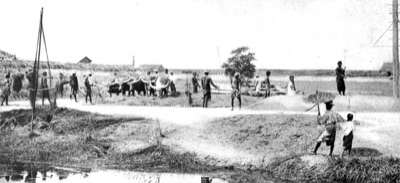
Photo: G. P. Putnam's Sons / Wikimedia Commons (Public domain)
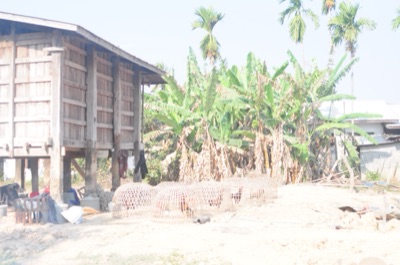
Photo: มะเดื่อ แสลงหลวง / Wikimedia Commons (CC BY 3.0)

Photo: PONGSATHORNCH09041980 / Wikimedia Commons (CC BY-SA 4.0)
Su khwan khao: bringing the rice soul to the granary
Lanna people believe rice has a soul, called khwan khao (ขัวฯรเขั้า, khwan khao), and a guardian, ya khwan khao (ย่าขัวฯรเขั้า, ya khwan khao), whom the dictionary compares to Mae Phosop, the rice goddess: a sacred presence dwelling in the rice plant and the grain.
When the harvest is done, people hold su khwan khao (สู่ขัวฯรเขั้า, su khwan khao). The dictionary explains it as inviting the rice soul, ya khwan khao, from the fields to dwell in the granary after the harvest; when the planting season comes, she is invited back to the fields again. The rite is like taking the rice soul home together with the rice that goes up into the granary.
After the harvest some villages also make lon bat (ล้฿นฯบาฯระฯต, lon bat) merit: filling the monks' alms bowls with paddy or milled rice until it overflows into a heap. The dictionary says it is also called tan doi ngoen doi kham, "giving mountains of silver and gold". The timing depends on each village.
Nao kat nao yen: cold-season words
December to January is often the coldest stretch of the year. Thairath (2023) reported the Thai Meteorological Department's outlook for that season, which put the coldest period from about early December to late January. If Duean Yi is nao ot hot, pleasantly cool, then Duean Sam is nao kat nao yen (หนฯาวฯกัดฯหนฯาวฯเอยฯันฯ, nao kat nao yen), very cold. We make it our word of the month for Duean Sam.
| Kham Mueang | Lanna script | Meaning (from the dictionary) |
|---|---|---|
| bai bot | ใบ้บอฯด | enormously, extremely; intensifies a word, as in nao bai nao bot, so cold you shiver |
| yong yong | อยฯอฯงๆ | shivering, as in nao san yong yong, shaking with cold |
| jo jo | โช฿ะๆ | trembling fast, as when you are very cold |
| hing fai | หิงฯไฟ | to warm yourself by a fire in the cold season |
| mai lua hing fai | ไม้ห฿ลฯวฯหิงฯไฟ | firewood logs for a warming fire in the cold season |
| nam moei | นาฯเหิมฯอฯ | dew |
| jai moei | จายฯเหิมฯอฯ | to set things out in the open to catch the dew |
| moei khap | เหิมฯอฯยขาปฯ | frost: dew frozen hard by intense cold |
On the high mountains, cold-season mornings often bring a sea of fog, and in some years frost forms on the grass. For words about mist, dew and weather, read Nature and Weather Words.
Getting ready for merit in Duean Si
The new rice that goes up into the granary this month is offered next month at tan khao mai (ทาฯนฯเขั้าไห่มฯ, tan khao mai), the offering of the newly harvested rice, which the dictionary says must be made before eating the new rice. Another rite is tan lua hing fai pha-jao (ทาฯนฯห฿ลฯวฯหิงฯไฟระฯพเจั้า, tan lua hing fai pha-jao), offering firewood for a fire to warm the Buddha images. The dictionary says it is held on the full moon of Duean Si, around January, because the weather is so cold.
In this cycle the full moon of Duean Si falls on Friday 22 January 2027. Read about the new-rice offering in Tan Khao Mai.
The bad days of Duean Sam: "Thursday and Saturday"
Lanna people observe wan sia (วันฯเสยฯ, wan sia), the inauspicious days of each month. The dictionary records a verse that elders use to remember them: "Kiang, ha, kao, sia tit kap jan; yi, hok, sip, sia angkan wan diao; sam, jet, sip-et, sia phat kap sao; si, paet, sip-song, sia put kap suk". It means: in months 1, 5 and 9 the bad days are Sunday and Monday; in months 2, 6 and 10 only Tuesday; in months 3, 7 and 11 Thursday and Saturday; in months 4, 8 and 12 Wednesday and Friday.
By this verse, the bad days of Duean Sam, Duean Jet and Duean Sip-et are Thursday (phat) and Saturday. So in this Duean Sam the bad days are:
- Thursdays: 10, 17, 24 and 31 December 2026, and 7 January 2027
- Saturdays: 12, 19 and 26 December 2026, and 2 January 2027
Pick a day in Duean Sam and see which days the verse calls bad.
Summary
- Duean Sam is the 3rd northern month, the first month (เดือนอ้าย) in central Thailand. In this cycle it runs from 10 December 2026 to 7 January 2027 and has 29 days, because it is an odd month (duean kik).
- The month's wan sin holy days are 17 and 24 December and 1 and 7 January; New Year's Day is a wan sin noi.
- In the fields it is time for ti khao on the threshing floor, drying the straw and lak khao khuen long, hauling the rice to the granary, with the su khwan khao rite that brings the rice soul home.
- The word of the month is nao kat nao yen, very cold.
- By the bad-day verse, Duean Sam is "bad on Thursday and Saturday".
Look up more month and day words in the Moradok Lanna dictionary, check the lunar date of any day in the Lanna calendar, and read the month before in Duean Yi.
Sources
- Moradok Lanna dictionary: sam(https://moradoklanna.com/dict/?สาม) · su khwan khao(https://moradoklanna.com/dict/?สู่ขวัญเข้า) · nao kat nao yen(https://moradoklanna.com/dict/?หนาวกั๋ดหนาวเย็น) · wan sia(https://moradoklanna.com/dict/?วันเสีย) · pak-kha-tuen tak khao(https://moradoklanna.com/dict/?ปั๋กขะตืนตั๋กเข้า)
- Moradok Lanna Lanna calendar: 10 December 2026 to 7 January 2027
- MGR Online (31 October 2016). พฤศจิกาฯ นี้นาข้าวพะเยาพร้อมเกี่ยว 85% เผยผลผลิตทั้งจังหวัดล้น 2.4 แสนตัน [This November Phayao's rice is 85% ready to harvest; province-wide output tops 240,000 tonnes]
- Thairath Online (2 October 2023). อุตุฯ คาด "ฤดูหนาว" ของไทย ช้ากว่าปกติ 2 สัปดาห์ อากาศเย็นน้อยกว่าปีที่ผ่านมา [Met department expects Thailand's cool season two weeks later than normal, less cold than last year]
- Photos from Wikimedia Commons as credited under each image.
Practise the words from this article
Flip through 40 flashcards of the Lanna words used in this article.


