
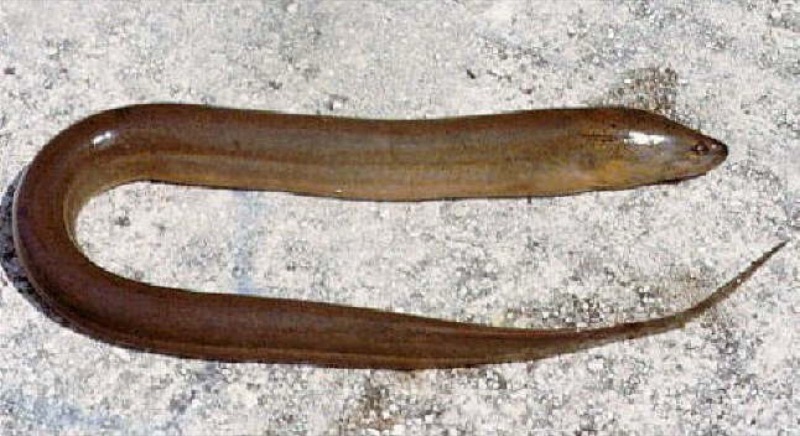
Photo: cloud.shepherd / Wikimedia Commons (CC BY 2.0)
Wiang Nong Lom: The White Eel and the Sunken City
Wiang Nong Lom is a large swamp on the border of Mae Chan and Chiang Saen districts in Chiang Rai. The people of Lanna have long told that it was once Yonok Nakhon (yonok nakon, โยน฿กฯนคอฯร), the royal city of Prince Singhanavati. Then, in a single night, the whole city sank and became a swamp, after its people caught a huge white eel, pa yian pon (ปลฯาอยฯยฯรพอฯร), and shared it out to eat. Only one house survived: that of an old widow whom nobody had thought to give any fish.
This article tells the legend of Wiang Nong Lom from the old written version, compares the different tellings, collects the Kham Mueang words hidden in the story, and visits the swamp as it is today.
Pa yian pon: the white eel in Kham Mueang
In Kham Mueang an eel is pa yian (ปลฯาอยฯยฯร, pa yian). The Moradok Lanna dictionary says it plainly under the Thai word ปลาไหล: "in the northern dialect it is called pa yian". An eel of unusual white colour is pa yian pon, which the dictionary translates as "a white eel, an albino eel".
| Kham Mueang | Lanna script | Meaning (from the dictionary) |
|---|---|---|
| pa yian | (see above) | eel |
| yian | อยฯยฯร | the eel, as in pa yian |
| ปลาไหล (Thai pla lai) | ปลฯฯาไหลฯ | eel; in the North called pa yian |
| pa yian pon | (see above) | white eel, albino eel |
| phueak | เผิอฯก | (adjective) white, pure white, as in an albino buffalo |
In many legends of sunken cities, an animal of strange white colour is where the trouble starts. The legend of Nong Han has a white squirrel (see the "Another telling" box below). The story of Wiang Nong Lom begins with one white fish.
Khai tam-nong: the city that sank in one night
A Lanna tale often opens with khai tam-nong (ไขทำนอฯง, khai tam-nong), "to begin recounting the story". What follows is retold in our own words from the outline of the Singhanavati Kumara chronicle, which the Fine Arts Department translated from a Northern Thai manuscript and printed in Prachum Phongsawadan part 61 (1936). We use the white eel, as the story is most widely told in Lanna; see the next box for the other versions.
The legend says the city of Yonok Nakhon was ruled by the descendants of Prince Singhanavati for many generations, until the reign of Phra-ong Maha Chai Chana. On the Saturday of the 7th day of the waning moon in the 7th month, the townspeople went down to the Kukkuta-nadi, the Kok River, and found a fish that was white all over, as thick as a ton tan (ต้฿นฯตาลฯฯ, ton tan), a sugar-palm trunk, and about seven wa (วาฯ, wa), a span of outstretched arms, long. They beat it to death and dragged it to the ruler, who ordered it cut into pieces and baeng pan (แบ่งฯปันฯ, baeng pan), shared out, so that everyone in the city could kin (กินฯ, kin), eat, their fill.
In the city lived an old woman, a mae mai (แม่ห้มฯายฯ, mae mai), a widow, with no children or grandchildren, so nobody thought to give her any fish. At yam laeng (ยามฯแลงฯ, yam laeng), evening, a young stranger came and asked to stay at her huean (เริอฯร, huean), her house. She brought him rice and water, but he would not eat. Instead he asked what the whole city was eating that smelled so good, and whether she had had any. "I am an old woman with no children or grandchildren," she said. "Who would give me any?" The young man told her that it was good she had not eaten it, and that she should not wish to. Before he left, he warned her: if anything happens, do not come down from the house until you see the face of this lan (หลฯานฯ, lan), this grandson, again.
As the sun set, the whole city heard a deafening roar, and the ground began to wai (ไหวฯ, wai), to shake, as if the city would fall apart. Then all went quiet. In the middle of the night it came a second time, and near dawn a third time, louder than ever. The widow got up in fright each time, but each time she remembered the young man's words and stayed in her house. That night the whole of Yonok Nakhon yup (ยุบ, yup), sank down, and jom (จ฿มฯ, jom), went under the water. The ruler and all the people of the city were lost.
At dawn, village heads and people living outside the city walls, who had heard what sounded like thunder all night long, came in to look. There was no city any more, only water everywhere, and the widow's house still standing. She told them everything. The people were ashamed that they had overlooked an old woman, and took her in and cared for her well. Later they met to talk things over, chose Khun Lang as their leader, and built a new city on the Mekong. They named it Wiang Prueksa, "the city of consultation", after that meeting. The chronicle ends with bo ya ja lae (บ£าช¦, bo ya ja lae): "and so it was".
- The Singhanavati Kumara chronicle (Prachum Phongsawadan part 61) says it was a white carp (ปลาตะเพียนเผือก). The Fine Arts Department's introduction in the same volume notes that the Yonok Chronicle says a white eel, and that the legend of Nong Han has a similar story, but with a white squirrel.
- The local telling, recorded in the Cultural Mapping Thailand database, calls the surviving widow Chao Mae Bua Khiao and the mound where her house stood Ko Mae Mai, "Widow's Island". Wat Pa Mak No stands there today.
- Sources also differ on which number king Maha Chai Chana was: some say the 45th, others the 46th. The Singhanavati chronicle says the dynasty ran for 45 generations and ended that night.
Mae mai in Kham Mueang is not quite the Thai "mae mai"
At the heart of the legend is an old woman everyone overlooked. Kham Mueang calls her a mae mai, and the Moradok Lanna dictionary makes an interesting note under mai (ห้มฯายฯ, mai): in Kham Mueang it means without a spouse because the other has died, and not yet remarried. That is different from Central Thai ม่าย, which covers both divorce and a spouse's death.
For a woman who has divorced her husband, Kham Mueang has a different word: mae hang (แม่ร้างฯ, mae hang). In the original chronicle, the old woman calls herself "แม่ร้างแม่หม้าย", divorced and widowed, with no children or grandchildren. The pair of words says how alone she was. Thai Post and the local telling recorded in the Cultural Mapping database explain that in those days a widow was looked down on, or seen as bad luck, so nobody shared the fish with her. Yet being overlooked is exactly what saved her life.
Nong lom: a name that says the ground gave way
The name Nong Lom paints a picture. Nong (หนฯอฯง, nong) is a pond or swamp, bigger than a buak. Lom (ห่฿ลฯม, lom) the dictionary defines as deep mud, a muddy hollow, a place that sinks when you step on it. In the original chronicle, the widow herself says she heard a roar "as if the house were sinking into the mud" (เป็นดั่งเรือนหล่มลงไป).
Wiang (วยฯง, wiang) means a town, a small city, or a city wall. So Wiang Nong Lom can be read as "the city that became a muddy swamp". Some sources spell it เวียงหนองล่ม, with ล่ม "to capsize, to sink", which fits the story just as well.
The legend names one more place. When people asked the widow how big the fish had been, she said she never saw it, only the track where the townspeople had dragged it, deep enough to become a waterway. So that place was named Mae Nam Lak, "the Dragged River".
Wiang Nong Lom today
The Cultural Mapping Thailand database places the great swamp that locals call Nong Luang, Mueang Nong, Wiang Nong or Wiang Nong Lom between Yonok subdistrict, Chiang Saen district and Chan Chwa subdistrict, Mae Chan district, in Jiang Hai (ชยฯงรายฯ, jiang hai), the Kham Mueang name for Chiang Rai. The mound of Ko Mae Mai is today the site of Wat Pa Mak No in Chan Chwa, Mae Chan.
As a natural place, an article by Dr Rangsarit Kanjanavanit in The Standard (2026) describes the Wiang Nong Lom wetland as more than 14,000 rai (about 22.5 square kilometres), with 286 plant species, 143 fish species and more than 290 bird species, and one of the country's largest roosts for harriers. The same article discusses a Royal Irrigation Department dredging project to store water there, and the author questions what it will do to the swamp's ecosystem.
Thai Post (2023) reports that Chiang Rai is a land of faults, crossed by the Mae Chan fault, a large active fault, and that the province is being developed as a geopark. So some people read the three roars of the legend as a memory of a past earthquake. That is an interpretation, not proof that the city of the legend existed. Historians also disagree about which swamp the legend means. Historian Chatlada Sinthuson told Posttoday (2014) that some scholars think it is Chiang Saen Lake, while others link it to Wiang Nong Lom in Mae Chan district.
Ko Mae Mai is the site of a temple where monks spend the rains retreat and lay people come to practise meditation. Dress modestly and keep your voice down. The wetland around the swamp is home to many birds and fish: don't disturb the wildlife or leave rubbish.
Kham Mueang words from the legend
Read the legend above again with this table.
| Kham Mueang | Lanna script | Reading | Meaning (from the dictionary) |
|---|---|---|---|
| tam nan | ตํานาฯ | tam nan | legend, chronicle: a story handed down |
| yonok nakon | (see above) | yonok nakon | Yonok Nakhon, the Yonok realm of the Tai Yuan |
| wiang | (see above) | wiang | town, city wall |
| huean | (see above) | huean | house |
| pan | ปันฯ | pan | to give, to share out |
| kin | (see above) | kin | to eat |
| yam laeng | (see above) | yam laeng | evening |
| jaeng | แจ้งฯ | jaeng | bright, light (rung jaeng = daybreak) |
| han | หันฯ | han | to see, to find, e.g. bo han mueang laeo, han tae nam = "the city can't be seen any more, only water" |
| wai | (see above) | wai | to shake, to tremble |
| yup | (see above) | yup | to sink down, to subside |
| jom | (see above) | jom | to sink, to go under the surface |
| ko | โกอฯะ | ko | island: land with water all around |
| bap | บาฯปฯ | bap | sin, bad deeds |
| bun | บุญ | bun | merit, good deeds |
What does the legend teach?
The legend never states its moral outright, so listeners can take more than one lesson from it.
- Don't overlook those who have no one: the whole city forgot the old widow, yet she was the only one to survive. The chronicle itself says the people were ashamed of having slighted an old woman, and took her in.
- Leave the unnatural alone: a giant white fish was a warning sign, but the townspeople saw only food. Listeners may read it as a warning against greed and against harming what you don't understand.
- Heed a warning: the widow got up several times, but each time she remembered the young man's words. The legend never says who he was, and leaves listeners to wonder.
Summary
- Wiang Nong Lom is a large swamp between Chiang Saen and Mae Chan districts in Chiang Rai, said in legend to have been the city of Yonok Nakhon.
- The legend says the townspeople shared a giant white fish from the Kok River; that night there were three great roars, the whole city sank into a swamp, and only the house of the widow who had not eaten survived.
- Kham Mueang calls a white eel pa yian pon, and lom means deep mud that gives way underfoot.
- Mae mai in Kham Mueang is a woman whose husband has died; a divorced woman is mae hang.
- The tellings differ: the Singhanavati chronicle says a white carp, the Yonok Chronicle a white eel, and the earthquake link is only an interpretation.
Look up more Kham Mueang words for fish and water animals in the Moradok Lanna dictionary, and read more Lanna tales in Dao Wi Kai Noi and Maeng Si Hu Ha Ta.
Sources
- Moradok Lanna dictionary: ป๋าเหยี่ยนปอน · แม่หม้าย · หม้าย · หล่ม · โยนกหนะกอน
- Fine Arts Department. (1936). "ตำนานสิงหนวติกุมาร" [The Singhanavati Kumara chronicle] and introduction. In ประชุมพงศาวดาร ภาคที่ ๖๑ [Prachum Phongsawadan, part 61]. Cremation volume for Nang Chuen Ratchaphinitchai (Wikisource edition). The outline this article retells in our own words
- Cultural Mapping Thailand. (2023). บ่อน้ำทิพย์ (วัดป่าหมากหน่อ, โยนกนคร) [The sacred well (Wat Pa Mak No, Yonok Nakhon)]. Informant: Ronnachai Ikamnoet; recorded by Mae Fah Luang University
- Thai Post. (2023, 9 September). 3 เส้นทาง GEOPARK เชียงราย ย้อนเวลาหา 'รอยเลื่อน-โยนกนคร' [Three Chiang Rai geopark routes: back in time to the fault and Yonok Nakhon]
- Posttoday. (2014, 7 May). พลิกตำนานแผ่นดินไหวล้านนา โบราณถือเป็น 'อาเพศ' [Lanna earthquake legends: an omen in the old days]
- Rangsarit Kanjanavanit. (2026, 12 May). บทเรียนเวียงหนองหล่ม: เมื่อการพัฒนาเห็นเพียงมิติเดียว [The lesson of Wiang Nong Lom: when development sees only one dimension]. The Standard
Practise the words from this article
Flip through 32 flashcards of the Lanna words used in this article.
Look up "ป๋าเหยี่ยนปอน" in the Moradok Lanna dictionary (in Thai)


