
Photo: Sakchai Ruankam / Wikimedia Commons (CC BY-SA 4.0)
Chao Luang Kham Daeng: Spirit Lord of Doi Luang Chiang Dao
Chao Luang Kham Daeng is one of the names the people of Lanna speak with the greatest respect in the world of spirits and guardians. The Moradok Lanna dictionary gives him as the example of a phi chao nai (ผีเจั้านาฯยฯ, Kham Mueang reading phi chao nai): a guardian spirit who, in legend, was once an important person who did good deeds and so came to be honoured as a protecting deity. The dictionary even names his home: "in Chiang Dao District, Chiang Mai Province".
This article tells the legend of the prince who chased a golden deer until he vanished into a cave in Doi Luang Chiang Dao, compares the Tai Yuan and Tai Lue tellings, and collects the Kham Mueang words about spirits and guardians that travel with the story.
What does "Chao Luang Kham Daeng" mean?
His name is made of three Kham Mueang words, each with its own meaning. Chao luang (เจั้าหลฯวฯง, chao luang) is the title of the highest ruler of a principal city. Kham (ฅำ, kham) in Kham Mueang means gold, not "word". And daeng (แดงฯ, daeng) is the colour of blood or vermilion: red.
| Lanna word | Lanna script | Meaning (from the dictionary) |
|---|---|---|
| chao luang | (see above) | the highest ruler of a principal city, head of all the nobles |
| kham | (see above) | gold |
| daeng | (see above) | the colour of blood or vermilion; red |
| luang | หลฯวฯง | big, great |
| doi | ดอฯย | a mountain, a high mountain |
| jiang | ชยฯง | town, city, e.g. jiang dao = Chiang Dao |
The mountain's name can be read the Kham Mueang way too. Doi (ดอฯย, doi) is a high mountain, luang (หลฯวฯง, luang) means great, and Northerners say Chiang Dao as Jiang Dao, from jiang (ชยฯง, jiang), a town. "Doi Luang Jiang Dao" is simply the great mountain of the town of Chiang Dao.
Khai tam-nong: following the golden deer to Doi Luang Chiang Dao
The tam nan (ตํานาฯ, tam nan), the legend, of Chao Luang Kham Daeng has many versions. The one below is retold in our own words from the legend sign at Wat Tham Chiang Dao, as summarised by Pensupa Sukkata in Matichon Weekly (2020). In Lanna, a storyteller begins with khai tam-nong (ไขทำนอฯง, khai tam-nong), "let me tell the tale", so we will too.
Once upon a time, Chao Luang Kham Daeng was a son of the king of Phayao. One day he went into the forest to hunt nuea, the Kham Mueang word for wild game of the deer kind.
Deep in the forest he saw a kwang, a deer, that shone like kham, gold, more beautiful than any animal he had ever seen. He wanted that deer badly, so he followed its hoi, its tracks, without stopping, over forests and over hills, far from his own city.
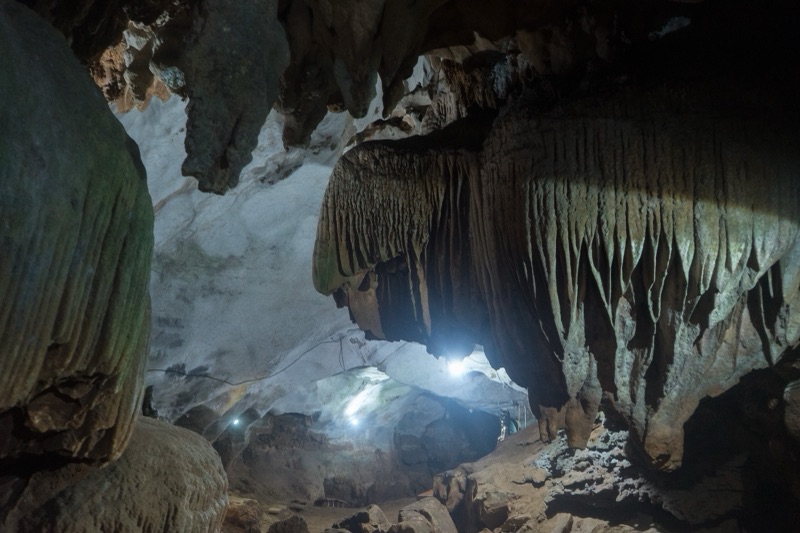
The golden deer led him all the way to the foot of Doi Luang Chiang Dao and ran into a great cave. Chao Luang Kham Daeng followed it inside, and the deer turned out to be Nang In-lao, the guardian of the cave, who had changed her shape to lure him in.
From that day on Chao Luang Kham Daeng never went back to Phayao. He and Nang In-lao stayed together to watch over Doi Luang Chiang Dao, and so the villagers honour the two of them as the protectors of this mountain and its cave. Bo ya ja lae.
The tale ends with bo ya ja lae (บ£าช¦, bo ya ja lae), the closing words that tell the listener the story is over, just as in the palm-leaf chronicles. These are the Kham Mueang words in the story worth knowing:
| Lanna word | Lanna script | Kham Mueang reading | Meaning (from the dictionary) |
|---|---|---|---|
| Phayao | พะเยัา | pha-yao | Phayao, one of the eight Lanna provinces |
| nuea | เนิ้อฯอ | nuea | wild animals, game of the deer kind |
| kwang | กวฯางฯ | kwang | deer |
| kham | (see above) | kham | gold |
| hoi | รอฯยฯ | hoi | a trace, a track, e.g. an animal's footprints |
In Kham Mueang, nuea (เนิ้อฯอ, nuea) does not mean meat for the table; it means wild animals of the deer kind. The deer itself is a kwang (กวฯางฯ, kwang), and to follow a trail is to follow its hoi (รอฯยฯ, hoi), from Central Thai roi, by the sound rule that turns Central Thai r into h in Kham Mueang.
The legend sign calls Nang In-lao a "phi suea yak tham". In Central Thai phi suea means butterfly, but in Kham Mueang phi suea (ผีเสิ้อฯอ, phi suea) means a guardian spirit of a place, as in phi suea ban (village guardian), phi suea doi (mountain guardian) and phi suea mueang (city guardian). Yak (ยัก์ขฯ, yak) is a giant of the tales. So Nang In-lao is a powerful guardian of the cave, not a butterfly in a garden.
- The Tai Lue telling of Ban Phaed, Chiang Kham District: Chao Phaya Kham Daeng is a son of Phaya Jo-ra-ni, king of Phayao. Coming home from war, he sees a beautiful deer and follows it. At the mouth of a great cave the deer becomes a woman named Nang In-lao, daughter of the giantess who guards Chiang Dao Cave, and the two vanish, never to return (Matichon Weekly, 2020).
- The Wiang Chet Lin telling: another version calls him Chao Suwanna Kham Daeng. The deer leads him south to the foot of Doi Suthep, where he meets a la-si (รสี, la-si), a hermit. He gives up the chase and founds Wiang Chet Lin in the Ping valley, which is why the people of Chiang Mai honour him as the head of the city's guardian spirits (Matichon Weekly, 2020).
- The seven lotus clumps: Krungthep Turakij tells that the golden deer vanished at Doi Luang Chiang Dao, and Chao Suwanna Kham Daeng found a pond of bua (บ฿วฯ), lotus, in seven clumps; a hermit read it as a good omen for founding a city.
- The Pu Sae Ya Sae legend: some chronicles count Chao Luang Kham Daeng among the 32 children of Pu Sae Ya Sae, the ancestor spirits of Chiang Mai.
One legend, two roots: Tai Yuan and Tai Lue
Why does one legend have so many versions? The thesis of Nittaya Wannakit (Chulalongkorn University, 2011), based on fieldwork in Chiang Mai, Chiang Rai, Phayao, Lampang and Nan, gives an interesting answer.
- Tai Yuan (Khon Mueang): the belief began with the great spirit of Doi Luang Chiang Dao, an old belief from before the Lanna kingdom was founded. When Buddhism arrived, he took on the status of a deity, a Buddhist guardian deva. The belief probably spread first in Chiang Mai and then to the Tai Yuan of other provinces.
- Tai Lue: the Tai Lue of Sipsong Panna honoured Phaya Kham Daeng, a hero who became a city spirit. When some Tai Lue groups moved into Lanna they brought their guardian spirit with them, then took in the Tai Yuan legend of Chao Luang Kham Daeng and blended the two, which is why the two groups' stories look so alike today.
The researcher also found that each group still keeps its own way of holding the rites, in timing, form and who may take part, so the rites are about community identity as well as faith.
His name changes from place to place, too. Pensupa Sukkata (2020) collected these names from the work of Dr Prasit Leeprecha:
| Place / people | Name used |
|---|---|
| Chiang Mai (chronicles) | Suwanna Kham Daeng, Chao Luang Kham Daeng |
| Phayao | Phra Ya Kham Daeng |
| Chiang Rai | Chao Pho Kham Daeng |
| Tai Lue of Chiang Kham (Phayao) | Chao (Pho) Phaya Kham Daeng |
| Tai Lue of Nan | Thewada Kham Daeng |
| Tai Yai (Shan) | Chao Khun Kham Daeng |
Phi chao nai: the great guardian of Lanna
Northerners have exact words for different kinds of spirits. A spirit that protects a city is a suea mueang (เสิ้อฯอเมิอฯง, suea mueang) or phi mueang (ผีเมิอฯง, phi mueang). A phi chao nai such as Chao Luang Kham Daeng is often called, with respect, jao po (เจั้าพํอฯ, jao po), "lord father". The dictionary gives the example "san Jao Po Kham Daeng" under the word san (ศาลฯฯ, san), a shrine.
Lanna has guardians on every mountain and in every town, but the name of Chao Luang Kham Daeng is usually placed above them. Peerapat Kiatpinyo, writing in Thansettakij (2026), cites a palm-leaf manuscript that praises him as greater than the other guardians of Chiang Mai, and argues that he should not really be called a "ghost" (phi), because in the legend he never died: he disappeared into an enchanted land where time does not pass.
| Lanna word | Lanna script | Kham Mueang reading | Meaning (from the dictionary) |
|---|---|---|---|
| phi chao nai | (see above) | phi chao nai | guardian spirit who was an important figure of legend |
| suea mueang | (see above) | suea mueang | guardian spirit that protects a city |
| phi suea | (see above) | phi suea | guardian spirit; spirit of a place |
| jao po | (see above) | jao po | "lord father", a name for a phi chao nai |
| te-wa-da | เทวดา | te-wa-da | deva, a heavenly being |
| ma khi | ม้าขี่ | ma khi | spirit medium, a person a spirit enters |
| long phi | ล฿งฯผี | long phi | to go into trance; to invite a spirit into a person to ask about good and bad fortune |
| liang phi | ล้ยฯงผี | liang phi | to make offerings to a spirit: food and offerings given to a spirit |
The word ma khi (ม้าขี่, ma khi) is worth remembering, because Northerners picture the medium as a ma (ม้า), a horse, that the spirit rides. Thansettakij reports that the faithful believe Chao Luang Kham Daeng comes down into his ma khi, and appears in the visions of monks who keep the precepts well.
Doi Luang Chiang Dao: the lord's flower garden
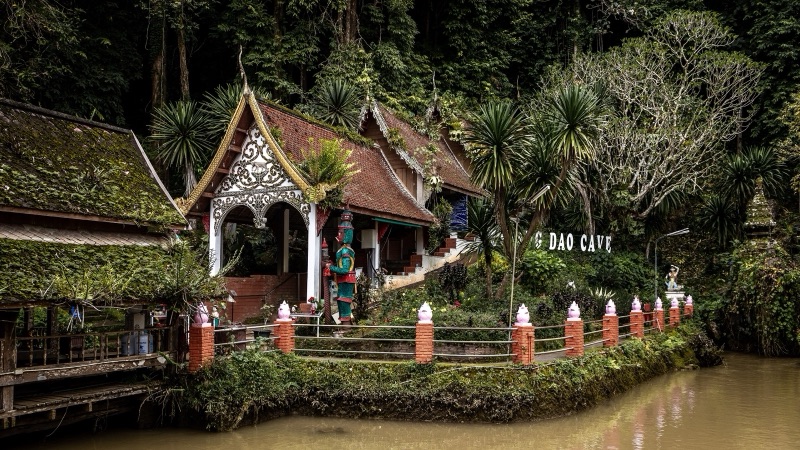
The belief in Chao Luang Kham Daeng is tied to a real mountain. The people of Chiang Dao believe Doi Luang is his home. Thansettakij (2026) reports that some elders have seen a great ball of light streak across the sky between Doi Luang Chiang Dao and Phayao; that villagers tell him when trouble comes; and that they believe the whole mountain is the lord's park and flower garden, full of rare plants found nowhere else. So the belief makes people careful with the mountain, and helps protect its forest.
Doi Luang is also an important source of water. The dictionary explains khun nam (ขุรนาฯ, khun nam) as the source of a river, with the example "the source of the Ping is at Doi Thuai, Chiang Dao District". The river that feeds Chiang Mai begins in the same district as the lord's mountain home.
- Where: Chiang Dao District, Chiang Mai Province, north of Chiang Mai city
- What it is: a limestone mountain with many caves carved by rainwater; the largest is Chiang Dao Cave
- Why it matters: in September 2021 UNESCO named Doi Chiang Dao a biosphere reserve, the only area in Thailand covered with sub-alpine vegetation (TAT News, 2021)
Chiang Dao Cave is both a sight to see and part of a temple. Dress modestly, speak softly, and don't take stones or plants home. More tips: Lanna temple etiquette
Try a short quiz on the story you have just read.
Summary
- Chao Luang Kham Daeng is a phi chao nai, a guardian spirit who dwells on Doi Luang Chiang Dao and is honoured as the greatest guardian of Lanna
- Kham in his name is the Kham Mueang word for gold, and Doi Luang Jiang Dao is the great mountain of the town of Chiang Dao
- The legend on the Wat Tham Chiang Dao sign tells of a prince of Phayao who followed a golden deer into a cave; the deer was Nang In-lao, and the two have guarded the mountain ever since
- The Tai Yuan and Tai Lue legends have different roots but borrowed from each other until their plots became alike (Nittaya Wannakit, 2011)
- The belief that Doi Luang is the lord's flower garden helps people protect the mountain's forest
Look up more spirit and guardian words in the Moradok Lanna dictionary, read all the Kham Mueang ghost words in Kham Mueang ghost and spirit words, and the legend of Chiang Mai's ancestor spirits in Pu Sae Ya Sae.
Sources
- Moradok Lanna dictionary: ผีเจ้านาย · ศาล · ผีเสื้อ · ขุนน้ำ · ม้าขี่
- Pensupa Sukkata. (2020, 16 October). เจ้าหลวงคำแดง – "ตำนาน" หรือ "เรื่องจริง" [Chao Luang Kham Daeng: legend or history?]. Matichon Weekly (the Wat Tham Chiang Dao legend sign, the Ban Phaed Tai Lue telling, the Wiang Chet Lin telling, and regional names after the work of Prasit Leeprecha)
- Nittaya Wannakit. (2011). พลวัตของลัทธิพิธีการนับถือเจ้าหลวงคำแดงของกลุ่มไทยวนและไทลื้อในภาคเหนือ [The dynamics of the Chao Luang Kham Daeng cult among the Tai Yuan and Tai Lue of northern Thailand] (thesis abstract). Folklore Centre, Faculty of Arts, Chulalongkorn University
- Peerapat Kiatpinyo. (2026). เจ้าหลวงคำแดง [Chao Luang Kham Daeng]. Thansettakij, column "Cat out of the box"
- Walan Supakorn. สวัชโรกร วรรณศร: ศิลปะจากรากเหง้าตำนานการเกิดเมืองล้านนา [Sawatchrokorn Wannasorn: art from the roots of Lanna's founding legends]. Krungthep Turakij
- Tourism Authority of Thailand. (2021). Chiang Mai's Doi Chiang Dao declared UNESCO biosphere reserve. TAT News
Practise the words from this article
Flip through 28 flashcards of the Lanna words used in this article.
Look up "ผีเจ้านาย" in the Moradok Lanna dictionary (in Thai)


