
Photo: Jakub Hałun / Wikimedia Commons (CC BY-SA 4.0)
Ch Becomes J in Kham Mueang: Jiang Mai, Jao Ban, Jin
Ch becomes j is the second most audible sound rule in Kham Mueang. Northerners call their province jiang mai (ชยฯงไห่มฯ, read jiang mai) where Central Thai says chiang mai, call villagers jao ban (ชาวฯบ้าฯนฯ, read jao ban) for chao ban, and call meat jin (ชิ้นฯ, read jin) for chin, "piece". The ch that Central Thai pronounces with a puff of air becomes j in Kham Mueang.
This post follows R Becomes H in Kham Mueang with the same method: how the rule shows up in the dictionary, how many words follow it, which words are exceptions, and whether sister languages such as Lao, Isan and Tai Lue have the same sound.
Where to see the ch to j rule
The Moradok Lanna dictionary explains the r to h rule in its entries for the letters ra and ha. From our search, though, there is no entry for the letter cha or ja that explains this rule as an entry of its own. The ch to j rule can only be seen from the entries themselves. Several of them say outright how Kham Mueang differs from Central Thai, such as the entry for Chiang Mai, "Northern Thai (Kham Mueang) calls it jiang mai", and the entry for chim, "Northern Thai (Kham Mueang) says jim".
On the research side, Atcharaporn Chansawang's article "Kham Mueang–Lao: Language and Culture as Siblings" (2011) compared Northern and Isan Thai and concluded that both varieties have no /ch/ sound and say /j/ or /s/ instead, and say /h/ for /r/ as well. In the Kham Mueang dictionary the usual choice is j, while the example of the word for elephant in Isan has s. See the sister-languages section below.
For all five rules together, read Kham Mueang Sound Rules.
300+ entries in the dictionary
We counted from the Moradok Lanna dictionary itself (the Thai-form field and the Kham Mueang reading field of each entry, counted on 18 October 2026 from the 17,309 entries that have both fields):
- 334 entries have a Thai form that starts with ช.
- 328 of them (98%) are read starting with จ in Kham Mueang.
- The other 6 are still read starting with ช, but all 6 are look-up pages that point from a Central Thai name to the Kham Mueang word (see the exceptions below).
- From the other side, 952 entries are read starting with จ: 624 of them have a Thai form that already starts with จ, and 328 start with ช. No other letter appears at all.
The count includes compounds (jin ping, jin lap and jin som each count as separate entries), so it is a rough overview and not a linguistic census. The word families with the most entries by Thai form are chin 23 entries, chak 16, chueak 13, chang ("craftsman") 10, chang ("elephant") 9, and chao and chiang with 7 each. The examples below are grouped by theme, and every word is in the dictionary.
Towns and people
| Kham Mueang | Lanna script | Central Thai | Meaning |
|---|---|---|---|
| jiang mai | ชยฯงไห่มฯ | chiang mai | Chiang Mai province |
| jiang hai | ชยฯงรายฯ | chiang rai | Chiang Rai province (this also uses the r to h rule) |
| jiang tung | ชยฯงตุง | chiang tung | the town of Chiang Tung |
| jiang | ชยฯง | chiang | town, city |
| jao | ชาวฯ | chao | a group of people of one nationality or one home area |
| jao ban | ชาวฯบ้าฯนฯ | chao ban | ordinary people, common folk |
| jao jiang mai | ชาวฯชยฯงไห่มฯ | chao chiang mai | people of Chiang Mai |
| jao man | ชาวฯม่านฯ | chao man | the Burmese people |
| jai | ชายฯ | chai | man (po jai is also said) |
For jiang, meaning town, the dictionary gives three examples: Jiang Mai, Jiang Hai and Jiang Dao. By this example, town names that start with chiang are read jiang. The full names of the eight provinces are in The Eight Lanna Provinces.
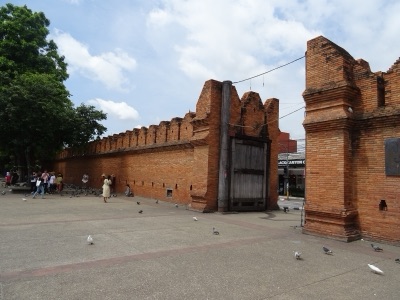
Photo: Christophe95 / Wikimedia Commons (CC BY-SA 4.0)
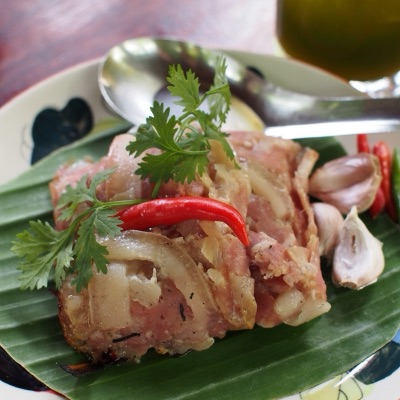
Photo: Takeaway / Wikimedia Commons (CC BY-SA 3.0)
Jin, and things to eat and use
The dictionary defines jin as "meat", and it is the parent of many food words, because the names of meats and of dishes made from meat often begin with jin.
| Kham Mueang | Lanna script | Central Thai | Meaning |
|---|---|---|---|
| jin | ชิ้นฯ | chin | meat, the part of the body of people and animals beneath the skin |
| jin ping | ชิ้นฯปิ้งฯ | chin ping | grilled meat, fried pork |
| jin lap | ชิ้นฯลาปฯ | chin lap | a dish of finely chopped meat mixed with lap chilli paste |
| jin som | ชิ้นฯส้฿มฯ | chin som | naem, a fermented sour sausage |
| jin som mok | ชิ้นฯส้฿มฯห฿มฯก | chin som mok | naem wrapped in banana leaf and cooked in hot ashes |
| jon | ช้อฯร | chon | spoon: a tool for scooping food |
| jueak | เชิอฯก | chueak | rope: a long strand twisted from hemp, jute or thread, used to tie things |
| jang | ช้างฯ | chang | elephant: the largest land animal, with a long nose called a trunk |
The dictionary has as many as 23 entries whose Thai form starts with chin. For northern dishes with both naem and lap, read Northern Thai Dishes to Try.
Actions
| Kham Mueang | Lanna script | Central Thai | Meaning |
|---|---|---|---|
| juai | ช่วฯย | chuai | to help, to support so that something succeeds |
| juan | ชวฯร | chuan | to invite, to lead on, to ask someone to join |
| jak | ชักฯ | chak | to pull a rope or thread tied to something so that it moves, as in jak thong khuen sao, hoist a flag up the pole |
| jim | ชิมฯ | chim | to taste with the tip of the tongue |
| jang | ชังฯ | chang | to hate, to dislike |
| jue | เชิ่อฯอ | chue | to believe, to listen, to trust |
| ji | ชี้ | chi | the index finger; to point, to tell or advise, as in ji tang, to tell the way |
| jon | ช฿นฯ | chon | to fight, as in kai jon, a fighting cock; or to hit hard, as in rot jon kan, cars collide |
| jet | เชัดฯ | chet | to wipe clean or dry |
| jao | เชั่า | chao | to rent: to use someone else's property for a while in return for payment |
| jai | ไช้ | chai | to order someone to do something, or to put something to use |
| jaeng | แช่งฯ | chaeng | to curse: to say something with ill intent, hoping harm will come to someone |
Names, times and states
| Kham Mueang | Lanna script | Central Thai | Meaning |
|---|---|---|---|
| jue | ชื่ | chue | name: a word given to call people, animals, things and places |
| jao | เชั้า | chao | the time before sunrise, as in luk jao, to wake before the sun is up |
| ja | ช้า | cha | not fast, moving slowly, as in tiao ja, to walk slowly |
| juen | ชื่นฯ | chuen | fresh, bright, glad, cheerful |
| jam | ชํา | cham | bruised and sore from hard knocks, or dark, dull |
| jong | ช่อฯง | chong | an opening that lets you in and out, as in jong pratu, a doorway |
The rule applies to idioms too. The dictionary records jue jang hang maeo (ชื่ช้างฯร่างฯแมวฯ, read jue jang hang maeo), whose Thai form is chue chang rang maeo, as meaning "a grand name, rank and title but poor circumstances". It has ch to j in name and elephant and r to h in body.
Tones change too
Looking at Kham Mueang words spelled in Thai script in the dictionary, the tone marks usually change along with the consonant. By Thai tone rules the reason is that ช is a low-class letter while จ is a mid-class letter (explained in Kham Mueang Sound Rules).
We counted only the entries whose Thai and Kham Mueang forms each have at most one tone mark: 205 entries. Of the 82 entries whose Central Thai word has the mai ek or mai tho mark, 62 change the mark: mai ek becomes mai tho in 32 (chuai to juai) and mai tho becomes mai tri in 30 (chang to jang), while 20 keep the original mark. These numbers are only a rough picture.
When ch does not become j
The rule is very strong. Of the 334 entries whose Thai form starts with ช, none is a real Kham Mueang word that is still read starting with ช. But a few things are worth knowing.
- Look-up pages where the Kham Mueang word still shows the Thai name: 6 entries, namely Chiang Mai (9104), chim (17288), Chiang Tung (17309), Chiang Rai (17324), chaphlu (17113) and chumhet thai (17134). All of them say what northerners call the Central Thai name. Chim is said as jim. For chaphlu and chumhet thai, the dictionary says northerners use entirely different words, so they are not examples of the rule.
- ch in a later syllable: some words keep the Central Thai reading in the dictionary, such as mae chi (แม่ชี, read mae chi) and luk chit (ลูกชิดฯ, read luk chit). The dictionary gives no reason, so we simply note that words like this exist.
- ch as a final consonant: the rule is about the sound that starts a syllable. Dictionary examples where ช is at the end of the word, such as buat (4215) and phesat (9767), are read as written.
- Two words jang: the dictionary has both jang (2931), which matches chang "craftsman", and jang (2941), meaning to hire someone for work. Listeners have to follow the conversation. The dictionary also says Lanna people normally call a craftsman sala.
- ch with both j and s: for chamnan (skilled) the dictionary has ja nan (ชนาฯ, read ja nan) and says that spellings and readings with s (sa nan) are also said. This agrees with the research that Northern Thai uses j or s for ch.
Sister languages: Lao, Isan and Tai Lue
The sound that Central Thai writes ช does not always become j in the sister languages. According to the evidence we could check:
Isan. Atcharaporn Chansawang (2011) says that both Northern and Isan Thai lack the /ch/ sound. The north uses /j/, while Isan can use /s/. Wiktionary (a lead only) records chang, "elephant", in Isan as ซ่าง (sang).
Lao. Wiktionary and Wikipedia (both used as leads only) agree that the Lao word for elephant is ຊ້າງ, pronounced about sang [saːŋ], with the initial /s/ (the letter ຊ).
Tai Lue. English Wikipedia's article on Tai Lue (a lead only) gives Chiang Rai as pronounced /t͡ɕêŋ hâːj/ in Tai Lue, which starts with the sound /t͡ɕ/, close to Thai จ, and also has h from r. Wiktionary records the Tai Lue word for elephant as tsaang and the Shan word as tsâang.
| Language | The word for elephant | Initial sound | Source |
|---|---|---|---|
| Central Thai | ช้าง | ch | standard Thai |
| Kham Mueang | จ๊าง | j | Moradok Lanna dictionary (2946) |
| Isan | ซ่าง | s | Wiktionary (lead) and Chansawang (2011) |
| Lao | ຊ້າງ | s | Wiktionary and Wikipedia (leads) |
| Tai Lue | tsaang | ts | Wiktionary (lead) |
The Moradok Lanna dictionary itself warns that sister languages are not one language. Its entry for Chiang Tung records that Kham Mueang speakers say jiang tung, while the Khun and Lue say kengtung and the Shan say wengkengtung: the same town, but a different first sound in each variety.
Try the ch to j game
Test yourself on how many Kham Mueang words you can tell come from ช. The questions come from 34 real dictionary pairs, and after you answer you see the Lanna script and the meaning from the dictionary.
Summary
- For native words that start with ช in Central Thai, Kham Mueang reads จ, as in jiang mai, jao ban, jin, jang and jue, and the tone mark usually changes too.
- In the Moradok Lanna dictionary, 328 of 334 entries with a Thai form starting with ช are read as จ; the other 6 are look-up pages from a Thai name (counted 18 October 2026).
- It does not always work in reverse, because only about a third of the dictionary's จ entries come from ช.
- Notes: jang is two words, and ช as a final consonant or in some later syllables is read as written.
- Research says Northern and Isan Thai have no /ch/: in Kham Mueang it is mostly j, in the Isan and Lao example for elephant it is s, and Tai Lue is reported with ts.
Look up more Kham Mueang words that start with จ in the Moradok Lanna dictionary. To learn the other rules, continue with Kham Mueang Sound Rules and R Becomes H in Kham Mueang, and to meet the other Tai peoples read The Tai Peoples.
Sources
- Moradok Lanna dictionary (moradoklanna.com/dict, in Thai): jiang mai · jao ban · jin · jang · jue, checked and counted on 18 October 2026
- Chansawang, A. (2011). Kham Mueang–Lao: Language and Culture as Siblings. Journal of Social Innovation and Lifelong Learning, 5(1). (In Thai.)
- Wiktionary. ຊ້າງ and ช้าง (used as leads only)
- Wikipedia. Lao alphabet and Tai Lue language (used as leads only)
- Photos from Wikimedia Commons as credited under each image.
Practise the words from this article
Flip through 40 flashcards of the Lanna words used in this article.
Look up "เจียงใหม่" in the Moradok Lanna dictionary (in Thai)


