
False Friends: Polite Words and Small Words
The Kham Mueang false friends you hear most often are not rare words. They are the small words that turn up in every sentence. The first is yin di (ยินฯดี). A Central Thai speaker hears "glad" or "welcome", but the Moradok Lanna dictionary defines it as "pleased; thanks; thank you". That is why northerners say yin di jao where Bangkok says khop khun kha.
This lesson collects about 15 polite words and small words in Kham Mueang: words for saying yes, polite endings, question words and linking words. Every one comes from the Moradok Lanna dictionary, with what a Central Thai speaker expects and what a northerner means.
Many of these words also have their Central Thai meaning in the same dictionary: ko can mean "to build", and lae can mean "to look". This lesson does not say the Central Thai sense is wrong. It shows that when these words sit at the end or in the middle of a northerner's sentence, they usually do a different job.
Yin di, khop, maen: ways of saying yes that confuse people
| Word | Lanna script | A Central Thai speaker expects | The dictionary says |
|---|---|---|---|
| yin di | ยินฯดี | glad, welcome | pleased; thanks; thank you |
| khop | ขอฯบ | edge, frame | edge, frame; and also a verb: to accept, to report, to be pleased |
| maen | แม่นฯ | accurate, on target | a word of confirmation: true, yes, right, correct |
| maen laeo | แม่นฯ¦วฯ | (no such word) | yes, that's right |
| maen ko | แม่นฯกํอฯ | (no such word) | right? as in khon ni maen ko (is this the person?) |
Maen (แม่นฯ) is how northerners say "yes, that's right". If someone asks "maen ko?" and you answer "maen laeo", you have said "yes, it is". It has nothing to do with accuracy.
Under the word jao, the dictionary gives the example "yin di jat nak jao", thank you very much. If you remember only one sentence, make it this one. More ways to say thanks: Kham Mueang Words Locals Love
Jao: a polite ending, not a lord
A Central Thai speaker who hears jao (เจั้า) thinks of a lord or an owner. Those meanings are in the dictionary, but the one you hear most is the third: a polite word at the end of a sentence to show respect, like kha in Central Thai. For example, kin laeo jao (I've eaten) and bo ao jao (no, thank you).
The dictionary notes that today it is mostly used by women, but in earlier times men also used it when speaking to nobles and senior monks.
The dictionary has a second word jao (เชั่า) meaning "to rent": to use someone else's property for a while in return for payment. Central Thai ch often becomes j in Kham Mueang, so chao (rent) becomes jao. Listen to what the conversation is about.
More polite endings: Kham Mueang Sentence Endings
Ka, ko, lue: not a crow, not building, not a rumour
At the end of a sentence, all three of these words make a question.
| Word | Lanna script | A Central Thai speaker expects | The dictionary says | The dictionary's examples |
|---|---|---|---|---|
| ka | คาฯ | a crow | or? yet? right? (also "stuck") | ap nam laeo ka (have you bathed yet?) · bo muan ka (isn't it fun?) |
| ko | กํอฯ | to build, to light a fire | to cause or build, and also a question ending | pai ko (are you going?) · lam ko (is it tasty?) |
| lue | รฤ | a rumour, famous | or? what? |
Ka (คาฯ) and ko (กํอฯ) are used a little differently. The dictionary's examples show ko asking "…or not?" and ka asking "…is it?" or "…yet?". Lue (รฤ) means "or?" or "what?".
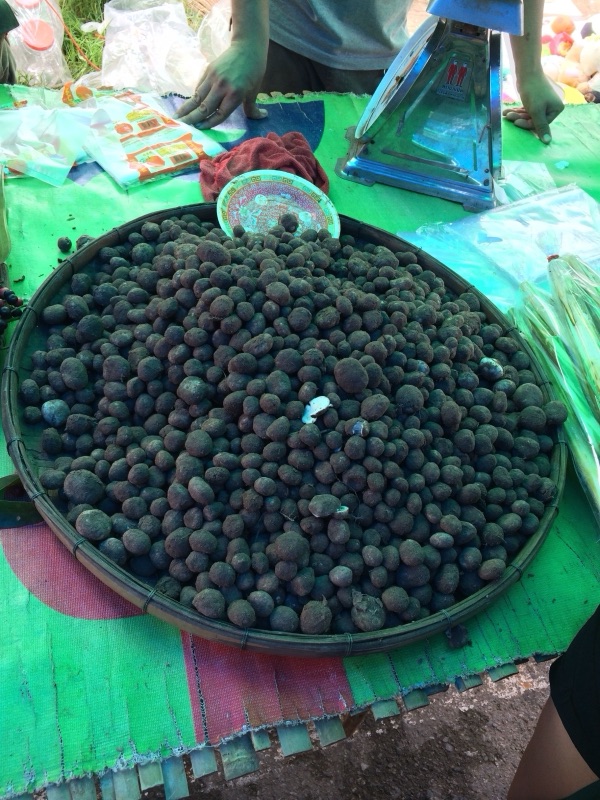
Ko (กํอฯ) is also the name of a tree. The dictionary says its hard-shelled nuts can be roasted and eaten, and the mushroom that grows under it is called het ko.
Other question words (phai, sang, yang, tao dai): Asking Questions in Kham Mueang
Lae, an, yon: linking words that look like verbs
| Word | Lanna script | A Central Thai speaker expects | The dictionary says |
|---|---|---|---|
| lae | แลฯ | to look | with, also, and; indeed |
| an | อั้นฯ | to hold back | that, like that, that way |
| ja an | จอั้นฯ | (no such word) | like that, so |
| i | อี้ | (no such word) | this, as in ja i (like this) |
| yon | ย้อฯร | to go back, to retort | because, due to |
Lae (แลฯ) is a conjunction in Kham Mueang: "and, with". Lae meaning "to glance, to look" is in the dictionary too, as a separate word (แล), which is also the old name for a parrot, nok lae.
An (อั้นฯ) pairs with i (อี้): "that" and "this". The dictionary's example is "ja an ko ngam di", that way looks nice too. It has nothing to do with holding anything back.
Yon (ย้อฯร) means "because". The dictionary's example is "mi yon man": rich because hard-working.
Heard with Central Thai ears, mi yon man sounds like three verbs: have, go back, be diligent. A northerner means rich because hard-working: mi here means "to be rich", and yon means "because".
Nak, dai, naem, kam: small words that change the whole sentence
| Word | Lanna script | A Central Thai speaker expects | The dictionary says | The dictionary's examples |
|---|---|---|---|---|
| nak | นักฯ | a "-er" person (singer, student) | very, much, extremely | ja pai u nak (don't talk so much) · wok nak (lies a lot) |
| dai | ดายฯ | in vain; to weed | only, idly, plain, careless | kin khao bo dai (eat plain rice) · yu dai (sit idle) |
| naem | แหนฯม | sour pork sausage | probably, ought to, might | |
| kam | คําฯ | a fist | a word, speech; a time, an occurrence | khian sam kam (whip three times) |
Nak (นักฯ) is mostly an adverb in Kham Mueang: "very, a lot". The dictionary explains that for someone skilled at something bad, northerners usually use khi, as in khi so (a prisoner). The sense "an expert" exists too, as in nak u (a speaker).
Kam (คําฯ) is simply Central Thai kham, "word". That is why the language of the north is called kam mueang (คำฯเมิอฯง), and u kam mueang means "to speak Kham Mueang".
This saying comes from dai. The dictionary translates it as all talk: someone who says things but never does them. It is not a compliment, so it is worth knowing but not something to say to an elder.
As for naem (แหนฯม), "probably", the full story is in Food False Friends. If you want the sour sausage, ask for jin som.
Tham: more than asking
Tham (ถามฯ) has the Central Thai meaning "to speak in order to get an answer", but the dictionary's first meanings are to negotiate, to approach someone with a proposal. So when an elder says they have already gone to tham, they may mean they have gone to negotiate or make a proposal, not just to ask a question.
Listen to a conversation
This dialogue was written by Moradok Lanna from dictionary words and examples. It takes place at a small coffee shop in the hills.
The owner, an older woman: Lam ko?
Kaeo: Lam nak jao. Yin di jat nak jao.
The owner: Ma aeo ka?
Kaeo: Maen laeo jao. Ma aeo yon yak pho doi jao.
The owner: Ja an ko di laeo.
In plain English: "Is it tasty?" "Very tasty. Thank you very much." "Are you here on holiday?" "Yes. I came because I wanted to see the mountains." "Well, that's good, then."
Quiz: 5 questions with answers
- A northerner says "yin di jao". What does it mean? Thank you.
- Someone asks "maen ko?" How do you say yes? Maen laeo.
- What does "pai ko" mean? Are you going? It does not mean "go first".
- What does "mi yon man" mean? Rich because hard-working.
- What does "ja pai u nak" mean? Don't talk so much. (nak means "a lot")
Play: guess the meaning of polite Kham Mueang words
Guess what these words mean to a northerner. Pick an answer, then see the meaning from the dictionary.
Summary
- Yin di means "thank you" in Kham Mueang, and khop can also mean "to accept, to be pleased".
- Maen means "yes, right": answer maen laeo, ask maen ko.
- Jao at the end of a sentence is a polite ending, like kha.
- Ka, ko, lue at the end of a sentence ask questions; lae, an, i, yon mean "and, that, this, because".
- Nak means "very", dai means "plain, idle", naem means "probably", and kam is simply "word".
Look up more words in the Moradok Lanna dictionary, read another set of traps in Kham Mueang False Friends: Feelings and Health, and practise greetings in How to Greet in Chiang Mai.
Sources
Practise the words from this article
Flip through 23 flashcards of the Lanna words used in this article.


