
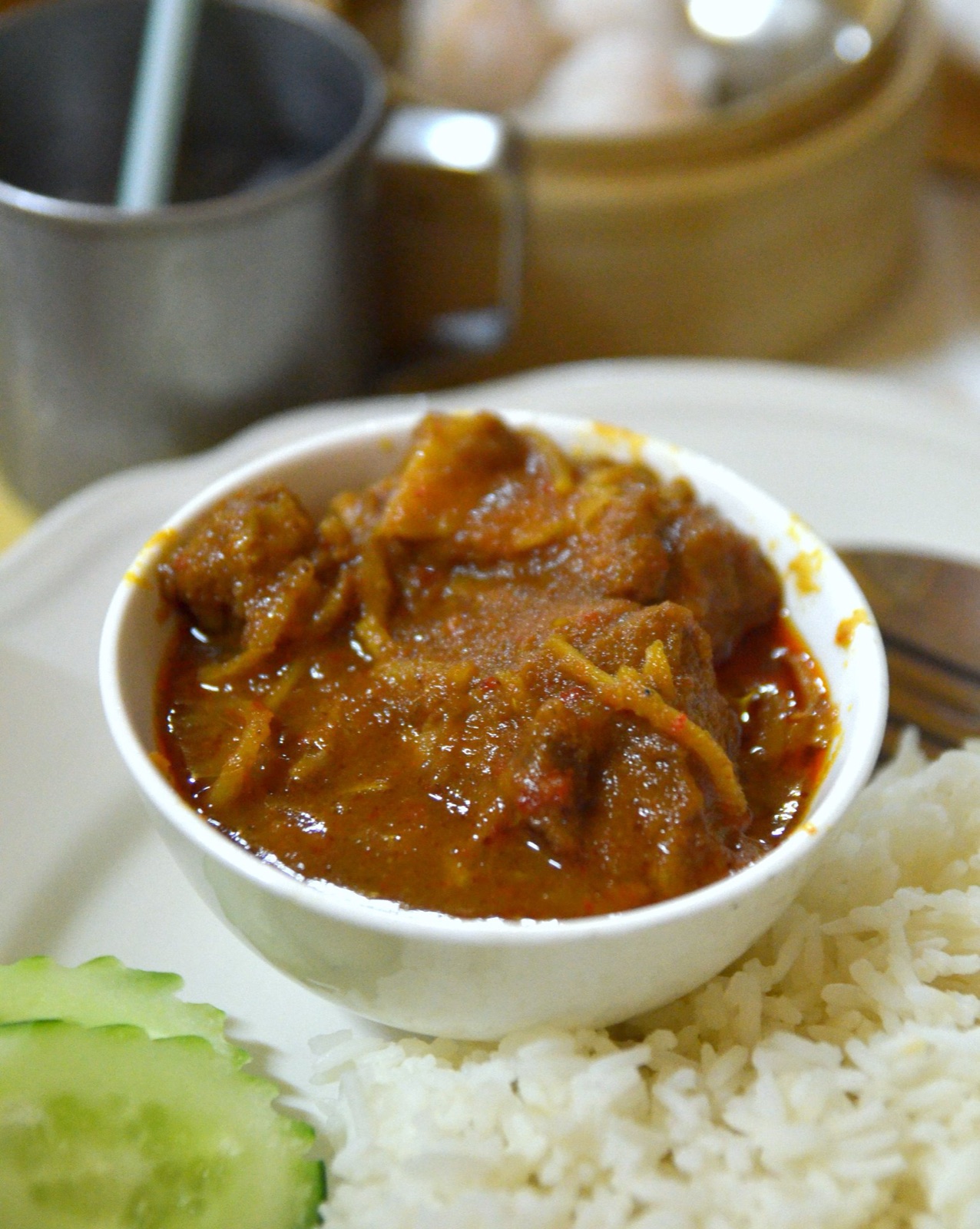
Photo: Chainwit. / Wikimedia Commons (CC BY-SA 4.0)
Kaeng Hang Le: History, Recipe and Kitchen Words
Kaeng hang le (แกงฯฮังฯเล, read kaeng hang le) is a Northern Thai curry of large pieces of pork belly, simmered very gently until the sauce reduces to a thick gloss. It is sour, salty and sweet, with spice, and finished with ginger strips and pickled garlic. It has long been part of Lanna merit-making feasts and hospitality, yet its name and its spices make people wonder where it came from.
This is the third post in our Lanna Kitchen series, after nam phrik ong and khao soi gai. It follows the history of hang le through a Thai academic study, then teaches the dish with the Kham Mueang words cooks use. Amounts are ranges, so you can adjust them to taste.
Kaeng hang le in the Kham Mueang dictionary
The Moradok Lanna dictionary (in Thai) describes kaeng hang le as a curry made with a special paste called "nam phik kaeng hang le". The meat "must be pork belly mixed with pure lean meat, not fatty", cut in large pieces and simmered until the sauce reduces to a jelly.
Another word to know is hang le (ฮังฯเล, read hang le). The dictionary records it as the name of a curry that uses large pieces of pork belly, made with a paste that includes curry powder, with a thick and very oily sauce. It adds that hin le is another name for it.
Where hang le comes from: what the research says
There is a study devoted to this dish: "Kaeng Hang Le": Culture and Beliefs by Thitiworada Yaisumlee and colleagues at Suan Dusit University, Lampang Center, published in the Valaya Alongkorn Review (2019). It concludes that hang le was influenced by Burma and that its way of cooking has been passed down to the present.
The study does not rest on one answer. It lists three routes by which Burmese food reached Lanna:
- Burmese rule over Lanna. Lanna was a vassal of Burma for about 216 years (1558–1774). The study also records the view of historians that in the early period Burma left the local rulers in charge, so food may not have been influenced much at first.
- Burmese traders and workers. In the Rattanakosin period, Burmese traders and labourers who were British subjects came to work the teak concessions and settled along the Ping and Wang rivers. The study gives the example of the Tha Mao community in Lampang, which makes hang le paste handed down from Burmese ancestors, now in its fourth generation.
- A shared border. The study found hang le being cooked and eaten in Mae Hong Son, which is another old centre of hang le powder, and in Mae Sot District, Tak. The Mon of Sangkhla Buri District, Kanchanaburi, have a curry called "khwa hin le" that is similar to the northern hang le.
On the name, the study says the Burmese call this curry "wae ta hin", following a study by Ubonrat Phanthumin (1999). Wae ta is pork and hin is curry, so it means pork curry. Made with beef it is called "a-mae ta hin".
The spice powder at the heart of the dish has another name, masala powder (in Thai, phong ma-sa-la), and resembles Indian masala. The blend differs between makers, but the study says it mainly contains turmeric, cumin, fenugreek and many other spices. A hang le recipe from Chiang Mai on the Feast Thailand website, which reproduces David Thompson's recipe, tells a similar story: Northern cooks took the curry up during Burmese rule, and its spicing points to Indian roots.
Hang le Man, hang le Chiang Saen and the Burmese version
The study sorts the hang le found in the North today into two styles, and compares them with the Burmese version as recorded in the book Lanna Food (Wani Iamsrithong and Prayat Saiwichian, 1995).
| Hang le Man | Hang le Chiang Saen | Burmese hang le (per Lanna Food) | |
|---|---|---|---|
| Look | A thick sauce that coats the meat, red-brown, with orange-red oil on top | Yellow-green from the vegetables, little sauce, looks like kaeng ho | A thick red curry |
| Meat | Pork belly and lean pork leg | Pork belly and lean pork leg | Beef (sirloin) |
| Vegetables and extras | Ginger strips, pickled garlic | Like hang le Man, plus seasonal vegetables such as yardlong beans, long aubergines, pea aubergines, culantro, wild betel leaves and pickled bamboo shoots; no glass noodles | Tomato, large dried chillies |
| Found | Found and eaten more widely | Found less often | Differs from the dish made in the North |
Man (ม่านฯ, read man) is the dictionary's word for the Burmese people, so hang le Man simply means Burmese-style hang le. Hang le Chiang Saen is the version Northerners adapted with vegetables. The two styles share two things: pork, and the hang le curry powder.
When it is eaten: food for merit-making and honoured guests
The study says hang le is not an everyday meal. It is cooked for important occasions, such as Buddhist holy days and Pi Mai Mueang (the Lanna New Year), and is often offered to monks, because people believe what is offered to monks should be the best. Pork is costly and simmering it tender takes time, so hang le is also a way for a host to show warmth to guests.
The study goes on to say that in the past a pig had to be slaughtered, so the dish was made in large quantities, with relatives cutting the meat, stirring and simmering together, under a lead cook it calls "mae khrua kao" at the top of this "pyramid" of shared work. Today there are still giant-pot events, called "hang le mo khang luang", at the Salung Luang, Klong Yai, Pi Mai Mueang festival in Lampang.
On a Lanna table, hang le often sits on the khantoke (ขันฯโต฿กฯ, read khan tok), the footed tray used for evening meals with guests. Read about that tray in Khantoke, and find hang le among the 99 dishes in Kin Lam Kin Lam. For the big celebrations where food is cooked in bulk, see Poy Luang.
Hang le and kaeng ho
The dictionary explains kaeng ho (แกงฯโร฿ะ, read kaeng ho) as a mixed curry with hang le as its base, with glass noodles, pickled bamboo shoots, lemongrass, kaffir lime leaves, ivy gourd leaves, Thai dill and Para cress added, stir-fried and simmered until thick and fragrant. It is often made from curries left over after a merit-making event, which is counted as Lanna wisdom. Pickled bamboo shoots are called noi som (หนฯอฯส฿มฯ, read no som) in Kham Mueang: bamboo shoots sliced thin and soaked in brine or rice water until sour.
Ingredients and their Kham Mueang names
This recipe serves 4. It is written in our own words, using the ingredient lists and steps from the study above, with amounts compared against three published recipes. The amounts are ranges because dried chillies, hang le powder and pickled garlic differ from place to place. Start low and taste at the end.
Hang le paste (pounded)
| Ingredient | Kham Mueang | Lanna script | Amount (serves 4) |
|---|---|---|---|
| Large dried chillies (soaked, seeded) | phik | ฯระฯพิกฯ | 5–8 chillies |
| Shallots | hom bua | หอฯมบ่฿วฯ | 5–8 shallots |
| Garlic | hom tiam | หอฯมทยฯม | 4–6 cloves |
| Galangal (thinly sliced) | kha | ข่า | 1–2 tbsp |
| Lemongrass (finely sliced, bottom part) | chak khai | จักฯไฯระฯค | 2–3 stalks |
| Shrimp paste | kam pi | กําปิ | ½–1 tsp |
| Salt | kuea | เกิลฯอฯอ | ½–1 tsp |
Meat and seasoning
| Ingredient | Kham Mueang | Lanna script | Amount (serves 4) |
|---|---|---|---|
| Pork belly (large pieces) | mu | หู | 400–500 g |
| Lean pork, leg or shoulder (large pieces) | — | — | 300–400 g |
| Hang le curry powder | — | — | 1–2 tbsp |
| Turmeric powder | khao min | เขั้าหิ้มฯร | ½–1 tsp |
| Dark soy sauce | — | — | 1–2 tbsp |
| Fish sauce | nam pa | นาฯปลฯา | 2–3 tbsp |
| Palm sugar | nam tan | นาฯตาลฯฯ | 1½–3 tbsp |
| Tamarind water | ba kham pia | บ่าฯขามฯเปยฯะ | 2–4 tbsp |
| Water | nam | นาฯ | 2–3 cups |
| Cooking oil | nam man | นาฯมันฯ | 1–2 tbsp |
What makes it hang le
| Ingredient | Kham Mueang | Lanna script | Amount (serves 4) |
|---|---|---|---|
| Mature ginger, cut in fine strips | khing | ขิงฯ | ¼–½ cup |
| Pickled garlic (whole cloves) with its liquid | hom dong | หอฯมดอฯง | ¼–½ cup, plus 2–3 tbsp liquid |
| Roasted peanuts (some recipes) | ba thua din | บ่าฯถ฿วฯดินฯ | 2–3 tbsp |
| Boiled eggs (optional) | — | — | 2–3 eggs |
The word mu, pork (หู, read mu), is written and read just like Central Thai in Kham Mueang. The other ingredient names differ clearly. Turmeric is khao min (the same one that turns khao soi broth orange-yellow; read more in khao soi gai), tamarind is ba kham pia, and pickled garlic is simply hom dong.
Hang le powder is sold in markets across the North. It is not a headword in the dictionary yet, so it is written in Thai only.
How to make kaeng hang le, step by step
The order follows the study: pound the paste, marinate the pork, fry until the meat tightens, add water and simmer until tender, then season with tamarind, fish sauce and sugar, add ginger and pickled garlic, and leave a moment before turning off the heat.
1. Pound the paste. Start by pounding (ตำ, read tam) the salt fine, then add the dried chillies, galangal, lemongrass, shallots, garlic and shrimp paste one at a time, from the driest to the wettest, until fine.
2. Slice and cut. Kham Mueang cooks say soi (ซอฯยฯ, read soi), which the dictionary defines as cutting with a small knife. Cut the ginger in fine strips, peel the pickled garlic, and cut the pork in large pieces. Do not cut it too small, because long simmering will make it fall apart.
3. Marinate the pork. Mix the pork with the paste, hang le powder, turmeric and dark soy sauce. Mak (หัมฯก, read mak) is to leave to soak, according to the dictionary. Marinate for about 30 minutes.
4. Fry until it tightens. Heat the oil in a pot over low heat and fry the marinated pork, stirring (ค฿นฯ, read kon) until the meat firms up.
5. Simmer until tender. Add the water, bring to the boil, then lower the heat and hum (รุ่ม, read hum), which the dictionary explains as simmering or boiling over a low fire until tender and soft, for about 1–1½ hours. If you use boiled eggs, add them for the last 20 minutes.
The dictionary also has a word for meat simmered this tender: chin hum (ชิ้นฯรุ่ม, read chin hum), meat prepared like a curry but cut in large pieces and simmered on a low fire until it is tender. The dictionary does not link this word to hang le directly, but the method is very close.
6. Season. Add the tamarind water, fish sauce and palm sugar, then the ginger, pickled garlic, its liquid and the peanuts.
7. Reduce, then taste. Simmer for another 20–30 minutes until the sauce is thick and glossy with oil. Chim (ชิมฯ, read chim) means to taste: aim for a balance of salty, sour and sweet, then turn off the heat.
Choose the number of diners below; the amounts adjust and you can tick off ingredients as you prepare them.
The Chiang Saen style: add seasonal vegetables
To try hang le Chiang Saen as the study describes it, follow the same steps, add pickled bamboo shoots (noi som) when you add the water, then add the vegetables that take longest to cook first, such as yardlong beans, long aubergines and pea aubergines, followed by fresh chillies, culantro and wild betel leaves, before seasoning as before. Leave out the glass noodles.
Summary
- Kaeng hang le is a curry of pork belly mixed with lean pork in large pieces, simmered until the sauce is jelly-thick, made with a paste that includes hang le powder.
- The study by Thitiworada Yaisumlee and colleagues (2019) concludes it was influenced by Burma, by three routes: Burmese rule, Burmese traders and workers, and the shared border.
- Two styles are found in the North: hang le Man, with a clinging sauce, and hang le Chiang Saen, with seasonal vegetables added.
- It is food for merit-making, Pi Mai Mueang and honoured guests, served on a khantoke, not an everyday meal.
- Kham Mueang kitchen words today: tam (pound), soi (cut fine), mak (marinate), kon (stir), hum (simmer gently) and chim (taste).
When you have eaten, praise the cook with lam tae (ลำแท้, read lam tae), meaning really delicious. Look up more Kham Mueang kitchen words in the Moradok Lanna dictionary (in Thai), and read about other Northern dishes in What to Eat in Chiang Mai.
Sources
- The Moradok Lanna dictionary (moradoklanna.com/dict, in Thai): แก๋งฮังเล · ฮังเล · แก๋งโฮะ · ฮุ่ม · จิ๊นฮุ่ม · หมั๋ก and all the words in this post, checked 18 October 2026.
- Yaisumlee, T., Thanyakit, S., Sakmunwong, C. and Peatrat, N. (2019). “Kaeng Hang Le”: Culture and Beliefs. Valaya Alongkorn Review (Humanities and Social Science), 9(2), 172–186. (In Thai.)
- Tipsuwan, W. (2016). Kaeng Hunglay (Northern Thai Burmese Pork Curry). ThaiCookbook.tv. (Used to compare amounts and times.)
- Thompson, D. Gaeng Hang Lae (Chiang Mai Pork Curry), a recipe from Thai Food, published on Feast Thailand. (Used to compare the paste and times.)
- Akira. Hang Lay Pork Curry. Wongnai. (Used to compare amounts; in Thai.)
Practise the words from this article
Flip through 31 flashcards of the Lanna words used in this article.
Look up "แก๋งฮังเล" in the Moradok Lanna dictionary (in Thai)


