
Photo: Adam Jones / Wikimedia Commons (CC BY-SA 2.0)
Lanna Cloth and Clothing Words in Kham Mueang
Pha (ผ้า, Kham Mueang reading pha) means cloth in Kham Mueang, just as in central Thai, but many everyday clothing words are different. Northerners call trousers tiao, the checked all-purpose cloth (central Thai pha khao ma) pha tong, and a blanket pha tuap. And they use one verb, nung, for putting on almost anything, from a sin skirt to a shirt.
This article gathers Lanna cloth and clothing words from the Moradok Lanna dictionary: the basic verbs, shirts, trousers, wraps and skirts, headcloths and things you carry, cloth at home, cloth at the temple and in rituals, weaving, dyeing, and jewellery. For the full story of the Lanna skirt, see Sin Tin Chok.
Nung, hom, khua bai: the basic words
The first word to learn is nung (นุ่ง, Kham Mueang reading nung). The dictionary explains that northerners use nung ("to wear a wrap") for wearing anything: nung pha tong (wear a checked cloth), nung sin (wear a sin skirt), nung tiao (put on trousers) and nung suea (put on a shirt). All your clothes together are khua bai or khueang nung khua bai.
| Kham Mueang | Lanna script | Meaning (from the dictionary) |
|---|---|---|
| nung suea nung tiao | นุ่งเสิ้อฯอนุ่งเต่วฯ | to put on a shirt and trousers; to get dressed |
| hom | ห฿มฯ | to cover, wrap, e.g. hom pha (wrap a cloth around you); also "to bounce up and down" |
| khua bai | ระฯค฿วฯไบ | clothes, things to wear |
| khueang nung khua bai | เระฯคิอฯงนุ่งระฯค฿วฯไบ | clothes, things to wear |
| phuen phaen pha | ผืนฯแผ่นฯผ้า | clothes, things to wear |
| chai | ไช้ | to use, put to use, e.g. chai suea pha (wear your clothes) |
| miat suea pha | หมฯยฯดเสิ้อฯอผ้า | to put clothes away |
Suea: from suea kom to suea mo hom
Suea (เสิ้อฯอ, Kham Mueang reading suea) is anything worn on the upper body. Northerners name each kind of top by its shape. The airy camisole that older women love is the suea kom or suea ba hoi, and the dark-blue shirt dyed with hom is the famous suea mo hom.
| Kham Mueang | Lanna script | Meaning (from the dictionary) |
|---|---|---|
| suea kom | เสิ้อฯอก้อฯม | a women's camisole with a scoop neck; cool and airy, much loved by older women |
| suea ba hoi | เสิ้อฯอบ่าฯห้อฯยฯ | a scoop-neck camisole (also suea kom) |
| suea hoi | เสิ้อฯอห้อฯยฯ | see suea kom or suea ba hoi |
| suea ok | เสิ้อฯออ฿กฯ | a scoop-neck camisole |
| suea pai | เสิ้อฯอป้ายฯ | a fitted, cropped, long-sleeved blouse with a front panel that crosses over and fastens at the side with buttons or ties |
| suea khaen bok | เสิ้อฯอแขนฯบอฯก | a blouse with long tube-shaped sleeves and a short body that ends at the waist |
| suea aeo loi | เสิ้อฯอแอวฯลอฯยฯ | a cropped top that stops above the waist |
| suea kong heng | เสิ้อฯอก฿งฯเฮงฯ | a round-necked shirt open all the way down the front, fastened with buttons or ties |
| suea kho mon | เสิ้อฯอฅํอฯม฿นฯ | a round-necked shirt |
| suea kak | เสิ้อฯอคักฯ | a men's undershirt, a vest (also suea kam) |
| suea kam | เสิ้อฯอก้ลฯามฯ | see suea kak |
| suea nao | เสิ้อฯอหนฯาวฯ | a warm jacket (also suea un) |
| suea un | เสิ้อฯออุ่ร | a warm jacket |
| suea nok | เสิ้อฯอนอฯก | a suit jacket, Western formal wear |
| suea mo hom | เสิ้อฯอหํมฯอฯห้อฯม | a shirt dyed with hom or indigo, dark blue or blue-black |
| suea yan | เสิ้อฯอยัน์ตฯ | a shirt inscribed with yantra and spells, believed to make the wearer invulnerable; worn into battle |
| khaen suea | แขนฯเสิ้อฯอ | a sleeve |
| ba tom | บ่าฯต่อฯม | a button |
| dum | ดุม | a button (also the hub of a cart wheel) |
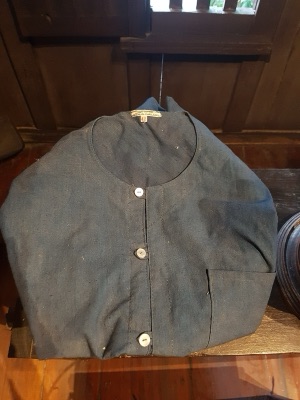
Photo: Iudexvivorum / Wikimedia Commons (CC0)
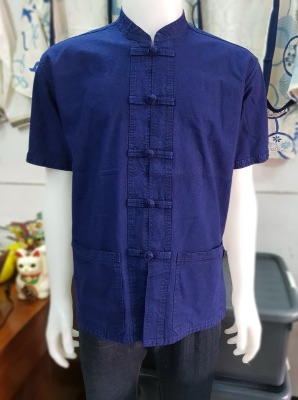
Photo: 19thronin / Wikimedia Commons (CC BY-SA 4.0)
Tiao: trousers in Kham Mueang
Every kind of trousers is tiao (ต่ยฯว, Kham Mueang reading tiao) plus a word for the style. The loose, drop-crotch farm trousers that end at mid-calf are tiao sado, and Western long trousers are tiao lang.
| Kham Mueang | Lanna script | Meaning (from the dictionary) |
|---|---|---|
| tiao kom | ต่ยฯวก้อฯม | shorts, usually the kind with a drawstring waist |
| tiao lat | ต่ยฯวลัดฯ | shorts like school shorts |
| nung tiao lat | นุ่งต่ยฯวลัดฯ | to wear shorts |
| tiao sado | ต่ยฯวสดํอฯ | loose drop-crotch trousers like Chinese-style trousers, but only mid-calf long |
| tiao mo hom | ต่ยฯวหํมฯอฯห้อฯม | local-style trousers sewn from mo hom cloth |
| tiao lang | ต่ยฯวระฯหั่งฯ | Western-style long trousers |
| tiao yin | ต่ยฯวยีน์สฯฯ | jeans |
| tiao nai | ต่ยฯวไน | underpants (also tiao ling, tiao long) |
| tiao ling | ต่ยฯวลิงฯ | see tiao nai |
| tiao long | ต่ยฯวหลฯอฯง | see tiao nai |
| tiao put kon | ต่ยฯวปุดก้฿นฯ | trousers torn at the seat |
| thong tiao | ถ฿งฯต่ยฯว | a trouser pocket |
| hang tiao | หางฯต่ยฯว | the tail of a wrap tucked up between the legs |
Wraps and skirts: sin, pha toi, pha salong and pha tong
A Lanna woman's skirt is the sin (สิ้นฯ, Kham Mueang reading sin). The dictionary names many kinds of sin, all explained in Sin Tin Chok; here are only the ones not covered there.
| Kham Mueang | Lanna script | Meaning (from the dictionary) |
|---|---|---|
| pha sin | ผ้าสิ้นฯ | a sin skirt |
| sin luat | สิ้นฯลวฯด | a sin woven as one piece throughout, with no other cloth joined on |
| sin mai | สิ้นฯไหมฯ | a sin woven from silk |
| sin ma yaeng | สิ้นฯหมฯาแอยฯงฯ | a sin hitched up high, to move freely or keep it clean when walking through mud |
Men wore the pha toi, a wrap tied as chong kraben trousers, or the pha salong, a sarong. The cloth men used every day was the pha tong (ผ้าต่อฯง), the checked cotton pha khao ma, worn as a wrap, a bathing cloth, a headcloth or a shawl.
| Kham Mueang | Lanna script | Meaning (from the dictionary) |
|---|---|---|
| pha toi | ผ้าต้อฯยฯ | a wrap tied as chong kraben (wrapped trousers) |
| nung pha toi | นุ่งผ้าต้อฯยฯ | to wear a wrap tied as chong kraben |
| pha salong | ผ้าสโระฯห่฿งฯ | a sarong, a man's wrap |
| pha khama | ผ้าขม้า | the checked cloth pha khao ma (see pha tong) |
| ken mam | เค้นฯม่ำ | to hitch up a wrap: gather the hem, pass it between the legs and tuck it in at the back of the waist |
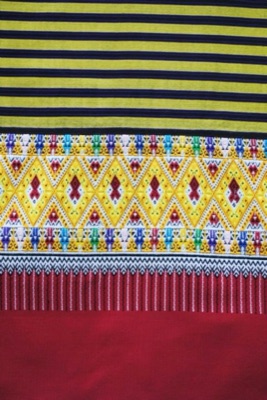
Photo: Chezballoon / Wikimedia Commons (CC BY-SA 3.0)
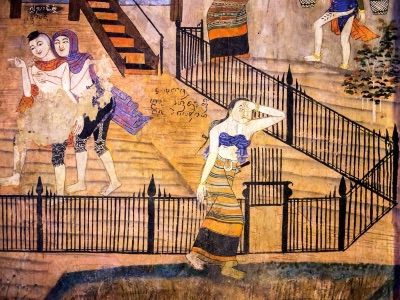
Photo: Takeaway / Wikimedia Commons (CC BY-SA 3.0)
Headcloths, hats, bags and sandals
Farmers in Lanna wrapped a cloth around the head against the sun, called pha pan hua (ผ้าพันฯห฿วฯ) or pha khian hua; tied under the chin, it is pha kalom. A hat is kup (กุบ, Kham Mueang reading kup).
| Kham Mueang | Lanna script | Meaning (from the dictionary) |
|---|---|---|
| pha khian hua | ผ้าฅยฯรห฿วฯ | a headcloth (also pha pan hua) |
| pha kalom | ผ้ากลอฯม | a headcloth tied under the chin, worn against the sun when travelling or working the fields |
| kup kalo | กุบกโล่ | a dome-shaped hat with a stiff brim all round, made of woven bamboo, pressed paper or palm leaf |
| kup ta laeo | กุบตาแหลฯว | a hat of criss-crossed bamboo strips |
| pha si chaeng | ผ้าสี่แจ่งฯ | a handkerchief, a small square cloth |
| pha tum | ผ้าทุ้ม | a wrap for the body, a shawl |
| pha chuai ba | ผ้าจ้วฯายฯบ่าฯ | to wear a cloth diagonally over one shoulder |
| yam | อยฯ้ามฯ | a shoulder bag; a monk's bag (also thong yam) |
| thong yang | ถ฿งฯยางฯ | a Karen-style shoulder bag sewn from colourful handwoven cloth |
| thong poe | ถ฿งฯเปิอฯ | a large shoulder bag |
| pha pok | ผ้าพ฿กฯ | a large square cloth for wrapping clothes and belongings to carry on your back when travelling |
| thong tin | ถ฿งฯตีนฯ | socks |
| koep | เกิปฯ | open-heeled shoes, sandals (also kueak) |
| koep tae | เกิปฯแตะ | flip-flops |
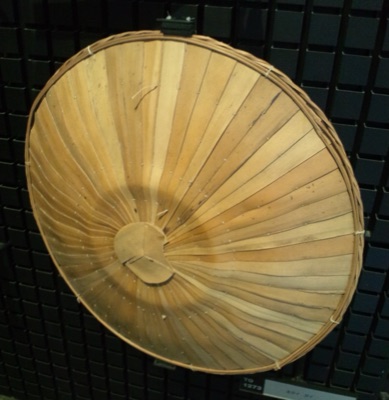
Photo: Yanajin33 / Wikimedia Commons (CC BY-SA 4.0)
Cloth at home: pha tuap, pha sali and pha man
A blanket is pha tuap (ผ้าทวฯบ, Kham Mueang reading pha tuap), a bed sheet is pha sali or pha lop, and a curtain is pha man or pha kang.
| Kham Mueang | Lanna script | Meaning (from the dictionary) |
|---|---|---|
| pha luam | ผ้าลวฯม | a quilt |
| pha sakkato | ผ้าสักกฯโต | a felt blanket |
| pha sali | ผ้าสลี | a bed sheet |
| pha lop | ผ้าห฿ลฯบ | a bed sheet |
| pha man | ผ้าห้มฯา | a curtain (also pha kang) |
| pha kang | ผ้ากั้งฯ | a curtain |
| pha kop | ผ้าคัอฯปฯฯ | a seat cushion, a cloth to sit on |
| pha om | ผ้าอ้อฯม | a small cloth for wiping, wrapping or laying under a baby; a nappy |
| pha yok | ผ้าหัยฯอฯก | a rag, old cloth, scraps |
| pha yoi | ผ้าย่อฯยฯ | scraps of cloth |
| pha yang | ผ้าอยฯางฯ | a rubber or plastic sheet against sun and rain, or to spread on the floor |
| lai saeng | ลายฯแซงฯ | a woven pattern of many stripes, popular on blankets |
top pha tuap (ท฿ปฯผ้าทวฯบ) fold the blanket · tuen pha tuap (ทื้นฯผ้าทวฯบ) spread the blanket out · tum pha tuap (ทุ้มผ้าทวฯบ) wrap yourself in the blanket · mut pha tuap (มุดผ้าทวฯบ) hide under the blanket · pueng pha tuap (พึ้งฯผ้าทวฯบ) yank the blanket off
Cloth at the temple and in rituals
A monk's set of robes is pha kai (ผ้าไค, Kham Mueang reading pha kai): the three robes, namely pha sabong (the lower robe), pha langka (the upper robe) and pha pat (the outer robe worn over the shoulder). Robes are offered at major merit-making events, such as the kathin robes given from the end of Buddhist Lent until the full moon of Duean Yi, described in Yi Peng Words.
| Kham Mueang | Lanna script | Meaning (from the dictionary) |
|---|---|---|
| pha sabong | ผ้าสบ฿งฯ | the lower robe of monks and novices |
| pha langka | ผ้าลังกฯา | the upper robe of a monk |
| pha pat | ผ้าพาดฯ | the outer robe worn over the shoulder (also pha pat ba) |
| pha lueang | ผ้าเหิลฯอฯง | yellow cloth; the robes of monks and novices |
| pha khak | ผ้าขักฯ | cloth dyed with jackfruit heartwood, a dull dark yellow, like the robes of forest monks |
| pha angsa | ผ้าอํฯสะ | the vest monks and novices wear underneath instead of a shirt |
| pha kathin | ผ้ากฐิน | the robes offered from the first waning day of Duean Kiang to the full moon of Duean Yi |
| thot pha pa | ทอฯดผ้าป่า | to offer robes by laying them on a tree branch; can be done all year |
| pha tum phachao | ผ้าทุ้มระฯพเจั้า | a cloth used to drape a Buddha image |
| pha khao | ผ้าขาวฯ | white cloth; also a lay devotee who keeps the precepts and dresses all in white |
| pha yan | ผ้ายัน์ตฯ | a cloth inscribed with spells or old letters such as Lanna script, kept as a sacred object |
Cotton thread matters in northern rituals too. Fai mai mue (ฝ้ายฯไหมฯมื) is the thread tied around the wrists of a bride and groom or to call back the khwan (soul), and tying it is mat mue (มัดฯมื), which the dictionary explains as inviting the khwan into a person; read more in Hong Khwan. There is also fai mongkhon (ฝ้ายฯม฿งฯค฿ลฯฯ), thread for auspicious rites such as the sai sin, and fai chung (ฝ้ายฯจูง), nine loops of raw cotton by which monks lead a coffin to the cremation ground. The cloth tung (ทุง) banners are covered in Tung Lanna.
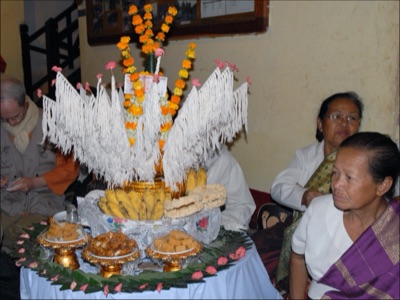
Photo: Dalbera / Wikimedia Commons (CC BY 2.0)
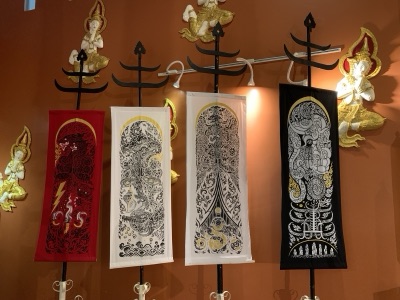
Photo: Chainwit. / Wikimedia Commons (CC BY 4.0)
From cotton boll to cloth: weaving words
Lanna cloth begins with fai (ฝ้ายฯ, Kham Mueang reading fai), which means both raw cotton and cotton thread. Local cotton with naturally light-brown fibre is fai tun or fai khon; the dictionary notes that fai tun is rare and harder to spin than white cotton because its fibres are short and less fluffy.
Before weaving, cotton goes through many steps, and Kham Mueang has a word for each one.
| Step | Kham Mueang | Lanna script | Meaning (from the dictionary) |
|---|---|---|---|
| 1 | fai tun | ฝ้ายฯตุ่ร | local cotton with naturally light-brown or cream fibre, not dyed |
| 1 | fai khon | ฝ้ายฯข่อฯร | cotton with naturally light-brown fibre (also fai tun) |
| 2 | it | อีดฯฝ้ายฯ | to gin cotton: squeeze the fibre to remove the seeds |
| 2 | kang it fai | ค้าฯงฯอีดฯฝ้ายฯ | a cotton gin |
| 3 | kong dit fai | ก฿งฯดีดฯฝ้ายฯ | a bow for fluffing cotton: a curved bamboo handle with a thick cord that is plucked (also kong ying fai) |
| 3 | sa lun | ซ้าลุ่ร | a deep, wide, closed basket in which cotton is bowed until fluffy |
| 4 | pan fai | ปั่นฯฝ้ายฯ | to spin: feed the cotton into the spinning wheel to make thread |
| 4 | phian | ผ่ยฯร | a spinning wheel |
| 4 | nai | ไน | a tool for winding thread onto bobbins |
| 4 | kwak | กัวฯก | a reel, a tool used in spinning |
| 5 | chai | ไจ | a skein: thread or silk taken off the reel and tied so it does not tangle; also the counting word for skeins |
| 5 | fai tong | ฝ้ายฯต่อฯง | raw cotton thread wound in loops ready for weaving |
| 6 | to huk | ทํอฯหูก | to weave on a loom |
| 6 | huk | หูก | a loom (also ki) |
| 6 | fuem | ฟืมฯ | the comb-like reed of a loom, used to beat the woven thread tight |
| 6 | wae | แว | the pulley that lifts the reed up and down (also the name of a big cicada) |
| 6 | sapan | สพ้านฯ | the beam of the loom that rolls up the finished cloth |
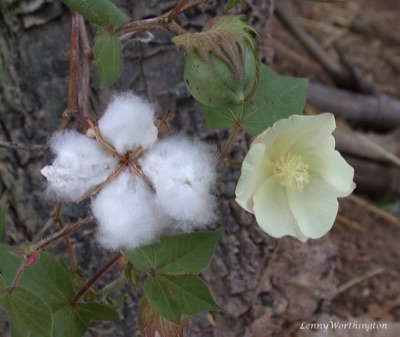
Photo: Len Worthington / Wikimedia Commons (CC BY-SA 2.0)
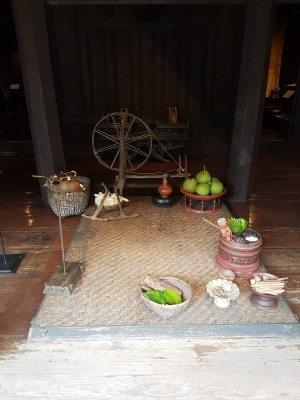
Photo: Iudexvivorum / Wikimedia Commons (CC0)
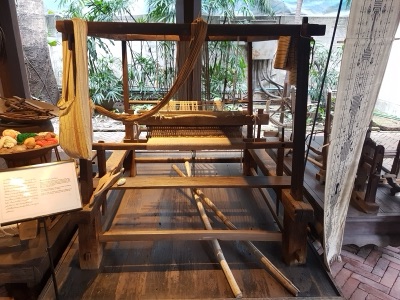
Photo: Iudexvivorum / Wikimedia Commons (CC0)
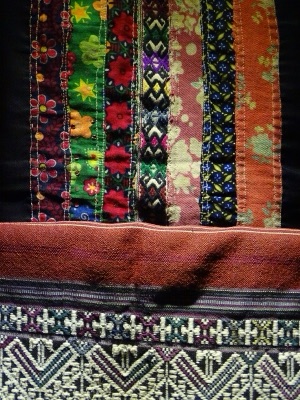
Photo: Adam Jones / Wikimedia Commons (CC BY-SA 2.0)
Silk cloth is pha hae (ผ้าแร). The word mai (ไหมฯ) has two meanings: the silkworm and its silk, and sewing thread. Sewing thread is mai yip (ไหมฯหิยฯบ), factory thread wound on a spool is mai lo (ไหมฯลอฯ), and to sew is yip (อยฯปฯ). Gold and silver thread for weaving or embroidery is din (ดิ้), and a big needle, like one for sewing rice sacks, is lem (เหลฯม).
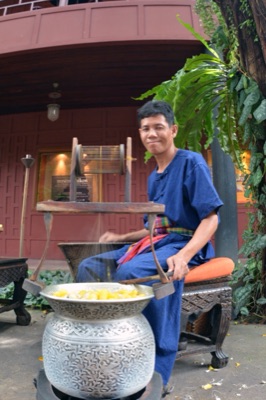
Photo: Don Ramey Logan / Wikimedia Commons (CC BY-SA 3.0)
Dyeing: hom, khak, lac and turmeric
Woven cloth is then yom (ย้อฯม), dyed with natural colours. The most famous northern dye is hom. Pha mo hom (ผ้าหํมฯอฯห้อฯม) is, in the dictionary's words, a local cloth made by dyeing plain white cotton with hom leaves into a deep blue: light, easy to care for, and worth passing on to the next generation. For the colour names, see Colours in Kham Mueang.
| Kham Mueang | Lanna script | Meaning (from the dictionary) |
|---|---|---|
| nam yom | นาฯย้อฯม | dye liquid for cloth |
| hom | ห้อฯม | the hom plant (Assam indigo), which dyes cloth blue-black; indigo gives blue-black too, and both are called mo hom |
| mo hom | หํมฯอฯห้อฯม | the pot of fermented hom dye |
| khak | ขักฯ | jackfruit heartwood boiled for a dark brown dye; cloth dyed with it is pha khak |
| khi khang | ขี้ระฯคั่งฯ | lac, the resin of the lac insect, used to dye cotton and silk |
| khao min | เขั้าหิ้มฯร | turmeric, used in cooking, as a dye and as medicine |
| fang | ฝางฯ | sappan wood, a thorny tree with red heartwood used for medicine or dye |
| ta suea | ตาเสิอฯอ | noni, whose heartwood and roots are used for dye |
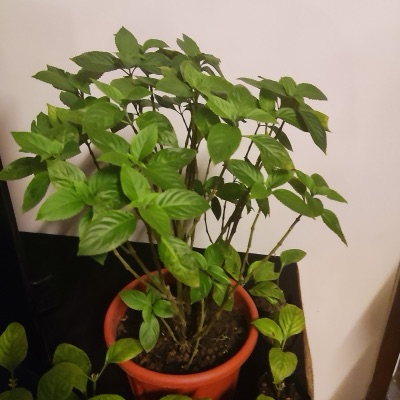
Photo: Shyamal L. / Wikimedia Commons (CC BY-SA 4.0)
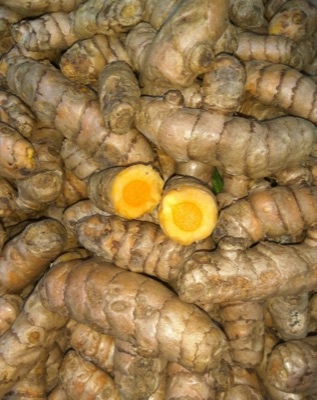
Photo: MattPicks / Wikimedia Commons (CC BY-SA 4.0)
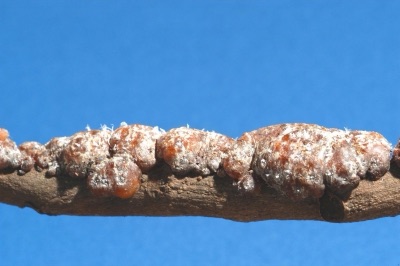
Photo: Jeffrey W. Lotz / Wikimedia Commons (CC BY 3.0)
Khueang yong: jewellery
Jewellery is khueang yong (เระฯคิอฯงห้ยฯอฯง, Kham Mueang reading khueang yong), and dressing up with it is taeng yong (แต่งฯอยฯอฯง). A handy word is wong, a ring or loop: hence wong hu (earring), wong mue (bracelet) and wong tin (anklet).
| Kham Mueang | Lanna script | Meaning (from the dictionary) |
|---|---|---|
| pin | ปิ่นฯ | a hairpin for a bun |
| dok hu | ดัอฯกหู | a stud earring with a post through the earlobe |
| wong hu | ว้อฯงหู | a hoop earring |
| lan hu | ลานฯหู | an ear ornament of rolled palm leaf worn through the earlobe |
| tang hu | ต่างฯหู | an earring |
| soi | ส้อฯยฯ | a chain, a long ornamental string |
| sai kho | สายฯฅํอฯ | a necklace (also sai soi) |
| waen | แหวฯร | a finger ring (also pok mue, pop mue) |
| pok mue | ปลฯอฯกมื | a ring |
| wong mue | ว้อฯงมื | a bracelet |
| kho khaen | ขํอฯแขนฯ | a bangle |
| wong tin | ว้อฯงตีนฯ | an anklet |
| paeng | แป่งฯ | an anklet (also kho paeng, kha paeng) |
| mao | ม้าวฯ | an armlet worn high on the upper arm |
| khua tong | ระฯค฿วฯทอฯง | brass ornaments or utensils, such as the trembling flowers in a dancer's hair or the long nails for the nail dance |
| khuang | ฅวฯง | the counting word for rings and bracelets, e.g. waen 5 khuang (five rings) |
| wi | หีวฯ | a comb, also used for combing thread |
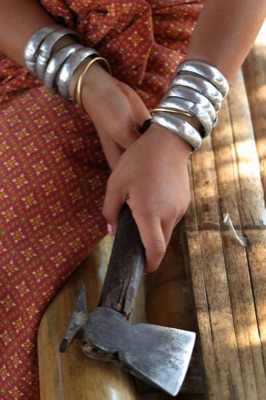
Photo: Steve Evans / Wikimedia Commons (CC BY 2.0)
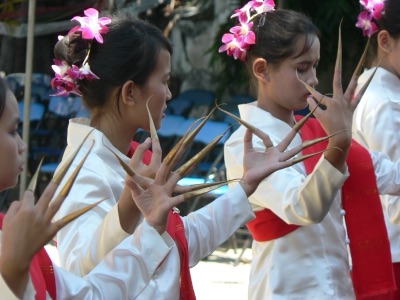
Photo: YashiWong / Wikimedia Commons (CC BY-SA 3.0)
Summary
- Northerners use nung for wearing almost anything (nung sin, nung tiao, nung suea) and call clothes in general khua bai.
- Trousers are tiao, the checked cloth is pha tong, a blanket is pha tuap, a hat is kup and sandals are koep.
- Suea kom or suea ba hoi is the scoop-neck camisole; suea mo hom and tiao sado are the classic northern work clothes.
- Cloth-making has a word for every step: it (gin), bow, pan fai (spin) on the phian, to huk (weave) and yom (dye) with hom.
- Jewellery is khueang yong; a bracelet is wong mue and an anklet wong tin or paeng.
Look up more cloth words in the Moradok Lanna dictionary (in Thai), read the full story of the Lanna skirt in Sin Tin Chok, and the colours of cloth in Colours in Kham Mueang.


