
Photo: Takeaway / Wikimedia Commons (CC BY-SA 3.0)
Lanna Kitchen Words: Pots, Jars and Kitchenware
In Kham Mueang the kitchen is called tao fai (เตัาไฟ, Kham Mueang reading tao fai, literally "the fire stove") or huean fai (เริอฯรไฟ, "the fire house"): the whole room is named after the hearth in its middle. For all the Lanna kitchenware inside it, people have two easy catch-all phrases: tuai wan chan chon (ถ้วฯยฯหวฯานฯจานฯช้อฯร, "bowls, plates and spoons") and mo hai ta lai pak (หํมฯอฯมฯอฯไหตไหลฯพากฯ, "pots, jars, trays and ladles").
This article gathers Kham Mueang words for the kitchen from the Moradok Lanna dictionary: the hearth, the sticky-rice gear, pots and mortars, jars and clay pots, and serving dishes and baskets. It ends with a little puzzle: why the "rabbit" coconut grater of central Thailand is a "cat" in the north.
Tao fai: the hearth and the cooking place
Lanna kitchens used to cook over a wood fire, with the pot resting on three lumps of earth or stone. Later came small clay stoves that could be carried around. Above the hearth there was often a rack for drying things in the smoke.
| Kham Mueang | Lanna script | Meaning (from the dictionary) |
|---|---|---|
| tao fai | เตัาไฟ | the kitchen, the place where food is cooked (also huean fai, hong fai) |
| tao | เตัา | a stove, anything that gives heat for cooking |
| kon sao | ก้อฯรเส้า | three lumps of earth, stone or brick set in a triangle to hold a curry pot over the fire |
| tao lua | เตัาห฿ลฯวฯ | a stove that burns firewood |
| tao hang lo | เตัาฮังฯโล | the ang lo: a small portable stove moulded from clay (also hang lo) |
| hing kha | หิ้งฯข่า | a rack or woven tray hung above the hearth |
| han nam | ร้านฯนาฯ | a raised stand for the drinking-water pots |
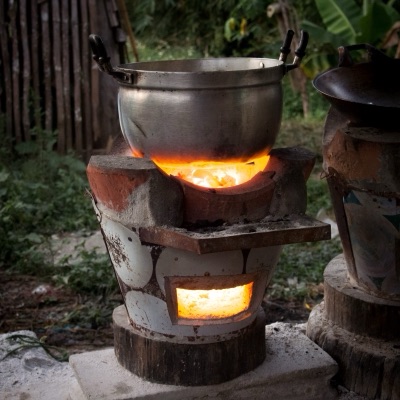
Photo: Takeaway / Wikimedia Commons (CC BY-SA 3.0)
The sticky-rice gear
Sticky rice is the staple of the Khon Mueang, so this is the set of kitchen things with the most detailed names: for soaking the rice, washing it, steaming it, cooling it and keeping it ready to eat.
| Kham Mueang | Lanna script | Meaning (from the dictionary) |
|---|---|---|
| mo khao chae | หํมฯอฯเขั้า | the pot for soaking sticky rice before steaming, usually cylindrical and glazed (also mo khao ma) |
| sa huat | ซ้าหวฯด | a small woven bamboo basket used to wash the soaked rice before it is steamed |
| mo nueng | หํมฯอฯหึ้นฯง | the steaming pot, for steaming rice or vegetables; used together with the hai khao |
| hai khao | ไหเขั้า | the rice steamer: a wooden cylinder whose bottom is a wooden disc with small holes for the steam to pass through |
| tat hai khao | ตาดฯไหเขั้า | the disc at the bottom of the rice steamer that holds the rice (also huem hai) |
| ko khao | โก฿ะเขั้า | a wooden tray for resting freshly steamed rice and stirring it so it doesn't stick together (also kwa khao) |
| pong khao | ป฿ลฯงเขั้า | to tip the steamed rice from the steamer onto the ko khao and turn it over and over to let the heat out |
| kong khao | ก่อฯงเขั้า | the rice box: a container woven from bamboo or rattan for keeping steamed sticky rice to eat |
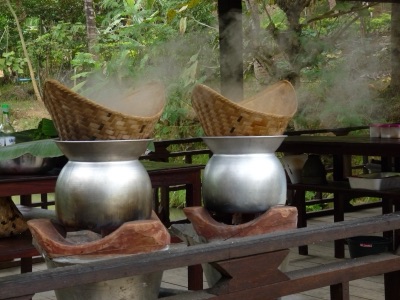
Photo: Feral Arts / Wikimedia Commons (CC BY 2.0)
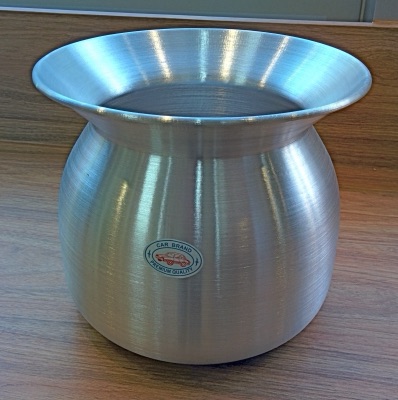
Photo: Susan Slater / Wikimedia Commons (CC BY-SA 4.0)
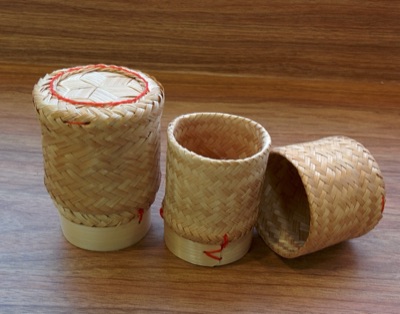
Photo: Susan Slater / Wikimedia Commons (CC BY-SA 4.0)
Pots, mortars and cooking tools
These are the things used to cook every day, and many of them are hard to guess from central Thai. A wok, for example, is a mo khang in Kham Mueang, because woks used to be made of cast iron, which the northern dialect calls khang (ขางฯ).
| Kham Mueang | Lanna script | Meaning (from the dictionary) |
|---|---|---|
| mo | หํมฯอฯ | a pot for cooking or holding water or other things, of clay, metal or other material |
| mo kaeng | หํมฯอฯ | the pot for cooking curries |
| mo khang | หํมฯอฯขางฯ | a wok, formerly made of cast iron |
| mo nguang | หํมฯอฯมฯอฯงวฯง | a clay pot with a spout, used as a kettle |
| ka nam | กานาฯ | a kettle or water pot with a spout and a handle |
| khok | ระฯค฿กฯ | a mortar, of clay, wood or stone |
| khok phik | ระฯค฿กฯระฯพิกฯ | the mortar for pounding chilli paste |
| kaen khok | แกนฯระฯค฿กฯ | the pestle used with the chilli-paste mortar (also kaen tam) |
| mong | มอฯง | the foot-operated rice pounder, for pounding rice, beans, corn and flour |
| khiang | ขยฯง | a chopping block, usually a round cross-section cut from a tamarind trunk |
| mit khom bang | มีดฯฅ฿มฯบาฯงฯ | a small thin-backed knife for peeling and fine work (also mit bang) |
| pak | พากฯ | a ladle, the coconut-shell ladle (khao sam pak = three ladles of rice) |
| nam buai | นาฯบวฯยฯ | a water dipper made from a coconut shell, with a handle |
| chon | ช้อฯร | a spoon |
| mai kip | ไม้คีปฯ | chopsticks (also mai thu) |
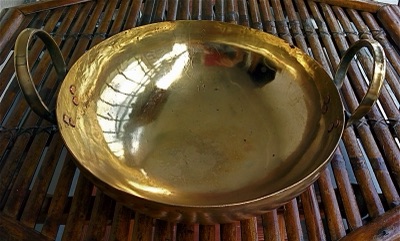
Photo: Susan Slater / Wikimedia Commons (CC BY-SA 4.0)
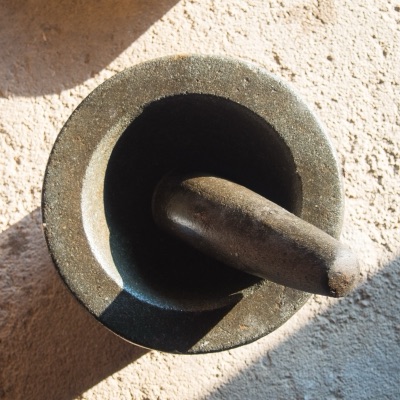
Photo: Takeaway / Wikimedia Commons (CC BY-SA 3.0)
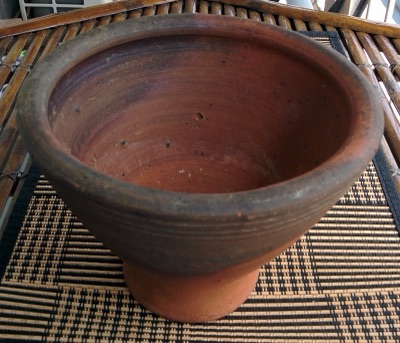
Photo: Susan Slater / Wikimedia Commons (CC BY-SA 4.0)
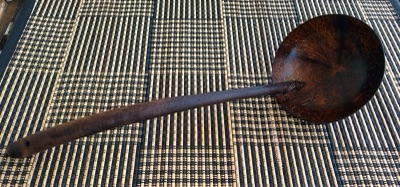
Photo: Susan Slater / Wikimedia Commons (CC BY-SA 4.0)
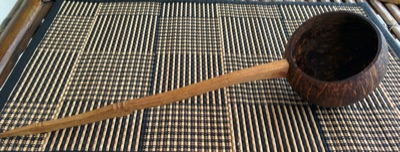
Photo: Susan Slater / Wikimedia Commons (CC BY-SA 4.0)
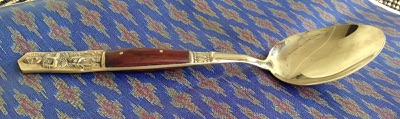
Photo: Susan Slater / Wikimedia Commons (CC BY-SA 4.0)
Jars and clay pots: for water and for keeping
Jars and clay pots held drinking water and pickled food that had to last. The dictionary names them clearly by shape and by what goes inside.
| Kham Mueang | Lanna script | Meaning (from the dictionary) |
|---|---|---|
| hai | ไห | a tall wooden or clay jar, narrow mouth, round belly, for water or pickled food |
| hai pa ha | ไหปลฯาร้า | the jar for fermenting fish (pla ra), with a rim around the mouth that holds water to keep ants and insects out |
| hai song | ไหซอฯง | a cylindrical clay jar for pickled fruit or fish sauce, with a rattan sling for carrying |
| hai luang | ไหลวฯง | the dragon jar: a brown-and-yellow glazed clay jar decorated with dragons (luang) all around |
| mo nam | หํมฯอฯมฯอฯนาฯ | a clay pot for water |
| nam ton | นาฯต้฿นฯ | the Lanna clay water flask: long neck, small mouth, for drinking water and for rituals |
| mo suai tin | หํมฯอฯมฯอฯ | the pot of water for washing your feet at the foot of the house stairs |
| mo om | หํมฯอฯมฯอฯออฯม | a small clay pot with a narrow mouth, a money box or jar |
| bok kuea | บอฯกเกิลฯอฯอ | a bamboo tube for salt |
| bok ha | บอฯกร้า | a bamboo tube for fermented fish |
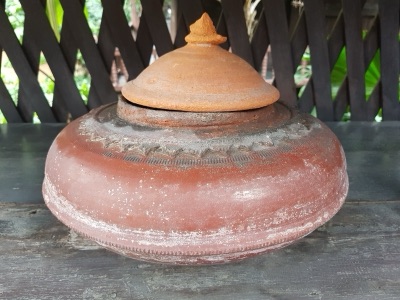
Photo: Iudexvivorum / Wikimedia Commons (CC0)
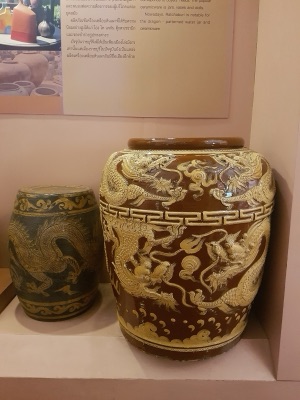
Photo: Iudexvivorum / Wikimedia Commons (CC0)
Serving dishes and baskets
A common slip for learners: tuai in Kham Mueang means a bowl, while a flat plate is a tuai baen or chan. A Lanna meal is laid out on a khan tok, and baskets have separate names for each shape and use.
| Kham Mueang | Lanna script | Meaning (from the dictionary) |
|---|---|---|
| khan tok | ขันฯโต฿กฯ | a pedestal tray used as a food table (also sa tok) |
| tuai | ถ้วฯยฯ | a bowl, a deep dish for food |
| tuai baen | ถ้วฯยฯแบนฯ | a flat plate (also chan) |
| tuai ka kai | ถ้วฯยฯกาไก่ | the rooster bowl, mostly made in Lampang |
| tuai i pik | ถ้วฯยฯอี่ปิกฯ | a small dish for dipping sauce |
| tuai sai | ถ้วฯยฯสายฯ | a tiffin carrier: stacked food containers with a carrying handle |
| ta lai | ตไหลฯ | a tray, a large flat dish |
| sa chi | สชี | a woven food cover placed over the meal |
| kuai | กวฯยฯ | a basket, woven in many sizes for holding things |
| kuai hap | กวฯยฯหาปฯ | a pair of baskets carried on a shoulder pole |
| sa | ซ้า | a basket (also sa po) |
| dong | ด้฿งฯ | a flat round winnowing tray, for winnowing rice or drying things in the sun |
| hoeng | เหิงฯ | a woven bamboo sieve for sifting |
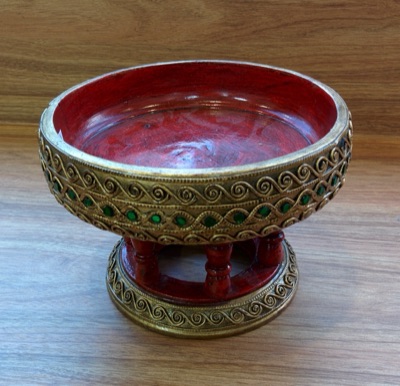
Photo: Susan Slater / Wikimedia Commons (CC BY-SA 4.0)
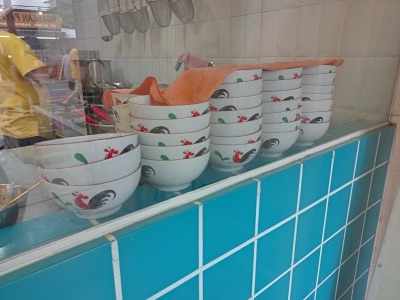
Photo: Bennylin / Wikimedia Commons (CC BY-SA 4.0)
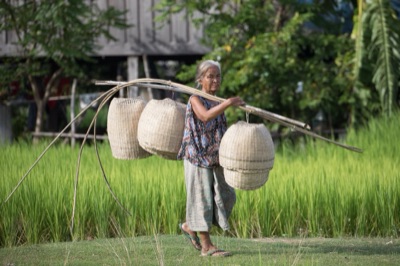
Photo: Basile Morin / Wikimedia Commons (CC BY-SA 4.0)
Why the "rabbit" coconut grater is a "cat"
In central Thai, the coconut grater with a little seat is called a kratai khut maphrao, a "coconut-grating rabbit". The dictionary explains that the seat was originally carved in the shape of a rabbit. In Kham Mueang the same tool is a maeo (แมวฯ), "cat", or maeo khut ba pao, and in some places a ngong (งอฯง). Grating a coconut is khut ba pao (ขูดบ่าฯพ้ลฯาวฯ).
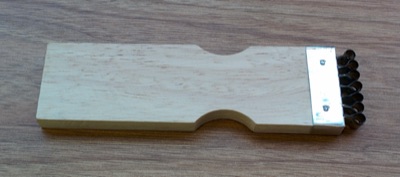
Photo: Susan Slater / Wikimedia Commons (CC BY-SA 4.0)
Summary
- The kitchen in Kham Mueang is tao fai or huean fai; everything in it is tuai wan chan chon or mo hai ta lai pak.
- The sticky-rice gear comes as a full set: mo khao chae, sa huat, mo nueng, hai khao, ko khao and kong khao.
- Words unlike central Thai: mo khang (wok), khok (mortar), pak (ladle), chon (spoon), mai kip (chopsticks).
- Tuai in Kham Mueang is a bowl; a flat plate is tuai baen or chan; nam ton is the Lanna clay water flask.
- The central Thai "rabbit" coconut grater is a maeo ("cat") or ngong in the north.
Look up more kitchen words in the Moradok Lanna dictionary (in Thai), read about the food cooked in these kitchens in Khong Kin Khon Mueang and Kin Lam Kin Lam, or learn the words for a trip to the market in Going to the Kad.


