
Photo: Takeaway / Wikimedia Commons (CC BY-SA 3.0)
Lanna Funeral Castles and the Hatsadiling Bird
A Lanna funeral castle is called phasat phi tai in Kham Mueang (ผา(ระฯบาฯ)สาทฯผีตายฯ, Kham Mueang reading phasat phi tai), or phasat sop (ผา(ระฯบาฯ)สาทฯศ฿พฯ). The dictionary describes it as a piece of Lanna funeral equipment shaped like a castle, with a tiered roof, built over the coffin and used to carry the dead to the cemetery for cremation. A study by Phra Peeyapob Thanpanalee and colleagues (2020) points out that this very custom, dressing a castle for the dead, is what sets Lanna funerals apart from those of other Thai regions. This article looks at which castle was used for whom, how they are built, why some stand on the back of the hatsadiling bird, and what became of the castles that were never burned.
For the whole funeral, from a person's last days to the gathering of the bones, see A Lanna Funeral, Step by Step. This article is about the castle itself.
Phasat: a tiered house for the departed
Phasat (ผาสาทฯ, Kham Mueang reading phasat) means a castle or palace. The dictionary defines it as "a building with a tiered roof, the dwelling of a king or of something sacred". Building such a house for the dead is a way of raising them up in honour.
The study by Phra Peeyapob and colleagues, citing Phra Maha Jaran Jittasamvaro (2011), explains that decorating the castle with flowers honours the dead so they may rise to heaven, and also reassures the living family that the dead will have a castle to live in after leaving this world. The idea calls to mind another dictionary word, phasat kaew wiman kham (ผา(ระฯบาฯ)สาทฯแก้วฯวิมานฯฅำ): a heavenly palace adorned with crystal and gold, where, it is said, those who made much merit will dwell after death.
Ranked by status: from a plain cover to a royal castle
In the past Lanna did not use one kind of funeral castle for everyone. The dictionary records that castles were graded by the rank of the dead:
| Type | Used for |
|---|---|
| phasat lang kup or phasat lang kong | kings, senior royalty and monks holding ecclesiastical rank |
| phasat lang piang or phasat lang kai | lesser royalty, monks, novices and nobles |
| maeo or maeo khuap | ordinary people |
Lang kup (หัลฯงกูบ) is defined in the dictionary as "the set of parts that form the roof of a castle". Maeo (แมวฯ), in its third sense, is a cover placed over a coffin, shaped like a camping tent or a child's hooped mosquito net, used for commoners in the past. It is also called maeo khuap (แมวฯฅวฯบ, Kham Mueang reading maeo khuap).
The study by Phra Peeyapob and colleagues, citing Khomnet Chetthaphatthanawanit (1996) and Sujit Wongthes (2008), gives the same picture in craftsmen's terms:
- High-ranking dead, meaning important monks, kings and people of royal descent, had castles with 12 to 24 posts, gables on all four sides, each gable layered several times (3, 5, 7 or 9 tiers), a spire, roof finials and barge-board ornaments. They were hauled to the cemetery with music.
- People of means, such as wealthy merchants, used a type called "mai lang klai": a castle without a spire, on 8 posts, carried on shoulders, not hauled.
- Ordinary villagers used a type the craftsmen call "ka jong": 6 to 8 posts and a roof without gables, the maeo khuap. It was not hauled, and no music played.
Names vary between sources and places. The study by Pimkalaya Ritpen (2024), described in our funeral article, found a "pak kraban" type without gables or spire for villagers and a four-gabled "lang klai" type for respected elders. Today these limits have largely relaxed, and the choice depends mostly on what the hosting family can afford.
Panupak Mokhasak (2021), citing the book Phasat Lanna by Phra Khru Siriwachirophat and colleagues (2011), suggests that funeral castles developed from something simple, the cover over a body, into the lang piang and lang kai castles, the mutjarin and ka jong castles, castles with spires, castles carried on creatures of the Himavanta forest, and finally castles on the back of the hatsadiling bird.
How they are built: light, open, with a folding spire
Funeral castles are built by a sala (ส่ๆลฯา, Kham Mueang reading sala), a craftsman or skilled worker. A big job has a sala kao (ส่ๆลฯาเคั้าฯ), the master craftsman, and a sala yong (ส่ๆลฯาอยฯอฯง), the decorator. Panupak's study (2021) followed the craftsmen of Wat Koh Klang in Mueang district, Chiang Mai, as they built a hatsadiling castle.
Phra Peeyapob and colleagues divide a castle into four parts:
- Spire: pointed like a three- or five-tier umbrella, usually topped with a lotus bud.
- Roof: three kinds, a layered roof, a fan-shaped (krajang or pak ban) roof and a gabled roof. The roof shape is the main way funeral castles are classified.
- Body and posts: 8, 12, 16 or as many as 20 posts, depending on size.
- Base: a plain stepped base, an indented-corner base, or a pedestal base like that of a Buddha image.
Funeral castles also have features of their own. The spire folds down so the procession can pass under power lines across the road. The body is open, without walls, so the coffin can be lifted in and out. The base is a long rectangle to fit the coffin. And the materials are light and burn easily: paper, bamboo and the wood of the ngio tree (งิ้วฯ, red silk-cotton), decorated with coloured paper and flowers. Castles for the high-ranking also carry jo fa (ชํอฯฟ้า), roof finials, like those of a temple hall.
The hatsadiling: a mount to heaven
The finest Lanna funeral castles stand on the back of the nok hatsadiling (น฿กฯหัสีดฯลิง์คฯ, Kham Mueang reading nok hatsadiling). The dictionary describes it as a bird of legend from the Himavanta forest, enormous, with the head of an elephant, trunk and tusks, the body of a bird and immense strength; Lanna people use it for the funeral castles of "people of great rank" or of senior monks. A castle of this kind is called phasat nok hatsadiling (ผา(ระฯบาฯ)สาทฯน฿กฯหัสฯฯดีลิง์คฯ).
The dictionary illustrates the bird with a line from the Great Vessantara Jataka, in the chapter of Queen Matsi: returning from the forest to find her two children gone, she fears that "a hatsadiling hunting on high, soaring through the sky, snatched them and carried them off". (Read about the Vessantara sermon in Tang Tham Luang.)
Panupak records that the bird is called by short names, "nok chang" (elephant bird) or "nok hat". It is part elephant and part hong (ห฿ง์สฯฯ, the sacred goose): the head of an elephant, the body and tail of a goose. Lanna people believe it carries the spirit of those who lived well up to heaven, and hatsadiling castles are built only for the funerals of senior monks and high nobility.
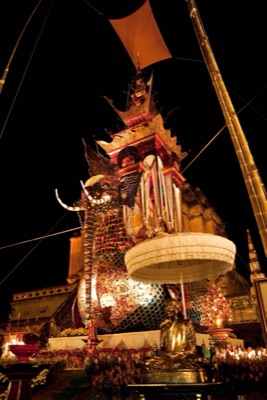
Photo: Takeaway / Wikimedia Commons (CC BY-SA 3.0)
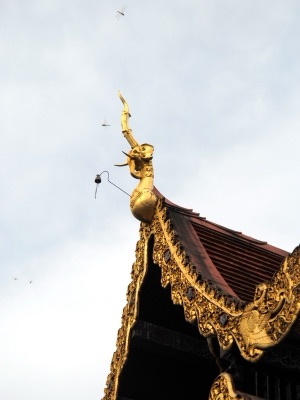
Photo: Takeaway / Wikimedia Commons (CC BY-SA 3.0)
Where does the bird come from? Surachai Phutchu (2022) traced it through Buddhist scripture and literature. It appears in the Pali Canon and its commentaries, and in works such as the Lanna chronicle Tamnan Mulasasana, the Panyasa Jataka and the Traiphum Phra Ruang. The scriptures say only that it is huge, as strong as five elephants, and lives in Uttarakuru, the continent that in Buddhist cosmology lies north of Mount Sinelu (สิเนรุ, Mount Sumeru, the mountain at the centre of the universe). One passage the author quotes tells how flocks of hatsadiling snatched shrouded bodies from a cemetery and carried them to the peaks of the Himavanta, taking them for meat. The author concludes that only later literature gave the bird a kindly role, until craftsmen made it into funeral castles that speak of sending the dead to be reborn in heaven.
In history, Panupak cites the Yonok chronicle: when Queen Wisutthithewi, ruler of Chiang Mai, died, a pavilion was built on a huge hatsadiling set on wheels, pulled by elephants, and a breach was cut in the city wall so it could be hauled to the field of Wat Lok, where it was burned with the body. Phra Peeyapob and colleagues, citing Sarassawadee Ongsakul (2003), note several hatsadiling castles for rulers and senior monks of the Chiang Saen period. Panupak concludes that later funerals of the rulers of Chiang Mai followed the customs of the Siamese court, so the castle on the hatsadiling's back survives mainly in the funerals of senior monks to this day.
Cremation day: hauling the castle, and fire at the spire
A great funeral for a senior monk or a much-revered person is called poi lo (พอฯยฯลํอฯ, Kham Mueang reading poi lo). The dictionary explains that the body is usually placed in a castle on wheels or a cart and hauled to the cremation ground. The crowd joining to pull it is lak phasat (ลากฯระฯบาฯสาทฯ). The dictionary says the castle once stood on a base of logs or a pair of coconut trunks, and that the word later came to cover pulling a body on any kind of vehicle.
Panupak recorded these steps at Wat Koh Klang:
- The poi lo festival runs for about 3 to 7 days, with merit-making, food and entertainment.
- The castle procession is led by the kong jum (กลฯอฯงชุม, a set of drums) and a pi nae oboe, playing the slow tune "Yaeng Luang", also called "the swaying castle". The dictionary also records the pan (พานฯ), a gong-like instrument beaten at the head of a senior monk's funeral procession.
- At the cremation ground the mourners walk three times around the castle that will be burned, ask the dead for forgiveness, and then lift the body onto it.
- Men (เมรุ): the place where bodies are burned
- Pha phidan (ผ้าพิดานฯ): a cloth stretched over the place where a monk is cremated, usually the robe of the monk who died, held up by bamboo poles at the four corners
- Bok fai lo (บอฯกไฟหํลฯอฯ): a rocket on wheels, sent racing into the pyre or castle instead of lighting it in the ordinary way
- Ba phap (บ่าฯผาปฯ): a fuse of paper wrapped around gunpowder, used to light rockets or to set the pyre alight
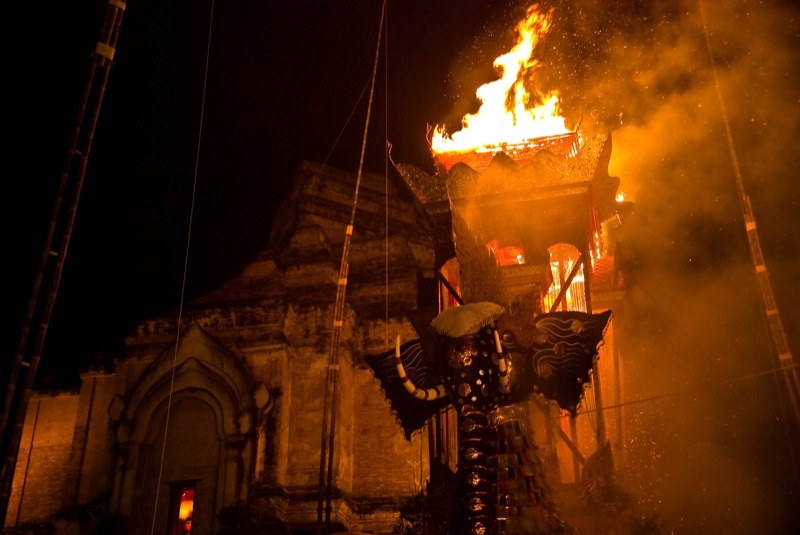
The cremation ground or cemetery is called pa hoe (ป่าเฮ่วฯ, Kham Mueang reading pa hoe).
The castles that were not burned: pulpits
Most funeral castles burn with the body. But Phra Peeyapob and colleagues surveyed 15 important pulpits in Chiang Mai, Lamphun, Lampang, Phrae and Nan, and found that three had once been funeral castles:
| Pulpit | Once the funeral castle of |
|---|---|
| Wat Chetuphon, Chiang Mai | Chao Inthawichayanon; his son Chao Kaew Nawarat had the castle repaired as a pulpit and gave it to the temple in 1897 |
| Wat Phra That Hariphunchai, Lamphun | Chao Luang Daoruang, seventh ruler of Lamphun, who died in 1891 |
| Wat Phra That Cho Hae, Phrae | Nai Khrong Thongthin, a Phrae merchant; the base records that it was dedicated to him on 3 April 1949 |
The authors suggest the custom comes from a Lanna belief: once a ruler has passed away, the things he used may be used by no one but monks. So a ruler's residence was taken down to build a wihan (วิหารฯ, temple hall), and his funeral castle was given to a temple as a pulpit. All three are still used for sermons on important occasions.
The custom also ran the other way. At the funeral of Khruba Phromma Phromjakko, former abbot of Wat Phra Phutthabat Tak Pha, in 1987, a pulpit modelled on the one at Wat Ton Kaew, Wiang Yong, Lamphun, was built to hold the body and set on the back of a hatsadiling.
Kham Mueang words for the funeral castle
| Kham Mueang | Lanna script | Meaning |
|---|---|---|
| phasat phi tai | ผา(ระฯบาฯ)สาทฯผีตายฯ | funeral castle |
| phasat | ผาสาทฯ | castle, tiered building |
| maeo khuap | แมวฯฅวฯบ | coffin cover for commoners |
| lang kup | หัลฯงกูบ | the roof set of a castle |
| nok hatsadiling | น฿กฯหัสีดฯลิง์คฯ | elephant-headed bird of the Himavanta |
| sala | ส่ๆลฯา | craftsman |
| poi lo | พอฯยฯลํอฯ | great funeral with a hauled castle |
| lak phasat | ลากฯระฯบาฯสาทฯ | pulling the funeral castle together |
| pha phidan | ผ้าพิดานฯ | cloth over a monk's pyre |
| pa hoe | ป่าเฮ่วฯ | cemetery |
Out of respect for the departed and their families, this article has no flashcards or quiz. Review the words in the table above, or look them up in the Moradok Lanna dictionary.
Summary
- A funeral castle is phasat phi tai or phasat sop in Kham Mueang; it covers the coffin on the way to the pa hoe, the cemetery.
- Castles were once ranked, from the maeo khuap of commoners to the royal castles of kings and ranking monks; using the wrong one was khuet, an ill omen.
- A sala builds the castle light, open and quick to burn, with a spire that folds to pass under power lines.
- Castles on the back of the nok hatsadiling are kept for senior monks and high nobility; the bird is believed to carry the spirit to heaven.
- Some castles were never burned but given to temples as pulpits, as at Wat Chetuphon, Wat Phra That Hariphunchai and Wat Phra That Cho Hae.
Look up more words in the Moradok Lanna dictionary, and read the whole funeral sequence in A Lanna Funeral, Step by Step.
Sources
- Moradok Lanna dictionary: ผาสาทผีต๋าย · นกหั๋สดีลิงค์ · ผาสาทนกหั๋สดีลิงค์ · ลากผาสาท · ปอยล้อ · แมว
- Phra Peeyapob Thanpanalee, Phra Khru Pravitvaranuyut and Phra Khru Pipitsuttatorn. (2020). จากปราสาทศพสู่ธรรมาสน์ล้านนา [From Funeral Castle to Lanna Pulpit]. Journal of Humanities, Naresuan University 17(3), 49–60 (in Thai)
- Panupak Mokhasak. (2021). ดนตรีในพิธีเผาปราสาทนกหัสดีลิงค์ สำนักวัดเกาะกลาง อำเภอเมือง จังหวัดเชียงใหม่ [Music in the Prasat Nok Hastilinga Cremation Ceremony in Koh Klang Temple, Chiang Mai]. Mahidol Music Journal 4(1) (in Thai)
- Surachai Phutchu. (2022). ปราสาทนกหัสดีลิงค์: รูปสัญญะแห่งความหมายและแหล่งที่มาจากคัมภีร์และวรรณกรรมทางพระพุทธศาสนา [Hatsadiling Bird Castle: Signifiers of Meaning and Sources in Buddhist Texts and Literature]. Dhammadhara 8(2), 175–217 (in Thai)
- Pimkalaya Ritpen. (2024). รูปแบบของพิธีกรรมในงานศพที่คล้ายคลึงกันของชาวล้านนาและชาวเขมรถิ่นไทย [Similar funeral rites of the Lanna people and the Northern Khmer of Thailand]. Journal of Modern Learning Development 9(10) (in Thai)
Look up "ผาสาทผีต๋าย" in the Moradok Lanna dictionary (in Thai)


