
Photo: Rowan Heuvel / Unsplash
Duean Si: Si Peng, New Rice and Fire for the Buddha
Duean Si (สี่, Kham Mueang reading si, "four") is the fourth month of the Lanna year. It matches the second month (เดือนยี่) of central Thailand and falls roughly from early January to early February. Duean Si in Lanna is the month of an important full moon, si peng, when villagers take the new rice to the temple and some temples light a fire for the Buddha images to warm them.
This post gathers what to know about Duean Si: the key dates for 2026, the tan khao mai and hing fai pha chao traditions, Kham Mueang words for fire and firewood, and the month's bad days according to the elders' verse.
- Month begins: 1st waxing day of Duean Si = Friday 8 January 2027
- Full moon (duean peng, si peng): 15th waxing day = Friday 22 January 2027
- Month ends: 15th waning day = Saturday 6 February 2027 (this month has 30 days)
- Next month: Duean Ha begins on Sunday 7 February 2027
What is Duean Si?
Lanna counts its months (duean, เดิอฯร) two months ahead of central Thailand. After Duean Sam (สามฯ, sam) comes Duean Si. The dictionary explains Duean Si as the lunar month that matches the second month of Bangkok and the third month of Chiang Tung. Read why Lanna counts this way in Duean Nuea.
Duean Si is an even-numbered month. The dictionary calls even months duean ku (เดิอฯรคู่, duean ku): months 2, 4, 6, 8, 10 and 12. Even months have 30 days, unlike Duean Sam, an odd month with 29.
- The waxing half has 15 days. The night of the 15th waxing day is the day the moon is full, called peng (เพงฯ, peng), "full". The dictionary also has wan duean peng (วันฯเดิอฯรเพงฯ, wan duean peng), the full-moon day, the 15th waxing day. The name "si peng" therefore means the full moon of Duean Si.
- The waning half of an even month has 15 days. The last night, the 15th waning day, is called dap tem (ดัปฯเตมฯ, dap tem), which the dictionary says exists only in even months. An odd month such as Duean Sam ends on the 14th waning day.
Key dates of Duean Si 2026
Buddhist holy days are called wan sin (วันฯสีลฯฯ, wan sin) in Kham Mueang. The dictionary divides them into wan sin noi (วันฯสีลฯฯห้นฯอฯยฯ, wan sin noi), the 8th waxing and waning days, and wan sin luang (วันฯสีลฯฯหลฯวฯง, wan sin luang), the 15th waxing day and the 14th waning day of an odd month, or the 15th waning day of an even month. Duean Si is an even month, so its last wan sin luang falls on the 15th waning day.
| Date | Lunar date | What it is |
|---|---|---|
| Fri 8 Jan 2027 | 1st waxing day of Duean Si | first day of Duean Si |
| Fri 15 Jan 2027 | 8th waxing day | wan sin noi |
| Fri 22 Jan 2027 | 15th waxing day | full moon (si peng) · wan sin luang |
| Sat 30 Jan 2027 | 8th waning day | wan sin noi |
| Sat 6 Feb 2027 | 15th waning day (dap tem) | wan sin luang · last day of Duean Si |
All dates are calculated with the Moradok Lanna calendar. Each temple may hold its merit-making on a different day, so check with your local temple. To see Duean Si in the whole year, tap a date in the calendar below to see that day's lunar date.
Si peng: tan khao mai
The rice that went up into the granary in Duean Sam is offered this month. The dictionary explains tan khao mai (ทาฯนฯเขั้าไห่มฯ, tan khao mai) as "offering the rice newly harvested that year, to dedicate the merit to the deities who guard the headwaters and to the ancestors who handed down the rice fields; an important ceremony that must be done before eating that new rice". The word tan (ทาฯนฯ, tan) means giving or donating, the same as than in Thai. Phi khun nam (ผีขุรนาฯ, phi khun nam) is explained in the dictionary as the guardian spirit of each stream's headwaters.
A study by Phra Khru Phisan Piyathamma and colleagues (2025) on temples in Chiang Kham district, Phayao, explains that once the rice is in the granary, the household does not pound or mill it to eat until it has been offered as tan khao mai. This fits the Lanna custom of khao pha chao (เขั้าระฯพเจั้า, khao pha chao), the small tray of rice offered to the Buddha image every morning, with the teaching the dictionary records: "bo di kin kon tu kon phra", don't eat before the monks and novices.
The dictionary also says that on the full moon of the 4th northern month people offer tan khao chi khao lam (ทาฯนฯเขั้าจี่เขั้าหลฯามฯ, tan khao chi khao lam) after the rice harvest.
| Kham Mueang | Lanna script | Meaning (from the dictionary) |
|---|---|---|
| khao chi | เขั้าจี่ | sticky rice shaped into a ball and grilled over a fire |
| khao lam | เขั้าหลฯามฯ | glutinous rice soaked in water or coconut milk, packed in a bamboo tube and roasted |
| tan khao lon bat | ทาฯนฯเขั้าล้฿นฯบาฯระฯต | merit-making after the rice harvest: unhusked or milled rice is put into an alms bowl until it overflows into a heap |
| doi ngoen | ดอฯเงินฯ | milled rice heaped together to be offered at tan khao mai |
| doi kham | ดอฯฅำ | unhusked rice heaped together to be offered at the tan khao mai ceremony |
The whole ceremony, from the pre-dawn steps at the temple to the "heavenly rice" and the rice mountains, is in Tan Khao Mai. Tan khao mai as an offering that is not packed in a salak basket is in the section Another offering: tan khao mai of Lanna Temple Offerings.
Count down to the morning of si peng with the Moradok Lanna calendar.
Hing fai pha chao: the fire of Duean Si
On the same si peng, Lanna has another tradition, tan lua hing fai pha chao (ทาฯนฯห฿ลฯวฯหิงฯไฟระฯพเจั้า, tan lua hing fai pha chao). The dictionary explains it as offering firewood to be made into a fire in the cold season so that the Buddha may be relieved of the cold. It is held on the full moon of Duean Si, around January, because the weather is very cold: the faithful felt that the Buddha image must be cold too, so they heaped logs together as fuel for fires around the vihara or wherever a Buddha image is enshrined.
The tradition also has a short name, hing fai pha chao (หิงฯไฟระฯพเจั้า, hing fai pha chao), and the logs that are offered are called lua hing fai pha chao (ห฿ลฯวฯหิงฯไฟระฯพเจั้า, lua hing fai pha chao). An article by the Fine Arts Department (Rungnapha Sa-nguansaksri) says it is also called the "firewood offering", held on the 15th waxing day of the 4th month in the North, roughly December to January. The logs are about 1 wa long (roughly 2 metres), one bundle each, and the abbot lights the first fire at about 4 to 5 a.m. while striking a gong three times; bamboo in the pile pops loudly and wakes the villagers to come and make merit.
There are two layers of reason for the fire. According to Noppadon Phimason in Sansai Discovery, Maejo University (2024), some believe the Buddha has not yet passed into nirvana and so might feel cold. In practice, the fire warms the monks and the villagers who come to give alms in the cold pre-dawn. The steps and taboos of the tradition are in Tan Khao Mai.
Word of the month: hing fai
If Duean Sam is nao kat nao yen, "very cold", Duean Si is the month of hing fai (หิงฯไฟ, hing fai), to warm yourself by a fire, as in the cold season. We make it our word of the month for Duean Si.
Kham Mueang has many words for firewood and fire. All of them are in the dictionary.
| Kham Mueang | Lanna script | Meaning (from the dictionary) |
|---|---|---|
| lua | ห฿ลฯวฯ | firewood, a log of firewood: wood used as fuel |
| mai lua | ไม้ห฿ลฯวฯ | firewood: logs used as fuel |
| kong lua | กอฯงหลฯ฿วฯฯ | a pile of firewood |
| dun lua | ดุ้รห฿ลฯวฯ | a log of firewood, for example the small logs used at home for steaming rice and cooking |
| dang lua | ดังฯ | to make a fire using logs as fuel |
| tao lua | เตัาห฿ลฯวฯ | a stove that burns firewood |
The cold has not left in this month. Thairath (2023) reported the Thai Meteorological Department's outlook for that season, which put the coldest period from about early December to late January. On high mountains in some years there may be moei khap (เหิมฯอฯยขาปฯ, moei khap), which the dictionary explains as dew frozen hard by intense cold. For more cold words, read Duean Sam and Nature and Weather Words.

Photo: Yingthipc / Wikimedia Commons (CC BY-SA 3.0)
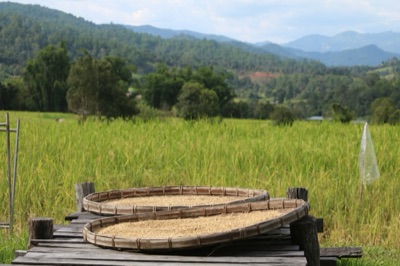
Photo: Ford Stratton / Unsplash
The bad days of Duean Si: "Wednesday and Friday"
Lanna people observe wan sia (วันฯเสยฯ, wan sia), the inauspicious days of each month. The dictionary records a verse that elders use to remember them: "Kiang, ha, kao, sia tit kap jan; yi, hok, sip, sia angkan wan diao; sam, jet, sip-et, sia phat kap sao; si, paet, sip-song, sia put kap suk". It means: in months 1, 5 and 9 the bad days are Sunday and Monday; in months 2, 6 and 10 only Tuesday; in months 3, 7 and 11 Thursday and Saturday; in months 4, 8 and 12 Wednesday and Friday.
By this verse, the bad days of Duean Si, Duean Paet and Duean Sip-song are Wednesday (put) and Friday. So in this Duean Si the bad days are:
- Wednesdays: 13, 20 and 27 January, and 3 February 2027
- Fridays: 8, 15, 22 and 29 January, and 5 February 2027
After Duean Si
Duean Ha begins on Sunday 7 February 2027 by the Moradok Lanna calendar, and its post will follow. In the meantime, see the list of monthly posts in the Lanna Calendar Guide and the whole year in Lanna Calendar 2027.
Summary
- Duean Si is the 4th northern month, the second month (เดือนยี่) in central Thailand. In this cycle it runs from 8 January to 6 February 2027 and has 30 days, because it is an even month.
- Si peng falls on Friday 22 January 2027. The month's wan sin holy days are 15 and 22 January, 30 January and 6 February.
- By the dictionary, tan khao mai is the offering of newly harvested rice, to be done before eating the new rice, and tan khao chi khao lam is offered on the full moon of Duean Si.
- Tan lua hing fai pha chao is offering firewood for a fire to warm the Buddha images. The word of the month is hing fai.
- By the bad-day verse, Duean Si is "bad on Wednesday and Friday".
Look up more month and day words in the Moradok Lanna dictionary, check the lunar date of any day in the Lanna calendar, and read the month before in Duean Sam.
Sources
- Moradok Lanna dictionary: si(https://moradoklanna.com/dict/?สี่) · tan khao mai(https://moradoklanna.com/dict/?ตานเข้าใหม่) · tan lua hing fai pha chao(https://moradoklanna.com/dict/?ตานหลัวหิงไฟพะเจ้า) · hing fai(https://moradoklanna.com/dict/?หิงไฟ) · wan sia(https://moradoklanna.com/dict/?วันเสีย)
- Moradok Lanna Lanna calendar: 8 January to 6 February 2027
- Phra Khru Phisan Piyathamma (Bunrot Chiangphrom), Wanchai Phonlamuangdi and Naphaporn Hongthong. (2025). วิเคราะห์หลักพุทธธรรมที่ปรากฏในประเพณีทำบุญตานข้าวใหม่ของอำเภอเชียงคำ จังหวัดพะเยา [An analysis of Buddhist principles in the new-rice merit-making of Chiang Kham district, Phayao]. Thammawat Journal 6(2)
- Rungnapha Sa-nguansaksri. (n.d.). ประเพณีทานหลัวหิงไฟพระเจ้า : ความเชื่อและความศรัทธาในพระพุทธศาสนา [The firewood-for-the-Buddha tradition: belief and faith in Buddhism]. Office of Literature and History, Fine Arts Department
- Porakamol Massamer. (14 February 2024). “ตานหลัวหิงไฟพระเจ้า” ประเพณีที่มอบความอบอุ่นในเดือนสี่เป็ง ["Tan lua hing fai pha chao", the tradition that gives warmth in Duean Si Peng]. Sansai Discovery, Maejo University (interview with Noppadon Phimason)
- Thairath Online (2 October 2023). อุตุฯ คาด "ฤดูหนาว" ของไทย ช้ากว่าปกติ 2 สัปดาห์ อากาศเย็นน้อยกว่าปีที่ผ่านมา [Met department expects Thailand's cool season two weeks later than normal, less cold than last year]
- Photos from Unsplash and Wikimedia Commons as credited under each image.
Practise the words from this article
Flip through 32 flashcards of the Lanna words used in this article.


