
Photo: Don Christie / Wikimedia Commons (CC BY-SA 4.0)
Liang Khwai: Kham Mueang from a Jaran Manopetch Song
Liang Khwai ("Herding Buffalo") is a Kham Mueang (Northern Thai) folk song by Jaran Manopetch that makes the khwai (ฅวฯายฯ, Kham Mueang reading khwai, water buffalo) its hero. It tells of people and buffalo living side by side, from the rice field to the evening. It is an easy song to listen to, but its words mix real Kham Mueang with central Thai, which makes it a good text for practising how to tell which words are Kham Mueang in the dictionary.
This article is part of the series Kham Mueang through songs and literature. We do not print the whole song; we pick out only the lines and words worth knowing and explain their meaning, sound and the words the song spells differently from the dictionary. You can listen to the full song in the video below.
The song Liang Khwai
This song is on the album Luk Khao Nueng (track 4). Wikipedia gives the album year as 1981, while the "Phleng Wan" (songs of old) column of MGR Online (2012) gives 1982, so we give both years. The words and music are by Jaran, as shown in the karaoke video from the rights holder RMS. MGR Online writes that in this song Jaran tells of "the bond between people and buffalo", which matches what we hear.

The audio comes from the "จรัล มโนเพ็ชร - Topic" channel, which YouTube generates from the files the rights holder (RMS) delivers. Words and music by Jaran Manopetch.
Two horns: the words for buffalo
The song begins by comparing the buffalo with the people:
ควายก็มีสองเขา เฮาก็มีสองมือ — Liang Khwai, words: Jaran Manopetch
("The buffalo has two horns, and we have two hands.")
Khon Mueang do not have just one word for "buffalo". The dictionary separates buffalo by sex, age and shape in detail.
| Kham Mueang | Reading | Meaning in the dictionary |
|---|---|---|
| khwai ฅวฯายฯ | khwai | a ruminant, hoofed animal with a big body and long curved horns |
| khwai laeo ฅวฯายฯแลวฯ | khwai laeo | a young buffalo |
| khwai ngan ฅวฯายฯหงฯานฯ | khwai ngan | a lone buffalo, a buffalo in its prime; often also means a young man |
| khwai tong ฅวฯายฯต้อฯง | khwai tong | a castrated buffalo (also called khwai lat) |
| khwai khao wong ฅวฯายฯเฯขัาว้อฯง | khwai khao wong | a buffalo whose horns curve in towards each other |
| khwai mae boe ฅวฯายฯแม่เบิอฯะ | khwai mae boe | a female buffalo with very widely spread horns (a male is called khwai pu boe) |
| khwai pon | khwai pon | an albino buffalo |
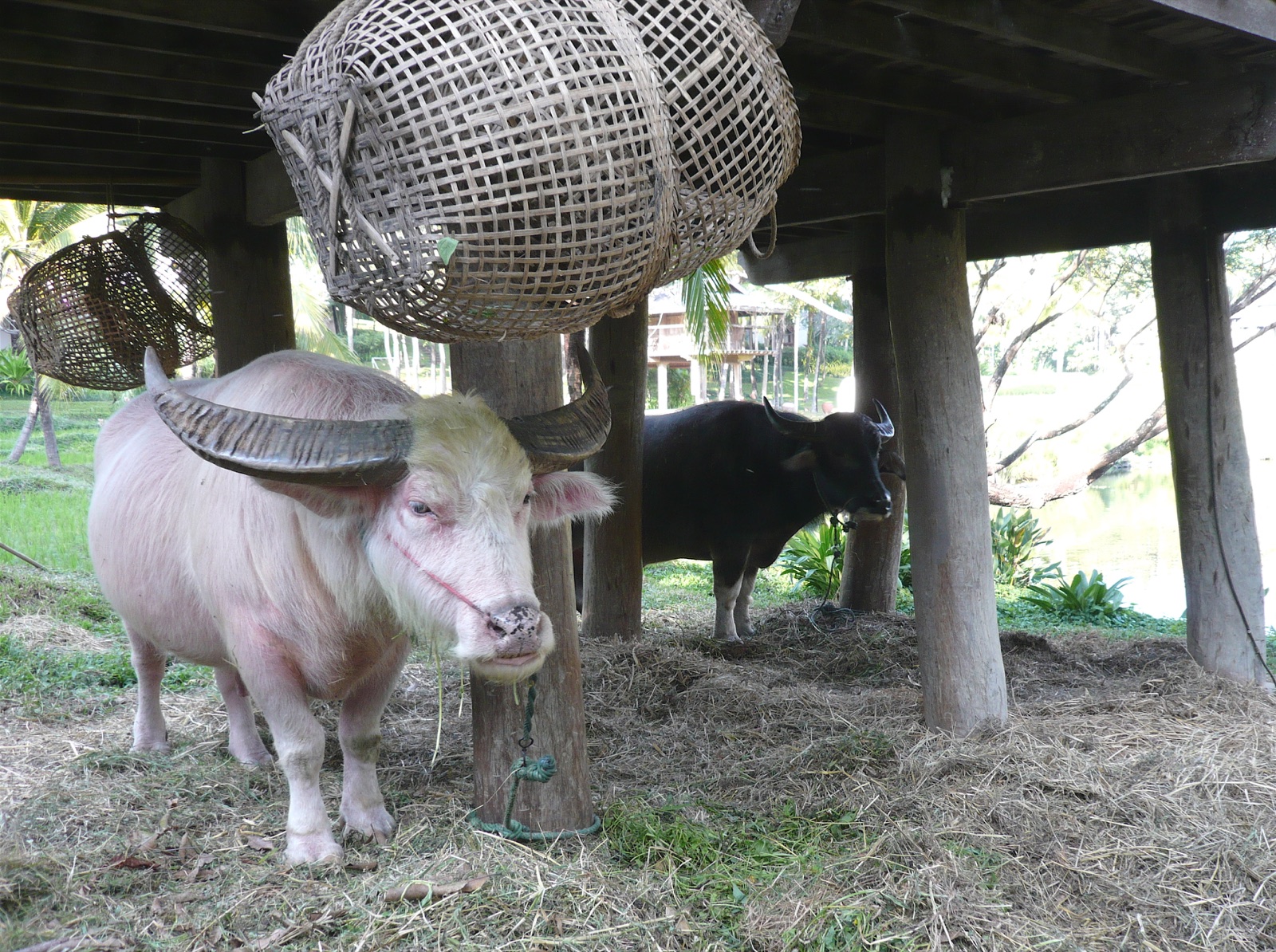
Photo: Steve Jurvetson from Menlo Park, USA / Wikimedia Commons (CC BY 2.0)
Khwai ngan is especially interesting, because the dictionary says it can also mean a "young man". So the name has two layers of meaning. Jaran has another song called Khwai Ngan, but this article does not cover it yet.
Hao, hak, bo: the buffalo is a benefactor
The song states the herder's position plainly at the end of the second verse:
เฮาเป็นคนฮักควาย — Liang Khwai, words: Jaran Manopetch
("I am a person who loves buffalo.")
| Word | Reading | Meaning |
|---|---|---|
| hao เรัา | hao | we (first-person plural), used for the speaker or a group of speakers |
| hak รักฯ | hak | to care for and be attached to; to be fond of with affection; to cherish and want to protect |
| bo บ | bo | not; a word placed before a verb to make it negative (may also be pronounced ba) |
Both hao and hak begin with the sound h where central Thai writes r (rao, rak). This is the Kham Mueang sound rule by which r is pronounced h in native words. Try the tool below; the article Kham Mueang sound rules explains the whole set, including ch→j, th→t and ph→p.
Bo chang: the buffalo does not know how to scold
The second verse is the one that makes you smile, because Jaran turns around the insult people throw using the buffalo and asks who really suffers.
ควายบ่จ้างด่าคน — Liang Khwai, words: Jaran Manopetch
("The buffalo does not know how to scold people.")
| Word | Reading | Meaning in the dictionary |
|---|---|---|
| bo chang บช่างฯ | bo chang | cannot do, does not know how to |
| da ด่า | da | to use coarse words against someone |
| ai อายฯ | ai | to feel embarrassed, shy, ashamed |
| panya ปั¡า | panya | knowledge, wisdom from learning and thinking |
The dictionary gives bo chang the meaning "cannot do", so "khwai bo chang da khon" reads as "the buffalo does not know how to scold people" (this reading is ours, from the dictionary meaning). The word panya that the song sings in the line before it matches panya in the dictionary.
Ta wan tok din: the herder's evening
The third verse takes us to the evening: crows calling, buffalo going down to the water, and the people's supper.
จูงควายลงอาบน้ำคลอง — Liang Khwai, words: Jaran Manopetch
("Lead the buffalo down to bathe in the canal.")
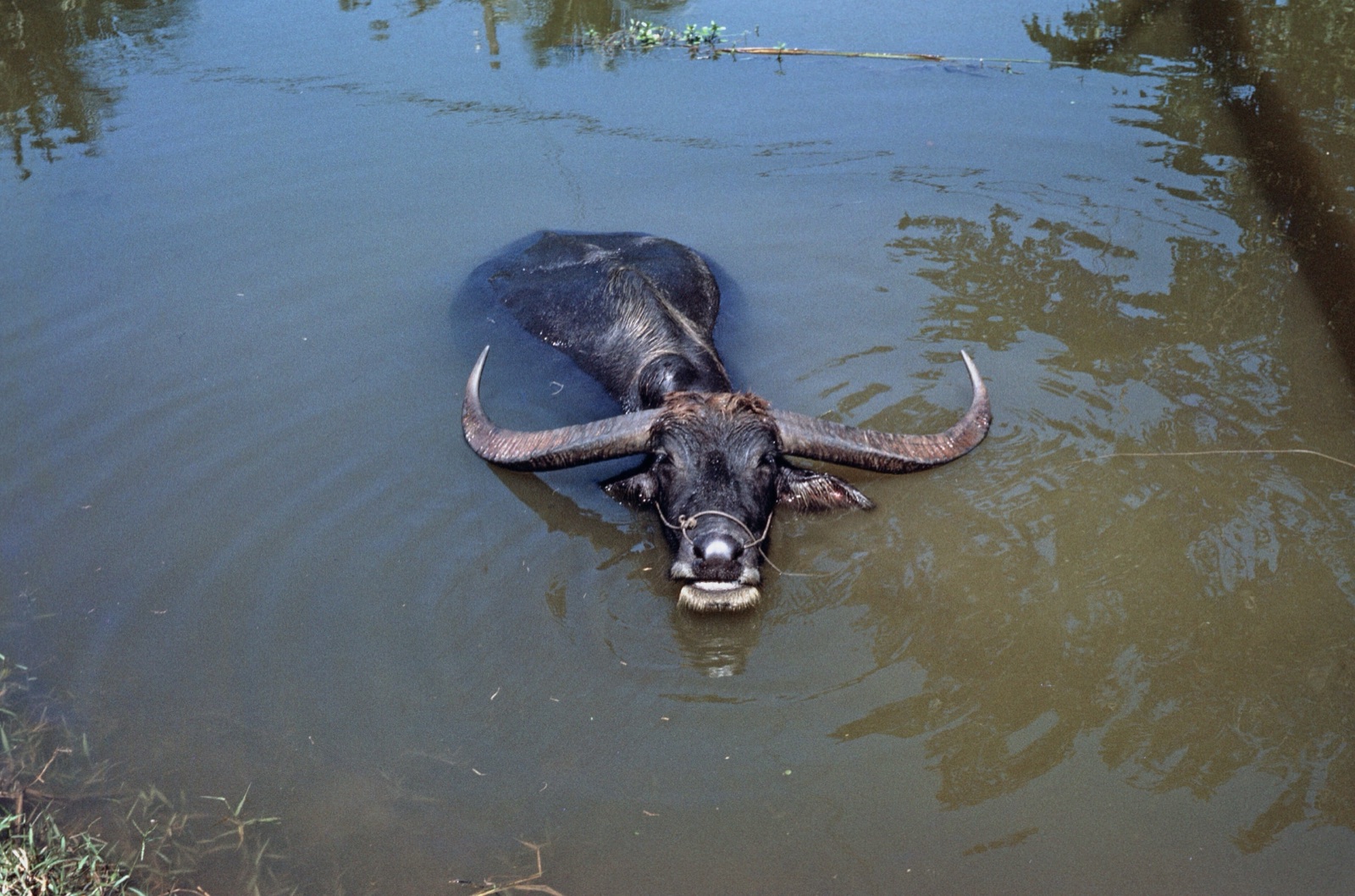
Photo: Don Christie / Wikimedia Commons (CC BY-SA 4.0)
The dictionary has several words for this time of day directly, and for the words the song sings in central Thai there are real Kham Mueang counterparts.
| Kham Mueang | Reading | Meaning | The song sings |
|---|---|---|---|
| ta wan tok din ตาวันฯต฿กฯดินฯ | ta wan tok din | the sun setting | ตะวันตกดิน |
| ta wan ตาวันฯ | ta wan | the sun | ตะวัน |
| ta wan laeng ตาวันฯแลงฯ | ta wan laeng | evening time | – |
| yam laeng ยามฯแลงฯ | yam laeng | evening time | – |
| khao laeng เขั้าแลงฯ | khao laeng | the evening meal | ข้าวแลง |
| ka กา | ka | crow | นกกา |
| hong ร้อฯง | hong | to cry out, call, shout | ฮ้อง |
| chung จูง | chung | to lead by pulling (dictionary example: to lead cattle and buffalo) | จูง |
Laeng for the evening is a common word, but the song's "ข้าวแลง" mixes central Thai and Kham Mueang. In full Kham Mueang it is เข้าแลง (khao laeng), because the Kham Mueang word for rice is เข้า (ข้าว in central Thai), in a tone of its own, as the article Rice and the fields in Kham Mueang explains.
For the part about building a smoky fire at dusk to drive off mosquitoes, the dictionary has these words:
| Word | Meaning in the dictionary |
|---|---|
| sum สุม | to put together, to heap together |
| yung ยุง | a mosquito; a small insect found all over the world, most common in the tropics and temperate zones |
| haeng แรงฯ | strength, power (central Thai: raeng) |
The song has the phrase "ao haeng", which reads as "to rest and regain strength". The dictionary gives ao haeng ´าแรงฯ the meaning "to exercise the body to be strong", so it is close to the meaning in the song but not exactly the same word. A learner should know what the dictionary says before using it.
Words the song spells differently from the dictionary
The song mixes central Thai and Kham Mueang words to fit the singing. Open the dictionary and you will find that many of them have another form.
| Spelled in the song | Spelled in the dictionary | Meaning |
|---|---|---|
| ตาย | ต๋าย (tai) ตายฯ | to die, to lose life, to stop breathing |
| เนื้อ | chin ชิ้นฯ | flesh of people and animals (example: chin khwai = buffalo meat) |
| ข้าวแลง | khao laeng เขั้าแลงฯ | the evening meal |
| ตะวัน | ta wan ตาวันฯ | the sun |
| ปัญญา | panya ปั¡า | knowledge, wisdom |
| ขาย | khai ขายฯ | to exchange goods for money (same as central Thai) |
The word fang in the line about eating grass and "fang" is central Thai. The Kham Mueang dictionary we have does not record fang in the sense of rice straw (it only has fang meaning "blurred, not clear" for the eyes), so there is no Kham Mueang word to compare it with yet.
Buffalo in the life of the rice farmer: words the dictionary records
The title and the words of the song talk about a buffalo that is "raised" for work, and the dictionary also keeps many words for the field work that depended on buffalo power.
| Word | Meaning |
|---|---|
| liang ล้ยฯง | to look after, nurture, give food and shelter, e.g. to raise animals (and "to make offerings" in liang phi) |
| thai na ไถนาฯ | to plough the field with cattle, buffalo or a tractor to prepare the soil for rice |
| aek แอกฯ | the curved wooden yoke on the neck of cattle and buffalo that plough or pull carts |
| piang ปยฯง | a tool pulled by cattle or buffalo to level the mud before the rice is planted |
| foek na เฝิ้กฯนาฯ | to train cattle or buffalo to plough |
| pen na เปนฯนาฯ | cattle or buffalo trained well enough to plough |
| kha haeng khwai ค่าฯแรงฯฅวฯายฯ | the fee for renting a buffalo in the farming season |
| hok kok ฮอฯกกัอฯก | a wooden bell hung on the neck of a buffalo or cow that goes "kok kok" as it walks |
| khi khwai ขี้ฅวฯายฯ | buffalo dung |
| ta lang khi khwai ตาลางฯขี้ฅวฯายฯ | a threshing floor coated with buffalo dung mixed with water, then dried in the sun |
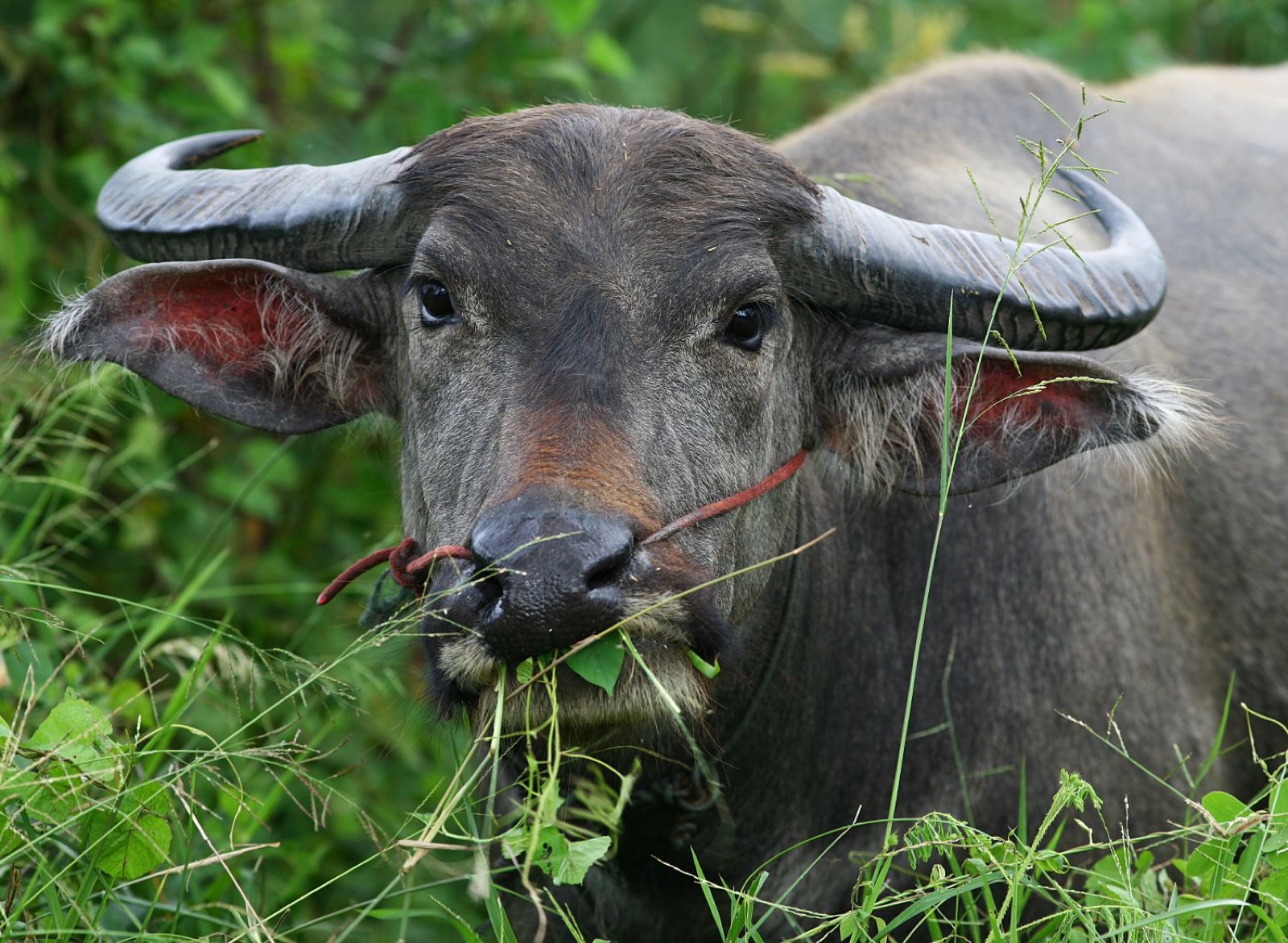
Photo: Heiko S / Wikimedia Commons (CC BY 2.0)
When the farming season ends, farmers hold the hong khwan khwai (ร้อฯงขัวฯรฅวฯายฯ) ceremony. The dictionary records that it calls back the spirit-essence (khwan) of the buffalo that did the work of ploughing and harrowing. If this ceremony interests you, read on in Rice and the fields in Kham Mueang and, for the idea of khwan, Hong khwan. The line in the song that says the buffalo "is the one who has given us a debt of gratitude" has a counterpart in real farming life.
The meaning as a whole
The song speaks for the buffalo and the herder. The first verse compares the buffalo with people and says that the buffalo has done us a kindness. The second answers people who use the buffalo as an insult: the buffalo does not know how to scold anyone, and it is the buffalo that should be ashamed to be used that way. In the end the herder says he himself "loves buffalo". The third verse tells of the evening of people and buffalo, from the bath to the feed to the smoky fire that keeps mosquitoes away so the buffalo can sleep well, and the song closes by saying that he will not sell his buffalo. (This reading of the meaning is by Moradok Lanna; for the full lyrics see the rights holder.)
Summary
- khwai has words by age and shape, such as khwai laeo (a young buffalo), khwai ngan (a buffalo in its prime, which can also mean a young man) and khwai pon (an albino buffalo).
- hao is "we" and hak is "to love"; both are examples of the r→h rule.
- bo chang means "does not know how to"; "khwai bo chang da khon" means the buffalo does not know how to scold people.
- ta wan tok din is the sun setting, khao laeng is the evening meal, and chin is meat, while เนื้อ (nuea) in the dictionary means wild animals.
- The song writes many words in central Thai, such as ตาย, ข้าวแลง, ตะวัน and ปัญญา, which the dictionary has as ต๋าย (tai), เข้าแลง (khao laeng), ต๋าวัน (ta wan) and ปั๋ญญา (panya).
Look up more words from the song in the Moradok Lanna dictionary (in Thai), and read about other animals in Animal names in Kham Mueang.
More in the same series: Phak Kat Cho · Long Mae Ping, or see the whole series at Kham Mueang through songs and literature (in Thai).
Sources
- Moradok Lanna dictionary (dict2), entries ควาย, ควายหงาน, ควายแลว, ควายต้อง, ควายปอน, เฮา, ฮัก, บ่, บ่จ้าง, ต๋าวันต๋กดิน, เข้าแลง, จิ๊น, ต๋าย and the other words named in this article. In Thai.
- RMS Karaoke. เลี้ยงควาย - จรัล มโนเพ็ชร์ [Liang Khwai – Jaran Manopetch]. YouTube (RMS Studio karaoke video showing the words; used to check the quoted lines).
- จรัล มโนเพ็ชร - Topic. เลี้ยงควาย [Liang Khwai]. YouTube (℗ RMS, delivered by AnyMind Music).
- บอน บอระเพ็ด [Bon Borapet]. (2012, 7 May). “จากยอดดอย-มิดะ” อมตะเพลง “จรัล” ยุคคลาสสิค ["From Yot Doi to Mida": the immortal classic-era songs of Jaran]. MGR Online (the "Phleng Wan" column). In Thai.
- Classy Records. แผ่นเสียง อัลบั้ม ลูกข้าวนึ่ง / จรัล มโนเพ็ชร [Vinyl album Luk Khao Nueng / Jaran Manopetch] (the album track list). In Thai.
- วิกิพีเดีย [Wikipedia]. จรัล มโนเพ็ชร [Jaran Manopetch] (discography), used as background on the album and year. In Thai.
Practise the words from this article
Flip through 40 flashcards of the Lanna words used in this article.


