
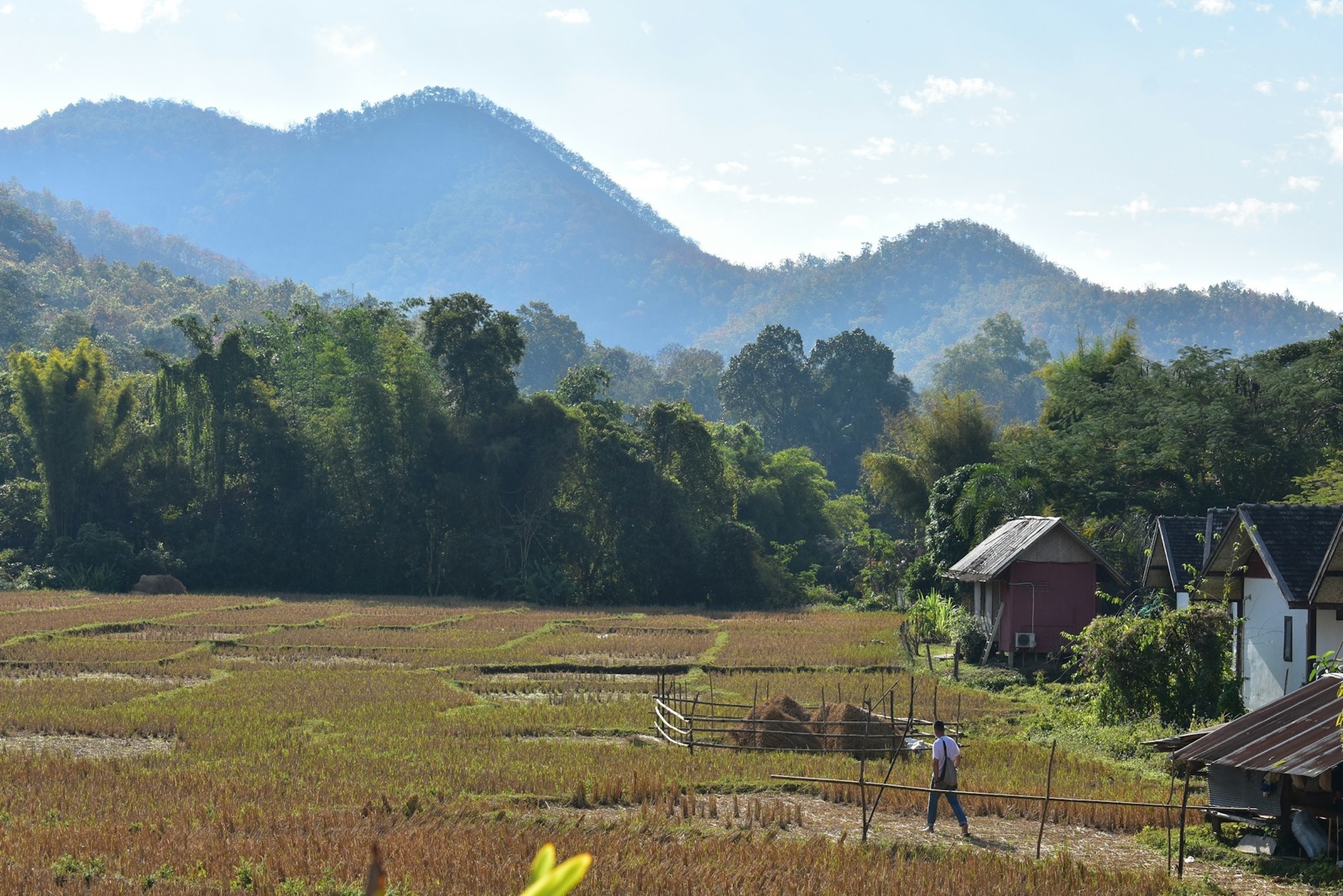
Photo: Rowan Heuvel / Unsplash
Ue Cha Cha: Kham Mueang from the Lanna Lullaby
Ue cha cha (อื่ชาชา, Kham Mueang reading ue cha cha) is the sound that opens the Lanna lullaby every Northern Thai person knows, and it is also the title of the opening song on an album by Jaran Manopetch. This article about the song Ue Cha Cha therefore learns Kham Mueang from the folk lullaby behind the name: the word for the cradle, the words for the child, the gentle commands of a mother, and the humming sounds that carry no meaning. We also say plainly how much of Jaran's song we could check.
This article is part of the series Kham Mueang through songs and literature. We have not found a checkable printed text of the song on the album, so we quote none of Jaran's lyrics. The folk lullaby belongs to everyone and has been handed down by singing; we quote only short lines that can be matched across several sources.
What is "ue cha cha"?
The Moradok Lanna dictionary defines ue (อื่, read ue) as a lullaby, called "ue" or "phleng ue", the name of a tune for singing or so to make a soothing sound, to rock or to sing a baby to sleep, and it says the ue song often begins "ue cha cha", followed by an example lullaby line.
The study by Kornchanok Nanthakanok (2020), following Sirikon Chaima (2003), says that in the North the lullaby is called phleng ue la-on, phleng ue luk or phleng ue, from the humming sound used when soothing a child: ue ue ue or ue ue cha cha. In the Central region and Isan it is simply a lullaby, and in the South it is called phleng cha-nong, cha-nong or phleng ruea.
The book Phleng klom dek Lanna ("Lanna lullabies", edited by Phannaphen Khruathai, 2009) of the Social Research Institute, Chiang Mai University, collects lullabies from the singing and telling of Tai Yuan (Khon Mueang) and Tai Yong speakers in Chiang Mai and Lamphun. Kornchanok's study chose 25 lullabies that begin with the "ue ue cha cha" tune and found that they follow the verse form called kham ha, in which the number of words in a line is not fixed: about three or four.
Jaran's song: how much can we check?
Ue..Cha..Cha is track 1 on the album Folk Song Kham Mueang Ue...Cha..Cha, which Wikipedia dates to 1983. The track list matches the album table in the study by Ueamporn Thipdet and Siriwan Nanthachanthun (2023), which gives the order: Ue..Cha..Cha · Lai Lao · Ha Ni Bo Hoei · Yin Di Ton Rap · Ban Na Chao Na · Num Chiang Mai · Sa-oeng Yai Ban · Tho Oei · Bai Mai Wai · Tong Chai Wela.
"Ue...Cha...Cha" is also the title of a book about Jaran compiled by Sire and Chan, which a blogger, citing a column in the newspaper Khao Sod, says was first printed in September 1984 by Phuean Doen Thang magazine (second-hand information that we use only as a lead).
We could not confirm whether the lyrics of the album track match the folk lullaby word for word, and we found no video published by the rights holder to embed here. To hear Jaran sing it, listen to the original album or a licensed music service.
Words from the lullaby
The lines below are folk lullaby text, not Jaran's lyrics. Most of them appear in at least two sources; where a line comes from the dictionary alone, the table says so. Spelling follows the dictionary.
| Line from the lullaby | Dictionary Kham Mueang | Meaning |
|---|---|---|
| หลับสองต๋า | lap หัลฯบ (read lap) · ta ตา (read ta) | to sleep, the body's rest · eye, the organ for seeing |
| ป้อแม่ปิ๊กมา (from the dictionary's example) | po พํอฯ · mae แม่ · pik พิกฯ (read pik) | father · mother · to return |
| ก้อยตื่น | koi ค่อฯยฯ (read koi) · tuen ตื่นฯ (read tuen) | a joining word meaning "then", "only then" · to wake up |
| ไกว๋อู่ | kwai u ไกวฯอู่ (read kwai u) | to rock the cradle |
| ใส่ซ้า | sa ซ้า (read sa) | basket |
| ใส่ป๊ก | pok พ฿กฯ (read pok) | something carried in a bundle of cloth |
| บ่าส้าน | san ส้านฯ (read san) | a tree (several kinds); ba is a prefix before fruit names, as in ba muang, so this probably means the fruit of the san tree (our reading) |
| ลูกหน้อย · ลูกเหย | noi ห้นฯอฯย · hoei เหิยฯ | small · a word showing affection, as in luk hoei, "oh, my child" |
| หื้อ · ขอหื้อ | hue หื้ (read hue) | to give, to hand over |
U, sa, pok: pictures of life in the lullaby
Lullabies describe what is around the singer. Kornchanok's study sums up the content as child-rearing, the daily routine of the parents and the local setting. In the lullabies she collected, a father makes an u (อู่, read u, a cradle for a baby) from bamboo, hangs it from two ropes and rocks it, the kwai u of the table. A mother goes to the market and to the fields, digs bamboo shoots and yams, and gathers fruit into a sa (some versions say a pok) to bring home for her child. These pictures turn the lullaby into a record of ordinary Northern family life.
The dictionary defines sa as a basket and notes that another name for it is sa po; pok is something carried in a bundle of cloth. Both are things a mother carries when she goes out to find food for her child.
Why is a lullaby full of commands?
Kornchanok's study analysed 25 ue cha cha lullabies and found 191 utterances that carry an intention. The most common kind is the "directive", with 84 utterances: 30 commands, 29 requests and 25 suggestions. So a lullaby is a way of speaking to a child, in a gentle voice, to make it sleep, not only a way of telling a story.
| Kind | Example from the study | What to notice |
|---|---|---|
| Command | หลับสองตา | begins with the verb lap (sleep) |
| Request | ขอหื้อลูก…นอนอื่อจาจา | uses kho, kho hue, and endings like toe ("please") |
| Suggestion | แม่นายมาค่อยตื่น | uses a joining word like koi ("then") to give the order of events |
The dictionary has the word hia (เหยฯ, read hia), meaning "(do it) already", added after a verb to stress that it should be finished, as in kin khao hia, "eat your rice, now". The study has the form "hia toe", as in "หลับก็หลับเหียเทอะ", which probably means "do go to sleep" (our reading); the ending toe makes it a request rather than an order, as the study explains. The word koi in the dictionary's example is the joining word meaning "then", as in the dictionary's "อาบน้ำแล้วก้อยแต่งตั๋ว", "bathe, then get dressed".
Sound changes from central Thai
| Central Thai | Kham Mueang in the lullaby | What changes |
|---|---|---|
| หลับ (lap) | หลั๋บ (lap) | rising tone |
| ตา (ta) | ต๋า (ta) | rising tone |
| กลับ (klap) | ปิ๊ก (pik) | a different word |
| ค่อย (khoi) | ก้อย (koi) | different consonant and tone |
| เสีย (sia, after a verb) | เหีย (hia) | different sound |
| ให้ (hai) | หื้อ (hue) | different sound and spelling |
| ร้อง · เรียก (rong, riak) | ฮ้อง (hong) | r becomes h |
The same line, written differently in different sources
We compared the lullaby text from four sources: the Moradok Lanna dictionary, entry "ue cha cha" (A), the study by Kornchanok Nanthakanok (2020), which draws on the book of Chiang Mai lullabies (B), the description of a lullaby video by Apichart Martmool (C), and the description of a video by Mintra Channel, which credits the words and tune to a folk lullaby (D). The words agree in sense but are spelled differently.
- หลั๋บ·สองต๋า (A) / หลับสองตา (B, C) / หลับสองต๋า (D)
- ก้อยตื่น (A) / ค่อยตื่น (B, C)
- kwai u (dictionary, entry 1328) / กวัดไกวไปมา (B) / ก๋วยอู่ (C, probably the sound of kwai u, our reading)
- ใส่ซ้า (B, C) / ใส่ส้า (D); in the dictionary sa means basket, while sa ส้า (with a different tone) means a dish of chopped meat or vegetables mixed with chilli paste
- หลับเสียเทอะ · หลับก็หลับเหียเทอะ (B uses several forms)
Link to other articles
For words about children and baby things, including la-on (ลอ่อฯร, read la-on) and u, read on at La-on: Kham Mueang words for raising children. For ue as the name of a so tune as well, see Khap so.
For another side of Jaran's work, which tells of the life of the Khon Mueang, see Sao Motorcycle.
What the lullaby means as a whole
Ue cha cha is the sound of a mother singing her child to sleep. The words hold love, gentle commands and pictures of making a living. When Jaran used the name for a song and for a Kham Mueang folk-song album, he took a sound that Northern Thai people remember from childhood and made it the name of a body of songs. For language learners, a lullaby is good practice: the sentences are short, repeated, and say things to a child directly.
Summary
- Ue cha cha is the sound that opens a Lanna lullaby. Cha cha is a drawn-out humming sound, not a word with a meaning.
- Useful words from the lullabies: lap (sleep), ta (eye), pik (return), koi (then), kwai u (rock the cradle), sa (basket).
- Lullabies are full of gentle commands, requests and suggestions: 84 out of 191 utterances in the study.
- Ue..Cha..Cha is track 1 of the Kham Mueang folk-song album of the same name (1983), but we have not been able to check a printed text of the song.
- The folk lullaby is written slightly differently in each source; we follow the dictionary first.
Look up more words in the Moradok Lanna dictionary (in Thai), or see the whole series at Kham Mueang through songs and literature (in Thai).
Sources
- Moradok Lanna dictionary (dict2), entries ue cha cha, ue, kwai u, u, lap, ta, pik, koi, tuen, sa, pok, san, ba, hia, hue, noi, hoei, hong, la-on, po, mae, sa (dish). In Thai.
- กรชนก นันทกนก [Kornchanok Nanthakanok]. (2020). วัจนกรรมในเพลงกล่อมเด็กจังหวัดเชียงใหม่ [Speech acts of the lullabies in Chiang Mai Province]. Udon Thani Rajabhat University Journal of Humanities and Social Science, 9(1), 125–148. In Thai.
- พรรณเพ็ญ เครือไทย [Phannaphen Khruathai] (Ed.). (2009). เพลงกล่อมเด็กล้านนา [Lanna lullabies] (3rd ed.). Chiang Mai: Social Research Institute, Chiang Mai University (cited through Kornchanok Nanthakanok). In Thai.
- เอื้อมพร ทิพย์เดช และสิริวรรณ นันทจันทูล [Ueamporn Thipdet and Siriwan Nanthachanthun]. (2023). ภาพแทนคนเมืองในบทเพลงของจรัล มโนเพ็ชร [The Representation of Lanna people in Charun Manopetch's songs]. Journal of Humanities and Social Sciences, 10(1), 167–184 (album table). In Thai.
- Apichart Martmool. (2016). เพลงกล่อมลูก อื่อจาจา [Lullaby: Ue Cha Cha]. YouTube (folk lullaby text in the description, used for cross-checking).
- Mintra Channel. (2024). อื่อ จา จา (ล้านนากล่อมลูก) - มินตรา น่านเจ้า [Ue Cha Cha (Lanna lullaby) – Mintra Nanchao]. YouTube (the description credits the words and tune to a folk lullaby; used for cross-checking).
- พุกไม้ [Phukmai]. (6 September 2007). อื่อ...จา...จา... [Ue...Cha...Cha...]. Bloggang (mentions the book Ue...Cha...Cha Jaran Manopetch, citing a column in Khao Sod; a lead only). In Thai.
- วิกิพีเดีย [Wikipedia]. จรัล มโนเพ็ชร [Jaran Manopetch] (album list, a first check). In Thai.
Practise the words from this article
Flip through 20 flashcards of the Lanna words used in this article.
Look up "อื่อจาจา" in the Moradok Lanna dictionary (in Thai)


