
Photo: Andrea Schaffer from Sydney, Australia / Wikimedia Commons (CC BY 2.0)
New Year 2027 the Lanna Way: Pi Mai Mueang and Blessings
On Friday 1 January 2027 (BE 2570) the international New Year arrives once again. In the Lanna calendar, though, that day is only the 8th waning day of the 3rd month, in the middle of the cool season. The Lanna year is still Chula Sakarat (CS) 1388 and will not change until April. That is why New Year the Khon Mueang way comes twice.
Pi mai (ปีให่มฯ, pi mai) therefore carries two meanings in one word in the dictionary: "a new era" and "the Songkran festival". This article looks at how the two New Years differ, which words Khon Mueang (Northern Thai people) use to greet each other, and the three blessings that all begin the same way: yu di mi hang (the health one), yu di mi hang (the wealth one) and yu di mi suk.
Two New Years: 1 January and April
The 1 January New Year is newer in Thailand than many people think. The Thai government once counted 1 April as the start of the year, then switched to 1 January under the government of Field Marshal Plaek Phibunsongkhram, in order to be in line with international practice (THE STANDARD, 2021). The "Announcement to use 1 January as New Year's Day" is dated 24 December 1940 (BE 2483).
The Lanna year is counted by a different calendar. The dictionary explains that the Lanna calendar is "solar-lunar" and is calculated by the Suriyayat treatise, and that Wan Phaya Wan (วันฯพยฯาวันฯ, wan pha-ya wan) is Thaloeng Sok, "the day the Chula Sakarat year changes to a new year". In 2027 (BE 2570) it falls on Friday 16 April.
| 1 January New Year | Pi Mai Mueang | |
|---|---|---|
| Calendar used | The international (Gregorian) calendar used by the Thai government | The Lanna calendar (solar-lunar) |
| First day of 2027 (BE 2570) | Friday 1 January | Friday 16 April (Wan Phaya Wan) |
| Lanna date | 8th waning day of month 3 | 10th waxing day of month 7 |
| Year number that changes | BE 2569 becomes 2570 | CS 1388 becomes 1389 |
Pick other dates yourself and compare the two calendars side by side. The previous-day and next-day buttons help you find the day the Lanna year changes.
Month three (สามฯ, sam): the dictionary says this is "the 3rd northern month", which corresponds to the central Thai (Bangkok) first month, duean ai. On 1 January 2027 it is also wan sin noi (วันฯสีลฯฯห้นฯอฯยฯ, wan sin noi), the Buddhist holy day that falls on the 8th day of both the waxing and the waning moon. Anyone who wants to make merit at the start of the year can go to the temple on the same day (each temple's merit-making events may be held on other days, so check with your local temple). Read the whole month in Duean Sam.
The dictionary does not mention 1 January at all in its entry for pi mai. We therefore call that day the "international New Year" (in Thai, pi mai sakon) and will not write it in Lanna script until the dictionary confirms a word for it.
When does Pi Mai Mueang come?
Pi Mai Mueang (ปีให่มฯเมิอฯง, pi mai mueang) is the Lanna Songkran. The dictionary records that it mostly falls on 13–15 April, and warns that some years it may not, so check the Lanna calendar. For 2027 (BE 2570) our calendar works out that Wan Sangkhan Long is Wednesday 14 April, Wan Nao is Thursday 15 April and Wan Phaya Wan is Friday 16 April, followed by Wan Pak Pi and Wan Pak Duean.
Why the dates have moved from what many people remember, and what is done on each day, is told in Wan Phaya Wan. The full table of days for 2027 is in Lanna festivals 2027, and the day people visit their elders to ask for blessings is in Dam Hua. The dictionary also has the water-splashing that people elsewhere in Thailand know well: hot nam pi mai (ห฿ดฯ฿ดฯนาฯปีไห่มฯ, hot nam pi mai), meaning to sprinkle New Year water, to splash Songkran water, or to play with water at Songkran.
See how many days are left until Pi Mai Mueang.
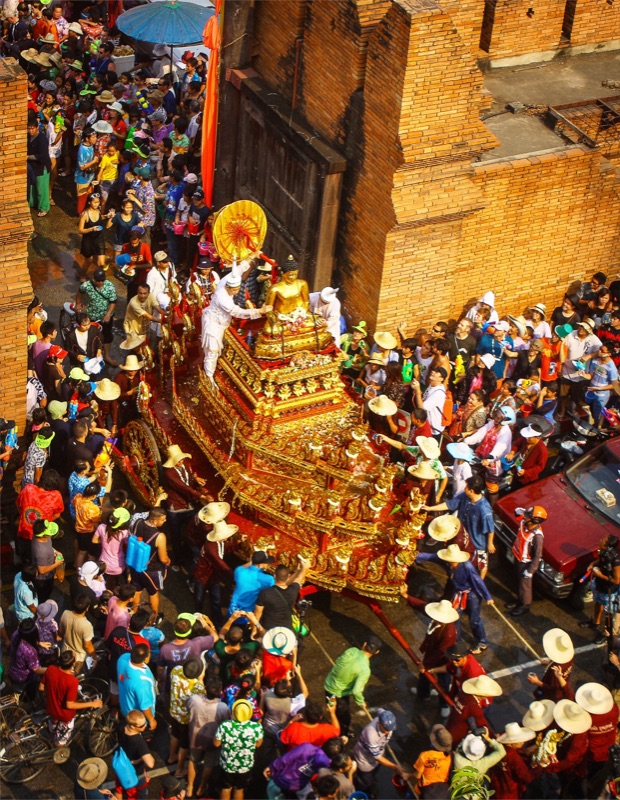
Greeting the New Year with tuak
Tuak (ทัวฯก, tuak): the dictionary gives the meaning as to greet, to address, and to presume (the Thai gloss is thuek thak, taking something for granted). Song tuak (ส่อฯงทัวฯก, song tuak) means to greet, and to predict.
So one word has both a side that greets and a side that looks ahead. We read that as close to what people do at New Year: greet one another, then say what they hope the coming year will be like. The dictionary has no example sentences for these two words, so we will not guess what sentence a Khon Mueang would use to greet someone at New Year. For everyday Kham Mueang greetings, such as sawatdi chao, and for the wai, read How to greet in Chiang Mai.
New Year blessings in Kham Mueang
Pon (พอฯร, pon) means a blessing: words that express goodwill, hoping the person meets only what is auspicious. Giving a blessing is called pan pon (ปันฯพอฯร, pan pon) or hue pon (หื้พอฯร, hue pon). In Dam Hua, the elders receive the dam hua offerings and then pan pon to the younger generation.
The blessing the dictionary records most clearly is yu di mi suk (อยฯู่ดีมีสุข์, yu di mi suk). The dictionary explains it as "to live in peace and happiness" and says it is "often used as a blessing to someone younger or junior", with the example hue yu di mi suk noe, meaning "may you have happiness and prosperity".
This phrase has two more "sisters" that begin with the same words, yu di mi. In this article we call the three "the three sisters", and only the last word changes.
| Phrase | Lanna script | Reading | The dictionary gives the meaning as |
|---|---|---|---|
| yu di mi hang (the health one) | อยฯู่ดีมีร่างฯ | yu di mi hang | good health, comfortable and happy |
| yu di mi hang (the wealth one) | อยฯู่ดีมีรั่งฯ | yu di mi hang | well off, wealthy |
| yu di mi suk | อยฯู่ดีมีสุข์ | yu di mi suk | to live in peace and happiness |
Read in a row, they are three blessings: good health, a comfortable standing in life, and living in peace and happiness.
Try making a blessing card from these three phrases and send it to someone you want to bless.
Related words recorded in the dictionary
- pen di mi hang (เปนฯดีมีร่างฯ, pen di mi hang): good health, comfortable and happy. The dictionary says yu di mi hang is also used.
- pen di mi hang (เปนฯดีมีรั่งฯ, pen di mi hang): wealthy, well off, prosperous and happy. The dictionary says yu di mi hang is also used.
- chung pen di mi hang (จุ่งเปนฯดีมีร่างฯ, chung pen di mi hang): "may you be wealthy and enjoy happiness and prosperity".
All the words used with these blessings are in the dictionary.
- Hue (หื้, hue) means to give, to hand over, to give away, to present, so it is the opening word of "hue yu di mi suk noe".
- Chai di (ไจดี, chai di): kind-hearted, generous and sharing, compassionate, even-tempered and not quick to anger, unselfish.
- Chok di (โช฿คฯดี, chok di) matches chok (โช฿คฯ, chok), which the dictionary explains as something that brings results that are hard to foresee, usually in a good way (luck).
- Muan (ม่วฯร, muan): pleasing, absorbing, melodious, fun, convenient.
- Noe (เนิอฯ, noe) is a sentence-final particle. The dictionary says it is pronounced differently in each locality, and glosses it in the blessing example above as the Thai particle na.
Try it the Khon Mueang way this New Year
- Go to the temple on wan sin noi. 1 January 2027 (BE 2570) is exactly a wan sin noi. Check with your local temple first about merit-making events.
- Greet and bless in Kham Mueang. Greet people with the everyday greetings, then bless juniors or friends with a phrase that begins yu di mi.
- Get ready for Pi Mai Mueang. The Lanna year changes on 16 April 2027 (BE 2570). If you would like to dam hua your elders this year, read through the steps first in Dam Hua.
Summary
- The 1 January New Year belongs to the international calendar, which Thailand switched to under Field Marshal Plaek Phibunsongkhram; the Lanna year changes on Wan Phaya Wan, 16 April 2027 (BE 2570).
- 1 January 2027 (BE 2570) is the 8th waning day of month 3, and a wan sin noi holy day.
- In the dictionary pi mai means a new era and the Songkran festival, while Pi Mai Mueang is the Lanna Songkran.
- Tuak means to greet; song tuak means to greet and to predict.
- Yu di mi suk is the blessing the dictionary says is often used to juniors, and it has two sisters: yu di mi hang (good health) and yu di mi hang (good standing).
Find more New Year words in the Moradok Lanna dictionary (in Thai), and keep reading with Wan Phaya Wan.
Sources
- Moradok Lanna dictionary (in Thai): ปี๋ใหม่ · ปี๋ใหม่เมือง · ตวั๊ก · อยู่ดีมีสุ๋ข · อยู่ดีมีฮั่ง · อยู่ดีมีฮ่าง · ปั๋นปอน · โจ้ก
- Moradok Lanna calendar: 1 January 2027 · 16 April 2027
- THE STANDARD TEAM. (2021). 7 กันยายน 2488 – ไทยใช้ Siam เป็นชื่อประเทศในภาษาอังกฤษ สุดท้าย จอมพล ป. เปลี่ยนเป็น Thailand. THE STANDARD. [English translation: "7 September 1945 (BE 2488): Thailand uses Siam as the country's English name; in the end Field Marshal Plaek changes it to Thailand"] In Thai.
- Government of Thailand. (1940). ประกาศให้ใช้วันที่ ๑ มกราคม เป็นวันขึ้นปีใหม่ (๒๔ ธันวาคม ๒๔๘๓). Wikisource (scanned edition). [English translation: "Announcement to use 1 January as New Year's Day (24 December 1940, BE 2483)"] In Thai.
- Images as credited under each picture.
Practise the words from this article
Flip through 25 flashcards of the Lanna words used in this article.


