
Photo: Tawashi2006 / Wikimedia Commons (CC BY 2.1 jp)
Sakura Sakura in Kham Mueang: Sky, Mist and Blossom
Sakura Sakura (さくらさくら) is the song people all over the world think of first when they think of Japan. Its words are only seven short lines, yet they hold the sky, mist, clouds and the scent of flowers that ban บาฯนฯ (bloom) all over the mountains. This article retells the song in Kham Mueang (Northern Thai), using only words found in the dictionary, to show how a Northerner might invite friends to go and see the flowers.
The author of the song is unknown, and the first printed text is in the public domain. Unlike a song still under copyright, such as My Way, we can print the Japanese original beside the Kham Mueang for every line.
Where Sakura Sakura comes from
A child's koto exercise. Songbooks often call it an "old Japanese song", but the Japanese Wikipedia (citing the Dictionary of Japanese Children's Songs, 2005) and the reference service database of the National Diet Library of Japan (NDL) agree that the tune began as a beginner's piece for the koto (箏), the Japanese long zither, in Edo (Tokyo) at the end of the Edo period. It was called "Saita Sakura" (咲いた桜, "the cherry has bloomed"), had different words, and its author is unknown.
The 1888 printing. Later the old tune was given new words and printed in the Sōkyokushū (箏曲集, Collection of Koto Music), compiled by the Music Investigation Committee (音楽取調掛) of Japan's Ministry of Education and published in October 1888. In the book the song is titled "櫻" (Sakura). The NDL answer calls the book a publication of the Tokyo Music School, the institution that succeeded the Music Investigation Committee, so both sources speak of the same book. After that the song spread as a song for singing and became a children's play song.
Two sets of words. In 1941 Japan's Ministry of Education gave the song new words in the music textbook Uta no Hon (うたのほん), beginning "sakura sakura, noyama mo sato mo" (over fields, hills and villages). The teacher's guide of the time explained that the old words were too difficult for children (according to the NDL answer). Post-war textbooks use the new words, and sometimes the new words are sung as the first verse and the old words as the second. In 2006 the Agency for Cultural Affairs and the Japan PTA chose the song as one of the "100 Japanese Songs" (日本の歌百選), according to the Japanese Wikipedia.
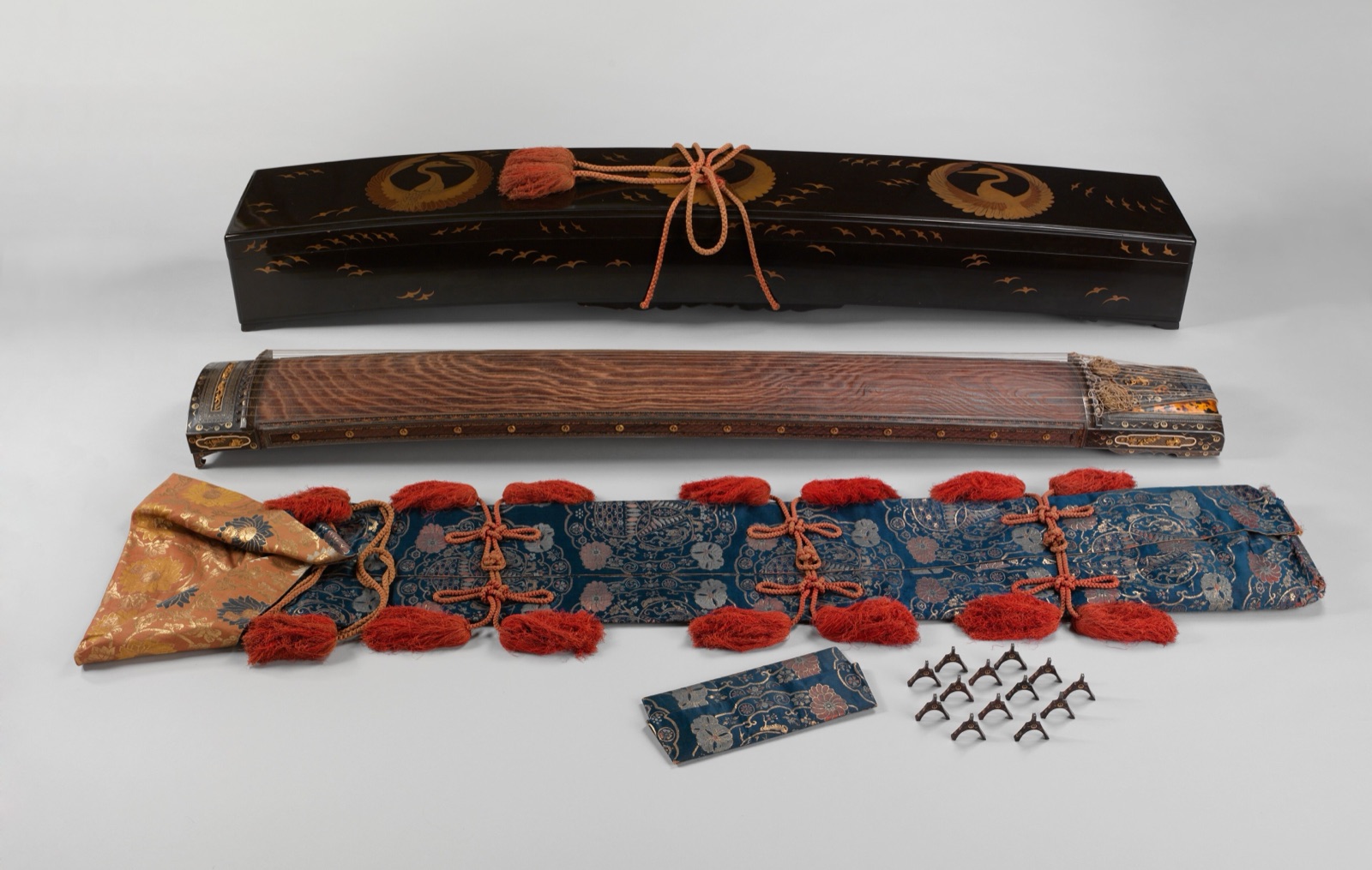
The version we used
This article uses the 1888 text in the Sōkyokushū, as transcribed on the Japanese Wikisource from the first printing (a digital copy is held by the NDL). Both the words and the tune of this version are in the public domain. We do not use the 1941 words and we have not copied anyone else's translation; the literal English and Thai glosses are Moradok Lanna's own.
Listen on the koto
Sakura Sakura sounds best on the koto, the instrument it was born on. This clip is a koto performance by Toshiko Yonekawa from the album Popular Koto Melodies Of Japan (Remastered), published on the Toshiko Yonekawa - Topic channel that the label delivers to YouTube (The Orchard Enterprises; ℗ 2011 Essential Media Group LLC).

The whole song
Original (Sōkyokushū, 1888, as printed):
櫻さくら 彌生の空は
見渡すかぎり 霞か雲か
にほひぞいづる いざや いざや
見にゆかむ
(Sakura sakura / yayoi no sora wa / miwatasu kagiri / kasumi ka kumo ka / nioi zo izuru / iza ya iza ya / mi ni yukan)Literal gloss: Cherry blossoms, cherry blossoms / the sky of the month of Yayoi / as far as the eye can see / is it mist, or is it cloud? / fragrance and beauty float out / come now, come now / let us go and see
Kham Mueang rendering by MoradokLanna:
ซากุระ ซากุระ
ฟ้าเดือนยาโยอิ
ผ่อไปเต็มต๋า
เป๋นหมอกก่อ เป๋นฝ้าก่อ
กลิ่นอ้มลอยออกมา
เฮาไป เฮาไป
ไปผ่อแด่เต๊อะ
(Sakura, sakura / the sky in the month of Yayoi / look out as far as the eye can see / is it mist? is it cloud? / a sweet scent floats out / let's go, let's go / let's go and see)
In modern spelling the last three lines are usually written "匂いぞ出ずる いざや いざや 見にゆかん", with the same meaning. The whole song is one picture: someone looks at a mountain where the cherry trees bloom so thickly that they look like mist or cloud, and invites friends to go and see. There is no love story and no farewell at all.
The Yayoi sky: pho pai tem ta
Fa ฟ้า in the dictionary is the sky, "the part above that covers the land". Yayoi (弥生), according to a dictionary of classical Japanese, is the name of the third month of Japan's old lunar calendar, the last month of spring, when the cherry trees bloom.
The word duean เดิอฯร in Kham Mueang means both the moon and a month of the year. The dictionary also notes that the Lanna people count their months two months ahead of central Thailand. So the "third month" of Japan, of central Thailand and of Lanna are not the same month, and in our rendering we keep the name "Yayoi" instead of turning it into a Lanna month.
For "as far as the eye can see", Kham Mueang uses pho ผํอฯ, to look, to watch, to look after, with ta ตา, the eye. "Pho pai tem ta" (look until the eyes are full) is our own phrase built from these words, and still needs a native speaker's check.
Pen mok ko, pen fa ko
The fourth line is a question that needs no answer: the flowers are so thick that you cannot tell mist from cloud. Kham Mueang has words for both. Mok หมฯอฯก is mist, fine droplets of water near the ground. For cloud, the dictionary has mek เมฆฯฯ, as in central Thai, and fa ฝ้า (with a falling tone), whose first meaning is "cloud, a mass of cloud".
For the "…or…?" question, Kham Mueang uses the final particle ko กํอฯ, which the dictionary explains turns a sentence into a question, as in "pai ko", are you going? Pen เปนฯ is "to be". "Pen mok ko, pen fa ko" sounds like a Northerner standing and asking themselves: is that mist, or cloud?
A sweet scent floats out
The fifth line, "nioi zo izuru", has the hardest word in the song. A dictionary of classical Japanese gives the verb niou (にほふ) both as "to bloom beautifully, to glow" and as "to give off a pleasant scent". So the picture in the song can be both the fragrance and the beauty of the flowers drifting out together.
Kham Mueang has a lovely word for a sweet smell: om อ้฿มฯ. The dictionary glosses it as fragrant, sweet-smelling, with the example "hen om", the civet that smells sweet. Loi ลอฯยฯ is to float in the air, not to sink. The word for "scent" (กลิ่น) is not in the dictionary as a Kham Mueang word, so we keep the Thai. For the beauty of the flowers, Kham Mueang has ngam งา, beautiful.
Hao pai, hao pai, pai pho dae toe
The last two lines are an invitation: "iza ya iza ya" is "come now, come now", and "mi ni yukan" is "let us go and see". Kham Mueang has a perfect match: pai pho ไพ฿กฯผํอฯ, which the dictionary defines as to go and see, and the ending dae toe แด่เทิอฯะ, meaning "please do, let's", a friendly closing word.
For the repeated invitation we use hao เรัา (we) and pai ไพ (to go): "hao pai, hao pai". Northerners might invite each other with a more natural phrase of their own local speech, but we chose only words that can be checked in the dictionary.
Summary of Kham Mueang words from the song
| Idea in the song | Kham Mueang used | Meaning in the dictionary |
|---|---|---|
| Flowers in bloom | dok ดอฯก · dok mai ดอฯกไม้ · ban บาฯนฯ · ngam งา | flower · flower, blossom · to unfold · beautiful |
| Sky and month | fa ฟ้า · duean เดิอฯร | sky · moon, month |
| Looking | pho ผํอฯ · ta ตา · pai pho ไพ฿กฯผํอฯ | to look · eye · to go and see |
| Mist or cloud | mok หมฯอฯก · fa ฝ้า · mek เมฆฯฯ | mist · cloud · cloud |
| Asking "is it?" | pen เปนฯ · ko กํอฯ | to be · question particle |
| A scent floating | om อ้฿มฯ · loi ลอฯยฯ | fragrant · to float in the air |
| Going together | hao เรัา · pai ไพ · dae toe แด่เทิอฯะ | we · to go · let's, please do |
All the Kham Mueang lines here are Moradok Lanna's own wording, mixing dictionary words with everyday Thai. Northerners from different areas may say the same thing with other words, and we still want a native speaker to check them.
Compared with Lanna flowers
Northerners have their own season of trees in full bloom too. The Kham Mueang word for season is la du รดู, and the dictionary's examples even include "the season when the leaves come out" (spring). The article Lanna flowers collects dozens of flower names in Kham Mueang. The closest to the picture in Sakura Sakura are:
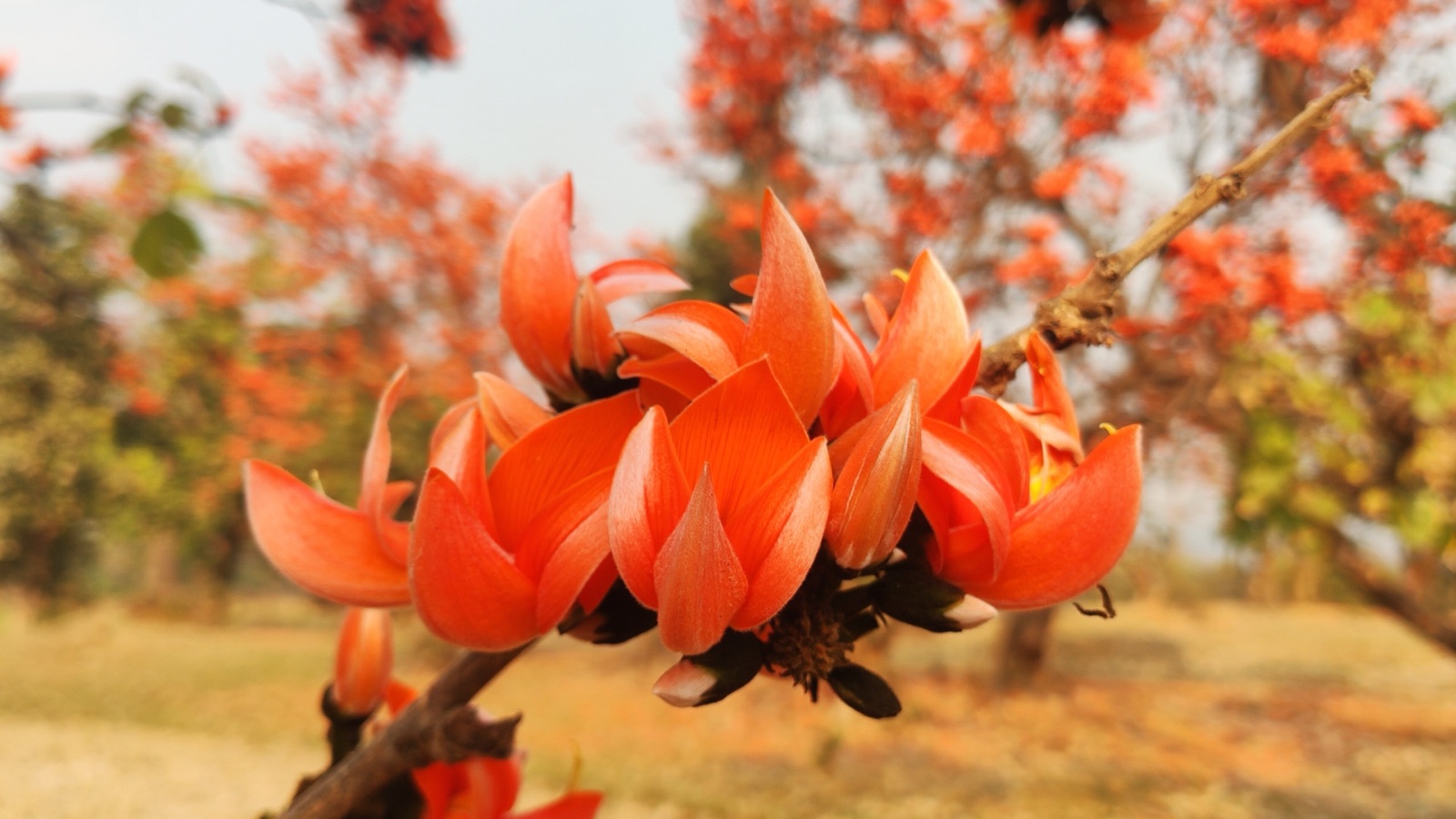
- Dok som pho luang ดอฯกดอฯกซอฯมภํอฯหลฯวฯง, the flame tree (royal poinciana). The dictionary describes it as shedding its leaves in the dry season, then "flowering heavily and dropping all its leaves, leaving only the flowers in full bloom", once a year. A tree with no bai ไบ (leaves), only flowers, brings the cherry mountain of the song to mind.
- Dok kwao ดอฯกกวฯาวฯ, the flame of the forest (Butea), the provincial tree of Chiang Mai, with flowers in clusters at the ends of the branches, in orange or yellow.
And the "Thai sakura"? The tree that Thais call "Thai sakura" is nang phaya suea khrong (Prunus cerasoides, the wild Himalayan cherry). MGR Online explains that it belongs to the same family as Japan's cherry trees, in the genus Prunus, and usually grows on slopes and ridges from about 1,000 metres up. A study in the Nepal Journal of Science and Technology (2023) records that in Thailand it flowers from December to February, and its pink blossoms fill the trees on many mountains of the North. Nang phaya suea khrong is a Thai name; we have not found a Kham Mueang name for this tree in the dictionary, so we do not make one up.
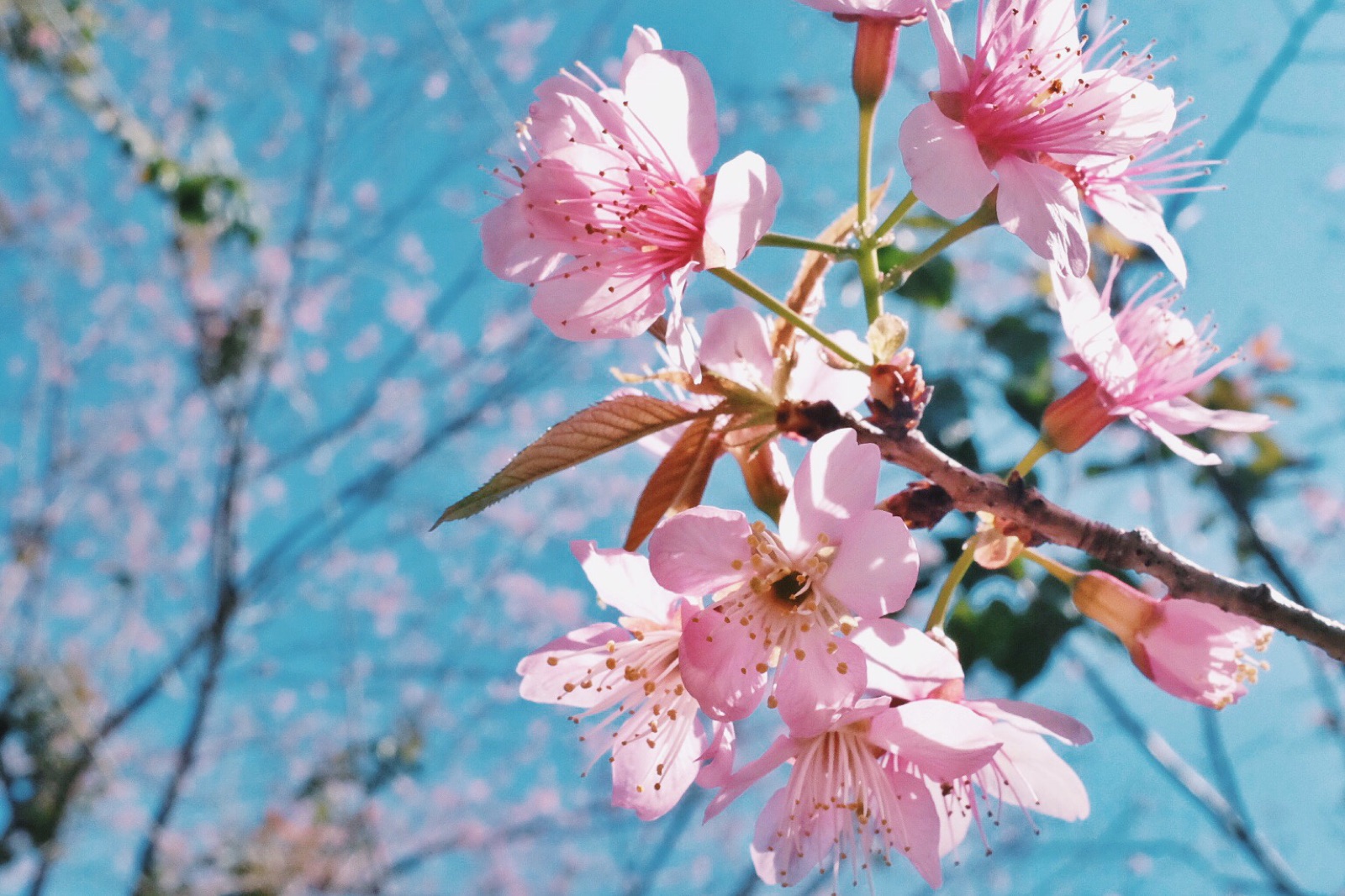
So our own doi ดอฯย have a picture much like the one in Sakura Sakura: mountains where pink flowers bloom so thickly that from far away they look like mist. To invite a friend up the mountain in that season with the Kham Mueang words from this article, you could say "pai pho dok mai ban dae toe": let's go and see the flowers in bloom.
Summary
- Sakura Sakura began as a koto practice piece in Edo, author unknown. The words we used were printed in the Sōkyokushū in 1888 and are in the public domain.
- In 1941 Japanese textbooks changed to a new set of words, so the song has two sets of lyrics.
- "To look" in Kham Mueang is pho, "to go and see" is pai pho, and "cloud" is fa (falling tone).
- For a sweet smell, Kham Mueang uses om; hom in the dictionary is the onion family.
- Sakura, "scent" and a Kham Mueang name for the wild Himalayan cherry are not in the dictionary, so we used Thai.
- The Kham Mueang lines are Moradok Lanna's wording and still need a native speaker's check.
Look up the words in the Moradok Lanna dictionary (in Thai). Read on in the same series: My Way · Lanna flowers or see the whole set at Kham Mueang through songs and literature (in Thai).
Copyright and courtesy
| Item | Details |
|---|---|
| Song | Sakura Sakura (さくらさくら); in the 1888 book it is titled "櫻" |
| Words | Author unknown (Japanese); the text used was printed in the Sōkyokushū (箏曲集), Music Investigation Committee, Japanese Ministry of Education, 1888 |
| Music | Composer unknown; the tune of the Edo-period koto practice piece "Saita Sakura" |
| Best-known recording | Sung and played everywhere; the version in the video: Toshiko Yonekawa (koto) |
| Status | Public domain: author unknown, and the text used was printed in 1888 |
This article was made by Moradok Lanna, a non-profit website, for learning the Lanna language and culture. The original words are in the public domain, so we render every verse in Kham Mueang. Modern arrangements and recordings (e.g. Toshiko Yonekawa's koto performance) remain under copyright; we do not use their particular wording. The English and Thai glosses are Moradok Lanna's own. Embedded videos come from the rights holders' official channels and remain their property.
With thanks and respect to the songwriters, performers and rights holders. If a rights holder would like anything changed or removed, please write to moradoklanna@gmail.com and we will act promptly.
References
- Moradok Lanna dictionary (dict2): ban, dok, dok mai, fa (sky), duean, pho, ta, mok, fa (cloud), mek, pen, ko, om, loi, hao, pai, pai pho, dae toe, ngam, la du, bai, dok som pho luang, dok kwao, doi.
- Music Investigation Committee, Ministry of Education (文部省音楽取調掛). Sōkyokushū (箏曲集). 文部省編輯局, October 1888. Digital copy, National Diet Library of Japan · text transcribed at Japanese Wikisource: さくらさくら
- Collaborative Reference Database, National Diet Library (レファレンス協同データベース). 「さくらさくら」の歌詞が2種類あることについて。その変遷を知りたい。 [Sakura Sakura has two sets of words: how did this come about?]
- Japanese Wikipedia. さくらさくら (used as a lead and checked against other sources).
- Gakken Zen'yaku Kogo Jiten (dictionary of classical Japanese). やよひ and にほふ. Weblio
- Nepal Journal of Science and Technology (2023). Flowering of Prunus cerasoides D.Don in its Native Land (The Himalayas) and Some Other Countries in Asia
- MGR Online. สุดทึ่ง! "ถนนสายซากุระเมืองไทย" งามชมพูสะพรั่ง หนาวนี้ต้องห้ามพลาดที่ อ.จอมทอง เชียงใหม่ [The "Thai sakura road" in Chom Thong, Chiang Mai] (in Thai)
- Toshiko Yonekawa - Topic. The Cherry Blossoms (Sakura Sakura). YouTube
- Moradok Lanna articles My Way and Lanna flowers.
Practise the words from this article
Flip through 24 flashcards of the Lanna words used in this article.


