
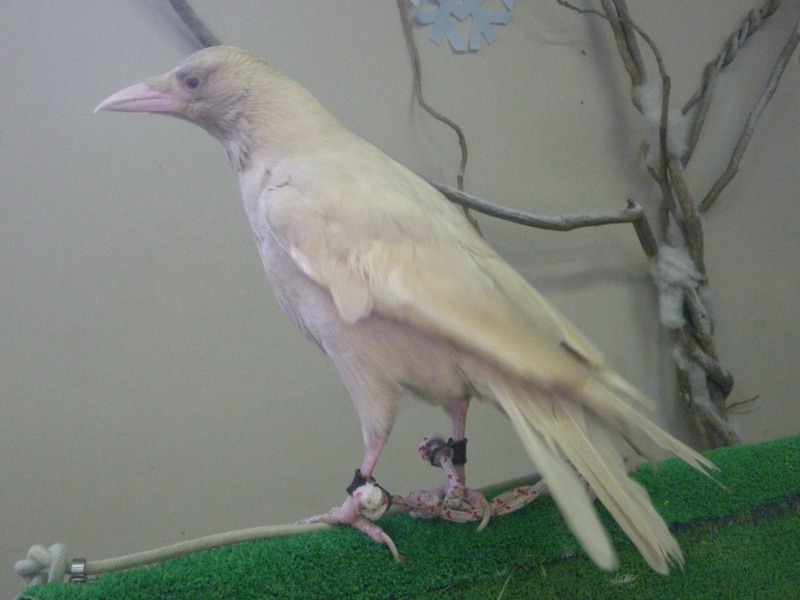
Photo: FredTC / Wikimedia Commons (CC BY-SA 4.0)
The White Crow Legend: Mother of Five Buddhas
The white crow legend says that the five Buddhas of our present age, the Bhaddakappa (the Fortunate Aeon), were once brothers, born from the five eggs of a white crow whose nest was blown apart by a storm. Chiang Mai University's Lanna knowledge bank also calls it "the Dhamma text of the white crow" and "the white crow and the five Buddhas", and says it is often recited on the night of Yi Peng and is used to explain the lighting of lamps at that festival (Thapanee Kruaraya, 2021).
This year Yi Peng falls on Tuesday 24 November 2026. In the days before it, this post retells the legend from the sources we read, says which version comes from where, and follows it to the crow's-foot wick in Lanna clay lamps, which the legend gives as a keepsake from the mother crow.
Who is the white crow?
The word for crow in Kham Mueang is ka (กา, read ka), which the dictionary glosses as a crow. Phueak (เผิอฯก, read phueak) means white, snow-white, as in "white as an albino buffalo". The dictionary has no headword for "white crow" as such and does not tell this legend, so everything in this post comes from the sources named in each section.
White crows exist in nature, birds whose feathers lack the usual black. The mother in the legend, though, is a character in a teaching story rather than a real bird.
The story: five eggs in a storm
This retelling is in our own words, following Chiang Mai University's Lanna knowledge bank (Thapanee Kruaraya, 2021) and an article from the Rajamangala National Library in Chiang Mai (Theerabun Mitmanochai), which agree on almost every point.
A white crow built her nest in a fig tree on the bank of the Ganges and laid five eggs. One day, while she was away looking for food, a violent storm broke the branch that held the nest, and the five eggs floated off on the water in five different directions. (A fig tree is doeu, เดิอฯอ, in Kham Mueang, and a big river is nam mae, นาฯแม่.)
The crow came back and found no eggs. She searched everywhere and, believing her children were dead, died of a broken heart. But through her merit and her love for her young, she was reborn as a Brahma, a god of the higher heavens. The Rajamangala library article names him Thao Khatika Maha Phrom, in the Suddhavasa realm.
Five different animals found the floating eggs and raised them: a hen, a naga (some sources say a snake), a turtle, a cow and a lioness. The eggs hatched into five baby boys, each growing up warmly cared for by their foster mother.
At about 16 years old, the five boys asked their foster mothers' permission to become hermits. They set out on pilgrimages and met by chance under a banyan-like nigrodha tree, noticed they looked alike, and learned they were brothers. (The age of 16 comes from the Chiang Mai University knowledge bank.)
The five made a solemn vow to see their mother once more, and the white crow appeared in her Brahma form. The sons asked to bow at her feet, so she twisted cotton thread (ฝ้ายฯ, fai, read fai) into a spiral shaped like a three-pronged crow's foot and gave it to them as a keepsake, then returned to heaven.
The five hermits made that thread into a lamp wick and lit it in her honour every Buddhist holy day. They kept building up their perfections until, one after another, each awakened as a Buddha.
The dictionary lists the five Buddhas under phra jao ha ton ("the five Buddhas"): "Kakusandha, Konagamana, Kassapa, Gotama (the present Buddha) and Metteyya (Sri Ariya)", the last of whom will awaken in the future, when 5,000 years of Gotama's teaching are complete.
Five Buddhas and five foster mothers
The Chiang Mai University knowledge bank pairs each Buddha with a foster mother in this order (the Kham Mueang animal names are from the dictionary).
| No. | Buddha | Foster mother | Kham Mueang |
|---|---|---|---|
| 1 | Kakusandha | hen | kai (ไก่) |
| 2 | Konagamana | naga (or snake) | nak (นาฯคฯ) |
| 3 | Kassapa | turtle | tao (เตั่า) |
| 4 | Gotama (the present Buddha) | cow | ngua (ง฿วฯ, cow) |
| 5 | Metteyya (Sri Ariya) | lioness | ratchasi (ราชสีห์) |
The eggs are khai (ไข่, read khai) in Kham Mueang, and for the five brothers, Kham Mueang has the word pi nong (พี่น้อฯง, read pi nong), siblings.
Why the versions differ
The legend exists in many versions. Anucha Pimsak's thesis (2007) collected 33 versions of the five Buddhas legend from across Thailand and sorted them into 3 tale types: the white crow type (19 versions), the five Buddhas type, which tells each Buddha's life story (10 versions), and a mixed type (4 versions). The thesis finds that the details differ because of oral transmission, copying and local culture, while the main structure of each type stays the same.
Some of the differences in the sources we read:
- The fourth foster mother: the Chiang Mai University knowledge bank says a cow, but notes that "some legends" say a washerwoman, which matches the banner legend we mention in our post Lanna banners, following the work of Phra Palad Phongsiri Buddhivamso and colleagues (2020).
- The second foster mother: some sources say naga, others say snake.
- Four Buddhas: Nation Online (2019) reported a version used by the community of Wat Phra That Choeng Chum in Sakon Nakhon for a wax-castle (prasat phueng) display. It tells of a white crow queen who keeps the precepts and eats no meat, of eggs floating past the islands of the naga, the garuda, the turtle, the hen and the cow, and ends with four Buddhas (Kakusandha, Konagamana, Kassapa, Gotama). The report does not explain why four.
- A Lanna-script edition: the Institute of Asian Languages and Cultures at Mahidol University published The White Crow Legend, Lanna Tham Script and Thai Script Editions (Yotsaphon Chaikosi and Nathee Sakkhayutthadet, 2021), according to the university's repository record. We have not read the text of this book, so we do not compare it here.
The clay lamp and the crow's-foot wick at Yi Peng
According to the Chiang Mai University knowledge bank, Lanna people link the birth of the five Buddhas to the lighting of lamps in honour of the white crow, and the three-pronged cotton wick in the lamp stands for the mother crow. The Rajamangala library article says the custom of lighting "crow's-foot lamps" for the white crow falls on the 15th day of the waxing moon of month 12 (in the central count), Loy Krathong day, and is part of Yi Peng.
The dictionary helps with the words.
| Kham Mueang | Lanna script | The dictionary says |
|---|---|---|
| phang | ผางฯ | a small clay dish for oil or wax, used to light a flame in place of a lamp |
| phang pha-ti(p) | ผังฯผทีปฯ | a lamp in a flat clay dish, with a thread wick, often lit as a Buddhist offering at festivals such as the Yi Peng month |
| si sai | สีสายฯ | a lamp wick, a beeswax candle wick, and "a crow's foot soaked in oil for lighting" |
| sai thian | ไส้ทยฯร | a candle wick |
The word si sai, which the dictionary glosses as a soaked "crow's foot", matches what the legend describes: a lamp wick twisted into the shape of a crow's foot. The belief that the crow's-foot wick is a keepsake from the white crow belongs to the legend and is not a historical fact, and the dictionary does not mention the legend.
The legend ties in with other Yi Peng customs as well. Pimsak's thesis (2007) concludes that the five Buddhas legend has been used to explain the origins of Yi Peng, Loy Krathong, the fire-boat festival, the lamp-hanging custom and the giving of banners. To see the banners of Yi Peng, read on in Lanna banners, and for the temples' sermon night, see Tang Tham Luang.
On the evening of Yi Peng people light lamps at temples and at home, and the Kham Mueang word for worshipping is pu ja (ปู่ชา, read pu ja). If you stand and watch a row of lamps along the Chiang Mai city wall or across a temple yard, think of the white crow and her five sons lighting a flame in the forest.
Summary
- The white crow legend says the five Buddhas of this age were born from the five eggs of a white crow, swept away in a storm and raised by a hen, a naga, a turtle, a cow and a lioness
- Grown up and ordained as hermits, the five met their mother again; she gave them cotton thread twisted into a crow's foot, which they made into a lamp wick to honour her
- Lanna tradition tells this as the origin of the crow's-foot wick in the clay lamp lit at Yi Peng, a belief and a legend
- There are many versions: some foster mothers differ, and some sources tell of four Buddhas
- At its heart, the story is about gratitude
Search for more Kham Mueang words about lamps and Yi Peng at พระเจ้าห้าตน(https://moradoklanna.com/dict/?พระเจ้าห้าตน) or read on in Yi Peng Kham Mueang words and Yi Peng, Lanna New Year and Banners.
📚 Whole series: see every tale and legend on one map at Lanna Folk Tales and Legends: A Story Map
Sources
- Moradok Lanna dictionary (in Thai): พระเจ้าห้าตน · สีสาย · ผังผะตี้บ · ผาง · เผือก · ยี่เป็ง
- ฐาปนีย์ เครือระยา [Thapanee Kruaraya]. (2021, 11 November). ตำนานกาเผือก [The White Crow Legend]. Lanna knowledge bank, Office of Arts and Culture, Chiang Mai University
- ธีรบูลย์ มิตรมโนชัย [Theerabun Mitmanochai]. (n.d.). องค์ความรู้: วันลอยกระทง เรื่อง ประเพณียี่เป็ง กับ ตำนานพระเจ้าห้าพระองค์ [Knowledge: Loy Krathong Day, the Yi Peng tradition and the legend of the five Buddhas]. Rajamangala National Library in Chiang Mai, Fine Arts Department
- อนุชา พิมศักดิ์ [Anucha Pimsak]. (2007). ตำนานพระเจ้าห้าพระองค์: โครงสร้างเนื้อหาและบทบาทในสังคมไทย [The legend of the five Buddhas: content, structure and role in Thai society]. Thesis, Faculty of Arts, Chulalongkorn University
- ศรีสุชาติ [Srisuchat]. (2019, 10 October). ตำนาน "นางพญากาเผือก" ผู้กำเนิด "พระพุทธเจ้าสี่พระองค์" [The legend of the "white crow queen", mother of "four Buddhas"]. Nation Online
- ยศพล ไชยโกษี [Yotsaphon Chaikosi] and นที สาครยุทธเดช [Nathee Sakkhayutthadet]. (2021). ตำนานพญากาเผือก: ฉบับอักษรธรรมล้านนาและฉบับอักษรไทย [The White Crow Legend: Lanna Tham Script and Thai Script Editions]. Institute of Asian Languages and Cultures, Mahidol University. Repository record
- พระปลัดพงศ์ศิริ พุทฺธิวํโส [Phra Palad Phongsiri Buddhivamso] and colleagues. (2020). Cited in our post Lanna banners
Practise the words from this article
Flip through 21 flashcards of the Lanna words used in this article.
Look up "พระเจ้าห้าตน" in the Moradok Lanna dictionary (in Thai)


