
Photo: Gannu03 / Wikimedia Commons (CC BY-SA 4.0)
Wind Beneath My Wings in Kham Mueang: The Song's Ideas
Wind Beneath My Wings is a worldwide favourite, best known in the voice of Bette Midler. It is a song of thanks to the person behind our success. In this article we ask a playful question: how would a Northerner (khon mueang) talk about wings, wind and kindness? You pick up Kham Mueang words that work in everyday life.
The word pik ปีกฯ (Kham Mueang reading pik) means, in the dictionary, the part of a bird or insect used for flying: a wing. It is in the title from the very first word.
This is another part of the series World songs in Kham Mueang, in the group Kham Mueang through songs and literature (the first was My Way). The song is still under copyright, so we do not translate it line by line, and we quote only two short phrases. What we retell are the song's ideas, and then we try saying those ideas in Kham Mueang.
Where Wind Beneath My Wings comes from
The song was written in 1982 by Larry Henley (words) and Jeff Silbar (music), according to Wikipedia. In an interview with SongwriterUniverse, Silbar says he saw the title on Henley's legal pad, taken from a poem Henley had written earlier, and the two went on to write the song together. Wikipedia adds that apart from the title, the song uses none of the poem's words.
Before it became famous, the song was pitched to many singers who turned it down, as Silbar tells it. The first to release it was Roger Whittaker, on an album of the same name in 1982. Who recorded it first is where the sources differ. Wikipedia says the Australian singer Kamahl recorded it the same year but it was never released, while SongwriterUniverse says Whittaker was the first to record it.
The first big hit was Gary Morris's version in 1983, which reached No. 4 on Billboard's country chart and won the writers the CMA Song of the Year award. The best-known version is Bette Midler's, from the film Beaches (1988). It came out as a single in early 1989, spent one week at No. 1 on the Billboard Hot 100 in June that year, and won the Grammy Awards for Record of the Year and Song of the Year in February 1990.
You can hear Bette Midler's official version in the video below, uploaded by the label Rhino's official channel.

Pik, lom, hoen: the wind that lets you fly
The first idea is in the title itself. The narrator says that another person is "the wind beneath my wings" (Larry Henley and Jeff Silbar, "Wind Beneath My Wings", 1982): the wind under the wing. A bird can fly high because the air holds it up.
Kham Mueang has words very close to this. Nok น฿กฯ is a winged animal with 2 feet and 2 wings. Hoen เหินฯ is defined as to fly high or soar high, with the dictionary example "nok khao hoen, yiao hoen lom" (a dove takes wing, a hawk soars on the wind). Lom ล฿มฯ is moving air, and nun หนฯร means to raise something up or prop it higher. So we get the song's picture entirely from dictionary words.
When we render an idea in Kham Mueang, we write in Thai script following the Kham Mueang sound, and add the Lanna script only for words found in the dictionary. A word not in the dictionary is never invented; we use Thai for it instead.
Kham Mueang rendering by MoradokLanna: ลมหนุนปีก นกเหินฟ้า ("the wind lifts the wing, the bird soars the sky")
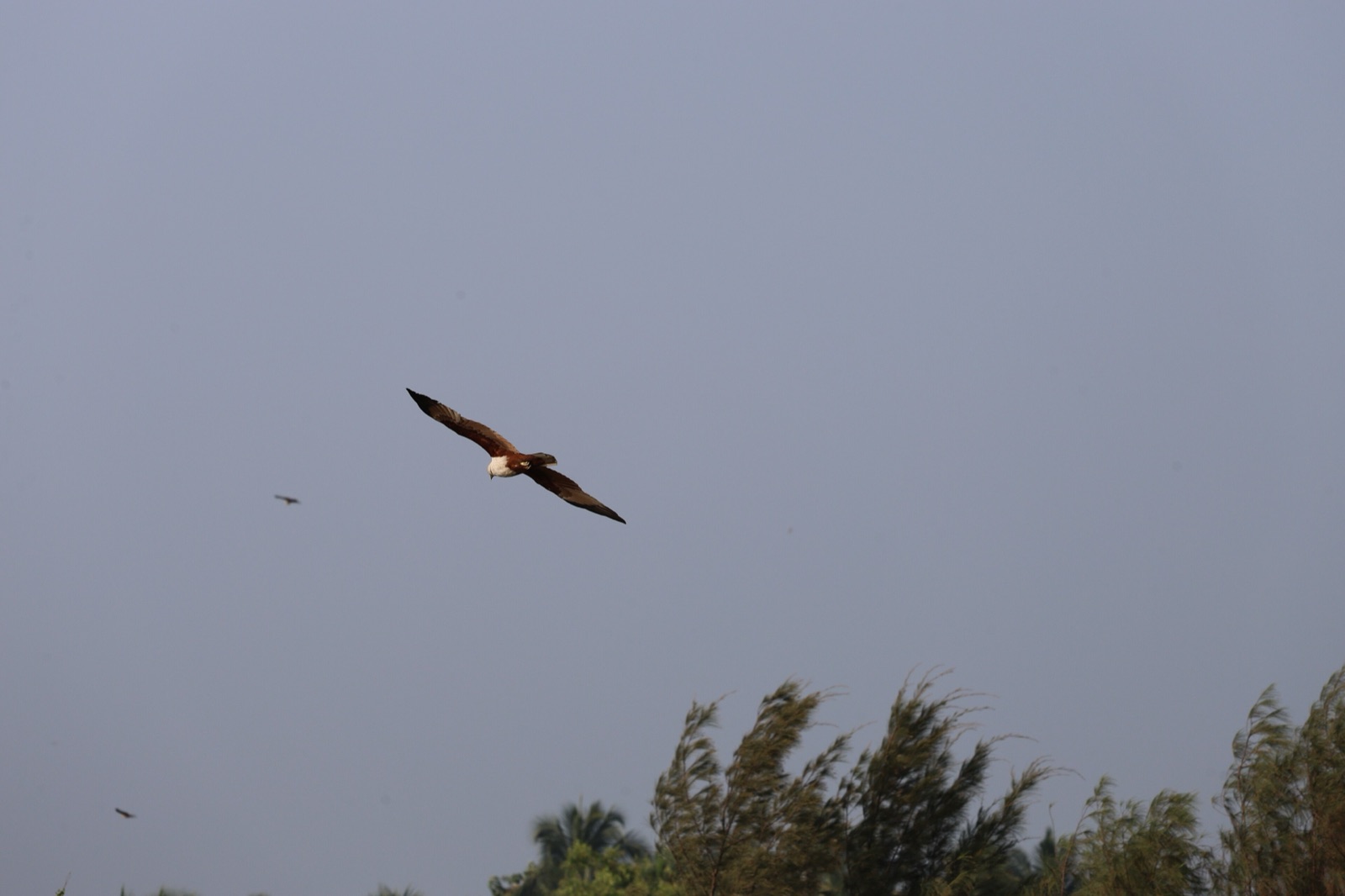
The dictionary defines fa ฟ้า as the visible space above the land, the sky. Yiao อยฯ่ยฯวฯฯ is a bird of the same family as the eagle, and the dictionary says it is also called laeo. The picture below shows a bird of that kind gliding in the wind.
Chuai kam yu lang: the one who props you up from behind
The second idea is that the people who lift us up often do not stand on the stage. The song speaks of someone behind the scenes who let the narrator go further than they thought possible.
Kham Mueang has a fitting word: kam คำฯ. The dictionary gives two meanings. The first is to prop something so it does not sag, fall or lean, as in mai kam, a forked prop. The second is to support, back and help. Chuai ช่วฯย is to help, and lang หัลฯง is the side opposite the front. For a more formal phrase, the dictionary has kam chu ut nun คำฯชูอุดหุนฯร, meaning to hold up, back and sustain.
Kham Mueang rendering by MoradokLanna: จ้วยก๊ำอยู่หลัง ("helping and propping from behind")
Ru nam chai khop lai: saying thanks
The third idea is the heart of the song: thanking the person who is your wind. The song calls that person a hero, in a line people remember: "Did you ever know that you're my hero" (Larry Henley and Jeff Silbar, "Wind Beneath My Wings", 1982).
There is a note about words here. The Moradok Lanna dictionary has no headword for "khop chai" or "khop khun" as such. The closest is khop ขอฯบ, which as a verb means to accept, reply, be pleased, be glad. So we do not claim that "khop chai" is an old Kham Mueang expression; we only point out that the dictionary meaning of khop lies in pleasure and gladness. Other related words that are in the dictionary are nam chai นาฯไจ (sincerity, generosity of heart), di chai ดีไจ (pleased, glad, happy) and ru รู้ (to understand, to know).
Kham Mueang rendering by MoradokLanna: ฮู้น้ำใจ๋ ขอบหลาย ("I know your kindness, many thanks")
The words in this sentence are ru (to know, understand), nam chai, khop and lai หลฯายฯ (much, many). The sense is "I understand your kindness, thank you very much". It is a general idea, not a translation of any line of the song. If you meet a native Kham Mueang speaker, ask how people really say thank you, because this is where the dictionary gives an incomplete answer.
Po mae pi nong kam hao: where does our wind come from?
The fourth idea is that everyone's wind is different. The song never says who the person is, so each listener thinks of their own: for many, a mother, a father, or siblings, the family who held them up.
The dictionary gives po พํอฯ as father, mae แม่ as the person who gave birth to a child or raised them, and pi nong พี่น้อฯง as elder and younger siblings, relatives, or people respected as kin. Hao เรัา means "we" or "us".
Kham Mueang rendering by MoradokLanna: ป้อแม่ ปี้น้อง ก๊ำเฮา ("father, mother, siblings hold us up")
To learn the Kham Mueang family words for the whole household, from the great-grandparent generation down to the grandchildren, read Kham Mueang family words.
Un chai: the comfort of knowing someone is behind you
The last idea is the feeling after you know someone is propping you up: ease, with less worry. The dictionary has this exact word: un chai อุ่รไจ, meaning comfortable in mind, relieved of worry. Phu ผู้ is a person.
Kham Mueang rendering by MoradokLanna: อุ่นใจ๋ มีผู้ก๊ำอยู่หลัง ("at ease, someone is propping from behind")
Kham Mueang words from the song's ideas
| Idea | Kham Mueang words | Dictionary meaning |
|---|---|---|
| Wind under the wing | pik ปีกฯ · hoen เหินฯ · lom ล฿มฯ · nun หนฯร | a wing · to soar · moving air · to raise up |
| Support from behind | kam คำฯ · chuai ช่วฯย · lang หัลฯง | to prop, support · to help · the side opposite the front |
| Thanks | nam chai นาฯไจ · di chai ดีไจ · khop ขอฯบ | sincerity, generosity · pleased, glad · to accept, be pleased |
| Family | po พํอฯ · mae แม่ · pi nong พี่น้อฯง | father · mother · siblings, kin |
| Ease of mind | un chai อุ่รไจ · phu ผู้ | comfortable, free of worry · a person |
All of these renderings are our own phrasing, built from dictionary words. They are not the only standard way to say it, and people in different parts of the North may say the same idea with other words. We would also like native speakers to check them again.
Compared with the Kham Mueang family words: who is our wind?
The article Kham Mueang family words shows what Northerners call each relative, from po, mae, pi, ai and nong up to the grandparent generation. This song names no one. It says only "someone behind you", so each listener fills in the name of the person they are thinking of.
Putting the two side by side gives a short lesson: the family words say "who they are to us", and the song says "what they did for us". Try listening to the song and naming, in Kham Mueang, the people who held you up. It might be mae, po or pi nong. For another song that looks at life from a different angle, read My Way alongside this one.
Summary
- Pik, hoen, lom and nun describe a bird that flies because the wind holds it up.
- Kam means to support, and mai kam is a prop; chuai is to help.
- The dictionary has no headword "khop chai", but it has khop (to accept, be pleased) and nam chai.
- Po, mae and pi nong are family words, and un chai means at ease.
- The "Kham Mueang rendering by MoradokLanna" lines in this article retell ideas; they do not translate the song's lyrics.
Look up more of the words in the MoradokLanna dictionary (in Thai). Keep reading in the same series: My Way · Kham Mueang family words or see the whole set at Kham Mueang through songs and literature (in Thai).
Copyright and courtesy
| Item | Details |
|---|---|
| Song | Wind Beneath My Wings |
| Words | Larry Henley (English, 1982) |
| Music | Jeff Silbar |
| Best-known recording | Bette Midler, from the film Beaches (single, 1989) |
| Status | Under copyright; all rights belong to the authors, publishers and record labels |
This article was made by Moradok Lanna, a non-profit website, for learning the Lanna language and culture. It is not an adaptation, translation or new version of the song. We quote only a few short lines, with credit, for study, criticism and review, as fair use allows (Thai Copyright Act B.E. 2537, section 32). The Kham Mueang lines are our own wording of the song's ideas, not a translation of its lyrics. Embedded videos come from the rights holders' official channels and remain their property.
With thanks and respect to the songwriters, performers and rights holders. If a rights holder would like anything changed or removed, please write to moradoklanna@gmail.com and we will act promptly.
References
- MoradokLanna Dictionary (dict2): pik, nok, hoen, lom, nun, fa, yiao, kam, kam chu ut nun, chuai, lang, khop, di chai, nam chai, ru, lai, po, mae, pi nong, hao, un chai, phu.
- Wikipedia. Wind Beneath My Wings (used as a lead and checked against other sources).
- SongwriterUniverse. Jeff Silbar Interview: Writing "Wind Beneath My Wings"
- Wikipedia. Beaches (1988 film)
- Rhino (official channel). Bette Midler: Wind Beneath My Wings (Official Music Video). YouTube
- Moradok Lanna's articles Kham Mueang family words and My Way.
Practise the words from this article
Flip through 23 flashcards of the Lanna words used in this article.


