
Photo: Sanyaluckyeemou / Wikimedia Commons (CC BY-SA 3.0)
Take Me Home, Country Roads in Kham Mueang: The Song's Ideas
Take Me Home, Country Roads is a worldwide favourite, best known in the voice of John Denver. It is a song of someone homesick, with a picture of a small country road leading back to the mountains and the home they left. In this article we ask a playful question: how would a Northerner (khon mueang) talk about missing home? You pick up Kham Mueang words that work in everyday life.
The word ban kao บ้าฯนฯเคั้าฯ (Kham Mueang reading ban kao) means, in the dictionary, the home of one's parents, the house where one was born. It is exactly the heart of this song.
This is another part of the series World songs in Kham Mueang, in the group Kham Mueang through songs and literature (the first was My Way). The song is still under copyright, so we do not translate it line by line, and we quote only two short phrases. What we retell are the song's ideas, and then we try saying those ideas in Kham Mueang.
Where Country Roads comes from
The song is the work of three people: Bill Danoff and Taffy Nivert (a married couple who played together as Fat City) and John Denver, according to Wikipedia and the West Virginia Encyclopedia (e-WV). The three finished it on the night Denver played the Cellar Door club in Washington, D.C., around 29–30 December 1970, as both sources tell it. Songfacts agrees that they finished at about six in the morning.
Where the idea for the title came from is told differently. e-WV and Wikipedia say Danoff began the song while Nivert drove them to her family reunion in Gaithersburg, Maryland. Danoff himself said the song had nothing to do with Maryland or any particular place, and Songfacts quotes his interview with the Library of Congress that it is about "country roads anywhere". Wikipedia says he grew up in western New England, and Songfacts says he took his picture of West Virginia from postcards from a friend who lived there and from listening to the radio station WWVA.
The song was recorded in New York City in January 1971 and released as a single on 12 April 1971 on RCA, from the album Poems, Prayers & Promises. It reached No. 2 on the Billboard Hot 100. According to Wikipedia, Denver's recording entered the Grammy Hall of Fame in 1998. e-WV and Wikipedia agree that the Library of Congress added it to the National Recording Registry in 2023, and that the West Virginia Legislature approved it as one of the state's official songs on 7 March 2014.
You can hear John Denver's official version in the video below, uploaded by the official channel JohnDenverVEVO.

Ban kao, pik ban pik chong: pa hao pik ban
The first idea is in the title itself. The narrator asks the country road to lead home: "Take me home, country roads" (Bill Danoff, Taffy Nivert and John Denver, "Take Me Home, Country Roads", 1971).
Kham Mueang has several words for home. Ban บ้าฯนฯ is a dwelling, and ban kao is the home where one was born, one's parents' house. Pik พิกฯ means to return or go back, and the dictionary has a phrase that sounds very much like the song's picture: pik ban pik chong พิกฯบ้าฯนฯพิกฯซอฯง, to go back home. For the word "take", which the title uses to ask the road to carry the narrator, the dictionary has pa พา, meaning to take along or lead, and hao เรัา means "we" or "us".
When we render an idea in Kham Mueang, we write in Thai script following the Kham Mueang sound, and add the Lanna script only for words found in the dictionary. A word not in the dictionary is never invented; we use Thai for it instead.
Kham Mueang rendering by MoradokLanna: ปาเฮาปิ๊กบ้านเก๊า ("take us back to our parents' home")
Hon tang, long, kai choi woi: the road that stretches far
The second idea is the country road stretching on. The song opens with a journey and the road as the thing that carries you home. The word "road" is not a headword in the Moradok Lanna dictionary, but there is hon tang ห฿นฯทาฯงฯ, meaning a path, lane, alley, road or way. For "as far as the eye can see" there is kai choi woi ไกลฯชอฯยฯวอฯยฯ, meaning so far that it reaches the limit of sight.
Long ล่อฯง is another word worth knowing. The dictionary defines it as travelling from north to south, or going down with the water, as in rafting or running rapids. Northerners use it for heading south. We are not saying which direction the song's journey goes; we use the word because it is one of the travel words Northerners know best.
Kham Mueang rendering by MoradokLanna: ล่องไปตามหนตางไก๋จอยวอย ("going along the road that runs out of sight")
Pho doi, pho mon: the mountains in the heart
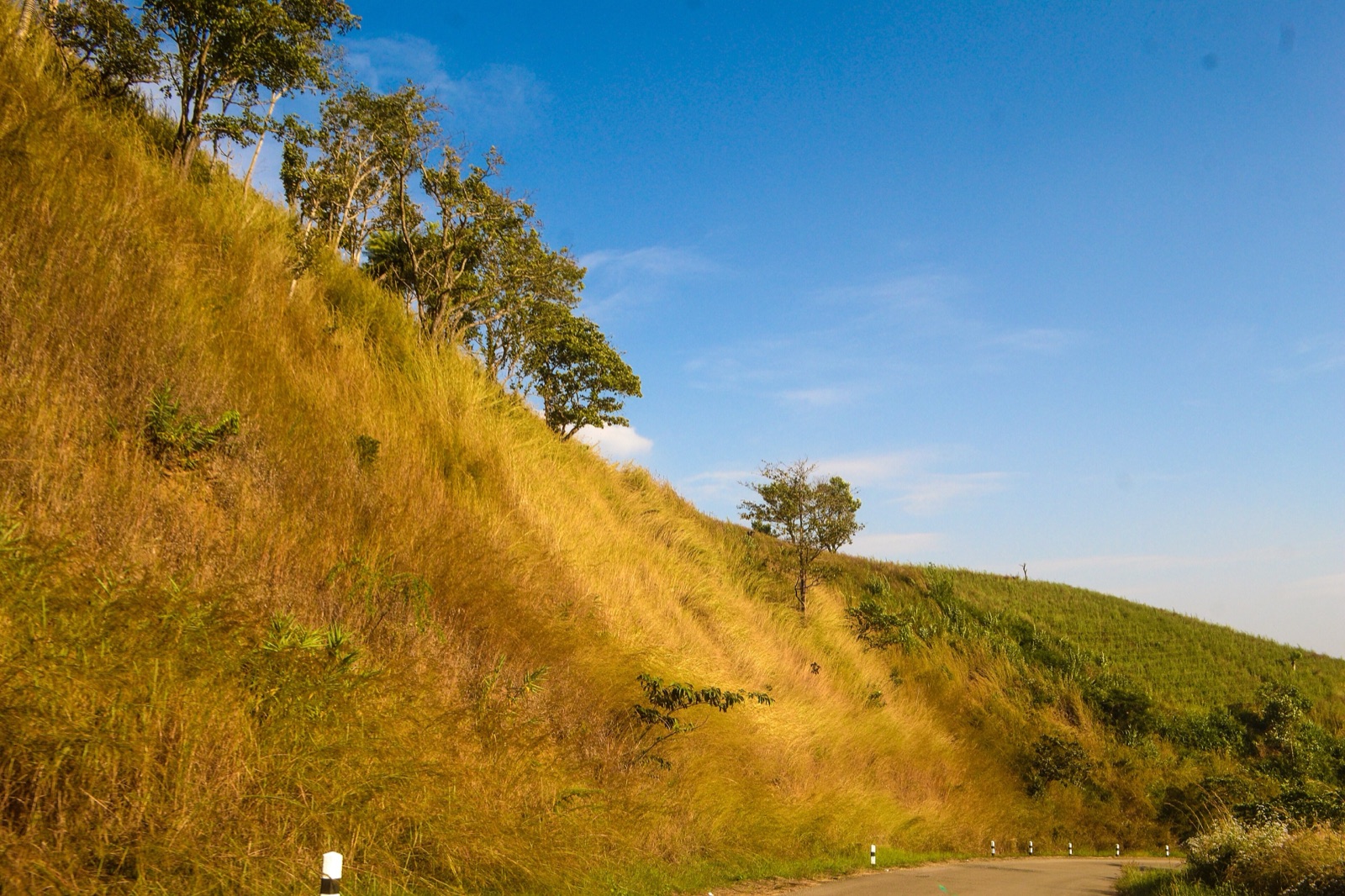
The third idea is the mountains. The song opens with a line the whole world remembers, "Almost heaven, West Virginia" (Bill Danoff, Taffy Nivert and John Denver, "Take Me Home, Country Roads", 1971), followed by mountains and a river. There is a small debate over whether the Blue Ridge Mountains and Shenandoah River in the words fit Virginia better, as e-WV records, while Danoff said his West Virginia friends influenced the song more.
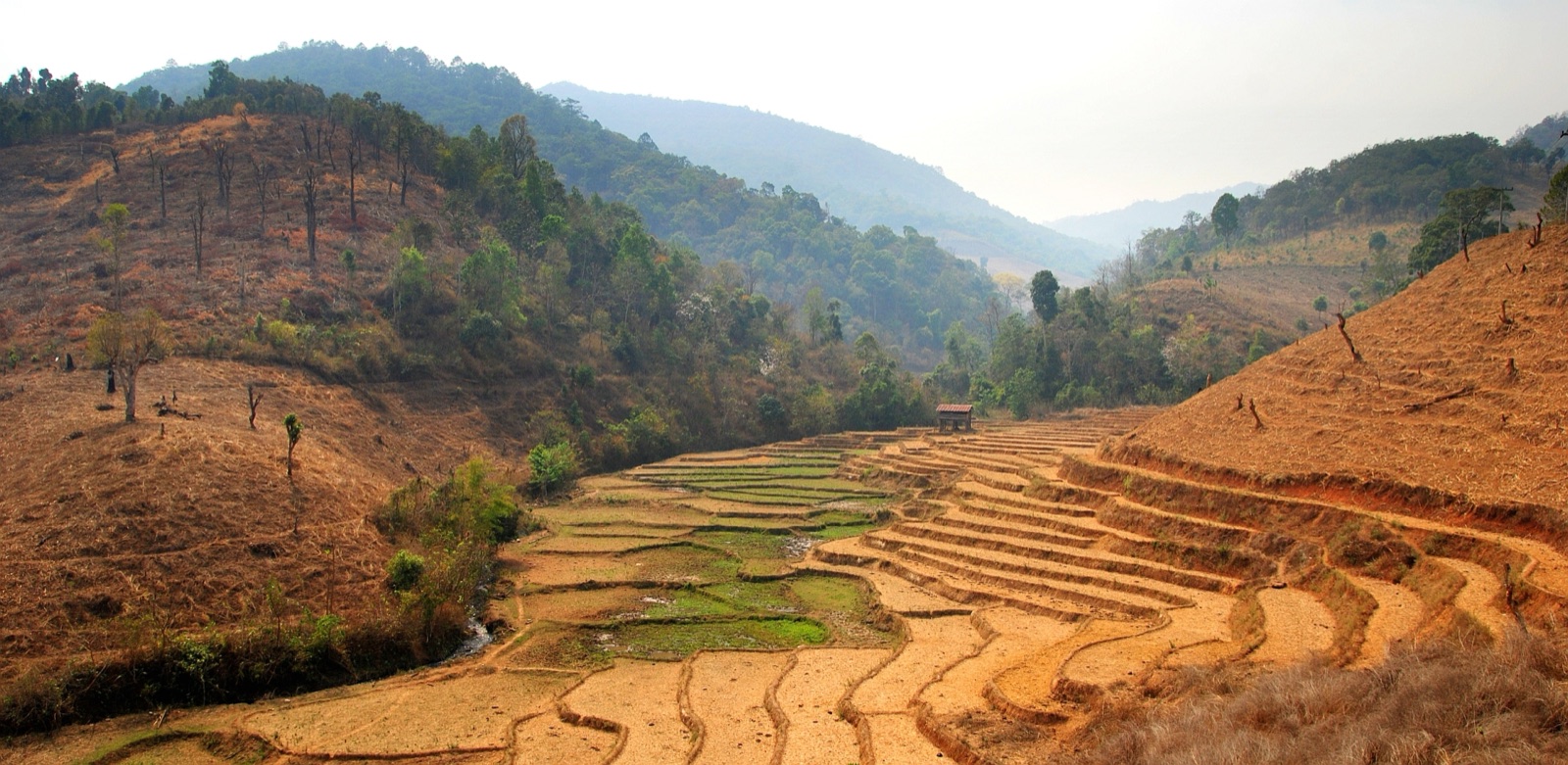
Kham Mueang separates its words for mountains in an interesting way. Doi ดอฯย is a mountain, a high mountain. The dictionary says that if it is not high, it is called mon ม่อฯร (a hill, a peak) or mon doi ม่อฯรดอฯยฯ (the top of a mountain). We do not decide whether the song's ridges would be called doi or mon; we only show that the language has words to choose by height. Pho ผํอฯ means to look at.
Kham Mueang rendering by MoradokLanna: ผ่อดอย ผ่อม่อน ("looking at the mountains, looking at the hills")
Kuet hot ban kao: missing home
The fourth idea is the heart of the song: missing a home that is far away. The dictionary defines kuet hot คึดฯรอฯด simply as to miss, to think of someone or somewhere. Joined to ban kao, it carries the whole song in three words.
Kham Mueang rendering by MoradokLanna: กึ๊ดฮอดบ้านเก๊า ("missing the parents' home")
Ban hao, un chai: home is in the heart
The last idea is that home is not in only one place. Danoff said the song is about "country roads anywhere", as Songfacts quotes him, so listeners around the world put their own home into it. Kham Mueang has a word that catches the feeling: un chai อุ่รไจ, which the dictionary defines as comfortable in mind, relieved of worry.
Kham Mueang rendering by MoradokLanna: บ้านเฮา อุ่นใจ๋ ("our home, a mind at ease")
Kham Mueang words from the song's ideas
| Idea | Kham Mueang words | Dictionary meaning |
|---|---|---|
| Going home | ban kao บ้าฯนฯเคั้าฯ · pik พิกฯ · pa พา · hao เรัา | the house where one was born · to return · to take along · we |
| The road stretching far | hon tang ห฿นฯทาฯงฯ · long ล่อฯง · kai choi woi ไกลฯชอฯยฯวอฯยฯ | path, road · travel from north to south, go down with the water · far out of sight |
| Mountains | doi ดอฯย · mon ม่อฯร · pho ผํอฯ | high mountain · hill, peak · to look |
| Missing home | kuet hot คึดฯรอฯด | to miss |
| Home is in the heart | un chai อุ่รไจ | comfortable, free of worry |
All of these renderings are our own phrasing, built from dictionary words. They are not the only standard way to say it, and people in different parts of the North may say the same idea with other words. We would also like native speakers to check them again.
Compared with Ban Bon Doi: home from two points of view
Jaran Manopetch's song Ban Bon Doi is also a song about home and mountains, but the difference is where the narrator stands. Country Roads is told by someone far from home who is missing it, and says they want to go back. Ban Bon Doi is told by someone who really lives on the mountain, introducing their own home and comparing it proudly with the home of city people, through the words kha and su (see the Ban Bon Doi article for details).
One song says "take me home". The other says "this is my home". They complement each other: the first says how it feels to miss a home far away, and the second says how it feels to be proud of the home you are in. You can start with either song. And for another world song about one person's whole life, read My Way alongside this one.
Summary
- Ban kao is the house where one was born, one's parents' home, and pik ban pik chong is to go back home.
- The dictionary has no headword for "road", but it has hon tang (path, road) and kai choi woi (far out of sight).
- Doi is a high mountain; if it is not high, it is called mon.
- Kuet hot is to miss, and un chai is to be at ease.
- The "Kham Mueang rendering by MoradokLanna" lines in this article retell ideas; they do not translate the song's lyrics.
Look up more of the words in the MoradokLanna dictionary (in Thai). Keep reading in the same series: My Way · Ban Bon Doi or see the whole set at Kham Mueang through songs and literature (in Thai).
Copyright and courtesy
| Item | Details |
|---|---|
| Song | Take Me Home, Country Roads |
| Words | Bill Danoff, Taffy Nivert and John Denver (English, 1971) |
| Music | Bill Danoff, Taffy Nivert and John Denver |
| Best-known recording | John Denver (1971) |
| Status | Under copyright; all rights belong to the authors, publishers and record labels |
This article was made by Moradok Lanna, a non-profit website, for learning the Lanna language and culture. It is not an adaptation, translation or new version of the song. We quote only a few short lines, with credit, for study, criticism and review, as fair use allows (Thai Copyright Act B.E. 2537, section 32). The Kham Mueang lines are our own wording of the song's ideas, not a translation of its lyrics. Embedded videos come from the rights holders' official channels and remain their property.
With thanks and respect to the songwriters, performers and rights holders. If a rights holder would like anything changed or removed, please write to moradoklanna@gmail.com and we will act promptly.
References
- MoradokLanna Dictionary (dict2): ban kao, ban, pik ban pik chong, pik, pa, hao, hon tang, long, kai choi woi, doi, mon, mon doi, pho, kuet hot, un chai.
- Wikipedia. Take Me Home, Country Roads (used as a lead and checked against other sources).
- e-WV: The West Virginia Encyclopedia. Take Me Home, Country Roads
- Songfacts. Take Me Home, Country Roads by John Denver
- John Denver (official channel JohnDenverVEVO). Take Me Home, Country Roads (Official Audio). YouTube
- Moradok Lanna's articles Ban Bon Doi and My Way.
Practise the words from this article
Flip through 15 flashcards of the Lanna words used in this article.
Look up "บ้านเก๊า" in the Moradok Lanna dictionary (in Thai)


