
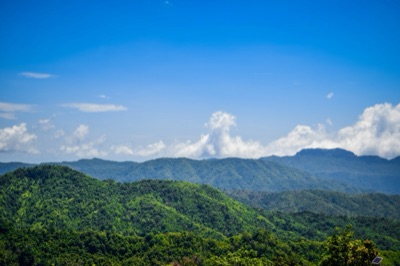
Photo: Nopparuj Lamaikul / Unsplash
What a Wonderful World in Kham Mueang: the Song's Ideas
What a Wonderful World is a worldwide favourite, best known in the warm, gravelly voice of Louis Armstrong. It is about someone who looks around and sees that the world is a marvel: trees, flowers, sky, clouds, passers-by and little children. In this article we ask how a Northerner (khon mueang) would put that feeling into words, and you pick up a good handful of Kham Mueang words for colours and nature.
The best-fitting word in the dictionary is ngam tae งาแท้ (Kham Mueang reading ngam tae), which means truly beautiful, very beautiful.
This is another article in the set World songs in Kham Mueang, within Kham Mueang through songs and literature, following My Way. The song is still under copyright, so we do not translate it line by line, and we quote only two short phrases. What we take from it is its ideas, and then we try saying those ideas in Kham Mueang.
Where the song comes from
The song was written by Bob Thiele and George David Weiss. At the time Thiele was credited as "George Douglas"; Wikipedia notes that his real name has been used since 1988. Thiele was a producer at ABC Records, and Weiss says he wrote the song specifically for Armstrong. The Louis Armstrong House Museum says Thiele conceived it because the United States of the time was divided and he wanted a healing message that only someone like Armstrong could deliver.
Sources differ on who was offered the song first. Songfacts says it was offered to Tony Bennett, who turned it down, but Wikipedia says the Armstrong biographer Ricky Riccardi disputes this. So we only say that the story is told in different ways.
Armstrong recorded it in Las Vegas after his midnight show. Wikipedia and the Louis Armstrong House Museum give the recording date as 16 August 1967, while Songfacts says "April 16", so the sources disagree; we follow the first two. The museum names Tommy Goodman as the arranger.
The song came back to life through the film Good Morning, Vietnam (1987), which used it over scenes of war. The re-issued single reached number 32 on the Billboard Hot 100 (the Louis Armstrong House Museum says 33). Wikipedia records that Armstrong's recording entered the Grammy Hall of Fame in 1999.
Listen to Armstrong's version on the artist's own official channel.

Green trees, red flowers
The song's first idea is to start with what is in front of you: green trees and red flowers. The opening lines paint the picture "I see trees of green" (Bob Thiele and George David Weiss, "What a Wonderful World", 1967), a phrase everyone recognises at once.
Kham Mueang calls a tree ton mai ต้฿นฯไม้; the dictionary explains it as a general word for plants, and calls a flower dok mai ดอฯกไม้. Colours come in many degrees. Khiao ขยฯว is green; for a tree that is fully, richly green you use khiao um hum ขยฯวอุ้มฮุ่ม, which the dictionary renders as lush green. Daeng แดงฯ is red, the colour of blood or cinnabar, and daeng ham แดงฯร่ามฯ is glowing red, used for red things gathered in a large group, such as a whole garden of red flowers.
Kham Mueang rendering by MoradokLanna: ต้นไม้เขียวอุ้มฮุ่ม ดอกไม้แดงฮ่าม ("trees richly green, flowers glowing red")
For more Kham Mueang colour names, see Colours in Kham Mueang, and for tree names, Kham Mueang trees and bamboo.
Sky and white clouds
The second idea is looking up at the sky. The song mentions a blue sky and white clouds, and Kham Mueang has finer words than that. Fa ฟ้า in the dictionary means the visible expanse above that covers the land; it is not the name of a colour, and the dictionary has no word for "sky blue". To say the sky is blue we use ordinary Thai.
Mek เมฆฯฯ is cloud, water vapour that has condensed and drifts in the air in masses, and khao ขาวฯ is white. For white all over, use khao phon ขาวฯผอฯร, which the dictionary glosses as bright white, white everywhere.
Kham Mueang rendering by MoradokLanna: เมฆขาวผอนอยู่ตี้ฟ้า ("white clouds, white everywhere, in the sky")
Day, night, light and dark
The third idea is that both day and night have a beauty of their own. Kham Mueang uses wan วันฯ for the span of time in which the earth turns once on its axis, and khuen ฅืนฯ for the time from dusk to dawn. Muet มืดฯ means lacking light.
Kham Mueang rendering by MoradokLanna: วันดี คืนมืด ("a good day, a dark night")
The word "di" here follows the dictionary's sense of di: beautiful, pleasing. We do not mean a "good day" in the sense of an auspicious date on the Lanna calendar, since that has to be checked on a real calendar.
People greeting one another
The fourth idea is that people passing in the street greet one another, and that the greeting is really a way of saying "I love you". The song tells this picture through handshakes and plain hellos.
Kham Mueang uses tuak ทัวฯก for greeting, chu phu ชุผู้ for everyone, and khon ฅ฿นฯ for a person. Hak รักฯ is love, and for speaking the word is u อู้, meaning to talk, chat, converse. The dictionary has no word for "shake hands", so that idea stays in Thai.
Kham Mueang rendering by MoradokLanna: จุ๊ผู้จุ๊คนตวั๊กกั๋น เหมือนอู้ว่าฮักกั๋น ("everyone greets everyone, as if saying 'I love you'")
To see how young Lanna men and women exchanged greetings in verse, read Kham u bao u sao.
Children are born crying
The fifth idea is the cry of a newborn, and the hope that the next generation will learn more than the last. It is the part of the song that makes it warm.
A child in Kham Mueang is la-on ลอ่อฯร, which the dictionary says comes from "luk on". To cry is hong ร้อฯง, which means to cry, make a loud sound, and also to call. Koet เกิดฯ is to be born, to come into being; hu รู้ is to understand, to know; and lai หลฯายฯ is many, a lot.
Kham Mueang rendering by MoradokLanna: ละอ่อนเกิดมาฮ้อง แล้วจะฮู้หลาย ("a child is born and cries, and will come to know much")
The world is ngam tae
The last idea is the heart of the title: the narrator pauses and concludes that this is a marvellous world. The title line is "What a wonderful world" (Bob Thiele and George David Weiss, 1967).
Kham Mueang uses kuet คึดฯ for to think, to ponder, and hao เรัา for "we". The most direct word of praise is ngam tae งาแท้, truly beautiful, or muan hu muan ta ม่วฯรหูม่วฯรตา, which the dictionary glosses as a delight to see and hear. It grows out of muan ม่วฯร, which means pleasing, enjoyable, sweet to hear.
Kham Mueang rendering by MoradokLanna: เฮากึ๊ดว่า โลกนี้งามแต๊ ("I think this world is truly beautiful")
The words at a glance
| Idea | Kham Mueang words | Dictionary meaning |
|---|---|---|
| Green trees, red flowers | ton mai ต้฿นฯไม้ · khiao um hum ขยฯวอุ้มฮุ่ม · daeng ham แดงฯร่ามฯ | a general word for plants · lush green · glowing red in a large group |
| Sky and white clouds | fa ฟ้า · mek เมฆฯฯ · khao phon ขาวฯผอฯร | the visible expanse above · condensed vapour drifting in the air · bright white |
| Day and night | wan วันฯ · khuen ฅืนฯ · muet มืดฯ | one turn of the earth · dusk to dawn · lacking light |
| People greeting | tuak ทัวฯก · chu phu ชุผู้ · hak รักฯ | to greet · everyone · love |
| Children and the future | la-on ลอ่อฯร · hong ร้อฯง · hu รู้ | a child · to cry, to call · to understand, to know |
| A beautiful world | ngam tae งาแท้ · muan hu muan ta ม่วฯรหูม่วฯรตา · kuet คึดฯ | truly beautiful · a delight to see and hear · to think, to ponder |
All of these renderings are phrasings we put together from dictionary words. They are not the one standard way to say it, Northerners from different places may say the same idea with other words, and a native speaker should check them again.
Compared with Kham Mueang colours and vegetables: beauty close to home
What is special about this song is that it praises nothing far away. It praises the same things we see every day, and that matches the way Kham Mueang names the colours around us. The article Colours in Kham Mueang explains that Kham Mueang has a great many colour intensifiers, such as dam kik ดำกิกฯ, very black, pitch black, or lueang เหิลฯอฯง, yellow, which goes on to become lueang ham or lueang am sam. Each word tells you both the colour and how large the patch of colour is. Kham Mueang garden greens and Kham Mueang vegetable names take you to the green of the kitchen garden and the market.
Compare the two angles. The song says "the world is beautiful" and then goes through the nearby things one by one; Kham Mueang already has many shades of colour for praising nearby things in detail. A vegetable garden can be ngam tae just as much as the sky. For the flowers of the garden, see Lanna flowers, and if you like songs about food, continue with Phak Kat Cho.
Summary
- Ngam tae means truly beautiful, used to praise something lovely from the heart.
- Khiao um hum and daeng ham are colour intensifiers that say the colour fills the space.
- Fa in the dictionary is the sky, not the name of a colour, and there is no word for "sky blue".
- La-on is a child, tuak is to greet, and chu phu is everyone.
- The "Kham Mueang rendering by MoradokLanna" lines in this article tell the song's ideas; they are not a translation of its lyrics.
Look up more of the words in the MoradokLanna dictionary. Keep reading in the same series: My Way · Phak Kat Cho, or see the whole set at Kham Mueang through songs and literature.
Copyright and courtesy
| Item | Details |
|---|---|
| Song | What a Wonderful World |
| Words | Bob Thiele (originally credited as George Douglas) and George David Weiss (English, 1967) |
| Music | Bob Thiele and George David Weiss |
| Best-known recording | Louis Armstrong (1967) |
| Status | Under copyright; all rights belong to the authors, publishers and record labels |
This article was made by Moradok Lanna, a non-profit website, for learning the Lanna language and culture. It is not an adaptation, translation or new version of the song. We quote only a few short lines, with credit, for study, criticism and review, as fair use allows (Thai Copyright Act B.E. 2537, section 32). The Kham Mueang lines are our own wording of the song's ideas, not a translation of its lyrics. Embedded videos come from the rights holders' official channels and remain their property.
With thanks and respect to the songwriters, performers and rights holders. If a rights holder would like anything changed or removed, please write to moradoklanna@gmail.com and we will act promptly.
References
- MoradokLanna Dictionary (dict2): ngam tae, khiao, khiao um hum, daeng, daeng ham, ton mai, dok mai, fa, fa yok, fa bot, mek, khao, khao phon, dam, dam kik, lueang, muet, khuen, wan, tuak, chu phu, khon, hak, la-on, hong, koet, hu, lai, kuet, muan hu muan ta, muan, hao, u.
- Wikipedia. What a Wonderful World (used as a lead and checked against other sources).
- Louis Armstrong House Museum. (2017). 50 Years of "What a Wonderful World"
- Songfacts. What A Wonderful World by Louis Armstrong
- Louis Armstrong (official channel, LouisArmstrongVEVO). What A Wonderful World (Official Video). YouTube
- Moradok Lanna articles My Way, Colours in Kham Mueang, Sky, rain and wind in Kham Mueang, Kham Mueang garden greens.
Practise the words from this article
Flip through 34 flashcards of the Lanna words used in this article.


