
Photo: calflier001 / Wikimedia Commons (CC BY-SA 2.0)
Kham Mueang False Friends: Feelings and Health
Kham Mueang false friends are words that look exactly like Central Thai words, letter for letter, but mean something else in the north. One of the most confusing for newcomers is hiu (หิวฯ). In Bangkok it means "hungry", but the Moradok Lanna dictionary defines it as "having no money, having no strength, weak and exhausted".
This lesson collects about 15 Kham Mueang false friends for feelings and health, all from the Moradok Lanna dictionary. For each one you will see what a Central Thai speaker expects, what a northerner means, and where a mix-up can be embarrassing.
Many of these words also carry their Central Thai meaning in the north today, especially among younger people. This lesson does not say the Central Thai sense is wrong. It shows that when an older northerner uses the word, they may mean something different. Some senses were recorded from the speech of earlier generations, so we write "the dictionary defines it as…".
Hiu does not mean hungry
| Word | Lanna script | A Central Thai speaker expects | The dictionary says |
|---|---|---|---|
| hiu | หิวฯ | hungry | having no money, no strength; weak and exhausted |
| hiu daet | หิวฯแดดฯ | (no such word) | worn out by the sun |
| hiu hon | หิวฯห฿นฯ | (no such word) | worn out by travelling |
| hiu hot | หิวฯหอฯด | (no such word) | drained, exhausted (also hot hiu) |
To say you are hungry the true Kham Mueang way, the dictionary uses khai yak (ไฅ่อยฯากฯ), "to be hungry", as in khai yak khao (hungry for rice). The hungry sense of hiu is heard too: the dictionary's own example under kae is hiu kae, "terribly hungry".
A northern friend sighs, "duean ni hiu tae" (this month I'm really hiu), and you rush to invite them for khao soi. They may laugh, because they probably meant I'm broke, not that their stomach is empty.
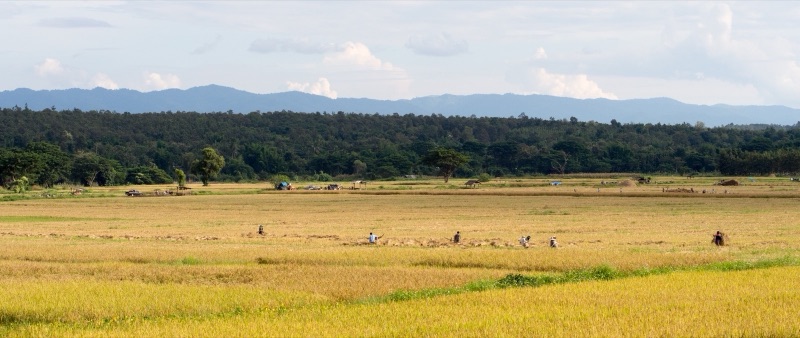
Yak and kan: poor and going without
This pair is also about money and food.
| Word | Lanna script | A Central Thai speaker expects | The dictionary says |
|---|---|---|---|
| yak | ยากฯ | difficult | difficult, yes, but also poor, without money or property, and hardship |
| yak jai | ยากฯไจ | (no such word) | troubled at heart, discouraged |
| kan | กั้ลฯร | to block | to hold back, to go without, to starve, to have nothing to eat |
| kan khao | กั้ลฯรเขั้า | (no such word) | to go without rice |
| kan khao kan nam | กั้ลฯรเขั้ากั้ลฯรนาฯํ้ | (no such word) | to go hungry with no rice or water to eat |
| kan tai | กั้ลฯรตายฯ | (no such word) | to starve to death |
Kan (กั้นฯ) in the Central Thai sense, to block or screen, is also in the dictionary as a separate entry, so you work out which one is meant from the conversation.
Mueai means ill, with a fever
The word to know before you see a doctor is mueai (เมิ่อฯยฯ). The dictionary's first meaning is "unwell, feverish and weak". The Central Thai sense, tired and aching muscles, comes second. In some areas it is said moei.
Under khai (ไข้), "fever", the dictionary adds a note: that word is borrowed, and "in Lanna it is mueai".
| Word | Lanna script | The dictionary says |
|---|---|---|
| mueai nuea mueai tua | เมิ่อฯยฯเนิ้อฯอเมิ่อฯยฯต฿วฯ | to feel achy and shivery, as if coming down with a fever |
| khai jai | ไข้ไจ | heartache from disappointed love, or the restlessness of falling in love |
The third meaning of mueai is about sticky rice. The dictionary says sticky rice that is not glutinous enough to press into a ball is called khao mueai.
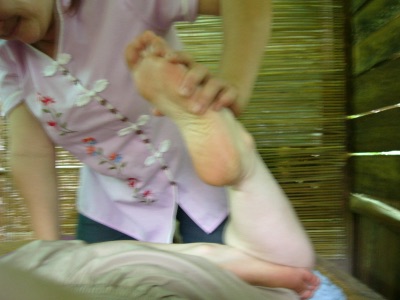
Photo: Mattes / Wikimedia Commons (Public domain)
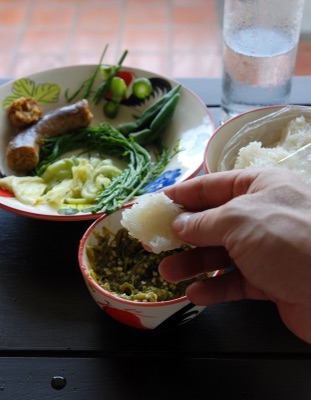
Photo: Takeaway / Wikimedia Commons (CC BY-SA 3.0)
Read more about village healers and herbal medicine in Lanna traditional healers and remedies.
Lambak: careful when you ask after the sick
Lambak (ลำบาฯกฯ) means "hard, inconvenient" in Central Thai. The dictionary's first meaning, however, is "a gravely ill person close to death", followed by a long-lasting fever or disability. The Central Thai sense is there too, but further down the entry. It is also said lam bak.
If an older northerner tells you "mae ui lambak laeo", they may mean grandma is gravely ill, not just having a hard time. Ask with concern, and never joke back "everyone's having a hard time".
Another word about life and death is sia (เสยฯ). The dictionary's first meaning is "to die", before "to get worse, to decay", much like sia chiwit (to pass away) in Central Thai.
Khot, lak, duem: words for feelings
| Word | Lanna script | A Central Thai speaker expects | The dictionary says |
|---|---|---|---|
| khot | โข฿ดฯ | a rocky outcrop | angry, resentful, deeply displeased |
| khueng khot | ขึ้งฯโข฿ดฯ | (no such word) | angry |
| sia jai | เสยฯไจ | sad, sorry | uneasy, upset |
| lak | หลฯากฯ | many, various | unable to decide, infatuated, troubled (and also many, various) |
| lak jai | หลฯากฯไจ | (no such word) | surprised |
| duem | ดื่มฯ | to drink | touching, moving, piercing the heart, profound |
| on jai | อ่อฯรไจ | (no such word) | weary at heart, discouraged, fed up |
The dictionary notes that for drinking water or liquor, northerners usually say kin nam, kin lao (literally "eat water, eat liquor"). Duem in Kham Mueang is more often about feelings: touching, moving.
Taeng, khaeng, khek, yap, on: words for attitude
| Word | Lanna script | A Central Thai speaker expects | The dictionary says |
|---|---|---|---|
| taeng | แต่งฯ | to dress up, to marry | to pretend, to feign (and to arrange, to adorn) |
| taeng hai | แต่งฯไห้ | (no such word) | to pretend to cry |
| khaeng | แข้งฯ | shin | to tease, to pretend, to bully |
| khaeng yia | แข้งฯเยยฯะ | (no such word) | to do something on purpose to annoy, to show off at work |
| khek | เขกฯ | to knock someone's head with a knuckle | to force, to bully, to threaten cruelly |
| yap | หยฯาปฯ | rude | first meaning: tough, enduring, good at bearing hardship |
| on | อ่อฯร | soft | to submit to authority (and gentle) |
In Kham Mueang a person who is yap may be tough and hard-working, able to take hardship, not someone who speaks rudely. The rude, coarse sense is also in the dictionary, so listen to the tone and the topic.
For character words with khi…, read Kham Mueang khi- personality words, and for "don't" sentences with ja pai…, read Ja pai means don't.
Listen to a short dialogue
This example was written by Moradok Lanna from dictionary words.
Puk: Mue ni bo pai aeo kat ka?
Kaeo: Bo pai jao. Duean ni hiu tae, laeo ko mueai ma song wan laeo.
Puk: Mueai ka? Pai ha mo laeo ka?
Kaeo: Pai laeo jao. Sang laeo, bo lambak noe, bo tong huang.
In English: "Not going to the market today?" "No. This month I'm really broke, and I've been ill for two days." "You're ill? Have you seen a doctor yet?" "Yes. It's easing off, I'm not seriously ill, don't worry."
Quiz: 5 questions with answers
- "Duean ni hiu tae" most likely means: I have no money this month (or no energy)
- A northerner says "mueai ma song wan". What should you do: ask if they have seen a doctor, because it means they are unwell, feverish
- The first meaning of lambak in the dictionary: gravely ill, close to death
- How do you say "hungry for rice" in Kham Mueang: khai yak khao
- In the first Kham Mueang sense, a person who is yap is: tough and enduring
Summary
- Hiu in Kham Mueang means broke or drained of strength; hungry is khai yak
- Mueai means unwell with a fever before it means aching muscles
- Lambak first means gravely ill, close to death, so listen carefully when asking after someone
- Yak means poor, and kan means to go without
- Feeling and attitude words such as khot, lak, duem, taeng, khaeng and yap differ from Central Thai, and many can carry the Central Thai meaning too
Look up more words in the Moradok Lanna dictionary, and for words that make northerners smile, read Kham Mueang words locals love.


