
Photo: Blowing Puffer Fish / Wikimedia Commons (CC BY 2.0)
Chiang Mai Place Names: What Doi, Wiang, Kad and Mae Mean
Chiang Mai place names often sound like plain Thai, but many hide Kham Mueang (Northern Thai) words, starting with doi (ดอฯย, Kham Mueang reading doi), which the dictionary explains as "mountain, high mountain", adding "if it is not high, it is called mon". Learn a dozen of these words and the road signs and maps of Chiang Mai become much easier to read.
This article keeps two things apart: what each word means, which we can confirm from the Moradok Lanna dictionary (in Thai), and where a particular name comes from, which needs a source. Where a source explains a name, we say who wrote it. Where the explanation is a legend, we say it is a legend. Where nobody has explained a name yet, we say plainly that we do not know.
13 words hidden in place names
| Kham Mueang (read as) | Lanna script | Dictionary meaning | Example in Chiang Mai |
|---|---|---|---|
| doi | ดอฯย | mountain, high mountain | Doi Suthep, Doi Inthanon |
| mon | ม่อฯร | hill, summit | dictionary examples: Mon Din Daeng, Mon Hua Chang |
| wiang | วยฯง | town, small town, temporary town; also a wall | Wiang Kum Kam |
| kad | กาดฯ | market | Kad Luang |
| chaeng | แจ่งฯ | corner | Chaeng Si Phum |
| pang | ปางฯ | a resting place in the forest, a temporary stop, a stop on the way | Ban Pang Hai (Doi Saket) |
| huai | ห้วฯยฯ | a deep water source in the forest, with streams running down from the mountain | Huai Tueng Thao |
| nong | หนฯอฯง | a pool of water larger than a small pond, natural or dug | Nong Hoi (subdistrict) |
| sop | ส฿ปฯ | where two or more rivers meet | Sop Tia (Chom Thong) |
| san | สันฯ | a prefix on place names: a rise with a lot of something | San Kamphaeng, San Sai |
| ta (Thai tha) | ท่าฯ | a landing place on a river bank, a mooring | Tha Phae |
| khua | ข฿วฯ | bridge | Khua Lek (Nawarat Bridge) |
| nam mae | นาฯแม่ | river: a large watercourse where many streams gather | Mae Rim, Mae Taeng |
The dictionary has the word khuang pa-tu ta pae (ref 1401), "the square in front of the Tha Phae Gate", which shows tha pronounced ta. The second part, raft (แพ, Kham Mueang reading pae), is explained as "wood or other material tied together in large numbers, used as a vehicle on water".
Try decoding a name yourself
Pick a place name in the widget below to see which words it is made of, what each word means, and whether the origin of the name is documented. A green box means a source explains the origin, purple means a legend, and amber means no confirmed origin yet.
Doi and wiang: names told through legend and royal names
Doi Suthep. According to the legend told by Asst. Prof. Dr. Phiphat Krachaechan in THE STANDARD (2018), a son of Pu Sae and Ya Sae became a hermit named Wasuthep (Sutheva), and the mountain took a new name from him; before that it was called "Doi Oi Chang". This is a legend, not settled history. Read about Pu Sae and Ya Sae in Pu Sae Ya Sae.
Doi Inthanon. The Moradok Lanna dictionary itself records that the mountain was first called "Doi Ang Ka" and was renamed "Doi Inthanon" in honour of King Inthawichayanon, the 7th ruler of Chiang Mai, by his birth name "Chao Inthanon", after Princess Dara Rasmi enshrined his ashes there in 1915. As for "Ang Ka", MGR Online (2024) retells a tale of a pool on the summit where crows liked to bathe.
Wiang Kum Kam. The first part is clear: wiang (วยฯง, Kham Mueang reading wiang) means a town, a small town or a temporary town. For "Kum Kam" we found no reliable source that explains the meaning. The Fine Arts Department (Office 7, Chiang Mai) quotes a chronicle passage that spells the name differently, as "Chiang Ku Mokwam". So we do not guess. To read more about the town, see Wiang Kum Kam: a drowned city?
Kad Luang and the chaeng: city names with a source
Kad Luang is what locals call Warorot Market. The official name honours Chao Inthawarorot Suriyawong, ruler of Chiang Mai. MGR Online (Thitiya Thaothammaphitak, 2011) reports that it was first built in 1910 by Princess Dara Rasmi, who pooled her own funds with those of Chao Inthawarorot.
The dictionary gives luang (หลฯวฯง, Kham Mueang reading luang) two meanings: "big, large" and "belonging to the king". The common reading of Kad Luang as "the big market" matches the first. More market words are in Kad: market words in Lanna.
The four corners of the Chiang Mai city wall are called chaeng (แจ่งฯ, Kham Mueang reading chaeng), meaning corner. The Sirindhorn Anthropology Centre's archaeology database (citing Sasithorn Uichareon, 2004) describes all four.
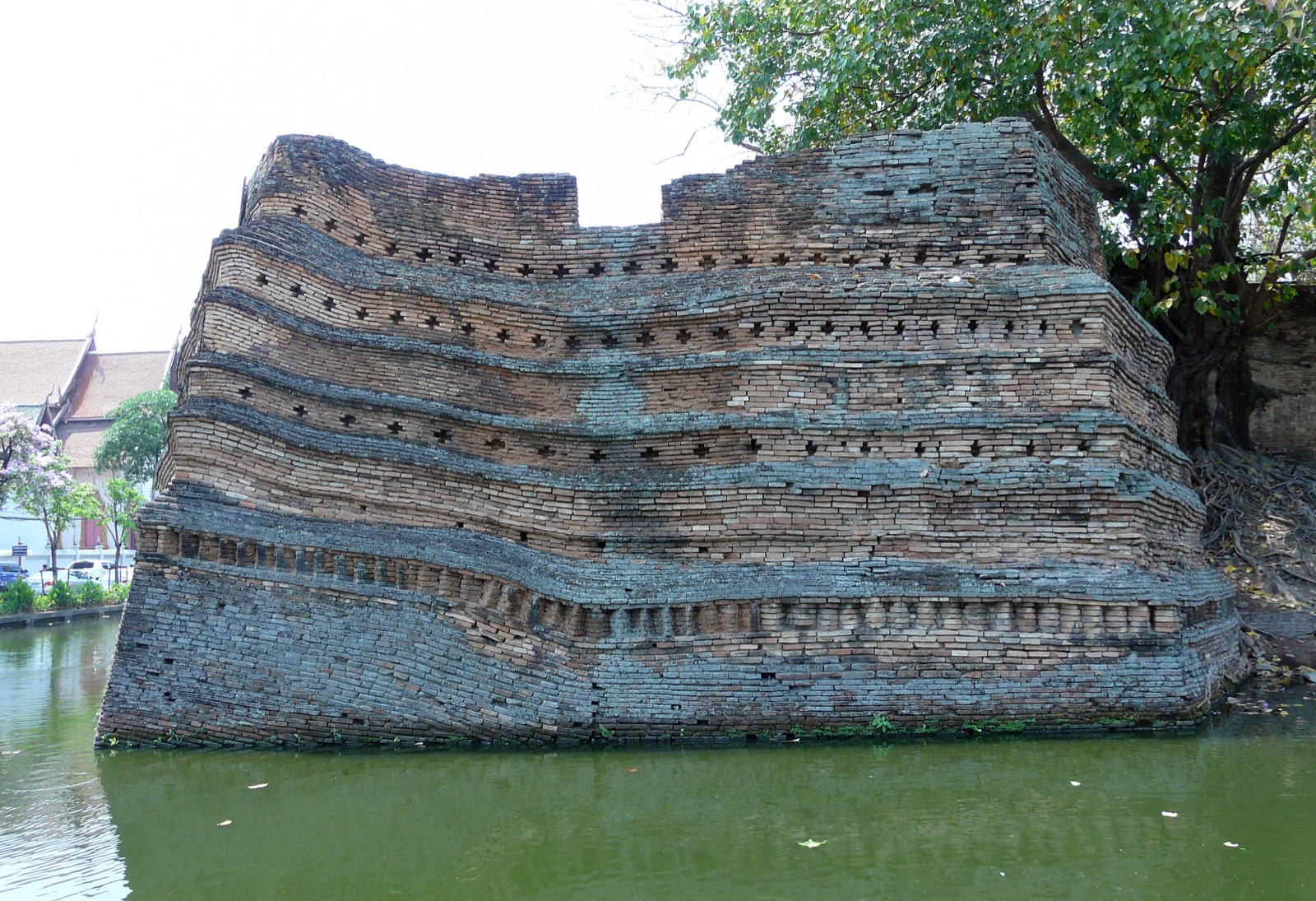
Photo: Hartmann Linge / Wikimedia Commons (CC BY-SA 4.0)
| Chaeng | Direction | Origin according to the database |
|---|---|---|
| Chaeng Si Phum | north-east | Wall building in 1296 (B.E. 1839) started here, because of a banyan tree that local people believed to be auspicious (the database does not explain the words Si Phum) |
| Chaeng Kha Tam | south-east | Kha tam means catching fish: this corner is lower than the others and where the water channels meet, so fish gathered |
| Chaeng Ku Hueang | south-west | The ashes of Muen Hueang were once kept in front of this corner (ku, กู่, is a stupa or shrine that holds ashes) |
| Chaeng Hua Lin | north-west | The corner higher than the rest, where water entered the city and was sent along the channels; the database does not explain the name |
One observation: lin (ลินฯ, Kham Mueang reading lin) is a water chute in the dictionary, which fits the role of Chaeng Hua Lin, but the source we read does not say this is the origin of the name. It is an observation, not an explanation. For the whole story of the city, read Chiang Mai (Jiang Mai): Nakhon Phing.
Tha Phae and Suan Dok are also gate names. The same database says the outer Tha Phae gate was the way out to the Ping River landing, and the Suan Dok gate was the way to the king's park. The meanings of the words fit the places (tha is a landing; suan (สวฯร, Kham Mueang reading suan) is a fenced plot of plants and trees; dok (ดอฯก, Kham Mueang reading dok) is a flower), but the source does not tell the story of the names, so we only say what each is made of. For Wat Suan Dok, see King Kue Na and Wat Suan Dok.
"Mae" does not always mean mother
Northern place names are full of the word mae. Lanner (Phakamat Krainara, 2024) counts 6 districts of Chiang Mai that carry it (Mae Chaem, Mae Taeng, Mae Rim, Mae Wang, Mae On and Mae Ai) and 31 subdistricts.
The dictionary lists nam mae (นาฯแม่, Kham Mueang reading nam mae) as "river: a large watercourse where many streams gather". Lanner explains that in the north a big river is called "nam mae", for example Nam Mae Ping, and place names then put mae in front of the river's name. On its own, mae (แม่, Kham Mueang reading mae) in the dictionary means a mother, or a head or leader.
- Mae Rim and Mae Taeng. Lanner, citing the Chiang Mai City Heritage Centre, says many districts in Chiang Mai are named after rivers flowing through them, including these two. "Rim" is the river's own name; we found no source explaining its meaning.
- Mae Ai is not named after a river. Lanner says it is tied to the legend of the revered "Chao Mae Malika".
The dictionary has him (read rim), "edge, border", which sounds the same, but no source confirms a link to the name Mae Rim. Without a source, we do not join the two.
Pa Daet, Huai Tueng Thao, Hang Dong: when no source explains the name
For some names we found no reliable source for the origin. What we can say is what each word means.
- Pa Daet (a subdistrict in Mueang Chiang Mai). Pa (ป่า, Kham Mueang reading pa) is "an area densely covered with trees in a large continuous stretch", and daet (แดดฯ, Kham Mueang reading daet) is sunlight. But place names are not always literal, so we do not conclude what Pa Daet means.
- Huai Tueng Thao. Huai (ห้วฯยฯ, Kham Mueang reading huai) is a forest water source with streams from the mountain. Tueng (ทึงฯ, Kham Mueang reading tueng) in the dictionary is the phluang tree (and also means "all"), which might suggest a name taken from a tree, but there is no source, and thao is not in the Moradok Lanna dictionary.
- Hang Dong. Hang (หางฯ, Kham Mueang reading hang) means "far off, the rear, the end" in the dictionary, and dong (ด฿งฯ, Kham Mueang reading dong) is dense forest. No source explains the district's name.
- San Kamphaeng and San Sai. The dictionary explains that san (สันฯ, Kham Mueang reading san) heads a place name to show the place is a rise with something as its main feature, and gives San Kamphaeng as a direct example, but it does not say what the "wall" in the name is. For San Sai, which contains sai (ซายฯ, sand), reading it as a sandy rise follows the word pattern; it is not a confirmed origin.
How are Lanna village names made?
Sansanee Saitip, Kochai Sarikabut and Rangsan Chanta (2016) studied 109 village names in 11 subdistricts of Hang Dong District and sorted them into 9 groups: plants, geography, history, legend or tale, buildings and places, leaders or notable people, administrative divisions, animals, production or occupation, and translation between languages.
That tells us that "named after a tree" and "named after the lie of the land" are both possible, but to say which one applies to a given name, you need evidence for that name.
How to read a place name without guessing
- Split the name into words, for example huai + tueng + thao.
- Look up each word in the dictionary. A word's meaning is not an explanation of the name, and one word can have several meanings. For example, hai (ไร่, Kham Mueang reading hai) in the dictionary is an upland field, and there is also a word hai for the fig tree. So for Ban Pang Hai (pang, ปางฯ, is a temporary resting place in the forest) we cannot decide what hai is.
- Look for a source that explains that name directly: a dictionary, a research paper, an archaeology database, or media that cite their sources.
- If you find no source, stop at "not known". Old place names changed shape many times, and an explanation that sounds right can be wrong.
Summary
- Chiang Mai place names are made of Kham Mueang words you can learn: doi, wiang, kad, chaeng, sop, san, huai, nong and nam mae.
- The meaning of a word can be confirmed from the dictionary, but the origin of a particular name needs a source for that name.
- Names with an explaining source include Doi Inthanon, Kad Luang and the corners of the city wall. Doi Suthep and Mae Ai are legends.
- In northern place names mae is usually a prefix on a river's name, but not everywhere (Mae Ai).
- Names such as Wiang Kum Kam, Pa Daet and Hang Dong have no source for their origin yet, so we do not guess.
Look up more Kham Mueang words in the Moradok Lanna dictionary (in Thai), and read more about nature words in Kham Mueang Sky, Rain and Wind Words.
Sources
- The Moradok Lanna dictionary (in Thai): ดอย · ม่อน · เวียง · กาด · หลวง · แจ่ง · ป๋าง · ห้วย · หนอง · ส๋บ · สัน · ต้า · แป · ขัว · น้ำแม่ · แม่ · อินทะนนท์ · กู่ · ลิน · ตึง
- Sirindhorn Anthropology Centre. ป้อม คูเมือง กำแพงเมืองเชียงใหม่ [Chiang Mai fort, moat and city wall]. Archaeological sites database of Thailand (citing Sasithorn Uichareon, 2004)
- Thitiya Thaothammaphitak. (28 January 2011). หนึ่งศตวรรษ "กาดหลวง" มนต์เสน่ห์วันวานมิจางหาย [A century of Kad Luang]. MGR Online
- MGR Online. (23 July 2024). มหัศจรรย์ "อ่างกา" สวยแปลกตา ป่าดึกดำบรรพ์ บนยอด "ดอยอินทนนท์" [The wonder of "Ang Ka" on Doi Inthanon]
- Phiphat Krachaechan. (30 April 2018). ดอยสุเทพทำไมจึงศักดิ์สิทธิ์ ศูนย์กลางศาสนาผี-พุทธ และสัญลักษณ์ทางการเมือง [Why is Doi Suthep sacred]. THE STANDARD
- Phakamat Krainara. (12 August 2024). ในภาคเหนือมีคำว่า "แม่" ในชื่อจังหวัด ตำบล และอำเภอกว่า ๑๕๙ ชื่อ [Over 159 northern place names contain "mae"]. Lanner
- Saitip, S., Sarikabut, K., & Chanta, R. (2016). ภูมินามท้องถิ่น: ที่มา ความหมาย และอัตลักษณ์ของชื่อหมู่บ้านในอำเภอหางดง จังหวัดเชียงใหม่ [Local toponymy: village names in Hang Dong District]. Ganesha Journal 12(2)
- Fine Arts Department, Office 7 Chiang Mai. กำเนิดเวียงกุมกาม [The founding of Wiang Kum Kam]
- The "Chiang Mai place-name decoder" widget: word meanings from the Moradok Lanna dictionary; name origins from the sources above
Practise the words from this article
Flip through 29 flashcards of the Lanna words used in this article.


