
Lilit Phra Lo: Real, Legend or Fiction?
Lilit Phra Lo is the tragic love poem every Thai student meets at school: Phra Lo of Man Suang follows the rumours of two beautiful princesses, Phra Phuean and Phra Phaeng of Sarong, and all three die together. Phrae province calls itself "home of Phra Lo's love" in its motto, Phayao has raised a statue of Phra Lo at the old town (wiang, วยฯง) of Wiang Lo, and another group of scholars says the towns in the story were never in Lanna at all.
This article is part of the Fact or Tale series. We do not rule on whether the Phra Lo story happened. We take it apart and show which pieces are on record in a form you can check, which exist only in the text of the poem, which later readers added, and which scholars still dispute, reading all 660 stanzas of the poem against the research.
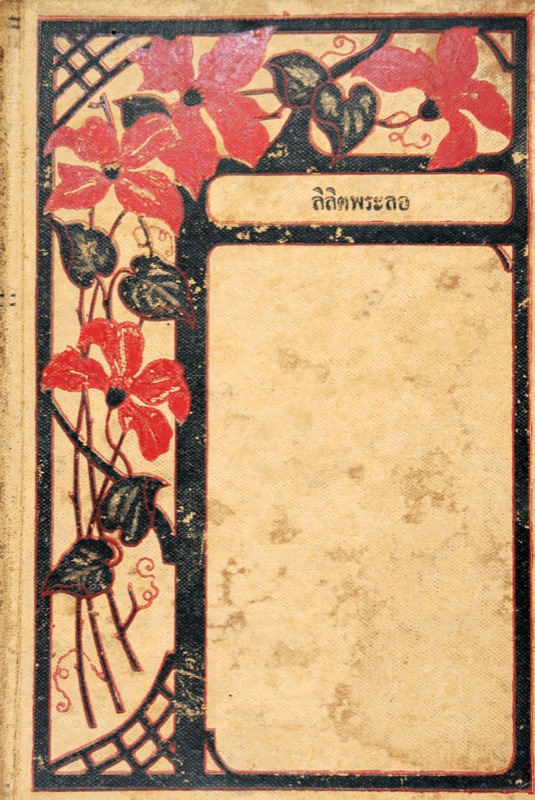
The cover image is a black folding-book (samut thai) copy of Lilit Phra Lo kept by Chiang Mai University Library. This page holds the stanza people remember best: "Siang lue siang lao ang, an dai phi oei" ("The rumours, the tales told, what are they, sisters?").
What Lilit Phra Lo tells
In the poem, King Man Suang and Queen Bun Luea have a son, Phra Lo. In Sarong, King Phimphisakhon has a son, King Phichai Phitsanukon, whose two daughters are Phra Phuean and Phra Phaeng. The two cities once fought: Man Suang's army killed King Phimphisakhon, and the grudge lives on in his widow, the princesses' grandmother (Somkiat Wanthana, 2019; TAT magazine Anusan Osotho, 2009).
Phra Lo's beauty becomes famous through so (ซํอฯ), Lanna sung verse: stanza 21 says "they sang so to praise the king in every town". The princesses fall in love; their nurses Ruen and Roi send singers to praise their mistresses in Phra Lo's city and ask Pu Chao Saming Phrai, a sorcerer, for a love spell. Phra Lo leaves his mother with his companions Kaeo and Khwan, crosses the Kalong river, and follows a rooster (kai, ไก่) sent by Pu Chao into the palace garden of Sarong.
King Phichai Phitsanukon learns of it, forgives them and plans a wedding, but the grandmother forges a royal order and sends soldiers. The four companions die, and Phra Lo and the princesses fight until they fall. Stanza 607 says "guns struck him" and the soldiers "rained poisoned arrows"; the three die standing, leaning on one another. The king punishes the grandmother and the soldiers and holds a royal cremation, and stanza 656 tells that the relics were split in two: half stayed in Sarong and half went to Suang, and both cities built stupas (Somkiat, 2019).
Everything in this section is in the text of the poem, not a record of events. We quote the text as published by the Vajirayana Library, which follows the Fine Arts Department edition of 1953.
Who wrote it, and when: still an open question
Lilit Phra Lo does not clearly name its author. The two closing stanzas even contradict each other: stanza 659 says "completed, composed by the great king", stanza 660 "completed, crafted by the young prince". The opening verse, on the other hand, says the poet wrote it "to please the king", that is, for a king rather than by one.
Prince Damrong Rajanubhab explained in the Literature Society bulletin (quoted in the Fine Arts Department's 1953 preface) that the two closing stanzas were probably added later, and concluded that the poem was written in early Ayutthaya by one of three kings, Borommarachathirat III, Ramathibodi II or Borommaracha Nor Phutthangkun: "any one of them, it cannot be known for sure". His main argument was that the Chindamani, the Thai primer written by Phra Horathibodi in King Narai's reign, quotes the stanza "Siang lue siang lao ang" as its model of the khlong si verse form, and that lilit poems were in fashion in early Ayutthaya.
The Fine Arts Department found something to think about too. Its 1953 preface says that when it checked 7 black folding books in the Vajirayana Library, the last stanza read "the great king" in every copy and never "the young prince" as in the printed editions. The printed editions also misspell the princesses' city as "Suang", the same as Phra Lo's, where all 7 manuscripts write "Sarong".
Other scholars have proposed other periods:
- After 1503, at the court of Ramathibodi II. Sumalee Veravong (2006) and Chonlada Ruangraklikhit (2010) noticed that near the end the princesses' mother recalls them bowing to the Phra Si Sanphet Buddha image, which the chronicle says was cast and celebrated in 1503 (Somkiat, 2019; TAT magazine, 2009).
- King Chairacha's reign (1534–1546). Niyada Laosunthorn points to the wars between Ayutthaya and Chiang Mai and the guns in the story (TAT magazine, 2009; Wikipedia).
- King Narai's reign (1656–1688). An older view the TAT magazine still mentions; Chanthit Krasaesin held that Phra Horathibodi wrote the poem himself and so could quote his own stanza in the Chindamani (as Sujit quotes him in Matichon Weekly, 2021).
- The early Bangkok period. Sujit Wongthes (2021), citing Chanthit, says the oldest handwritten Chindamani (1782) does not contain the stanza, which first appears in a copy written under Rama III, and that the oldest Phra Lo manuscripts are also Rama III scribal copies. He therefore holds that the version read today was written or rewritten in the Bangkok period.
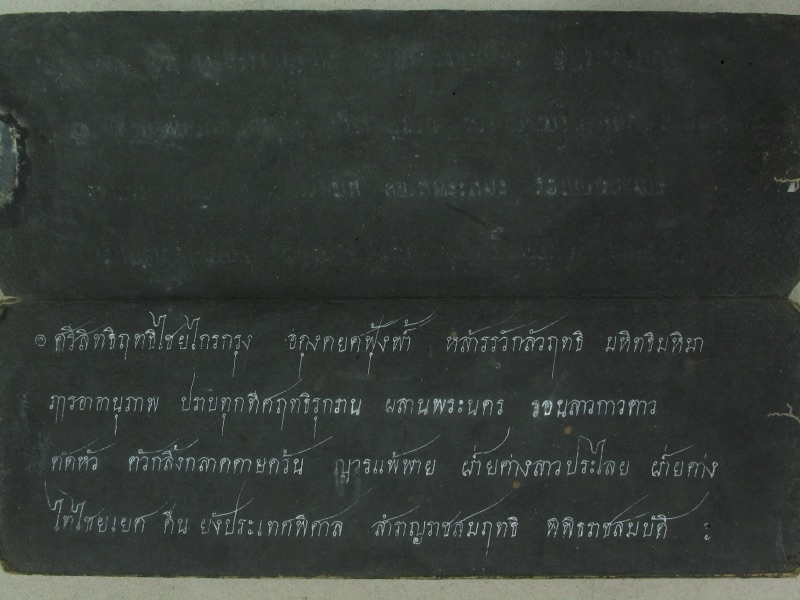
That opening verse is what scholars use as a dating point, because it praises Ayutthaya's victory: "the Yuan side was defeated, the Lao side destroyed". In Ayutthaya literature Yuan is the name the Ayutthaya side used for the people of Lanna, who call themselves khon mueang. Since the poem mentions war with Chiang Mai, each scholar links it to a different war. You can see all the views on one timeline in the "Who wrote it, and when" tab of the widget below.
Where the text puts the towns
Before asking which province Sarong is in, look at what the poem itself says. The answer: very little, and no river or mountain that matches a real map.
| Stanza | The text says | What it tells us |
|---|---|---|
| 5 | "ชื่อพระลอดิลกล่มฟ้า ทิศตวันออกหล้า" | Phra Lo's city of Man Suang lies in the east |
| 6 | "ทิศตวันตกไท้ท้าว อคร้าวครอบครองยศ" | King Phimphisakhon of Sarong is the king of the west, equal in wealth |
| 286 | "ถึงแม่น้ำกาหลง ปลงช้างชิดติดฝั่ง" | Phra Lo has timber lashed into a raft (pae, แพ) to cross the river |
| 296–297 | "น้ำชื่อกาหลงไหล เชี่ยวแท้" | Phra Lo asks the river for a sign; it swirls red as blood |
| 317 | "พระลอมา ฝั่งน้ำ กาหลงฝ่ายแดนรา" | Sarong treats the Kalong as its own border; Pu Chao lives on a "rock peak" |
| 656 | "ธาตุสามกษัตริย์แห่งละกึ่ง" | the relics are split between two cities, and both build stupas |
So in the text Suang lies east, Sarong lies west, and a river (nam mae, นาฯแม่) called the Kalong runs between them. Sujit Wongthes (Matichon, 2016) reads it the same way, but Somkiat (2019) and the TAT magazine (2009) summarise it the other way round, with Suang in the west and Sarong in the east. Even a detail as simple as direction can flip in works that mean to follow the text.
From the text to the map: where is Sarong?
Since the text names no real place, scholars of several generations have tried to put its towns on the map. At least four answers have been proposed and are reported by more than one source.
1. Wiang Song in Phrae, and Wiang Kalong. Phra Worawet Phisit placed Sarong on the Yom river "north of the town of Rong Kwang", which is today's Song district, and Suang perhaps at a town called Kalong towards Lampang (Chaweewan and Phatnari, 2016). Sujit says the Song–Wiang Kalong identification came from Bangkok scholars about seventy years ago (before 1957) and rests on the likeness of the names Sarong and Song.
2. Wiang Lo in Chun district, Phayao. The TAT magazine (2009) reports the local belief that this old town, split in two by the Ing river, was Man Suang, and describes a statue of Phra Lo holding two swords. It also records the objection that Wiang Lo lies north of Wiang Song and that the road between them crosses no Kalong river. Sujit (Silpa Wattanatham, 2021) says the "Lo" in the town's name comes from la-o, "beautiful", and that the town was tied to Phra Lo only recently.
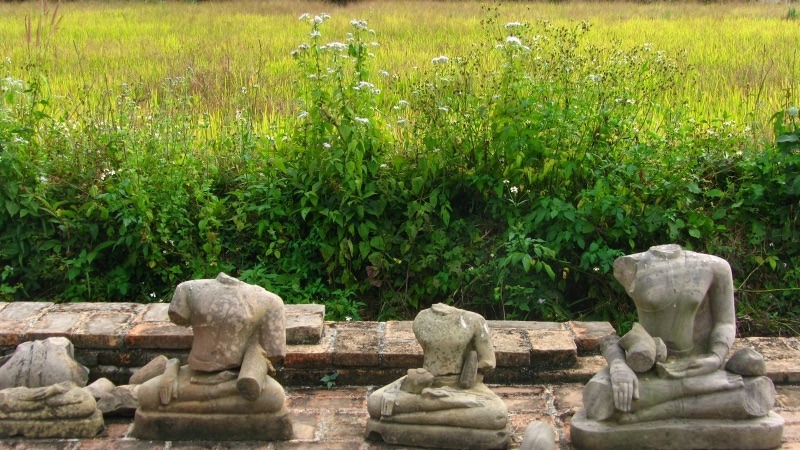
3. Wiang Kalong. The TAT magazine finds Wiang Kalong the most fitting Man Suang because its name matches the river in the story, but the sources place it differently: the magazine puts it in Wang Nuea, Lampang, while Sujit and an old map put it in Wiang Pa Pao, Chiang Rai. Sujit explains the name from the Mae Ka stream splitting off as a "lost stream" (nam long), and says Wiang Kalong was a ceramic-kiln centre around 1450 CE with nothing to do with Phra Lo.
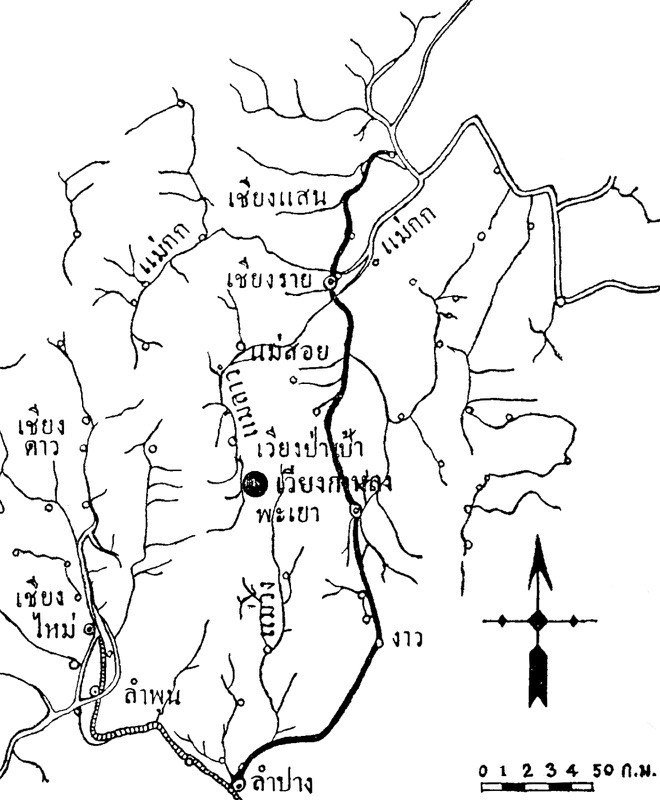
The TAT magazine and the Nakhon Phanom University study also mention the suggestion that the name Mae Suai in Chiang Rai may come from "Man Suang"; both say there is no evidence for it.
4. Phayao and Luang Prabang. Sujit Wongthes reads the story quite differently. Phra Lo's Man Suang is Luang Prabang, because in the Khun Borom legend the eldest son who ruled Luang Prabang was called Khun Lo; Sarong is Phayao, because the princesses descend from Thao Hung Thao Chueang; and the Kalong is the Mekong (Matichon, 2016; Silpa Wattanatham). Yet he also stresses that Phra Lo is "a novel" and its cities are invented names borrowed from older tales, not places where events happened.
Try placing each answer on the map yourself. The widget below puts Sarong and Suang where the answer you pick puts them, works out which way one lies from the other, and compares that with stanzas 5–6, both as the text has it and as some writers reverse it. The comparison covers direction only; it does not decide which answer is right.
Song district today: the park, the statues and the stupa
Whatever the scholarly answer, in Song district the Phra Lo story has become part of community life. The Lilit Phra Lo park in Ban Klang subdistrict opened officially on 18 December 2006 on about 33 rai (TAT magazine, 2009). At its centre stand statues of Phra Lo and the two princesses dying side by side, as in the story's ending. The magazine recalls that the statues made the news when scholars objected that in the story the princesses fight disguised as men, while the statues wear Lanna women's dress; Sujit calls them a product of "recently made official textbooks" (Matichon, 2016).
Nearby is Wat Phra That Phra Lo, whose small stupa the TAT magazine says "is believed" to hold the ashes of Phra Lo and the princesses. In Kham Mueang such a monument can be called a that (ธาฯตฯ) or a ku (กู่), which the dictionary explains as a memorial holding the ashes of the dead. Sujit, however, records that villagers used to call this stupa "That Hin Som", after the orange colour of its crumbling brick and stone, and that it was renamed Phra That Phra Lo only a few years ago. The TAT magazine itself noted that, at the time, Wiang Sarong had not been properly excavated, unlike Wiang Kum Kam, which the Fine Arts Department has dug systematically since 1984.
The park also has a shrine (san, ศาลฯฯ) to Pu Chao Saming Phrai, where people come to ask for a partner. Song district holds a yearly fair, "Cultural ground: carrying on the Lilit Phra Lo legend, asking blessings of Pu Chao Saming Phrai", with processions of offerings, northern so singing and activities by Song Phitthayakhom School; the 2021 fair, on 29 December, was the ninth (Thailand Plus, 2021; Chaweewan and Phatnari, 2016). The shrine and its rites are local beliefs, told here as the sources record them.
As for Wiang Song itself, Sujit (citing Srisakra Vallibhotama) explains it as an old community that grew into a moated town around 1450 CE, on the route linking Sukhothai, Phrae, Nan and Phayao; Wiang Lo is of about the same age. Both are real old towns of Lanna that were tied to the poem later. Read about the whole province at Phrae, Mueang Pae: the dictionary records Phrae's motto under Mueang Pae (mueang pae, เมิอฯงแระฯพ่). Wiang Lo in Phayao (phayao, พะเยัา) is covered in Phayao, city of the kwan.
Phra Lo in so singing and on the stage
If the Phra Lo story is tied to Lanna, the clearest trace may be a melody rather than a town. Prince Damrong called it "a tale from the Lanna country (that is, Monthon Phayap)", and Sujit (Matichon Weekly, 2021) holds that the story came south from the Mekong basin with the tradition of so singing; the text itself mentions singing so twice.
Today so ensembles of Nan and Phrae still play the Phra Lo melody, or Phra Lo Long Nan (long nan, ล่อฯงนาฯ), which the dictionary describes as a so melody popular in Nan province. Thao Sunthon Photchanakit also wrote a so called "Phra Lo walks the forest". But Chutiphong Kongsunthia (2013) warns that there is no evidence the Phra Lo melody arose in eastern Lanna; we tell this in detail in Noi Chaiya: learning Kham Mueang from the song. The melody's name shows that the Phra Lo story was known in Lanna; it does not show where the story happened.
In central Thailand the story went on stage many times. Narumol Khunsumrit and Tanakorn Suwanampha (2024) found 6 Phra Lo play scripts, among them the lakhon phanthang dance-drama by Prince Narathip Praphanphong, whose troupe performed it for King Chulalongkorn, first in 1908 according to that study. The water-omen scene and "Pu Chao calls the rooster" are still taught as set dances at the College of Dramatic Arts (Phichaya Bowornitthikorn, 2020). In 1916 the Literature Club named Lilit Phra Lo the finest lilit poem (Somkiat, 2019; TAT magazine, 2009), and it entered the school syllabus and became known across the country. The same prince also wrote the sung play Sao Khruea Fa, which many people take for a true northern story.
Piece by piece: on record, or added later?
Sort the story yourself. The widget below splits the Phra Lo story into 16 pieces: read each one and tap the box you think fits to see the reason and the sources. The second tab shows how the story grew, from the text of the poem to the yearly fair in Song; press "Compare" on two versions to set them side by side.
Common misunderstandings: what the sources show
The Phra Lo story has been retold in classrooms, on signs and in tourism until some details sound like facts. Below are sentences you often hear, and what the sources in this article say.
"We know who wrote it, and it was certainly early Ayutthaya"
Prince Damrong himself wrote "it cannot be known for sure". The proposed dates run from early Ayutthaya to the early Bangkok period, and even the key evidence of the Chindamani has been questioned (Sujit, 2021).
"Sarong is Song district, and the Kalong river flows through Song"
This is the guess of early scholars and a local belief (Chaweewan and Phatnari, 2016; TAT magazine, 2009). The poem names neither the Yom river nor any place on a real map, and Sujit takes "song" as an old word meaning "prosperous", not a reference to the two princesses.
"Phra Lo's grave is at Rong Kwang"
We found no source that says so. What we found is Phra Worawet Phisit's guess that Sarong lay "north of the town of Rong Kwang", which is today's Song district, and the stupa at Wat Phra That Phra Lo in Song that the TAT magazine says "is believed" to hold the ashes. In the poem the relics are split between two cities.
"Phra Lo was killed by arrows"
Stanza 607 has both "guns" and "poisoned arrows". The scholar who dates the poem to King Chairacha's reign uses these very guns as a clue.
"Scholars have decided the story is true, or wholly invented"
There is no settled answer. The TAT magazine and the study in Song district report a belief that the story grew from real events in the 11th–12th century CE, while Sujit sees a novel with no real people. In the sources we read, no inscription or chronicle names Phra Lo, Phra Phuean or Phra Phaeng. In Kham Mueang a story like this is a tam nan (ตํานาฯ), a legend each place tells its own way; the beliefs in spirits (phi, ผี) and deities that Pu Chao Saming Phrai commands belong to the world of the poem.
Summary
- Lilit Phra Lo survives as a 660-stanza text and many folding-book copies, but its author is unknown; proposed dates run from early Ayutthaya to the early Bangkok period.
- The text puts Man Suang in the east and Sarong in the west with the Kalong river between them, and names no real place.
- Placing Sarong at Song, Phra Lo's city at Wiang Lo or Wiang Kalong, and the Kalong at the Mekong are later readings that still disagree.
- The Lilit Phra Lo park (2006), its statues, the Phra That Phra Lo stupa and the yearly fair are how Song district keeps the story alive, not proof that it happened there.
- In Lanna the story lives on in a so melody; in central Thailand it has been a dance-drama since the reign of Rama V.
Look up the words in this story in the dictionary: เวียง ซอ and ล่องน่าน, then read more about Phrae at Phrae, Mueang Pae.
📚 All of Lanna: Lanna: where the name comes from, and 700 years of the land · Towns in the story: Phrae, Mueang Pae · Phayao · The Phra Lo so melody: Noi Chaiya
Lanna stories people still half-believe, taken apart into what is on record, what one teller or text first said, and what was added later.
1. Ma Mia: What's Real, What's Legend, What's Fiction · the Royal Gazette, the 1964 book Phet Lanna and Charan's song: what is on record and what was added later
2. Wang Bua Ban: What's Real, What's Told, What's Tale · the teacher's legend above Huai Kaeo Falls: six tellers, a song, a film and the family's own account
3. Sao Khruea Fa: A True Northern Story or Madame Butterfly? · Prince Narathip's sung play adapted from Madame Butterfly, and why people took it for a true northern story
4. Wiang Nong Lom: Did a City Really Sink? · the chronicle's town that sank in one night, set against the Mae Chan fault, archaeology and measured quakes
5. Wiang Kum Kam: Did a City Really Drown? · King Mangrai's town under the Ping river sand: the Fine Arts digs and the open question of when the sand came
▸ 6. Lilit Phra Lo: Real, Legend or Fiction? (you are here) · Sarong, Wiang Lo and the Kalong river: what the poem says, and how later readers placed its towns on a real map
Copyright and credit
Lilit Phra Lo is an old work in the public domain. We quote only a few short lines of the text, as published by the Vajirayana Library, for study, with our own translations. The views of each scholar are summarised from the works listed under Sources. If a rights holder would like anything changed, please write to moradoklanna@gmail.com.
Sources
- Moradok Lanna dictionary: เวียง · ซอ · ล่องน่าน · น้ำแม่ · แป · ไก่ · กู่ · ธาตุ · ศาล · ผี · เมืองแป้ · พะเยา · ต่ำนาน
- ลิลิตพระลอ [Lilit Phra Lo, the 660-stanza text]. Vajirayana Library (in Thai)
- กรมศิลปากร [Fine Arts Department]. (1953). คำนำ ลิลิตพระลอ [Preface to Lilit Phra Lo, quoting Prince Damrong]. Vajirayana Library (in Thai)
- สมเกียรติ วันทะนะ [Somkiat Wanthana]. (2019). บทเรียนทางการเมืองจากลิลิตพระลอ [Political lessons from Lilit Phra Lo]. Thai Khadi Journal 16(1)
- ฉวีวรรณ สุวรรณาภา และพัฒน์นรี อัฐวงศ์ [Chaweewan Suwannapha & Phatnari Atthawong]. (2016). ลิลิตพระลอ: การเสริมสร้างการเรียนรู้และจริยธรรมทางสังคม [Lilit Phra Lo: learning and social ethics]. Nakhon Phanom University Journal 6(1)
- นฤมล ขันสัมฤทธิ์ และธนกร สุวรรณอาภา [Narumol Khunsumrit & Tanakorn Suwanampha]. (2024). กลวิธีการแสดงละครพันทาง เรื่องพระลอ ตอนปู่เจ้าเรียกไก่ [Performing techniques of the lakhon phanthang Phra Lo]. Patanasilpa Journal 8(2)
- พิชญา บวรอิทธิกร [Phichaya Bowornitthikorn]. (2020). พิธีกรรมการเสี่ยงน้ำในละครพันทาง เรื่อง พระลอ [The water-omen rite in the lakhon phanthang Phra Lo]. Patanasilpa Journal 4(2)
- อนุสาร อ.ส.ท. [Anusan Osotho, TAT magazine]. (February 2009). ท่องเวียงโบราณ ตามรอยตำนานรักพระลอ [Old towns on the trail of Phra Lo] (in Thai)
- สุจิตต์ วงษ์เทศ [Sujit Wongthes]. (20 March 2016). พระเพื่อน พระแพง (ในเรื่องพระลอ) อยู่เมืองสรอง ปัจจุบันคือพะเยา [Phra Phuean and Phra Phaeng lived in Sarong, today Phayao]. Matichon (in Thai)
- สุจิตต์ วงษ์เทศ [Sujit Wongthes]. (6 June 2021). พระลอ เป็น 'นิยาย' แต่งสมัยกรุงเทพฯ [Phra Lo is a novel written in the Bangkok period]. Matichon Weekly (in Thai)
- สุจิตต์ วงษ์เทศ [Sujit Wongthes]. (2021). บ้านเมืองเรื่องพระลอ ไม่มีอยู่จริงในล้านนา [The towns of Phra Lo do not exist in Lanna]. Silpa Wattanatham (in Thai)
- ศิลปวัฒนธรรม [Silpa Wattanatham]. พระลอ อยู่ล้านช้าง (ลาว) พระเพื่อน พระแพง อยู่ล้านนา (ไทย) [Phra Lo in Lan Xang, the princesses in Lanna] (in Thai)
- Thailand Plus. (2021). วรรณคดีเล่าขาน สืบสานตำนานรักพระลอ ขอพรปู่เจ้าสมิงพราย [The Phra Lo fair in Song district] (in Thai)
- ชุติพงศ์ คงสันเทียะ [Chutiphong Kongsunthia]. (2013). ซอล่องน่าน: พลวัตการผลิตซ้ำทางวัฒนธรรมของเพลงพื้นบ้านไทยภาคเหนือ บทที่ ๒ [So Long Nan, chapter 2]. MA thesis, Chiang Mai University (in Thai)
- ภาวิณี เครือยา [Phawini Khrueaya]. สุนทรพจนกิจ, ท้าว [Thao Sunthon Photchanakit]. Thai Cultural Encyclopedia, Sirindhorn Anthropology Centre (in Thai)
- Wikipedia. ลิลิตพระลอ [Lilit Phra Lo] (used as a lead to the original sources; in Thai)
Practise the words from this article
Flip through 13 flashcards of the Lanna words used in this article.


