
Photo: Ngguls / Wikimedia Commons (CC BY-SA 4.0)
Lanna and the Mongols: The 1253 Shock and Chiang Mai
Lanna and the Mongols is the story of a kingdom born in the same century as the largest land empire in history. In 1253 (B.E. 1796) a Mongol army took the kingdom of Dali in Yunnan. Nine years later King Mangrai (mang lai, มังฯรายฯ) founded Chiang Rai, and some forty years after that the Yuan court sent twenty thousand soldiers south against the land China called "Babai Xifu", that is, Lanna.
Kham Mueang calls a war soek (soek, เสิกฯ). This article tells the story of that soek, and of how Lanna and the Yuan court dealt with each other once the fighting stopped, setting the Yuan court's own records beside the Lanna side. It is one part of the series Lanna and the World.
The map below tells the whole story year by year, from 1253 to 1368. Press ‹ › or ▶ to step through. Each step has a Yuan record button that quotes the original Chinese line with a translation, and a Lanna side button to compare. The Decode tab lets you tap the Chinese characters one by one to see what "Babai Xifu" means.
1253: when the Mongols reached Yunnan
In 1206 Temüjin was proclaimed Genghis Khan, ruler of all the Mongols. Nearly half a century later his grandson Kublai, on the orders of his elder brother Möngke, led an army against the kingdom of Dali in Yunnan in 1253 (B.E. 1796). Dali fell that year.
Christian Daniels, writing in the Journal of the Siam Society (2018), explains that the Mongols did not want Dali for its own sake: it was a bridgehead for a flanking attack on the Southern Song. They then followed Dali's old routes down to the upper Irrawaddy and the upper Mekong, the lands of the Burmese and of many Tai peoples.
Kublai became khan in 1260, named his dynasty Yuan in 1271, and completed the conquest of the Southern Song in 1279. From then on all of China and Yunnan answered to one court, and that court looked south at many smaller states that did not yet answer to it.
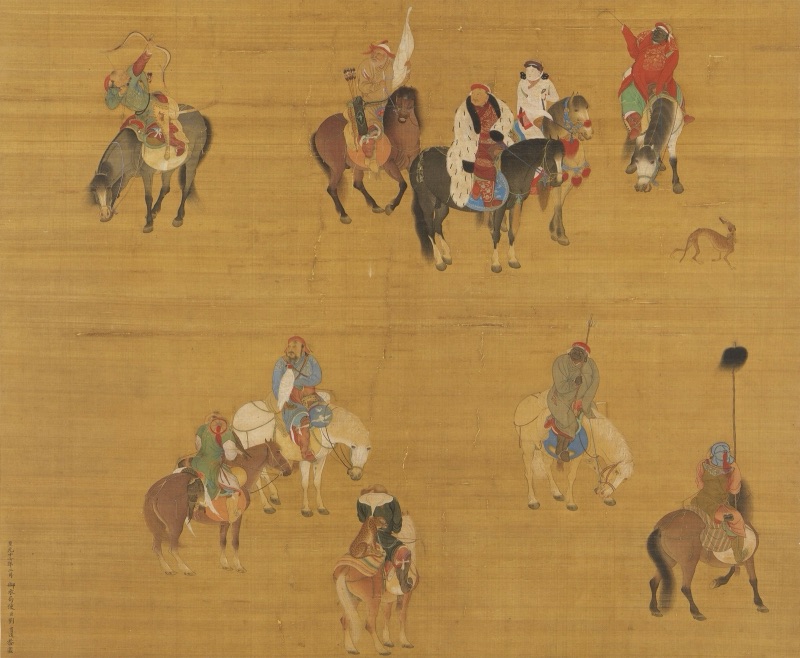
Image: Liu Guandao / Wikimedia Commons (Public domain)
A storm on every side: Pagan, Đại Việt, Japan and Java
The shock from Dali did not reach Lanna alone. Within one lifetime the Yuan court sent armies and envoys in almost every direction.
- Pagan (Burma): from 1271 the Yuan sent envoys demanding Pagan's submission. In 1277 the two armies clashed near Yongchang in western Yunnan; the Yuan record says Pagan fielded as many as eight hundred war elephants. In 1287 Mongol forces overran Pagan, which never regained its place as the centre of Burma.
- Đại Việt: Britannica records that Đại Việt's Trần dynasty turned back the Mongol armies several times (it gives 1257, 1284 and 1287), and Daniels also concludes that the campaigns against Đại Việt failed.
- Japan: Yuan fleets sailed against Japan in 1274 and 1281; both attempts failed, partly because of storms.
- Java: in 1292 a Yuan force crossed the sea to Java and had to withdraw within a year.

Image: Vyacheslav Argenberg / Wikimedia Commons (CC BY 4.0)
Columbia University sums up the lesson of these years: in mainland Southeast Asia, in Burma, Cambodia and above all Vietnam, Mongol armies sometimes won at first but were always forced to withdraw in the end because of the climate and disease, and each failed campaign cost the empire dearly in money and men.
King Mangrai builds a kingdom in the storm
South of Yunnan, the Kok river valley was still a cluster of small towns competing for manpower. Mangrai became a ruler there at about the time Kublai became khan (Britannica gives 1259), and founded Jiang Hai (jiang hai, ชยฯงรายฯ), Chiang Rai, in B.E. 1805 (1262), as the dictionary records.
He then moved south and took Hariphunchai, or La Pun (la pun, หลฯะพูร), the old Mon city of the Ping valley. The sources differ on the year: Prasert na Nagara and Britannica give 1281, the Jinakalamali gives 1292. He built Wiang Kum Kam on the Ping river in 1286, according to Monawat Phromrat (2025).
Why did Mangrai head south? Some writers see pressure from the north as part of the answer. An article in Silpawattanatham (2025) says that when he saw the Yuan pushing into the north, he expanded southward instead, and Volker Grabowsky (2004), following David Wyatt, ties Chiang Mai's strategic importance to the threat from the north. This is a scholarly interpretation: no Lanna chronicle says outright that the move south was because of the Mongols.
1287: the year Pagan was overrun, and the three kings
In the year the Mongols reached Pagan, Britannica records, Mangrai made an alliance with Ramkhamhaeng of Sukhothai and the ruler of Phayao (Ngam Muang), "hoping to take advantage of the Mongol capture of Pagan". Carl Bankston's article in EBSCO Research Starters (2022) also dates the alliance to 1287.
The Thai side has a story every Chiang Mai person knows. Charun Daennalert and Prayun Imiwat (2018), citing Prasert na Nagara, say the three kings once swore (sa ban, สาบาฯนฯ) friendship together on the bank of the Ing river. The dictionary explains the word as "to take an oath, calling on something sacred as witness". Whether they swore it to face the Mongols, the sources do not say outright. What they do show is that the alliance came in the same year Pagan was overrun.
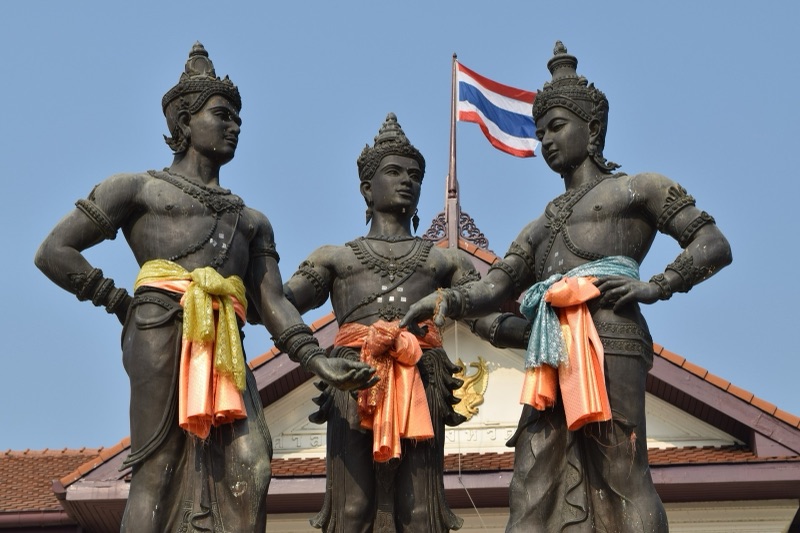
Image: Pixabay user iTenz / Wikimedia Commons (CC0)
Babai Xifu: Lanna's name in the Yuan annals
The first Chinese name for Lanna appears in the Yuanshi, the official history of the Yuan dynasty compiled by Song Lian and others in the fourteenth century. Its annals set out court business year by year and month by month, so this article calls them the Yuan annals. For 1292 (B.E. 1835) they record:
詔不敦、忙兀禿魯迷失以軍征八百媳婦國。 "An edict ordered two commanders to march against the Babai Xifu kingdom." (Yuan annals, chapter 17)
Babai Xifu (八百媳婦) means, word for word, "eight hundred" and "daughters-in-law" or "wives". Parit Chiwarak (2023), who collected the names outsiders gave Lanna, notes that this is the name's first appearance, and that it records a war. In the same stretch of the annals the court was also preparing a fleet for Java.
Why "eight hundred wives"? The Ming History, written later, says: "It is said that the chief had eight hundred wives, each in charge of a village, hence the name." Read this with care: it is an explanation told in China, not evidence from Lanna.
Chiang Mai is founded, 1296
Four years after the name Babai Xifu appeared in the Yuan annals, Mangrai founded Jiang Mai (jiang mai, ชยฯงไห่มฯ), Chiang Mai, in B.E. 1839 (1296). The dictionary records it as "the capital of the Lanna kingdom, an independent state until B.E. 2101 (1558)". Britannica adds that it was a royal residence from 1292 and became a town in 1296.
The new city was a wiang (wiang, วยฯง), a word the dictionary gives as both "town" and "wall; fortified camp". Charun Daennalert and Prayun Imiwat (2018) record that the first Chiang Mai had walls 900 by 1,000 wa and a moat all round. On the map, Chiang Mai lies much farther south of Yunnan than Chiang Rai.
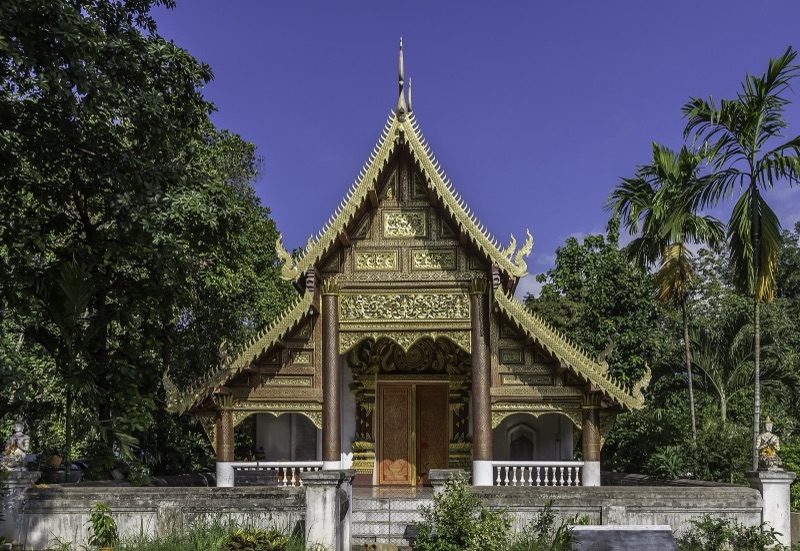
Image: Stefan Fussan / Wikimedia Commons (CC BY-SA 3.0)
What was the rest of the world doing that year? Drag the year line in the timeline below. In 1296 the Yuan envoy Zhou Daguan was arriving at Angkor, and Marco Polo had only just returned to Venice after years at Kublai Khan's court.
Twenty thousand men against Babai Xifu (1301–1303)
Before the great army came, something happened on the northern frontier that the two sides' records tell differently. Cheli in the Chinese sources is Chiang Rung in Sipsong Panna, the home of Mangrai's mother.
- The Yuan annals for 1297 say: "Babai Xifu rebelled and raided Cheli; a commander was sent to put it down." "Rebelled" is the Yuan court's word: it counted the states around it as its subjects.
- Grabowsky (2004), from the Tai sources, says Mangrai twice sent troops to help the ruler of Chiang Rung, a kinsman, who held off Mongol attacks (1296 and 1301).
1301: twenty thousand men
At the end of the fourth year of the Dade reign, about the start of 1301 (B.E. 1844), the Yuan annals record:
遣劉深、合剌帶、鄭祐將兵二萬人征八百媳婦 "Liu Shen, Helatai and Zheng You were sent with twenty thousand men to attack Babai Xifu." (Yuan annals, chapter 20)
The figure of twenty thousand matches the article in Silpawattanatham, quoting Winai Pongsripian's translation, and Bankston, who adds that Mongol archers went with the army. The annals for the same year also record new military units, convicts from Sichuan and Yunnan drafted as soldiers, and Mongol archers in Yunnan sent against Babai Xifu.
Before the army even reached Lanna, things began to go wrong. The annals say that as Liu Shen's army passed into Yunnan, the requisitioning of villagers to carry supplies led a local leader named Song Longji to rise up. That same year another Yuan army failed to take the town of the three Tai brothers in central Burma. The Tai (tai, ไท) here are the Tai Yai (Shan), who, the dictionary notes, call themselves Tai. Daniels concludes that "it was the military prowess of the Tai in Central Burma and northern Thailand that compelled Mongol-Yuan forces to withdraw".
1303: the Yuan army falls back
In 1303 (B.E. 1846) the Yuan annals record how the campaign ended:
以征八百媳婦喪師,誅劉深,笞合剌帶、鄭祐,罷雲南征緬分省。 "Because the army sent against Babai Xifu was lost, Liu Shen was put to death, the other two commanders were flogged, and the Yunnan office for the Burma campaign was closed." (Yuan annals, chapter 21)
Daniels says that after the failure against Babai Xifu, Emperor Temür also decided to pull out of Tagaung in Burma. Grabowsky concludes that the Mongol efforts of 1301–03 to bring Lanna under their rule "failed due to stiff military resistance by troops under King Mangrai's command and logistic problems of the Mongols".
Those supply problems are easy to picture from Lanna's own landscape: high, tangled doi (doi, ดอฯย, mountains), dense forest, heat and damp, and khai pa (khai pa, ไข้ป่า), which the dictionary explains as "malaria", "a dangerous, serious disease". Daniels sums it up as "the constraints of distance, terrain and climate", which let local rulers at the southern edge of the Mongol-Yuan world keep their autonomy.
- 1292: an edict orders troops against Babai Xifu (the name's first appearance)
- 1297: the annals say Babai Xifu raided Cheli; the court sends troops
- 1301: twenty thousand men are sent, new units raised and more Mongol archers added; a revolt breaks out within Yunnan
- 1302: Liu Shen and his fellow commanders are removed from office
- 1303: the commanders are punished and the Yunnan office for the Burma campaign is closed
From soek to gifts: Lanna's envoys and titles from the Yuan court
After the fighting, the relationship changed shape. The Yuan annals record that in 1312 (B.E. 1855) "Babai Xifu came and presented two trained jang (jang, ช้างฯ, elephants)". By then King Mangrai had died (B.E. 1854, 1311, in our article on King Mangrai, the year Grabowsky and Daniels also give; Britannica gives 1317). Grabowsky says this mission was led by Mangrai's son, Chai Songkhram (Khun Khram), and brought a white elephant as well.
Kham Mueang calls tribute gifts khong kan (khong kan, ขอฯงคั). Grabowsky and Bankston agree that from then on the Yuan court was content to receive gifts from Lanna instead of sending armies again. The annals for that same year also record that the court once more ordered a campaign, then cancelled it the next month and sent an imperial letter of persuasion instead. Grabowsky counts further missions from Lanna reaching China in 1315, 1316, 1317, 1328 and 1329.
Titles from the Yuan court, at Chiang Saen
In 1327 (B.E. 1870) the Yuan annals say Babai Xifu "asked for officials", so the court set up a commissioner's office at Mengqing, held jointly by a Yuan official and a local lord named "Zhao Nantong". In 1331 it set up "the office for Babai and other places" with a local lord named "Zhao Lian" as commissioner, and in 1347 it restored the office, with "Han Bu" succeeding his father.
Daniels (2018) reads these Chinese names as princes of the Mangrai dynasty: Zhao Nantong is Cao Nam Thuam, whom Grabowsky names as a son of Chai Songkhram; Zhao Lian is King Saen Phu; and Han Bu is King Pha Yu. Daniels places Mengqing in the Chiang Saen area.
The sources differ on when the Babai office was founded: the Yuan annals give 1331, while the Ming History and Grabowsky place it early in the Yuantong reign, about 1333–35.
Chiang Saen itself was built in these years. Our article Chiang Rai (Jiang Hai) cites scholarship that King Saen Phu founded Chiang Saen in B.E. 1871 (1328) as a defence against the north; Grabowsky gives about 1327 and Daniels 1329. So Chiang Saen was built in about 1327–29, the same years the Yuan court's titles reached the area.

Image: Takeaway / Wikimedia Commons (CC BY-SA 3.0)
Reading both records: the Yuan wrote one thing, Lanna remembered another
Read only the Yuan annals, and Lanna is a region that "rebelled", then "presented elephants" and "asked for officials". Read only the Lanna chronicles, and China hardly appears. Grabowsky observes that the Northern Thai chronicles "hardly report tribute missions to China", and that the Tai Yuan (tai yuan, ไทยวฯร) saw their kingdom as independent, even though China counted it as a vassal.
Daniels offers a helpful way to read this. He disputes the older view that the Mongol-Yuan "created" Tai states by handing out titles and models of government. The evidence from Lanna shows that accepting a title was a token gesture, not a promise of obedience: although Lanna had sent gifts since 1312, it did not allow an office to be set up in its territory until 1327. If the Mongol-Yuan were patrons, he writes, then the Tai of Lanna were "reluctant clients" who always put their own interests first.
Common mix-ups
"The Mongols conquered Lanna." The evidence says the opposite. The Yuan campaign against Babai Xifu in 1301–03 failed; the Yuan annals themselves record the commanders being punished for losing the army, and Grabowsky and Daniels agree. Pagan is the city that Mongol forces actually overran, in 1287.
"Babai Xifu means the king of Lanna had eight hundred queens." This is an explanation the Ming History gives as "it is said". No evidence from Lanna supports it, and the name Lanna's people used for themselves was "Lanna", not this one.
"After the war, Lanna and China had nothing more to do with each other." Also the opposite. Lanna sent envoys and gifts to China many times from 1312, and accepted commissioner's titles from the Yuan court from 1327. The relationship carried on into the Ming dynasty, which gave Lanna a new name, Babai Dadian (1391).
"King Mangrai founded Chiang Mai to escape the Mongols." An interesting idea, but still an interpretation. Some scholars link Chiang Mai's importance to the threat from the north, but the Lanna sources explain the choice of site through its seven auspicious signs and its water; read more in King Mangrai.
Summary
- In 1253 (B.E. 1796) the Mongols took Dali in Yunnan, bringing Mongol-Yuan power to the edge of the Tai lands, within the lifetime in which King Mangrai founded Chiang Rai (1262) and Chiang Mai (1296).
- The Yuan annals first call Lanna Babai Xifu in 1292, when they record an order to send troops.
- The 20,000-man Yuan campaign against Babai Xifu (1301–1303) failed, through stiff resistance, distance, mountains and jungle fever.
- After the war the relationship turned into envoys and khong kan (tribute gifts) from 1312, and commissioner's titles that Lanna accepted in name only (1327–1347).
- The Yuan annals and the Lanna chronicles tell the story from different angles; reading both together brings us closer to what happened.
Look up soek, khong kan and khai pa in the Moradok Lanna dictionary (in Thai), then read more about the city's founder in King Mangrai and Chiang Mai (Jiang Mai).
This article is one part of Lanna and the World: Human History and Lanna's Place in It, which sets Lanna's story on the same timeline as world history, era by era. For the whole 700 years of Lanna, read Lanna: the name and its history, and for King Mangrai's first city, Chiang Rai (Jiang Hai).
Sources
- Moradok Lanna dictionary (in Thai): เสิก · ของกัน · ไข้ป่า · เวียง · ล้านนา · มังราย
- Moradok Lanna articles that are the source of the Lanna events (each has its own sources): Lanna and the World · King Mangrai · Chiang Rai (Jiang Hai) · Chiang Mai (Jiang Mai) · Lamphun (La Pun) · Lanna
- Song Lian et al. 元史 Yuanshi (History of the Yuan), chapter 17 · ch. 19 · ch. 20 · ch. 21 · ch. 24 · ch. 30 · ch. 35 · ch. 41 · ch. 210. Wikisource (original text public domain; translations in this article are ours)
- Zhang Tingyu et al. 明史 Mingshi (History of the Ming), chapter 315. Wikisource
- Daniels, C. (2018). The Mongol-Yuan in Yunnan and Proto-Tai/Tai Polities during the 13th–14th Centuries. Journal of the Siam Society 106: 201–243
- Grabowsky, V. (2004). The Northern Tai Polity of Lan Na (Babai-Dadian) between the Late 13th to Mid-16th Centuries. ARI Working Paper 17, National University of Singapore
- พริษฐ์ ชิวารักษ์ (Parit Chiwarak). (2023). ความเป็นมาของคำล้านนาและล้านนาไทยโดยสังเขป [A Brief History of the Words Lanna and Lanna Thai]. Thammasat Journal of History 10(1), 79–106
- ปดิวลดา บวรศักดิ์ [Padiwlada Bowornsak]. (2025). Why did the Mongols send more than 20,000 men against Lanna? (in Thai). Silpawattanatham (quoting Winai Pongsripian's translation)
- จรูญ แดนนาเลิศ และประยูร อิมิวัตร [Charun Daennalert and Prayun Imiwat]. (2018). King Mangrai, the first king of Lanna's rule by Dhamma (in Thai). Dhonburi Rajabhat University Journal of Humanities and Social Sciences 1(3)
- Bankston, C. L. (2022). Kingdom of Lan Na. EBSCO Research Starters
- Columbia University, Asia for Educators. The Mongols in China: Military Successes and Failures
- Britannica: Mangrai · Kublai Khan · Yunnan · Pagan · Tran dynasty · Majapahit empire · Chiang Mai
- World events shared with the Lanna and the World series (Japan 1274/1281, Zhou Daguan 1296, the Ming 1368, Babai Dadian 1391): see the sources for eras 4–5 in Lanna and the World
Practise the words from this article
Flip through 14 flashcards of the Lanna words used in this article.


