
Photo: Basile Morin / Wikimedia Commons (CC BY-SA 4.0)
Lanna and Đại Việt: The War of 1479–80
Lanna and Đại Việt is the story of a war in which an army from the land of today's Vietnam reached the borders of Lanna. In 1479–80 (B.E. 2022–2023), in the reign of King Tilokarat, the Đại Việt army of Lê Thánh Tông invaded the kingdom of Lan Xang and then pushed into the territory of Nan. A Lanna army from Nan went out to meet it, and the news travelled all the way to the Chinese court in Beijing.
The war is unusual because it is told in four sets of records, Chinese, Lanna, Lao and Vietnamese, and they do not agree. Kham Mueang calls waging war hop soek (hop soek, ร฿ปฯเสิกฯ), which the dictionary explains as "to fight a war; to fight the enemy". This article is part of the series Lanna and the World, which sets Lanna's story on the same timeline as the rest of the world.
- When: the Đại Việt army set out around the middle of 1479 (B.E. 2022); the heaviest fighting in Lan Xang and around Nan came in 1479–80; word that the troops had all gone home reached the Ming court in 1484 (B.E. 2027)
- Who: Đại Việt (Lê Thánh Tông) · Lan Xang · Lanna (King Tilokarat, an army from Nan) · the Ming court mediated by letter and sent no army
- Outcome: every source agrees the Đại Việt army did not stay in Lan Xang or Lanna, but each record tells a different story of who won
Who was Đại Việt, and why did it turn west?
Đại Việt is the name the Vietnamese state used for itself. Britannica explains that it was adopted under the Lý dynasty in place of Annam, the name China used. The Chinese records in this story therefore call Đại Việt "Annam" and the Vietnamese "the Jiao people", while Kham Mueang calls the Vietnamese "kaeo" (Moradok Lanna dictionary). This article uses the name the Vietnamese gave their own state: Đại Việt.
The war came in the reign of Lê Thánh Tông (r. 1460–1497), which Sun Laichen (2003) calls Đại Việt's golden age. The state reorganised its government and army on the Chinese model and, above all, used firearms on a large scale: Sun estimates that about 38 per cent of Đại Việt's soldiers in the fifteenth century carried guns in wartime (Tana Li citing Sun, 2024).
In 1471 Đại Việt's army took the capital of Champa, the kingdom to its south. Less than ten years later Đại Việt turned west, toward the Tai lands in the hills, Muang Phuan (today's Xieng Khouang in Laos) and Lan Xang (Sun, 2003; Tana Li, 2024).
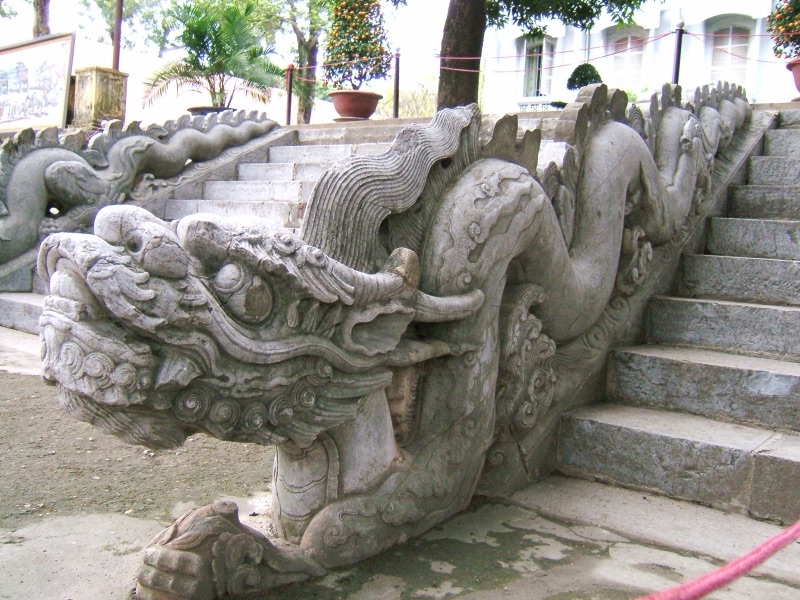
Photo: Viethavvh / Wikimedia Commons (Public domain)
Lanna and Lan Xang before the war
In Lanna this was the reign of King Tilokarat (r. about 1441–1487), the period called Lanna's golden age. He brought Phrae (1443) and Nan (1450) into Lanna, and just two years before this war, in 1477 (B.E. 2020), he had the Tipitaka revised at a council at Wat Chet Yot in Chiang Mai. The Ming court called Lanna Babai-dadian, or "Ba-bai" for short.
Nan (mueang nan, เมิอฯงนาฯ่นฯ) lay at the eastern edge of Lanna, next to Lan Xang. In Nan we told how Nan always traded with Luang Prabang; the war came in along that same road.
The neighbour to the east was Lan Xang (lan chang, ล้านฯช้างฯ), which the dictionary describes as "the kingdom of the Lao people, in the Mekong basin", with Luang Prabang as its capital. Its name pairs with Lanna's: one counts elephants, the other rice fields (more in Why 'Lanna', not 'Lan Na'?). Britannica notes that after 1416 Lan Xang enjoyed a long period of calm, "broken only by a Vietnamese invasion in 1479".
1479: the Đại Việt army enters Muang Phuan and Lan Xang
Reports from Guangxi to the Ming court say that around the eighth Chinese month of 1479 Đại Việt raised 80,000 troops, built roads and stored grain (Ming Shi-lu, tr. Wade). Vietnamese sources give a figure of 180,000 (Sun, 2003). While Lê Thánh Tông was on the march, an arsenal holding guns and gunpowder burned down; Sun notes that the Vietnamese record kept this detail precisely because firearms mattered so much to the campaign.
Kham Mueang has several words for military leaders. Nai soek (nai soek, นาฯยฯเสิกฯ) is "a commander, a general", while hua soek (hua soek, ห฿วฯเสิกฯ) means "the vanguard of an army", or its commander. The Ming record says Đại Việt first sent a minister in command of 60,000 men, before Lê Thánh Tông himself followed with 90,000 in the tenth month.
Late in 1479 the Đại Việt army reached the capital of Lan Xang, today's Luang Prabang. Grabowsky (2004) and Sun (2003) agree that Lan Xang lost its capital in this war. The men Yunnan sent to gather news reported in 1480 that the army had taken more than 20 stockades in Laos, and that more than 20,000 people had died.
The Chinese word for "stockade" matches the Kham Mueang wiang (wiang, วยฯง), which the dictionary gives two meanings: "a town, a small town, a temporary town" and "a wall, a military fort or stockade, a palisade". Towns in this region were often a home and a defended strongpoint at the same time.
Here you can follow the whole war on a map. Each step has buttons for reading what each side's record says; below are the troop numbers in the records, and a game in which you guess which record a sentence comes from.
Timeline of the war
| Year (B.E.) | Event | Main sources |
|---|---|---|
| 1471 (2014) | Đại Việt takes the capital of Champa in the south | Sun 2003; Tana Li 2024 |
| 1477 (2020) | Tipitaka council at Wat Chet Yot, Chiang Mai | King Tilokarat article |
| 1479 (2022) | Đại Việt raises an army and moves into Muang Phuan and Lan Xang; Lan Xang loses its capital | Ming Shi-lu; Grabowsky; Sun; Britannica |
| 1480 (2023) | The Đại Việt army pushes into Nan; a Lanna army from Nan helps the Lao; the invaders fall back · the Ming court orders Đại Việt to withdraw | Sun; Grabowsky; Ming Shi-lu |
| 1481 (2024) | Imperial edict rebukes Lê Thánh Tông; reward to Ba-bai; the Lao king's son confirmed as heir | Ming Shi-lu; Grabowsky |
| 1482 (2025) | Ba-bai reports it has driven out the Đại Việt army and burned the false edict under its elephants' feet | Ming Shi-lu; Sun |
| 1484 (2027) | Laos and Ba-bai report that Đại Việt has pulled its troops back home | Ming Shi-lu; Sun |
1480: Lanna's army from Nan
In 1480 (B.E. 2023) the Đại Việt army pushed into the territory of Nan, then part of Lanna. Sun (2003) summarises this from the Nan Chronicle and the Chiang Mai Chronicle. Grabowsky (2004) writes that Lanna sent an army commanded by the ruler of Nan to help the Lao, and that the Lao and Lanna drove the invaders out that year.
A Ming entry of 1481 tells another side of the same events. Đại Việt sent what the Chinese call a "false imperial order" to Chiang Rung (Sipsong Panna), telling it to join an attack on Ba-bai. Then several thousand Đại Việt soldiers died suddenly, said to have been struck by lightning, and Ba-bai sent troops to cut off their retreat and killed 10,000. The invaders broke and withdrew. As for the Lao king's youngest son who had fled to Ba-bai, the ruler of Lanna sent soldiers to escort him on his way.
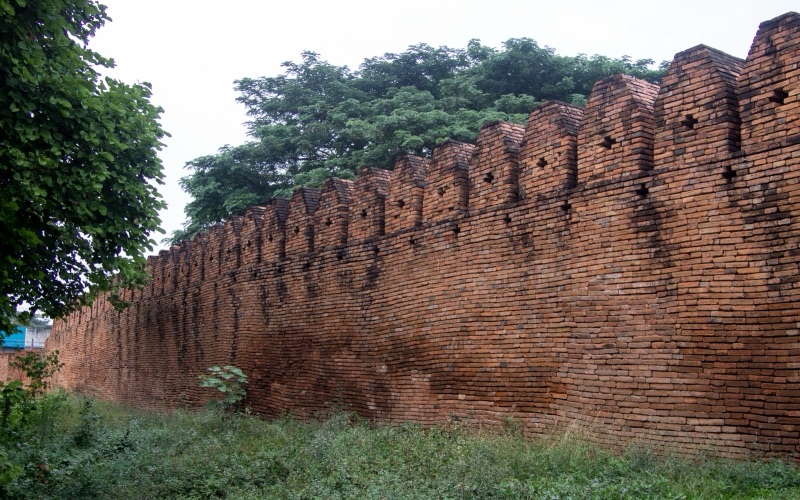
Photo: Takeaway / Wikimedia Commons (CC BY-SA 3.0)
Guns on both sides
This was not a war of guns against swords. Grabowsky and Sun show that Lanna itself used Chinese-style guns well before the middle of the fifteenth century. In Phrae (Mueang Pae) we told how, when King Tilokarat marched on Phrae in 1443, the Chiang Mai army had a cannon called "Pu Chao", a detail Grabowsky (2004) also quotes from the Chiang Mai Chronicle.
Kham Mueang calls the weapon puen (puen, ปืนฯ). For the Đại Việt war, Sun (2003) found in the Chiang Mai Chronicle an archer who could make "three-fathom arrows" and "big guns" for the fighting, most likely Chinese-style cannon.
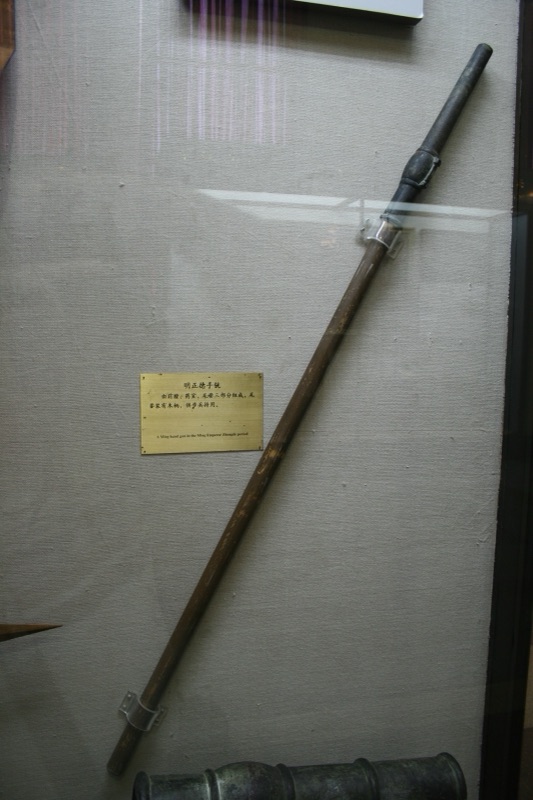
Photo: Flickr user Gary Todd / Wikimedia Commons (CC0)
The Ming court: stopping a war by letter
Lanna, Lan Xang, Chiang Rung and Đại Việt all sent tribute to China, so the Ming court saw every one of them as a realm under its care. In mid-1480 envoys from Chiang Rung, Laos and Ba-bai arrived at court together; the eunuch in charge of Yunnan reported that Laos was under attack and asked that the envoys be given travel money to hurry home (Ming Shi-lu; Grabowsky, 2004).
Kham Mueang calls stopping a fight ham tap (ham tap, ห้ามฯทัพฯ), "to hold back an enemy; to restrain or settle a quarrel". The Ming court did exactly that, but with letters (nang sue, หันฯงสื), not armies.
- 1480: Guangxi was told to send a letter to Lê Thánh Tông ordering him to withdraw and keep to his own land; Yunnan, Guangdong and Guangxi were told to guard their borders. Late that year Yunnan heard that Đại Việt was drilling troops to attack Ba-bai.
- Mid-1481: an imperial edict to Lê Thánh Tông warned that "the Jiao people are Heaven's people and the people of Laos are also Heaven's people" and told him to keep peace with every neighbour. The ruler of Ba-bai was rewarded with silver and silk, and the Lao king's son was confirmed as heir.
- Đại Việt's reply: Lê Thánh Tông answered that he had not attacked or killed anyone in Laos, had only sent men after a border chieftain, and did not even know where Ba-bai was (as quoted in the Ming record).
The two sides also saw this relationship differently. Grabowsky (2004) points out that to China, Ba-bai was one of the frontier chieftaincies under the court's appointment, so the Ming records give Lanna's ruler a Chinese-style title and call him "Dao Lan-na", that is, Chao Lan Na, "the lord of Lanna". The people of Lanna, however, saw their kingdom as independent, and the northern chronicles hardly ever mention tribute to China. The Đại Việt war is one of the few times the Chiang Mai Chronicle does, and it tells it in a way that honours Lanna.
Grabowsky (2004), citing Winai Pongsripian, says the Chinese sources confirm Lanna's victory, and that Chinese troops on the border were put on alert to apply pressure but did not join the fighting directly.
A false edict under the elephants' feet
In mid-1482 (B.E. 2025) the Yunnan commander passed on news (khao, ข่าวฯ) from Ba-bai: "We received the orders to save Laos and have now repulsed the Jiao troops." Ba-bai had burned the letter Đại Việt sent to pressure it and had elephants trample it (Ming Shi-lu; Grabowsky, 2004; Sun, 2003). Kham Mueang calls the elephant chang (chang, ช้างฯ).
Even so, Yunnan was not sure the invaders had really gone, because Laos had not yet sent a report.
Four records, four stories
Kham Mueang calls old stories handed down tamnan (tamnan, ตํานาฯ); the dictionary's example is "the chronicle of Chiang Mai". The Đại Việt war shows clearly how each realm's tamnan tells the same events from its own side.
| Record | Who won, it says | Source |
|---|---|---|
| Ming court records (Ming Shi-lu) | Đại Việt lost many men; Lê Thánh Tông fell ill with anger and went home; later Ba-bai cut off the retreat | tr. Wade; Sun 2003 |
| Chiang Mai Chronicle · Nan Chronicle | The Lanna army under the ruler of Nan won; the Chinese emperor rejoiced at Lanna's victory | Grabowsky 2004; Sun 2003 |
| Lao chronicles | Credit the Lao commander; say nothing of help from Lanna | Grabowsky 2004 |
| Đại Việt annals | Beat the Lao, entered the Lao capital, marched on to the Irrawaddy and "came back triumphantly" | quoted in Sun 2003; Tana Li 2024 |
The version of the Chiang Mai Chronicle quoted by Grabowsky (2004) adds that the Chinese commander in Yunnan at first would not believe Lanna had won until Vietnamese prisoners confirmed it, and that the emperor said "over all the earth, none is braver than the king of Lanna". King Tilokarat, for his part, sent nine elephant tusks, nine rhinoceros horns and eighteen pieces of cloth. Grabowsky notes that this fits the Ming record of Ba-bai envoys bringing tribute in the same period.
Even figures inside one tradition disagree. The Ming Shi-lu gives Ba-bai's reward as 200 liang of silver, while the Mingshi gao cited by Grabowsky says 100. And early in 1484 Yunnan heard that Đại Việt was approaching Sipsong Panna with "1,060,000 men", a figure Sun calls "grossly exaggerated".
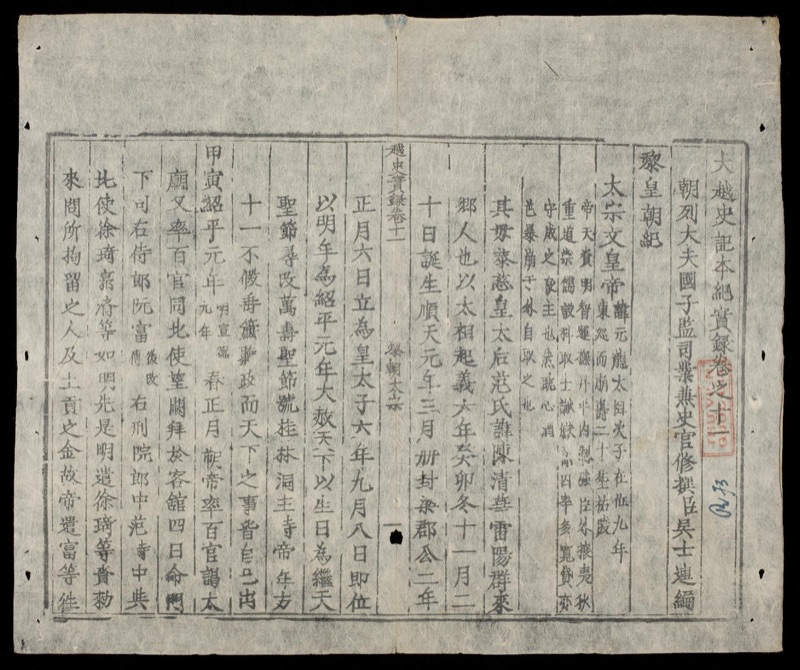
Photo: Ngô Sĩ Liên / Wikimedia Commons (CC BY-SA 3.0)
1484: news of the withdrawal, and after
Late in 1484 (B.E. 2027) Laos and Ba-bai each wrote to Yunnan that Đại Việt had withdrawn its troops to its own country. Ming officials still worried it might be a rumour or a mistranslation and kept the border on guard (Ming Shi-lu). Sun (2003) takes this as the end of Đại Việt's "long march", which had lasted about five years. That same year Ba-bai's envoys still brought ivory and rhinoceros horn to the Ming court as usual.
After the war Lanna's golden age went on. King Tilokarat died in 1487 (B.E. 2030), and in the following century Lanna and Lan Xang at one point shared a king who ruled both lands, as the Wat Chiang Sa inscription records; read more in Why 'Lanna', not 'Lan Na'? 700 Years in One Song.
Reading war records like a historian
The Đại Việt war is a good exercise in reading history, because one set of records contains both "the news" and "the denial". Try asking every record three questions.
1. Who wrote it, and for whom? The Đại Việt annals were written by the Đại Việt court, so they praise Lê Thánh Tông's reign for "sending expeditions in all four directions and expanding the realm" (Sun, 2003). The Chiang Mai Chronicle has the Chinese emperor praise the king of Lanna. Neither is lying, but each chooses what makes its own realm look good.
2. How did the writer know? The Ming court was very far from the fighting; the Ministry of War itself wrote that Ba-bai and Laos were "very far from Yunnan". The first news came from men Yunnan sent to scout, who came back through Chiang Rung, and from Guangxi officials repeating what they had heard. Even in 1484 Ming officials feared that the withdrawal reported by Laos and Ba-bai might be "a rumour" or "a forced interpretation by the translators" of frontier letters.
3. What do the other sides say? Lê Thánh Tông said he had not attacked Laos, yet the Chinese records, the Lanna chronicle and several scholars all say there was a war. Statements that several sides share are stronger than those only one side makes, such as that Lan Xang lost its capital and that the Đại Việt army finally went home.
Common misunderstandings: what the sources say
"Đại Việt conquered Lanna"
Work based on the Đại Việt annals says its army "overran Lanna" in 1480 (Tana Li, 2024), and Sun (2003) says the army pushed into Nan. But no source used here says Đại Việt set up rule over any town of Lanna, and the Chinese records and the Lanna chronicle agree that the army withdrew. What the evidence shows is a push to the border, not an occupation.
"China sent an army to help Lanna"
Every Ming entry cited here shows the court using letters: orders to withdraw, warnings and rewards. The border armies were told to be ready to defend. Grabowsky (2004), citing Winai Pongsripian, says Chinese troops "did not intervene directly in the fighting". The fighting was done by the Lao and Lanna armies.
"Troop numbers in chronicles are real counts"
The same war has Đại Việt armies of 80,000 to 180,000 men, and one report of 1,060,000. Numbers in chronicles and war reports are often inflated: read them as a sense of how big the war was, not as statistics.
The Lanna and the World series
Summary
- Lanna and Đại Việt met in the war of 1479–80 (B.E. 2022–2023), in King Tilokarat's reign, when Lê Thánh Tông's army invaded Lan Xang and pushed into Nan
- Lan Xang lost its capital; a Lanna army under the ruler of Nan went to help the Lao; the Đại Việt army fell back, and word that it had fully withdrawn reached China in 1484 (B.E. 2027)
- The Ming court stopped the war by letter, sent no army, and rewarded the ruler of Ba-bai, that is, Lanna
- The Chinese, Lanna, Lao and Đại Việt records disagree on who won, and their troop numbers differ wildly, which is why reading several records together matters
- Kham Mueang words learned: hop soek, tamnan, wiang, nai soek, hua soek, puen, chang and ham tap
Look up the full meanings of ล้านช้าง, เวียง and ต่ำนาน in the Moradok Lanna dictionary, then read more about the king of Lanna in this war in King Tilokarat.
📚 All of Lanna's story: Why 'Lanna', not 'Lan Na'? 700 Years in One Song · 🌏 Lanna and the World
Sources
- Moradok Lanna dictionary: ฮบเสิ๋ก · ต่ำนาน · เวียง · ล้านช้าง · เมืองน่าน · นายเสิ๋ก · หัวเสิ๋ก · ปืน · ห้ามทัพ · หนังสือ · ข่าว
- Wade, G. (tr.). Southeast Asia in the Ming Shi-lu: an open access resource. Asia Research Institute, National University of Singapore: Cheng-hua 16/7/23 · 16/8/7 · 16/11/6 · 16/12/21 · 17/6/9 · 18/6/15 · 20/8/20 · 20/10/12
- Grabowsky, V. (2004). The Northern Tai Polity of Lan Na (Babai-Dadian) Between the Late 13th to Mid-16th Centuries: Internal Dynamics and Relations with Her Neighbours. ARI Working Paper 17, National University of Singapore
- Sun Laichen. (2003). Chinese Military Technology and Dai Viet: c. 1390–1497. ARI Working Paper 11, National University of Singapore
- Tana Li. (2024). A Maritime Vietnam (introduction). Cambridge University Press
- Britannica. Laos: History · Dai Viet
- Moradok Lanna: King Tilokarat · Nan · Phrae (Mueang Pae) · Why 'Lanna', not 'Lan Na'? · Lanna and the World
Practise the words from this article
Flip through 13 flashcards of the Lanna words used in this article.
Look up "ล้านช้าง" in the Moradok Lanna dictionary (in Thai)


