
Photo: Unknown author / Wikimedia Commons (Public domain)
Lanna and the Portuguese: Mercenaries and Guns
Lanna and the Portuguese never exchanged embassies or signed a trade treaty with each other. They met through one thing that changed war in this land for good: the gun (puen, ปืนฯ), which the dictionary says is also called sinat. The Portuguese came as traders and as soldiers for hire, carrying European guns into the armies of both Ayutthaya and Burma, and now and then marching as far as the walls of Chiang Mai.
But guns did not reach Lanna with the Portuguese for the first time. Scholars point out that Lanna chronicles speak of guns almost a century earlier, and that they came overland from China. So this article follows two roads of firearms, overland and by sea, and sets them beside the world story told in Lanna and the World.
- Before the Portuguese: the Chiang Mai Chronicle speaks of guns from about 1411; the know-how probably came overland from China via Yunnan
- 1511: Portugal takes Melaka and sends its first envoy to Ayutthaya
- 1538–1549: Portuguese mercenaries fight on both the Ayutthaya side and the Toungoo side
- 1545–1546: Ayutthaya's army goes up to Chiang Mai twice; Pinto claims Portuguese marched with it
- Kham Mueang: puen, sinat, sinat fai, am mok, khi fao, luk puen
Follow the whole story on a map in the widget below. Green is the overland road from China, blue is the Portuguese sea road, and orange is an army on the move at each point. Every step names its sources.
Before the Portuguese: guns in the Lanna chronicles
Sun Laichen, a historian of the spread of military technology from Ming China (2003), argues that gunpowder and guns reached the north of mainland Southeast Asia overland through Yunnan, before Europeans arrived by sea. Sitthard Srikotr (2014) likewise suggests that Lanna got its firearm technology from China through its contacts with Yunnan.
The Lanna evidence both cite is the Chiang Mai Chronicle. Sun Laichen quotes it: about 1411 (B.E. 1954) the people of Phayao (phayao, พะเยัา) cast a copper cannon and fired it at an Ayutthaya army besieging the town. He takes this as the first appearance of a cannon in Lanna sources.
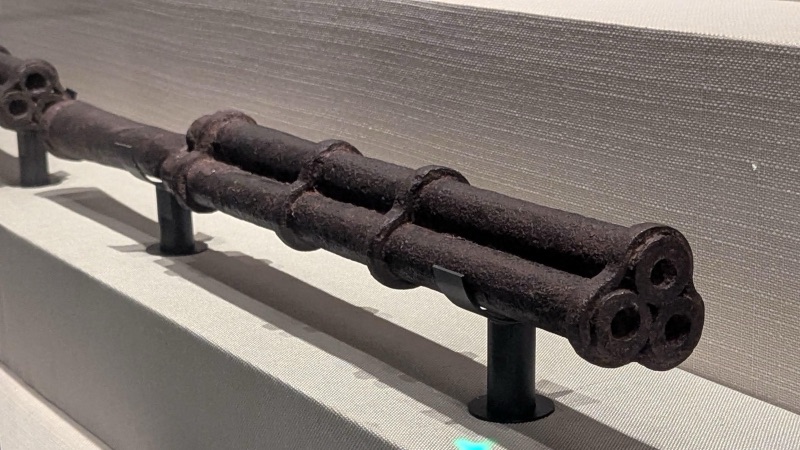
Photo: Underbar dk / Wikimedia Commons (CC BY-SA 4.0)
Pu Chao, the cannon before Phrae
The most detailed story is the war on Mueang Pae (mueang pae, เมิอฯงแระฯพ่), that is Phrae, in 1443, under King Tilokarat. According to the Chiang Mai Chronicle the king put his mother in command; the Chiang Mai army had a cannon called Pu Chao and fired it to frighten the town until Phrae submitted (told in Mueang Pae, following Phudet Saensa).
The chronicle adds that the man who knew how to fire Pu Chao was a Vietnamese, who shot at a palm tree by the city gate so the lord could see its power. Sun Laichen takes this detail to show that gun know-how crossed the land by more than one road, not only from China.
War with Ayutthaya, and a prince struck by a gun
The Chiang Mai Chronicle and the Ayutthaya chronicle both say that Prince Inthracha of Ayutthaya was hit in the face by a gun in a war with King Tilokarat, but they give different years: 1457 (B.E. 2000) on the Lanna side, 1463 (B.E. 2006) on the Ayutthaya side (Sun 2003; Sitthard 2014). The Lanna chronicle calls the weapon puen kong, and Sitthard notes it is not certain whether this was a firearm or another missile weapon such as a bow or crossbow.
1511: the Portuguese arrive by sea
The second road started much further away. In 1498 Vasco da Gama sailed from Portugal round Africa to India, opening a sea route between Europe and Asia. A little over ten years later, in 1511, Portugal took the port of Melaka, the spice-trade hub of the Straits.
That same year Albuquerque sent Duarte Fernandes to King Ramathibodi II at Ayutthaya. Wood (1926) and Campos (1940) agree that he was well received and went home with a Siamese envoy. The Portuguese travelled in ocean-going sailing ships. Kham Mueang calls a Chinese-style sea-going junk sapao (sapao, สเพัา), but the Portuguese ships were European vessels like those in the picture at the top.
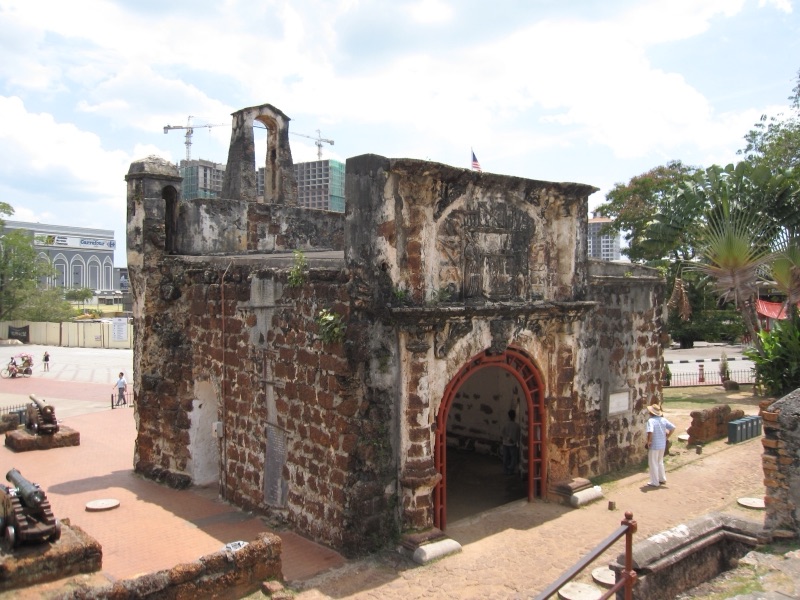
Photo: Gryffindor / Wikimedia Commons (CC BY-SA 3.0)
A treaty with Ayutthaya, and a manual of war
Later Duarte Coelho made a treaty with Ayutthaya. Wood and Sitthard date it 1516; Campos gives 1518. Under it the Portuguese could trade and live in Ayutthaya and the southern ports. Campos says this was in return for Portuguese supplies of guns and munitions to Siam.
Wood and Campos both record that in 1518 Ayutthaya reorganised the way men were called up for the army and issued a book on warfare, now lost. Sitthard explains that this manual of war was rewritten to suit firearms and the ways of fighting learned from the Portuguese.
Battle on the Wang River: when war with Lanna changed
While Ayutthaya was dealing with the Portuguese, its wars with Chiang Mai went on. Wood and Campos, from Ayutthaya-side records, say that after a Chiang Mai army reached Sukhothai and Kamphaeng Phet, King Ramathibodi II marched north to Lampang (lampang, ลำพางฯ) in 1515, and a battle was fought on the Wang River.
Did the Portuguese play a part? The sources do not say the same thing. Wood writes carefully that the help of the king's Portuguese allies may perhaps have had something to do with Ayutthaya's success; Campos believes Ayutthaya already had many guns and Portuguese trainers. This is best read as historians' inference, not a confirmed fact. More on the city in Lampang, Khelang Nakhon.
Mercenaries on both sides: Ayutthaya, Toungoo and the Portuguese
By the 1530s there were more Portuguese in Siam. Wood says that in 1538 King Chairacha hired 120 of them as a bodyguard and to teach musketry to his soldiers (tahan, ตหานฯ). They fought with him at Chiang Kran, a border town near Moulmein, and were rewarded. Sitthard agrees that after this war the Portuguese were given land for a Portuguese village and churches at Ayutthaya.
On the other side, Britannica records that King Tabinshwehti of Toungoo used Portuguese soldiers of fortune to take Martaban and Moulmein in 1541, and Wood says the Burmese king had many Portuguese in his service. Wood sums up the mercenaries of that age in one line:
The Portuguese of that day were "ready to fight for anybody against anybody" (W.A.R. Wood, A History of Siam, 1926)
When the Toungoo army besieged Ayutthaya in 1549, Campos records that the guns on the forts round the city were worked by about sixty Portuguese, while there were Portuguese gunners in the Burmese army too. In the mainland wars of the day there were Portuguese both inside and outside the walls.
1545–1546: Ayutthaya's army at Chiang Mai, and Pinto's tale
At the time Jiang Mai (jiang mai, ชยฯงไห่มฯ), Chiang Mai, was split over the succession. Following the Chiang Mai chronicle, Wood says King Chairacha went up to Chiang Mai in 1545. The first time the princess regent of Chiang Mai received him in friendship; the second time, the next year, there was fighting at Lamphun and Chiang Mai before Ayutthaya's army went back south. Campos also records that the fighting with Chiang Mai in 1545–1546 was fairly serious.
Were Portuguese in that army? The man who says so is Fernão Mendes Pinto, the Portuguese adventurer who wrote Peregrinação. In the translation quoted by Silpa Wattanatham magazine, Pinto says the King of Siam invited foreigners to volunteer and promised they could build a church; so 120 of the 130 Portuguese there went to the war at Chiang Mai. Pinto calls the city Chiammay.
Lanna in Portuguese eyes
Most Portuguese never came up to Lanna. They knew it from what they heard in Ayutthaya and the ports. John Villiers (1998) explains that João de Barros, the Portuguese royal historian, wrote that Chiamay (Chiang Mai) was the chief city of a land he called Jangama, and mentioned Chancray (Chiang Rai), but Barros spelled place names inconsistently, so Villiers warns that he must be used with caution.
Campos (1940) points out another thing: Barros counted Chiang Mai and Lan Xang as vassals of Siam, though at the time they were independent, because the Portuguese heard the story from Ayutthaya. The earliest European picture of Lanna was seen from the southern ports. The name Lanna itself had already appeared on European maps before this, as told in Lanna.
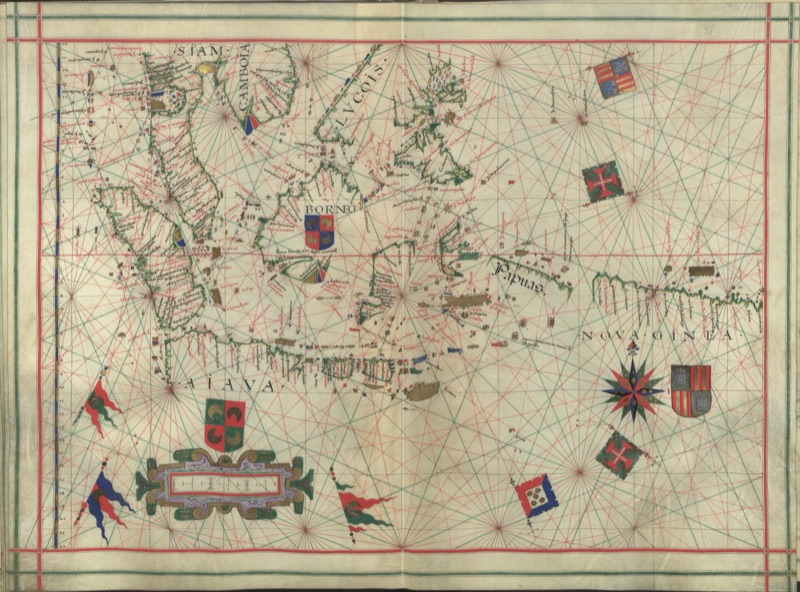
Image: Fernão Vaz Dourado (1520 — c. 1580) / Wikimedia Commons (Public domain)
1558 and after: guns in the Toungoo age
In 1558 the army of King Bayinnaung took Chiang Mai and Lanna became a vassal of Pegu, as told in Lanna under Burmese rule. Britannica records that Bayinnaung used Portuguese mercenaries and cannon in his wars, but the sources we found do not say that any Portuguese fought at Chiang Mai this time, so this article goes no further.
Some Portuguese mercenaries even made themselves rulers. Filipe de Brito held the port of Syriam, at a river mouth near Yangon: from 1599 according to The Irrawaddy (2014), while Wood says he was sent there in 1602 and gradually made himself master. In April 1613 the army of King Anaukpetlun of Ava took Syriam back; Britannica records that the Toungoo dynasty had reunited Burma by about that year.
The next year, 1614, Anaukpetlun marched in to reorganise Lanna and put the lord of Mueang Nan (mueang nan, เมิอฯงนาฯ่นฯ) over Chiang Mai, as Laddawan Saesiao, Kirigaya and Wood agree. The rest of Lanna's story in this period is told in Lanna under Burmese rule.
The age left traces in words too. Lanna chronicles call a cannon am mok (am mok, อํามัอฯก), which the dictionary defines as "an old short-barrelled cannon", also called mok or a mok. The word sinat (sinat, สินาฯดฯ) the dictionary simply glosses as "gun", also written sinat with a long vowel (สีนาด).
Where the two words came from is explained in different ways. Sun Laichen (2003) takes these gun words in the Chiang Mai and Nan chronicles as words that came with the period of Burmese rule over Lanna, while Sitthard (2014) explains sinat as coming from sihanat, "a mighty roar", added to the word for gun to mark a loud firearm. This article gives both views side by side.
How a matchlock works
The guns the Portuguese brought were matchlocks. Britannica explains that an S-shaped arm, the serpentine, holds a slow match, a cord soaked in saltpetre that smoulders for a long time. When the trigger is pulled, the serpentine lowers the match onto the flash pan beside the barrel; the flash passes through the touchhole and fires the powder in the barrel.
Kham Mueang has a word for each part of the story. Gunpowder is khi fao (khi fao, ขี้เฝัา), a bullet is luk puen (luk puen, ลูกปืนฯ), aiming a gun is nae puen (nae puen, แนปืนฯ), and a firearm is sinat fai (sinat fai, สินาฯดฯไฟ).
The dictionary glosses sinat fai as "firearm, flintlock". The flintlock was a later gun that used a flint to make the spark instead of a match. Britannica explains that the matchlock's great difficulty was keeping the match smouldering all the time, which led to the wheel lock and later the flintlock.
Try loading a matchlock yourself in the widget below. Tap the steps in the right order, from pouring the powder to pulling the trigger, and you will see why gunners needed training, and why mercenaries who could handle guns were valued by every king.
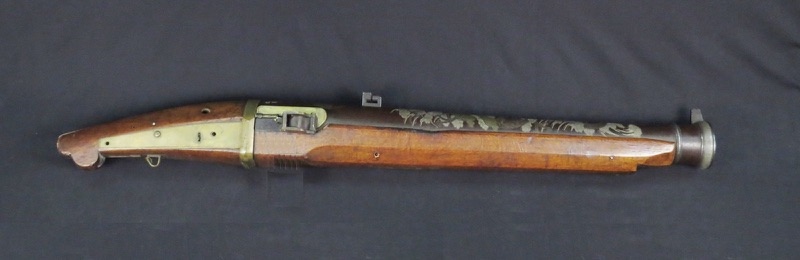
Photo: The Smithsonian Institution / Wikimedia Commons (Public domain)
Kham Mueang gun words: from the battlefield to rockets
Gun words in Kham Mueang are not only in war chronicles. The word soek (soek, เสิกฯ), which the dictionary glosses as "battle, war", lives on in old sayings, and gunpowder was used at merit-making festivals more than on battlefields.
| Kham Mueang | Lanna script | Meaning in the dictionary |
|---|---|---|
| puen | ปืนฯ | a gun, a weapon that fires a ball from a barrel; also called sinat |
| sapok | สโพกฯ | gunpowder packed in a bamboo tube, very loud when lit |
| bok fai khuen | บอฯกไฟขึ้นฯ | a rocket: a tube packed with gunpowder (fao), with a whole bamboo pole as its tail |
| khaam puen | ข่ามฯปืนฯ | (of a gun) unable to fire; also khaam sinat |
| khatha khaam sinat | คาฯถาข่ามฯสีนาฯดฯ | a spell said to make one invulnerable to guns |
Sapok and bok fai khuen are gunpowder in bamboo tubes that people in Lanna light at festivals. The kinds of rocket are listed in Yi Peng words, and rockets at funerals in Lanna funeral rites.
Khaam puen and khatha khaam sinat tell of the belief in invulnerability. The dictionary records them as a spell people believed would stop a gun from firing. This belief was part of the outlook of earlier generations who lived with war. The dictionary also records a related belief about the hem of a skirt and guns, told in Sin tin chok.
Traces you can still see today
At Ayutthaya there is still a Portuguese village. Wood wrote in 1926 that the ruins of the houses and church King Chairacha gave the Portuguese could still be seen. Silpa Wattanatham reports that the Fine Arts Department excavated the site with Portugal's Gulbenkian Foundation and found church ruins and many burials, though scholars still debate which religious order the church belonged to. Today it is an archaeological site open to visitors.
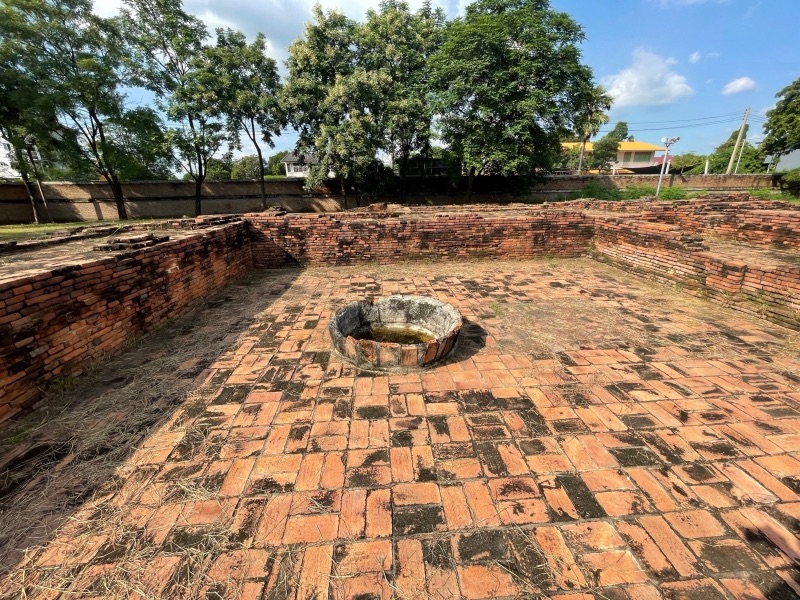
Photo: แอนเดอร์สัน / Wikimedia Commons (CC BY-SA 4.0)
In Lanna the traces of this age are not in buildings but in chronicles and words. The Chiang Mai Chronicle still tells of the cannon Pu Chao before Phrae, the Lampang tradition tells how Nan Thipchang used a gun to free the town (see Lampang, Khelang Nakhon), and the dictionary keeps words like sinat, am mok and khi fao so later readers can understand the old texts.
Common mix-ups: what the sources show
"Guns arrived in Lanna with the Portuguese." The sources show that Lanna chronicles speak of guns from about 1411, almost a century before the Portuguese reached Ayutthaya, and later scholars see the technology as coming overland from China. What the Portuguese brought were European guns, skilled gunners and new ways of fighting, even though an older scholar such as Campos doubted the Lanna evidence.
"Portugal once ruled or conquered Lanna." No source says so. The Portuguese came as traders and as mercenaries of various kings. Their footholds in the region were ports, such as Melaka and, briefly, Syriam; they never held the inland country.
"Pinto saw the Chiang Mai war with his own eyes and told it accurately." Wood points out that Pinto's dates contradict themselves: he says he lived in Siam from 1540 to 1545, yet claims to have joined the second campaign, and his army figures are greatly exaggerated. Campos also accepts that the numbers of men and elephants in Portuguese reports of the time were inflated. Pinto's book shows that Portuguese told stories about this war, but it is not evidence for its details.
"The Portuguese were on one side." The sources show Portuguese for hire on both the Ayutthaya side and the Toungoo side, sometimes in the same war. The mercenaries of that age worked for whoever hired them; they did not fight in the name of Portugal.
Summary
- Lanna and the Portuguese met through war and guns, not through diplomacy or direct trade.
- Guns reached the lands around Lanna by two roads: overland from China via Yunnan (the Lanna chronicles speak of guns from about 1411) and by sea with the Portuguese after 1511.
- Portuguese mercenaries fought for both Ayutthaya and Toungoo. Pinto claims Portuguese marched with Ayutthaya's army to Chiang Mai in 1545–1546, but his account must be read with care.
- Kham Mueang keeps the story in its words: puen, sinat, sinat fai, am mok, khi fao, luk puen and nae puen.
- Where sources disagree, this article gives both sides and draws no conclusion beyond the evidence.
Look up สิ๋นาด and ขี้เฝ่า in the Moradok Lanna dictionary, then read about the next age of Lanna in Lanna under Burmese rule.
This article is one part of the Lanna and the World series, which sets Lanna's story beside world history. Start with the main article, Lanna and the World: Human History and Lanna's Place in It, and see the same years in its parallel timeline.
📚 Read more: Lanna: where the name comes from, and 700 years of the land · King Tilokarat · Mueang Pae
Sources
- Moradok Lanna dictionary: สิ๋นาด · สิ๋นาดไฟ · อ่ำม๊อก · ขี้เฝ่า · ลูกปื๋น · แนปื๋น
- Moradok Lanna articles: Lanna and the World · Lanna under Burmese rule · Mueang Pae (the 1443 war on Phrae, following Phudet Saensa) · King Tilokarat · Lampang, Khelang Nakhon
- Sun Laichen. (2003). Military Technology Transfers from Ming China and the Emergence of Northern Mainland Southeast Asia (c. 1390–1527). Journal of Southeast Asian Studies 34(3): 495–517. Read in the Spanish translation: Transferencias de tecnología militar desde la China Ming…. Revista Universitaria de Historia Militar 10(21), 2021
- สิทธารถ ศรีโคตร (Sitthard Srikotr). (2014). นวัตกรรมทางทหารในสมัยกรุงศรีอยุธยาอันเป็นผลมาจากการติดต่อกับโปรตุเกส [Military innovation in the Ayutthaya period resulting from contact with Portugal]. Journal of European Studies 22(2) (in Thai)
- Campos, Joaquim de. (1940). Early Portuguese Accounts of Thailand. Journal of the Siam Society 32(1)
- Villiers, John. (1998). Portuguese and Spanish Sources for the History of Ayutthaya in the Sixteenth Century. Journal of the Siam Society 86
- Wood, W.A.R. (1926). A History of Siam. Chapter VII · Chapter XI. Vajirayana Digital Library
- ศิลปวัฒนธรรม (Silpa Wattanatham). เปิดบันทึกนักแสวงโชคชาวโปรตุเกส มองกษัตริย์สยาม ถึงการเมืองสมัยพระชัยราชาธิราช [A Portuguese adventurer's account of King Chairacha's Siam] · สมมติฐานใหม่ที่ "บ้านโปรตุเกส" วัดโดมินิกัน [A new hypothesis on the "Portuguese village" church] (in Thai)
- Britannica: Vasco da Gama · Melaka · Tabinshwehti · Bayinnaung · Myanmar: the unification of Myanmar · Syriam · Sengoku period · Ōsumi Archipelago · flashpan · serpentine · slow match
- UNESCO World Heritage: Monastery of the Hieronymites and Tower of Belém in Lisbon · Melaka and George Town
- Yan Pai. (2014). Forgotten, but Not Gone. The Irrawaddy
- The Metropolitan Museum of Art: Matchlock Gun (Japanese)
Practise the words from this article
Flip through 19 flashcards of the Lanna words used in this article.


