
Photo: (WT-fr) Ellnik at French Wikivoyage / Wikimedia Commons (CC BY-SA 1.0)
Nan: A Small City Where Many Peoples Live Together
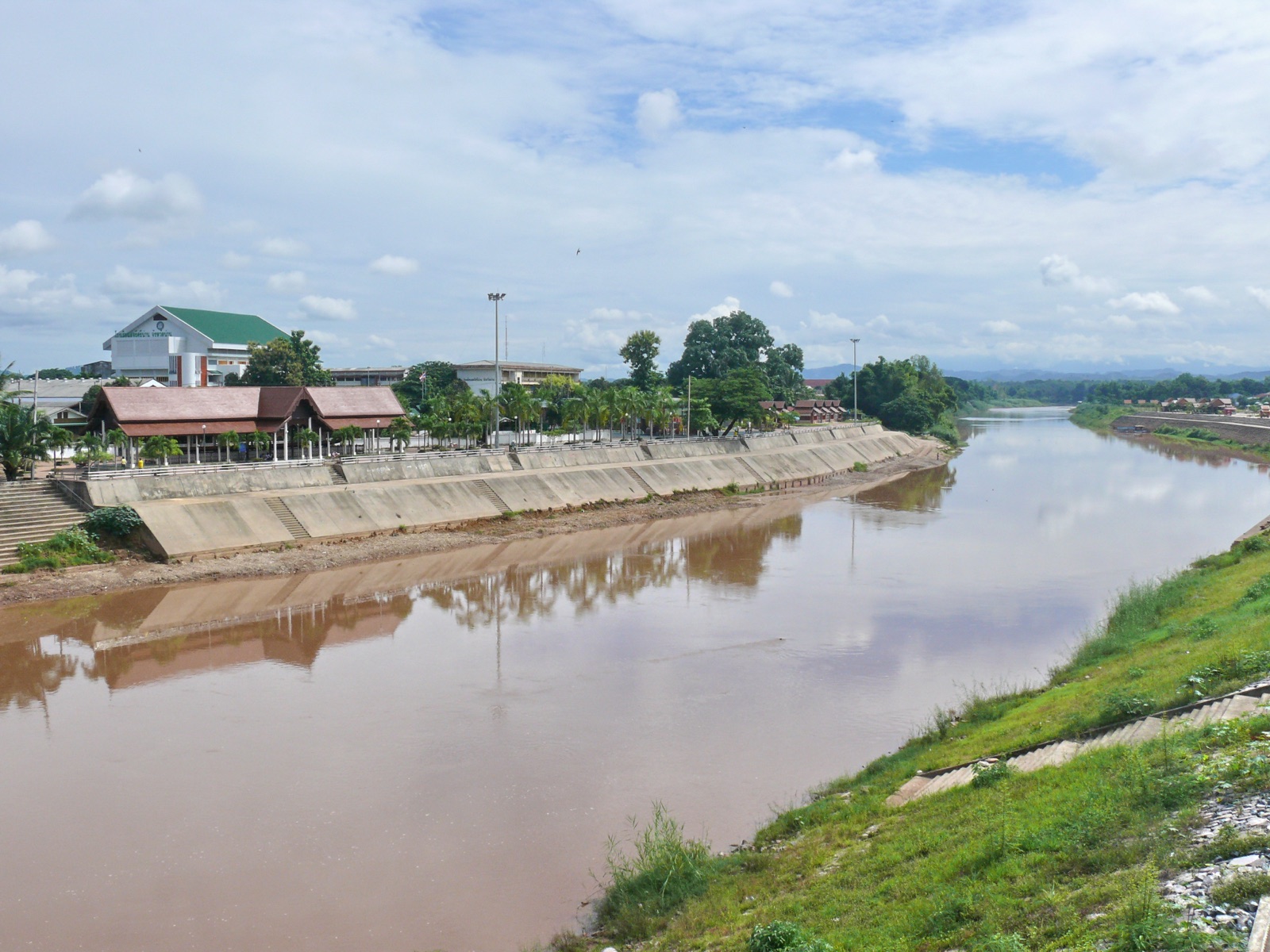
Nan (เมิอฯงนาฯ่นฯ, read mueang nan) is a small province in the North that the Moradok Lanna dictionary (in Thai) describes as still keeping "the charm of its towns, people, way of life, arts and culture, and nature". Most of the land is mountains, the Nan River runs through it, and many peoples have lived there side by side for a long time.
This post gets to know Nan through the dictionary and academic research: the name of the city, its many peoples, the murals of Wat Phumin, the provincial motto line by line, and the provincial tree, kamlang suea khrong.
Nan in the dictionary: a river, mountains and people
The dictionary records Nan as one of the 8 Lanna provinces, together with Chiang Mai, Lamphun, Chiang Rai, Phayao, Mae Hong Son, Lampang and Phrae. Most of it is complex mountain ranges, and besides Thais its people include many ethnic groups. The dictionary lists Hmong, Mien, Khmu, Mlabri, Lahu (the dictionary uses the name Mussur), Tai Lue, Tai Phuan and Tai Yuan (Khon Mueang) living together.
The river that has been bound to Nan's people is the Nan River, which the dictionary says is the longest (740 km) among the headwaters of the Chao Phraya, carrying fertility down to the central region.
The "small" in the dictionary's "small province" is the charming kind of small, not small in stories. The stories of its people come from academic work.
Where does the name "Nan" come from?
Piyanart Angkhawanichkul (Srinakharinwirot University), in her article on ethnic diversity in Nan's cultural identity (2023), summarises the names of the city from the old documents that Sarassawadee Ongsakul transcribed in the Nan Chronicle (Phuen Mueang Nan, Wat Phra Koet edition).
- Nan. The legend of Phra That Chae Haeng explains it as coming from the word nan ("a long time"), which the monk who wrote the legend presumably wanted to sound close to nan ("joy", from Pali), because the Pali name of the city is Nanthaburi. The Nan Chronicle explains that Nanthaburi was named after the white-robed ascetic Nanta who lived there, and that the city was called Nan because it lies near the Nan River, as appears in Stone Inscription No. 8 (the Khao Sumanakut inscription).
- Kao. This has long been the name for the native tribes in Nan, so the city was called "Mueang Kaothet" or "Kao Nan", and the Jinakalamali chronicle calls the kings of the Phu Kha dynasty "Phraya Kao".
- Yang. This appears in the Nan Chronicle in the part where the Phu Kha dynasty founded Pua.
The Nan Chronicle gives the order of the cities like this: Phraya Khran Mueang built Wiang Chae Haeng and Phraya Pha Kong built Wiang Nan; the Phu Kha dynasty ruled next; then Lanna under King Tilokkarat marched an army and annexed Nan; later Burma took over, and finally Nan became a vassal state of Bangkok. Read about King Tilokkarat in King Tilokkarat.
The dictionary records Nan as one of the five great cities ruled by a chao luang (เจั้าหลฯวฯง, read chao luang): Chiang Mai, Lamphun, Lampang, Phrae and Nan.
Why does Nan have so many peoples?
In Piyanart's work geography is the first answer. Nan lies in the east of Lanna, beside the Lan Xang kingdom, with the Luang Prabang and Phi Pan Nam ranges running through it. Nan traded with Luang Prabang throughout, and that route continued to Sipsong Panna, so ethnic groups moved in, especially the Tai Lue. The study says evidence of settlement by various groups appears from the 18th Buddhist century (the 12th–13th century CE).
The work studies the Lua, Mien, Tai Lue, Tai Yuan and Tai Yai in Mueang Nan, Tha Wang Pha and Pua districts. It concludes that Nan's cultural identity today has its original roots in the Lua, that the Tai Lue play the prominent part, and that Tai Yuan and Tai Yai influence arrived through rule, before Siamese influence from the central region and Western influence in the reign of King Rama V. The work also proposes calling Nan's culture "Tai Lue–Tai Yuan culture of Nan Province", not Tai Yuan culture as in Chiang Mai.
The Lua: the original owners of the land
Lua (ลวฯะ, read lua) in the dictionary is a tribal people of the Mon-Khmer family who still live in the Lanna region. Piyanart's work says the Lua are the group that settled the highlands of Nan before other groups. Lua families in Nan trace descent through the mother, and have a ceremony called kin salot or ti phi (striking the phi, a Lua bamboo instrument), which feeds the rice spirit and the village spirits after planting, best known at Tambon Sakat in Pua District.
Traces of the Lua remain in the lives of lowlanders, for example carrying a basket with a strap across the forehead, which Piyanart's work says villagers call po (the strap) and chaek (the carrying vessel).
The Mien and other highland groups
The Mien (Iu Mien) live in Tambon Pa Klang, Pua District. According to Piyanart, mien means "person", they migrated from southern China and entered Lanna about 200 years ago, and are known for five-colour embroidery and silverwork. Every house has an ancestor shelf.
The dictionary records other peoples tied to Nan: the Khmu (ขหุ, read kha mu), the original native people of Southeast Asia, which the dictionary says are densely present in Nan Province; and the Lao Kao (ลาวฯกาวฯ, read lao kao), a Tai group in Nan and Phrae who are Isan Lao, with an accent different from other Lao groups.
The Tai Lue in Nan: from Sipsong Panna to the Nan valley
The Tai Lue (ชาวฯไทลื้, read chao tai lue) are people from Sipsong Panna, and their spoken language is called Kam Lue (คำฯลื้, read kam lue). The dictionary says it is found in several districts of Nan, and in San Pa Tong and Doi Saket in Chiang Mai.
Piyanart's work says the Tai Lue came into Nan clearly around the 23rd–24th Buddhist centuries, matching the early Rattanakosin period (late 18th to early 19th century CE), after Siam drove the Burmese out of Lanna. Chao Fa Atthawarapanyo, the ruler of Nan, submitted to Bangkok, and King Phutthayotfa Chulalok (Rama I) had the royal idea of bringing the Lue of Sipsong Panna down to settle in Nan, to increase the city's population. The Lue became the local people of Nan and Lue culture the main culture of the city. A study by Nakhon Nan Buddhist College (2022), told in Meet the Tai, also says the Lue have been in Nan for about 200 years.
Traces of the Tai Lue in Nan that the research mentions include:
- The village and temple of Nong Bua, Tha Wang Pha District: a large Tai Lue community that has preserved its culture for a long time, with a Lue house displayed in the temple grounds and murals of the Panyasa Jataka, the Chantakhat story, by Nan Bua Phan.
- Pha lai nam lai (flowing-water pattern cloth): cloth for which the Lue village of Nong Bua is famous. Piyanart's work explains it as cloth using the Lue supplementary-weft technique, which developed from geometric designs into curved ones.
- Wat Ton Laeng and Wat Rong Ngae, Pua District: Lue-style viharas with low three-tiered roofs, wooden tiles, and small narrow windows.
Read the words for cloth and weaving in Cloth and Clothing in Kham Mueang, and tap the Tai Lue on the map of Tai peoples below. You can compare them with other Tai groups two at a time.
The Wat Phumin murals: a record of many peoples
Piyanart's work says the murals in the vihara of Wat Phumin were painted by Nan Bua Phan, a Tai Lue painter who was a native of Nan, in the reign of King Rama V. They are evidence of the lives of many groups, such as women carrying pots and baskets, which the study says reflects the lives of Lua, Tai Yuan and Tai Lue women, who had to carry things to the market or into the forest.
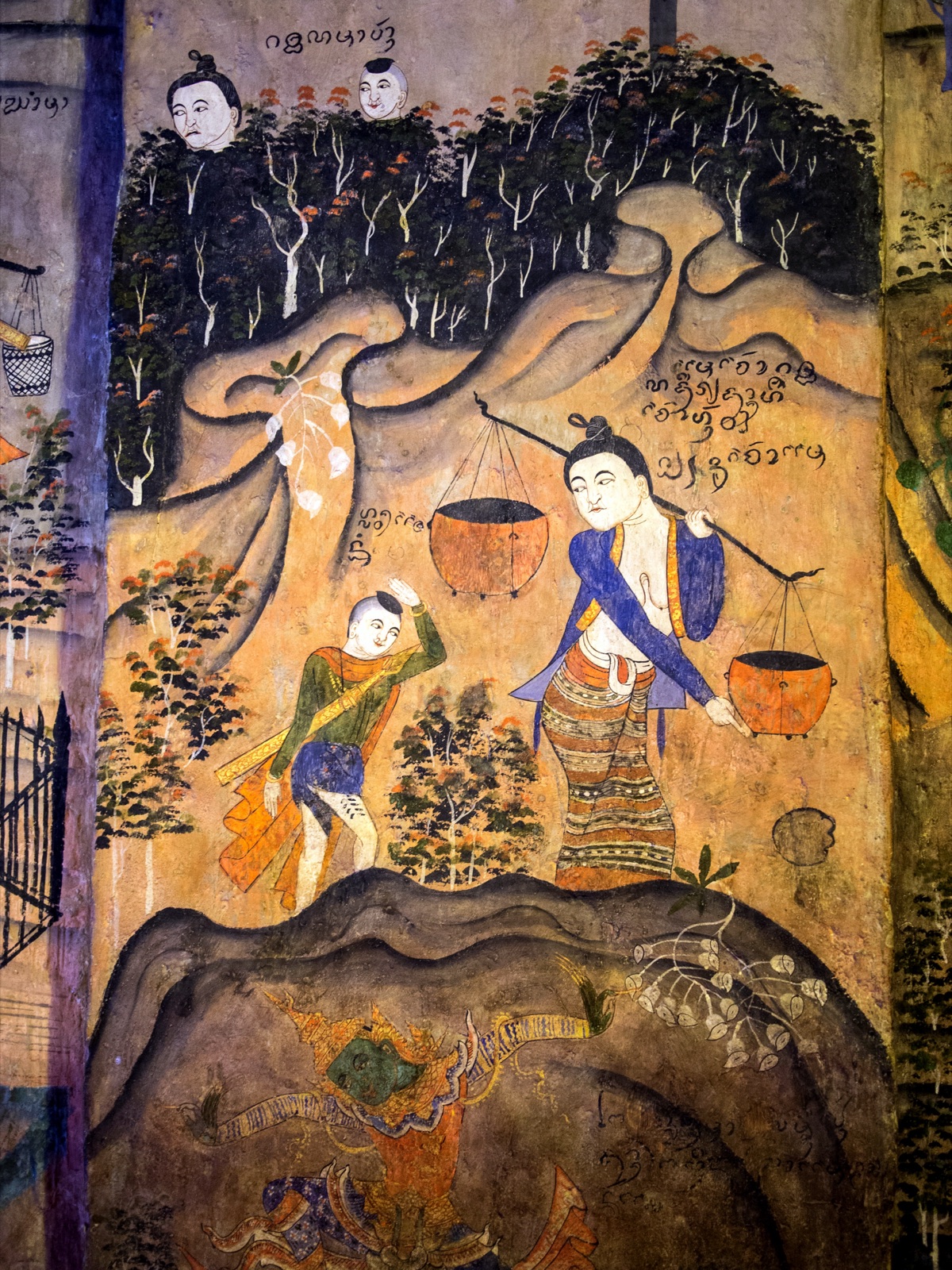
Another mural people in Nan know is "Pu Man Ya Man". Man (ม่านฯ, read man) in the dictionary is the Burmese people. Piyanart's work explains that this pair of figures blends Tai Lue, Tai Yuan and Tai Yai culture, but the Tai Yai culture is the most visible, so it is called Pu Man Ya Man, meaning a Tai Yai or Burmese man and woman in their prime.
At Wat Si Mongkhon in Tha Wang Pha District there is a recent mural telling of the great flood at Mueang Yom in 1881 CE. The study notes that in the picture the villagers' houses have crossed gable finials like Lua houses, the men have the "lao phung dam" tattoos of the Tai Yuan, and the women wear their hair in buns and Tai Lue-style skirts.
The Nan motto, line by line
The dictionary records the motto of Nan Province as "Famous boat races, city of the black-ivory elephant, the Wat Phumin murals, land of golden oranges, the glowing Phra That Chae Haeng". It has five lines, and each tells a story.
Famous boat races
A boat is huea in Kham Mueang (เริอฯอ, read huea), by the rule you can read about in R Becomes H in Kham Mueang. Suthira Kanatham (Faculty of Social Sciences, Chiang Mai University, 2023) explains that Nan's long-boat racing reflects the life of Buddhists and an agricultural society centred on the river, and has changed from a festival into a sporting competition that has grown in both size and number of participants.
City of the black-ivory elephant
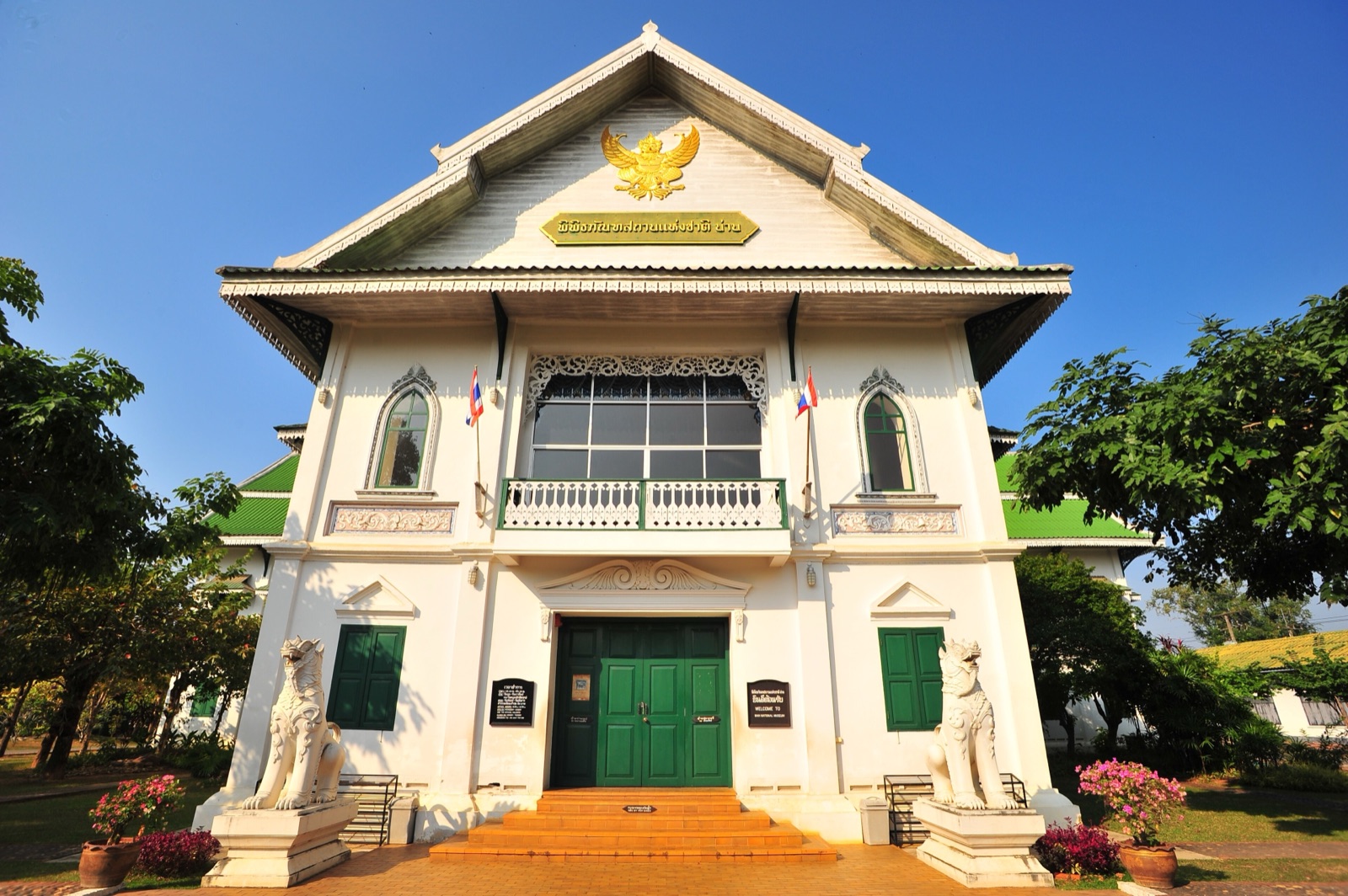
An elephant is chang in Kham Mueang (ช้างฯ, read chang), by the ch to j rule. As for the black-ivory tusk, Thai Post (2023) says it is "a precious treasure of Nan since ancient times", displayed at the Nan National Museum, which sits in the Ho Kham, once the residence of Nan's ruling princes. The building blends Western and Thai architecture, has a gallery of the line of Nan's rulers listing 64 of them, and an excavation in 2004 found bricks from the walls of the original Ho Kham.
The Wat Phumin murals
This line is the murals of the vihara of Wat Phumin by Nan Bua Phan, told in the section on murals above. The year the temple was built has not been checked against academic work, so it is not given in this post.
Land of golden oranges
For the Nan golden orange, research by Chaowalee Jaisuk and colleagues (Maejo University, 2022) says it is a geographical-indication (GI) plant and an important economic crop of Nan Province.
The glowing Phra That Chae Haeng
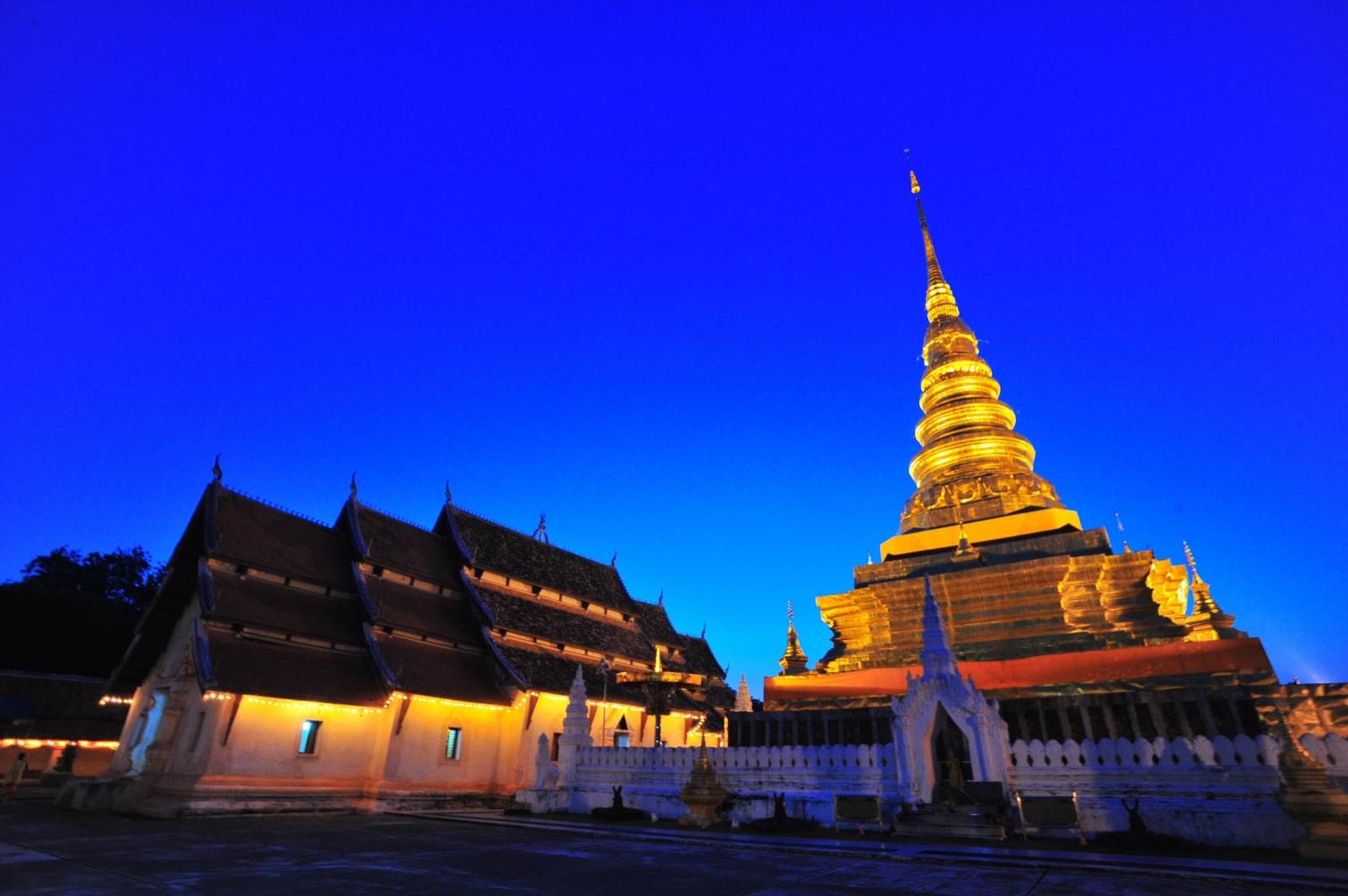
Phra That Chae Haeng, at Wat Phra That Chae Haeng in Phu Phiang District, is the birth-year stupa for the Year of the Rabbit, as the dictionary records under that pi koet (ธาฯตฯปีเกิดฯ, read that pi koet). Read about all twelve birth-year stupas in Birth-Year Stupas. The legend of Phra That Chae Haeng in the Nan Chronicle says Phraya Khran Mueang built Wiang Chae Haeng.
The provincial tree and Nan song
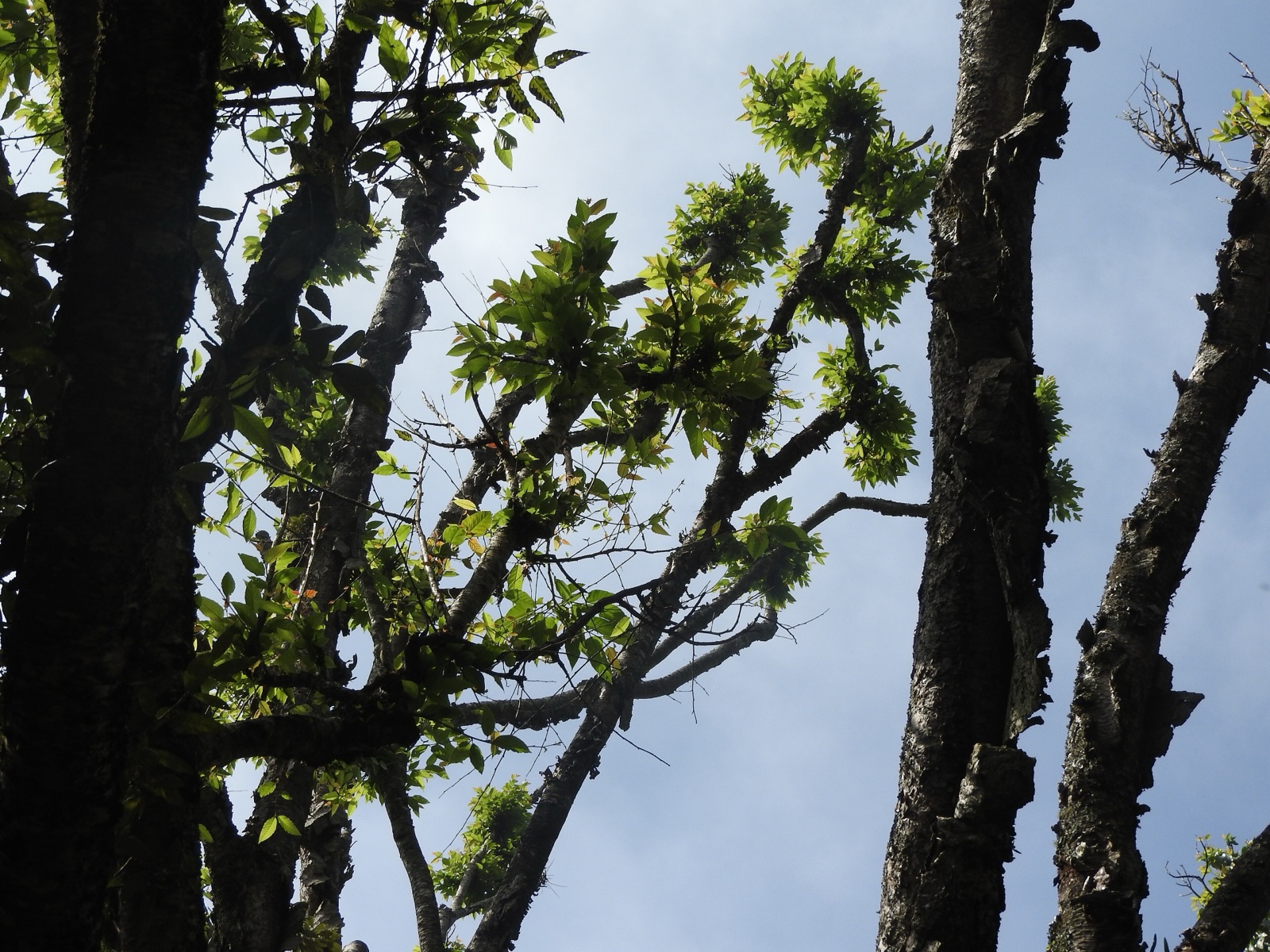
Kamlang suea khrong (กำลังฯเสิอฯอโระฯค่฿งฯ, read kamlang suea khrong) is the provincial tree of Nan. The dictionary describes it as a tall tree 20–35 metres high, with bark that smells like camphor and peels off in paper-like layers when old, flowers in long catkin-like clusters, and fruit with two thin wings. The timber is used for building, flooring and furniture, and the bark is boiled as a tonic for the body and to relieve aches.
The dictionary adds the gloss "Thailand's sakura", which brings to mind pink cherry blossom, but what it describes, flowers in catkin-like clusters and fruit with two thin wings, matches a birch. The Thai biodiversity database (Office of Natural Resources and Environmental Policy and Planning) lists the Thai name kamlang suea khrong together with the scientific name Betula alnoides, the Indian birch. So this post uses a photo of the Indian birch, not a cherry; they are different trees.
In music, Nan has its own sung melody. The dictionary records long nan (ล่อฯงนาฯ, read long nan) as the name of a melody for chanting so that is popular in Nan Province, and so long nan (ซํอฯล่อฯงน่าฯนฯ, read so long nan) as the so dance-song of Nan. Read about the sung verse in So Lyrics and Salo, So and Sueng.
Summary
- Nan is a small mountain province with the Nan River, 740 km long, bound to its people, as the dictionary records.
- The names Nan and Nanthaburi have origins in the Nan Chronicle, and the Phu Kha dynasty ruled before Lanna and Burma.
- Its many peoples include the Lua, Mien, Tai Lue, Tai Yuan, Tai Yai, Khmu and others. Nan culture today is a blend, with the Tai Lue playing the prominent part.
- The Wat Phumin murals by Nan Bua Phan, a Tai Lue painter, record the lives of several groups.
- The five-line motto speaks of boat races, the black-ivory elephant, Wat Phumin, golden oranges and Phra That Chae Haeng, and the provincial tree is kamlang suea khrong.
To read the Kham Mueang names and mottos of the other provinces, see Lanna's Eight Provinces, and look up more Kham Mueang words in the Moradok Lanna dictionary (in Thai).
Sources
- The Moradok Lanna dictionary (moradoklanna.com/dict, in Thai): เมืองน่าน · กำลังเสือโคร่ง · ซอล่องน่าน · จาวไตลื้อ and all the words in this post, checked 18 October 2026.
- Angkhawanichkul, P. (2023). Ethnic Diversity in the Cultural Identity of Nan Province. Journal of History, Srinakharinwirot University, 48(1), 283–306. (In Thai.)
- Kanatham, S. (2023). The Construction of Nan Identity in the Context of Globalization through the Festival of Longboat Racing. Humanities and Social Sciences Journal of Pibulsongkram Rajabhat University, 17(1), 117–131.
- Jaisuk, C., et al. (2022). Genetic Variation of Nan Golden Orange as a Geographical Indication, for Conservation and Genetic Management. Journal of Agricultural Research and Extension (Maejo University), 39(3), 100–110. (In Thai.)
- Thai Post. (14 July 2023). Nan Museum gets a modern makeover. (In Thai.)
Practise the words from this article
Flip through 14 flashcards of the Lanna words used in this article.
Look up "เมืองน่าน" in the Moradok Lanna dictionary (in Thai)


