
Photo: Vyacheslav Argenberg / Wikimedia Commons (CC BY 4.0)
Lanna and Ming China: Envoys, Elephants and the Yunnan Road
Lanna (lan na, ล้านฯนาฯ) and Ming China lay thousands of li apart, yet for more than 120 years envoys from Chiang Mai carried elephants, horses, ivory and gold and silver vessels up to the Chinese court many times, and came home with silks, seals of office and tallies that proved who they were. The Ming court wrote these visits down in its daily records, and Thai and foreign scholars have now translated them. The story of Lanna and Ming China can therefore be told from the evidence of the time itself.
This article is part of the series Lanna and the World. It reads the Chinese records one theme at a time: the names China gave Lanna, the road the envoys walked, the bronze tallies used to check them, the one time an army from Yunnan came into Lanna's land, and the last letter that never got an answer.
Kham Mueang has a word for gifts carried to an overlord: khong kan (khong kan, ขอฯงคั). The dictionary defines it simply as "tribute goods", and that is the heart of this article.
Before the Ming: "Babai Xifu" in the Yuan records
Lanna's name in Chinese writing is older than the Ming. The Yuan dynastic history calls the kingdom Babai Xifu (八百媳妇), first when recording a war in 1292, as our article Lanna: where the name comes from explains. The Mongol-Yuan years are another part of this series, so this article starts with the next dynasty.
The Ming History explains the name this way: "it is said that the chief had eight hundred wives, each leading a village". So the name is a Chinese chronicler's explanation, not what the people of Lanna called themselves. One Yunnan record (the Dian zhi) also notes that the local name of the place was Jingmai (景迈), which the translator identifies as Chiang Mai (Kanokporn Numtong, 2020).
- Babai Xifu (八百媳妇), literally "eight hundred daughters-in-law": the Yuan-era name, from 1292
- Babai Dadian (八百大甸): the office the Ming set up in 1391; dadian means "great plain"
- Babai Zhenai (八百者乃): a second office set up in 1404 and later abolished; the translator thinks it probably meant Chiang Rai
- Jingmai (景迈): the local name a Yunnan record gives, i.e. Chiang Mai
- Dao Lanna (刀揽那): the name the Chinese records use for King Tilokarat
The Ming reach Yunnan
🎯 In 1368 Zhu Yuanzhang drove the Yuan out of China and founded the Ming dynasty, which ruled until 1644. Yunnan, next to the Tai lands, stayed in the hands of Mongol lords for some years more. In September 1381 the Hongwu emperor appointed the generals Fu Youde, Lan Yu and Mu Ying to lead an army into Yunnan (Ming Shi-lu, Geoff Wade's translation). Once Yunnan was taken, Mu Ying stayed to guard it until his death, and the Mu family went on commanding in Yunnan until the end of the dynasty (Kanokporn Numtong, 2020).
From now on Lanna's northern neighbour was a province of China. A Ming work, the Shuyu zhouzi lu, says that after the Ming army entered Yunnan the Tai and Burmese lands to the south came one by one to submit, and the court made them six offices: Cheli (Sipsong Panna), Mubang (Hsenwi), Mengyang, Miandian (Burma), Babai Dadian (Lanna) and Laowo (Laos).
Tai peoples in the north used to call the Chinese who came overland from Yunnan "Haw", a name given by others rather than one that people used for themselves; the dictionary explains it as "the name Tai groups use for the Chinese of Yunnan province". This article therefore says Chinese from Yunnan. The name is a reminder that, for Lanna, China meant the Yunnan next door, not the distant capital.
The first year the Ming records mention Lanna is 1388: "the country of Babai Xifu" sent people to offer local products. Three years later, in 1391, envoys of Dao Banmian, ruler of Babai, offered elephants and local products. The record says that Mu Ying had earlier sent an officer named Yang Wanzhe to invite them, and that same month the court renamed the office Babai Dadian. Zhou Bifeng and Sarassawadee Ongsakul (2020) identify Dao Banmian as Phaya Saen Mueang Ma, who began the great stupa of Wat Chedi Luang in Chiang Mai.
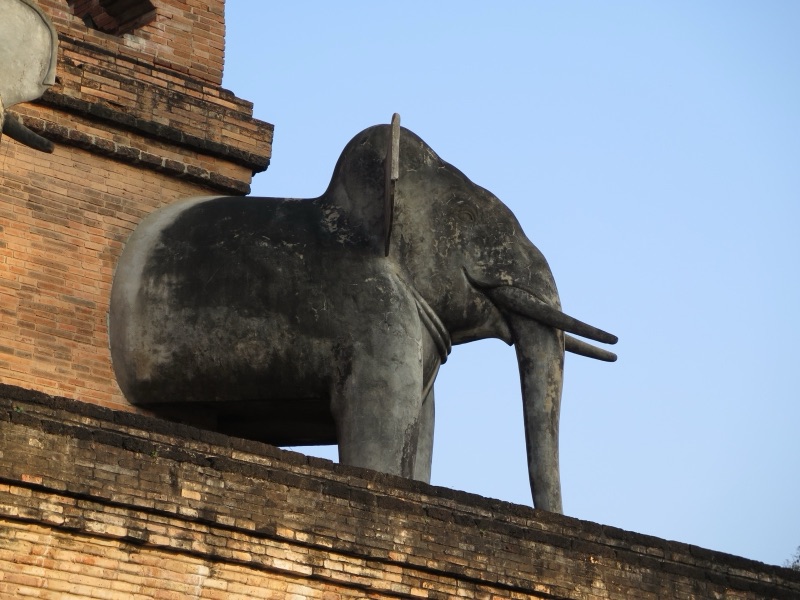
Photo: Douglas Perkins / Wikimedia Commons (CC BY 4.0)
In the same year the Hongwu emperor told his minister of war he had heard that Babai was at war with the "Baiyi" and had no peace, and that Babai, "ten thousand li away", still sent tribute as custom required, which showed its sincerity; Babai should be told to train troops and hold its ground. "Ten thousand li" comes back again and again in the Chinese records. Distance shaped this relationship more than anything else.
The tribute system: gifts up, gifts back
The tribute system was imperial China's way of doing diplomacy. States sent envoys with gifts for the emperor and received gifts, titles and seals in return. Zhou Bifeng and Sarassawadee Ongsakul (2020) describe it as an unequal power relationship, like that of patron and client: one side sent tribute and accepted its place, the other rewarded and recognised it. But the relationship kept changing with the circumstances of both sides, and Lanna also used it for its own political ends.
What Lanna sent, as the records list it, falls into three groups:
| Group | Examples in the records |
|---|---|
| Animals | chang (chang, ช้างฯ, elephants) and ma (ma, ม้า, horses) |
| Valuables | gold and silver vessels, a letter engraved on gold, a gold and silver elephant saddle |
| Local products | nga chang (nga chang, งาช้างฯ, ivory), rhinoceros horn, mats, aromatics, white sandalwood |
What the Ming gave back was mostly many kinds of silk, paper money, robes, headwear and belts, and sometimes seals, patents of appointment and banquets. One example from 1394: a mission of 36 people brought ivory, mats and aromatics and received 480 ding of paper money, 20 bolts of silk and 120 bolts of cloth. The largest mission we found in the records, in 1431, had 113 people.
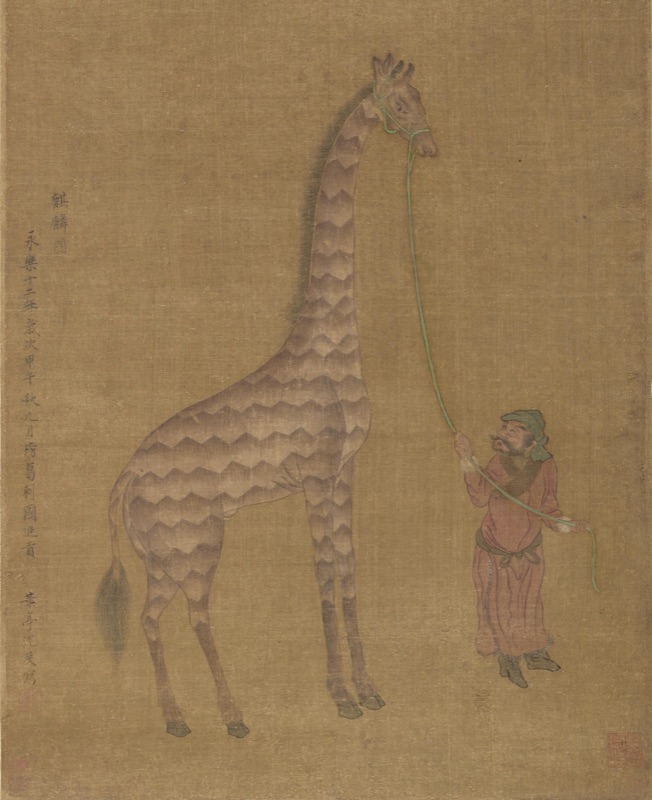
Image: Shen Du (沈度, 1357–1434) / Wikimedia Commons (Public domain)
Elephants were the most meaningful gift. A Ming geography (the Da Ming Yitongzhi) lists Babai's local products as elephants, white sandalwood and benzoin, and explains that the ruler kept elephants to ride and used them as the vanguard in war (Kanokporn Numtong, 2020).
The tribute-elephant road: from Chiang Mai to Yunnan
How did the envoys travel? The Wanli-era Yunnan gazetteer (Yunnan Tongzhi) has a heading "the road of the tribute elephants" and counts the way in days: from Jingdong one day to Zhenyuan, two more to the edge of Cheli's land, two to Pu'er, where "tea is produced", two to a wide plain where elephants were kept, four to the town of Cheli by a great river, then eight days southwest to Babai. That is about 19 days from Jingdong. Envoys from Lanna travelled it the other way.
Cheli was the Chinese name for Sipsong Panna, home of the chao tai lue (chao tai lue, ชาวฯไทลื้), whom the dictionary describes as "a people living in Sipsong Panna, People's Republic of China, with their own spoken and written language". Cheli stood on the Mekong, where the city of Chiang Hung (Jinghong) is today. To the west lay chiang tung (chiang tung, ชยฯงตุง), Kengtung, which the Chinese records call Menggen (on the different Tai peoples see Tai peoples).

Photo: Dan Lundberg / Wikimedia Commons (CC BY-SA 2.0)
A mission was not only people; it needed pack animals too. Kham Mueang calls a beast of burden tang (tang, ต่างฯ), and the dictionary gives the example "ma tang", a horse carrying panniers to take goods to sell. The elephants meant as gifts, of course, had to walk the whole way themselves.
For the whole distance, the Ming History says it was 38 cheng (travel stages) north from Babai's seat to the provincial seat of Yunnan, and from there on to the capital. There were checkpoints on the way. A record of 1433 says that at Hedi in Lin'an there had been an official ferry since the Hongwu reign, on the road to Cheli and Babai, but people had begun posing as envoys to force a crossing, so the court set up a police post.
Walk this road yourself, read every record, and try checking an envoy's tally like a Ming official in the widget below.
1404–1407: two offices, a blocked envoy and an army from Yunnan
In the early 15th century both sides had new rulers. The Yongle emperor took the throne in China, and in Chiang Mai Phaya Sam Fang Kaen succeeded Phaya Saen Mueang Ma. Zhou Bifeng and Sarassawadee (2020), citing Lanna documents, say that his elder brother Chao Yi Kumkam, ruler of Chiang Rai, resented Sam Fang Kaen's accession, and the brothers fought over the throne.
The Chinese records reflect this. In July 1404 envoys of Dao Zhaoni came to court first. Two days later the Ming set up two offices at once: Dao Zhaoni over Babai Zhenai and his younger brother Dao Zhaosan over Babai Dadian, sending seals, patents, headwear and robes to both. Zhou and Sarassawadee identify Dao Zhaoni as Chao Yi Kumkam and Dao Zhaosan as Phaya Sam Fang Kaen. Each side sought China's recognition; China recognised both and stayed out of the quarrel.
Then things grew tense. In September 1404 the party of the eunuch Yang Xuan, carrying imperial orders to the southern lands, passed through Babai Dadian and was stopped by Dao Zhaosan; it could not go on. The Chinese records do not give Lanna's reasons. The next year the ruler of Cheli asked to attack Babai. The emperor answered that a few leaders were at fault, not the soldiers or the people, and that the ruler was young: envoys should warn him first, troops should go only if he refused, only the ringleaders should be seized, and there must be "no great killing".
At the end of December 1405 the general Mu Sheng, Mu Ying's son, reported that Ming and Cheli troops had entered Babai, taken two stockades and reached the stockade of Zheng Xian, which Zhou and Sarassawadee identify as Chiang Saen, while troops from Mubang took more than ten others. Babai sent men to admit fault, so the troops halted and withdrew. (The Thai and English translations differ by two days on the date: 27 and 29 December.)
Early in 1406 an imperial edict told Dao Zhaosan that as soon as the troops entered his land he had admitted fault, "I see that you are young", and the people of Babai were the emperor's people too, so he was pardoned. Later that year Babai's envoys brought an apology gift, but the emperor judged it insincere and refused it. In mid-1407 they came again with local products and gold and silver vessels, and this time the court accepted them. Relations returned to normal, and Dao Zhaosan kept sending missions for decades.
The Lanna side tells the clash differently. Zhou Bifeng and Sarassawadee (2020) note that according to legend in the Nan chronicle, Lanna's defenders poured hot roasted sand into the Chinese soldiers' armour and the Chinese lost; the Chiang Mai chronicle says the Lanna king fought the "Lord of the Sky" (the Chinese emperor) with the help of the gods, and the Chinese general was killed by lightning. The two authors say these stories still need weighing, but at least they show how much the clash mattered to Lanna.
Gold warrants and tallies: how the Ming checked envoys
Great distance raised a question: was this envoy real? In November 1404 the Ming court made verification tallies (xinfu, 信符) and red warrants lettered in gold for six offices in Yunnan, Babai Dadian among them.
In Geoff Wade's translation, five bronze tallies were cast. One was incised with four characters, 文 (wen), 行 (xing), 忠 (zhong) and 信 (xin); the other four had raised characters that fitted each of these exactly. There were also despatch notes numbered 1 to 100 that had to match a stub book kept in Yunnan. When an envoy arrived, officials checked both the tally and the number; if they did not match, he could not pass.
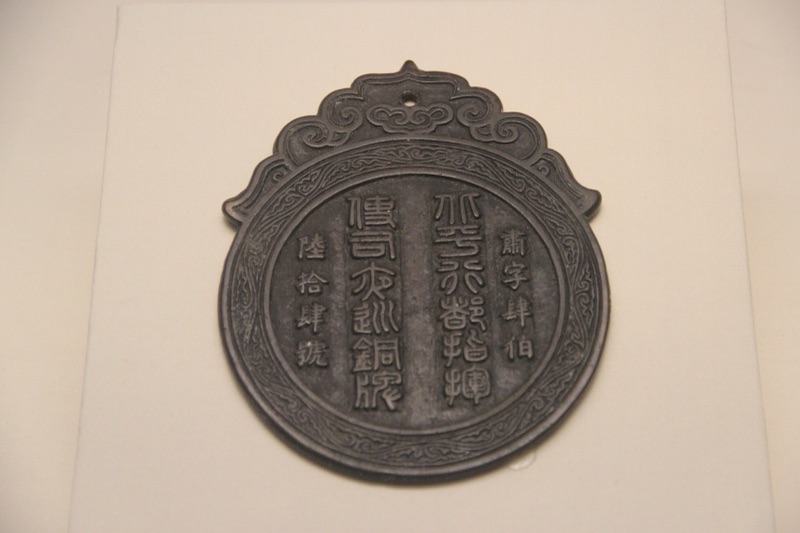
Photo: Gary Todd / Wikimedia Commons (CC0)
The two translations differ slightly in the details. Wade's has the incised tally kept by the native lord and the raised ones held at the capital for the court's envoys to carry, while Zhou Bifeng and Sarassawadee (2020) describe it the other way round: the incised one kept by China and the four raised ones by the local ruler. What both agree on is the principle: the halves must fit exactly and the number must match the stub.
Tallies could be lost or destroyed. A record of 1445 says the court had to make a new set for Babai Dadian because the old one had been burnt by troops from "Xianluo", that is sayam (sayam, สๆยฯามฯ, Siam). That year fell in the reign of King Tilokarat, whose reign saw wars with Ayutthaya. In 1466 new ones were needed again because the old set had been destroyed by fire.
Interpreters, and a bureau for the Babai language
Language was another wall. The day after the tallies were issued in 1404, the emperor noted that the lords in Yunnan "did not know Chinese characters" or the proper forms for a memorial, so he created posts for literate clerks in six offices, Babai Dadian among them. In 1440 Babai's own envoys asked for help: their people "did not understand the Chinese language", so they asked that an interpreter bring the gold warrant and tally to tell them when to send tribute, with troops to escort them between relay stations.
Kham Mueang calls such a person a lam (lam, ล่ามฯ). The dictionary explains it as "one who carries the words of one side to the other; an envoy who translates one side's words so the other can understand", and it was also a rank of Lanna officials, such as nai lam and chao phan lam.
China had its own translators' bureau, the Siyi guan (四夷馆). The Ming Huidian and the Ming History record that it was founded in the fifth year of Yongle (1407), and that in the sixth year of Zhengde (1511) a new section, the Babai guan (八百馆), was added to translate documents from Lanna, before a Siam section was added in 1579 (Kanokporn Numtong, 2020). Zhou Bifeng and Sarassawadee (2020) convert the same year as 1512, and point out that a dedicated section shows contact was close enough to need people who knew both languages, to translate and check the royal letters Lanna sent.
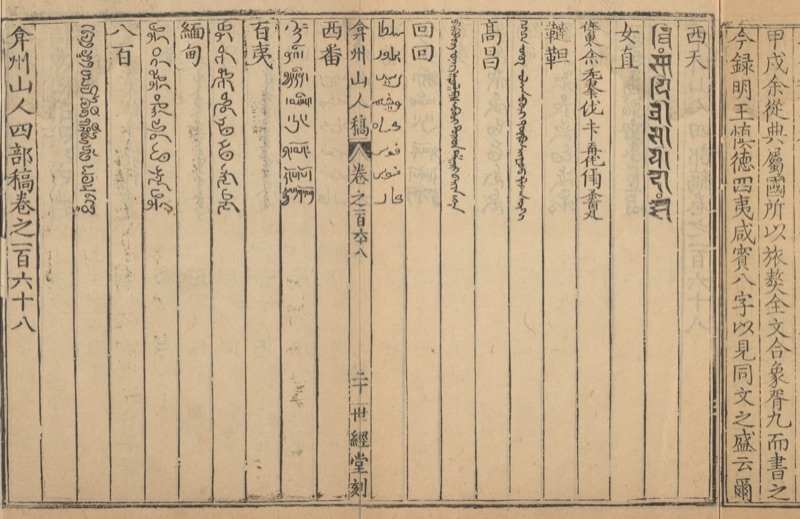
Image: Wáng Shìzhēn 王世貞 (1526–1590) / Wikimedia Commons (Public domain)
The age of King Tilokarat: Đại Việt, Laos and "Dao Lanna"
In the reign of King Tilokarat (1441–1487) the Chinese records call him Dao Lanna (刀揽那), "Lord of Lanna", as our article Lanna explains. The biggest story of this age in the Chinese records happened to the east. 🎯 In 1479 the army of Đại Việt invaded lan chang (lan chang, ล้านฯช้างฯ, Lan Xang). A Ming court record of September 1480 reports that it took more than 20 stockades in Laos and meant to push on toward Babai; the Ming court had Guangxi send a warning to the king of Annam.
In mid-1482 the Yunnan commander reported that Babai had told him it had helped Laos drive back the Đại Việt army. Đại Việt had earlier sent a forged order to threaten and win over Babai; Babai burnt the order and had elephants trample it. The Ming History adds that Dao Lanna sent troops to escort a Lao prince who had fled to him as far as Jingkan, which the translator identifies as Chiang Khan, and that the court rewarded him with a hundred taels of silver and silks. The full story of that war is another part of the Lanna and the World series.
In 1489, after King Tilokarat's death, Dao Yue Zhenglai, grandson of Dao Lanna, sent envoys asking to inherit the post. China's Ministry of War said Babai was far from Yunnan and "full of fevers", so the usual check was waived and he was confirmed at once, with headwear and a belt. The translator thinks Dao Yue Zhenglai is probably Phaya Yot Chiang Rai, King Tilokarat's grandson (Kanokporn Numtong, 2020).
The last tribute, and when Babai passed to Burma
The last tribute from Lanna in the Ming records came in August 1513. Envoys of the ruler the record calls "Zhao Lanna" offered elephants, horses and a gold and silver elephant saddle, and were feasted and given silks. Zhou Bifeng and Sarassawadee (2020) note this is the last such mission in the Ming records.
They also warn that silence in the records does not mean no envoys came. In the Chenghua reign (1465–1487) there are gaps of five and seven years with no tribute recorded, perhaps because the chroniclers thought such visits too routine to note.
In 1558 King Bayinnaung's army took Chiang Mai, and Lanna entered its time under the man (man, ม่านฯ, the Burmese), as our article Lanna under Burmese rule tells. The Chinese records say only that in the Jiajing reign Babai was absorbed by Burma, its ruler moved to Jingxian, which was called "Little Babai", and tribute stopped coming. The translator thinks Jingxian was probably Chiang Saen (Kanokporn Numtong, 2020).
In 1586 Yunnan officials reported that the ruler at Pegu had absorbed many lands, leaving Laos, Babai, Menggen and Menglian still "hesitating". In 1587 Babai Dadian wrote asking China to help restore it. The Ming History records a single answer: "no reply"; a Yunnan record says the matter was discussed and not approved. After this no formal relations between Lanna and the Ming are recorded.
Lanna through the eyes of the Chinese chroniclers
Besides envoys and politics, the Chinese records note what the chroniclers had heard about Lanna itself. The Wanli Yunnan gazetteer says that in Babai "each village has a temple and each temple a stupa; the villages number ten thousand and so do the stupas", and calls it "the country of compassion" (慈国), because its ruler "dislikes killing and does not like to contend"; if he must fight, he stops once the wrong is avenged. The Ming History uses similar words: "loves the Buddha, hates killing; temples and stupas number in the ten thousands".
A Ming geography also notes that the people of Babai "greet a guest by taking his hand" and "follow the Buddha as the Burmese do". "Ten thousand" is the chronicler's way of saying "very many", not a survey count, but the picture agrees with what we know from the Lanna side: this was a time when Buddhism flourished in Lanna.
Common mix-ups: what the records actually say
"Sending tribute means Lanna was a vassal of China"
The records show a more complicated picture. Lanna had its own kings and its own government, and China hardly ever meddled in its internal affairs. When Lanna asked for troops against a neighbour in 1432, the emperor replied that Babai was "more than 5,000 li from Yunnan", that Chinese troops should not fight its wars, and that it should keep good relations with its neighbours. Zhou Bifeng and Sarassawadee (2020) conclude that China's rule over Lanna was symbolic, and that Lanna used the relationship for its own political ends.
"Eight hundred wives means the king of Lanna really had eight hundred wives"
The Ming History itself calls it something "it is said". The name is a Chinese chronicler's explanation with no support from the Lanna side, and a Yunnan record notes that the local name of the place was Jingmai, that is Chiang Mai.
"China invaded Lanna many times in the Ming period"
In the Ming records scholars have collected, an army entered Lanna's land only once, in 1405, and the episode ended quickly when Babai admitted fault. The wars with the Mongol-Yuan before that belong to another age.
Summary
- Ming China called Lanna Babai Dadian from 1391. Records of tribute from Lanna begin in 1388, and the last one recorded is from 1513.
- The khong kan Lanna sent were elephants, horses, ivory and gold and silver vessels; China gave back silks, paper money, seals, headwear and belts.
- Envoys walked the tribute-elephant road through Cheli (Sipsong Panna), about 19 days from Jingdong to Chiang Mai according to the Yunnan gazetteer.
- China checked envoys with bronze tallies whose halves had to fit and despatch numbers that had to match a stub book, and set up clerks, interpreters and a Babai guan translation section to communicate with Lanna.
- The only armed clash in the records was in 1405, after a Chinese envoy was stopped; the two sides tell it differently, and relations were normal again by 1407.
- Once Lanna was under Burma, its 1587 plea for Chinese help went unanswered, and the formal relationship ended.
See what else was happening in the world in the same years on the series' parallel timeline, opened at 1405.
The Lanna and the World series
This article is part of the Lanna and the World series, which looks at Lanna's relations with one land at a time.
- The main article of the series: Lanna and the World: Human History and Lanna's Place in It, with every part of the series listed
- Lanna's names in Chinese sources and 700 years of Lanna: Lanna
- The golden age, when Lanna envoys went to China most often: King Tilokarat
- After the link with the Ming ended: Lanna under Burmese rule
Look up khong kan, lam and tang in the Moradok Lanna dictionary, and read about the border city the Yunnan army reached in Chiang Rai.
Sources
- Moradok Lanna dictionary: ของกัน · ล่าม · ต่าง · จาวไตลื้อ
- กนกพร นุ่มทอง (Kanokporn Numtong). (2020). หลักฐานล้านนาในเอกสารโบราณจีน: บันทึกเกี่ยวกับอาณาจักรสนมแปดร้อยในเอกสารโบราณสมัยราชวงศ์หมิงและราชวงศ์ชิง [Evidence of the Lanna Kingdom in ancient Chinese manuscripts: records of the "Eight Hundred Concubine" kingdom in Ming and Qing documents]. Chinese Studies Journal, Kasetsart University, 13(2) (Thai translations of the Ming Shi-lu, Ming History, Da Ming Yitongzhi, Yunnan Tongzhi, Dian zhi and Ming Huidian)
- โจวปี้เฟิง (Zhou Bifeng) and สรัสวดี อ๋องสกุล (Sarassawadee Ongsakul). (2020). ความสัมพันธ์ในระบบบรรณาการระหว่างจีนและล้านนา ในสมัยปลายคริสต์ศตวรรษที่ 13–16 [The tributary relations between China and Lan Na in the late 13th–16th centuries]. Chinese Studies Journal, Kasetsart University, 13(2)
- Geoff Wade (translator). Southeast Asia in the Ming Shi-lu: an open access resource. Asia Research Institute and Singapore E-Press, National University of Singapore (each record is linked in the widget), e.g. 1381, army sent to Yunnan · 1404, two offices · 1404, the tallies · 1405, Mu Sheng's army · 1482, the forged order · 1513, the last tribute
- The Ming dynasty, 1368–1644, and Zheng He's fleets, 1405–1433: Britannica: Ming dynasty · The Met: Ming Dynasty (Heilbrunn Timeline) · Britannica: Zheng He · Columbia University, Asia for Educators: The Ming voyages
- Đại Việt invades Lan Xang, 1479: Britannica: Laos, history · Ming Shi-lu, Geoff Wade's translation, 1480
- Moradok Lanna articles that are the source of the Lanna side (each has its own sources): Lanna · King Tilokarat · Lanna under Burmese rule · Lanna and the World
Practise the words from this article
Flip through 12 flashcards of the Lanna words used in this article.


