
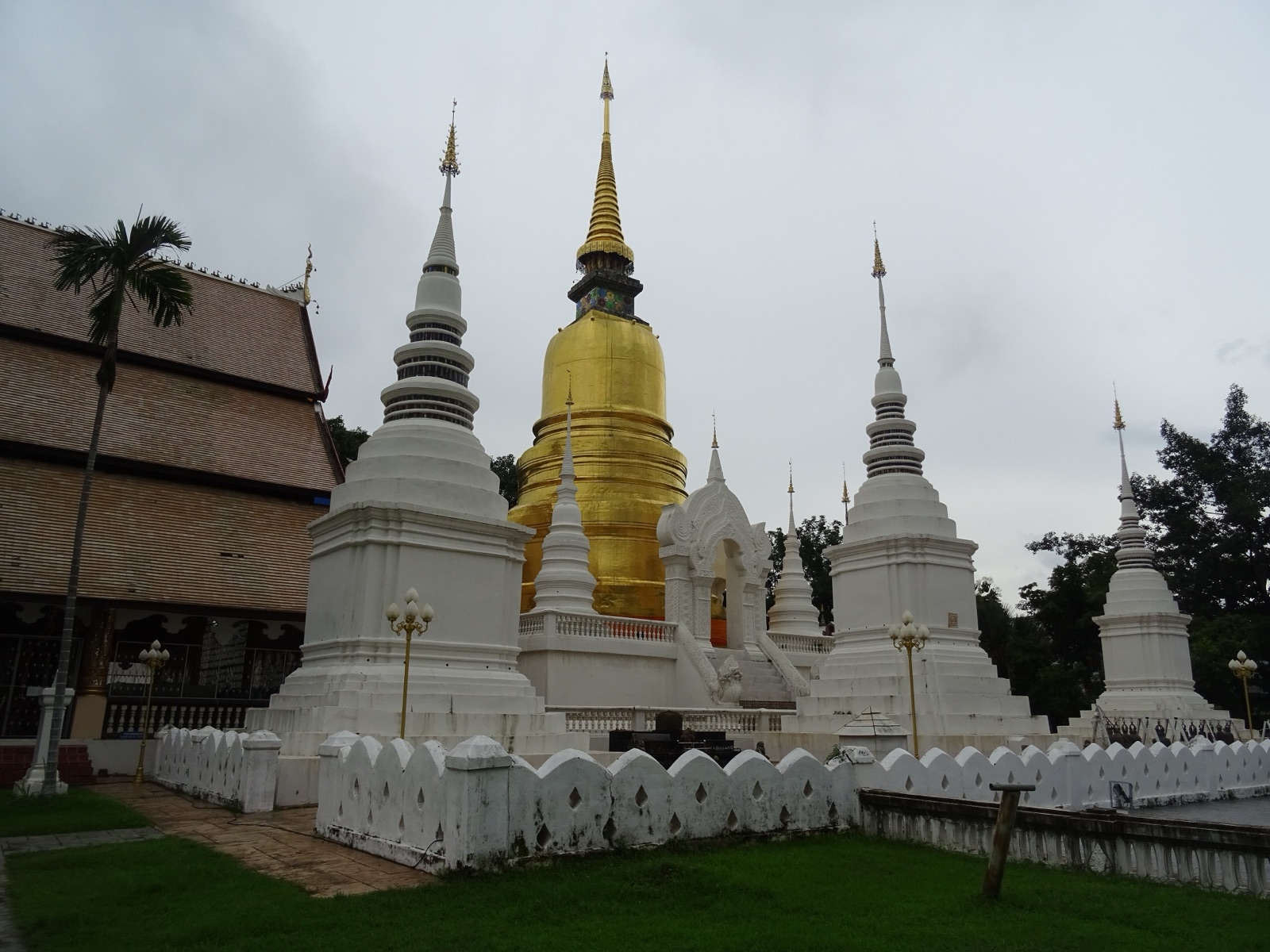
Photo: PsamatheM / Wikimedia Commons (CC BY-SA 4.0)
Ma Mia: Kham Mueang from a Jaran Manopetch Song
The song Ma Mia is a Kham Mueang (Northern Thai) folk song for which Jaran Manopetch wrote the words and the tune, and that Soontaree Vechanont sang until the whole country knew it. It tells of a Burmese young woman and a prince from Chiang Mai. The lyrics are full of everyday Kham Mueang, such as hak (รักฯ, Kham Mueang reading hak), phai (ไผ, read phai) and po chai (พํอฯชายฯ, read po chai). This article reads the song as a language lesson, and keeps two things apart: what the lyrics say, and what different sources say about what really happened.
This article is part of the series Kham Mueang through songs and literature. The song is still under copyright, so we quote only short lines as needed to explain them, and invite you to listen to the full song on the official channel. The story of Chao Noi Sukkasem is told with respect for the Northern royal family and the Na Chiang Mai family, and we name the source of every point.
Listen first
Ma Mia is on the album Folk Song Kham Mueang Luk Khao Nueng (1981), track 10 in the list of Jaran's works on Wikipedia, which matches the album table in the study by Ueamporn Thipdet and Siriwan Nanthachanthun (2023). LANNER (Thanyachanok Inthrangsi, 2024) says it was recorded in 1981, with Jaran writing the words and the tune. The Wikipedia page on Ma Mia gives 1977, which does not match the other sources, so we follow the album list and use 1981.

This video is from the Nititad AOA Official channel, which publishes the work of Jaran and Soontaree. Listen once first, then read the explanations below.
The story in the song, in brief
The song opens with a spoken narration saying that the story happened many decades ago: Chao Noi Sukkasem, aged fifteen, was sent by his father to study in the town of Mawlamyine (Moulmein; in Thai, Mala-maeng). Then the tune begins. Ma Mia is a Burmese market woman, so beautiful that young men fall for her, but she gives her heart to the young prince, the son of a ruler of Chiang Mai. When the prince finishes his studies he must leave her. She disguises herself as a man and follows him, but a love that crosses class and nationality goes against the custom of the time, so the two must part. At the end the prince dies of a broken heart, and Ma Mia becomes a nun.
This is our own summary. Please listen to the full song in the video above.
Words in the song: a quick table
We checked the lyrics we quote against the description of the video by Nititad AOA Official and the lyrics published by MUSIC DEE DEE Official, which agree (see the note near the end). The Moradok Lanna dictionary is the authority for spelling and meaning.
| In the song | Dictionary Kham Mueang | Meaning |
|---|---|---|
| แม่ก้า | ka ค้าฯ (read ka) | to trade: buying, selling and exchanging. Mae ka is a woman trader; a close word is mae kat แม่กาดฯ, a person who comes to buy or sell at the market |
| ฮัก | hak รักฯ | to care for and feel bound to; to be fond of someone with affection, as young lovers are |
| ไผ | phai ไผ | who, which person, as in phai pen khon yia, "who is the one who did it?" |
| ฮื้อ | hue หื้ (read hue) | to give, to hand over; the song writes ฮื้อ |
| ป้อจาย | po chai พํอฯชายฯ | man, a male of any age |
| เป๋น | pen เปนฯ | to be |
| ตี้ | ti ที่ | place, locality; also order in a sequence ("that" or "which" in the song) |
| หัวใจ๋ | hua chai ห฿วฯไจ | heart |
| มีด · ดาบ · ฟัน | mit มีดฯ · dap ดาปฯ · fan ฟันฯ | knife · sword · to strike hard with something sharp; used here as a metaphor |
| ลา · จาก | la ลา · chak จากฯ | to leave, to abandon, to go away · to go away from a place |
| เฮย | hoei เฮิยฯ | a filler word at the end of a verse, as in luk lan hoei ("children, oh") |
Hak, phai, hue: small words that make the song Kham Mueang
The song says that Ma Mia "bo yom hak phai" (will not love anyone), and then gives her heart to one young man. The dictionary defines hak as to care for and feel bound to, and to be fond of someone with affection, for example young lovers. Phai is the question word "who", which the song uses in a negative sentence: she will not love anyone.
The word hue, which the song writes ฮื้อ, means to give or hand over. In the song, chai (ไจ, read chai, heart, feelings) is what she hands over. Those few words say that she chose with a sincere heart.
The dictionary also has hak tae (รักฯแท้, read hak tae), meaning true love or real love. To describe the kind of love the song tells of, you can add tae to hak.
Po chai: disguised as a man
In the part where Ma Mia follows the prince there is the line
ปลอมเป๋นป้อจายหนีตามมา — Ma Mia, words and music: Jaran Manopetch
("disguised as a man, she ran after him"). Po chai literally means "father-man". The dictionary explains that it means a male human being of any age: a baby, a child, a young man or an old man are all called po chai. The dictionary defines sao (สาวฯ, read sao) as an unmarried woman past childhood, from age 15 up, the counterpart of the man called bao, a pair of words you also hear in Sao Chiang Mai.
Ngam lam: beauty and the images of the song
The song praises Ma Mia: "ngam lam muean duean song saeng" (beautiful beyond measure, like the moon shining). The dictionary defines lam (ลํา, read lam) as to cross beyond a set boundary and, as a modifier, "very, overflowing". It gives exactly this example, "ngam lam", meaning very beautiful, which matches the song.
At the saddest moment the song compares the pain to "mit sap dap fan hua chai" (a knife chopping, a sword striking the heart). It uses the picture of a knife and a sword instead of saying outright that she is hurt, and the listener feels the pain at once. This is a technique of the narrative folk song: an image carries the feeling.
Sound changes from central Thai
The lyrics show several ways Kham Mueang sounds differ from central Thai. Every pair in the table was checked in the dictionary.
| Central Thai | Kham Mueang in the song | What changes |
|---|---|---|
| รัก (rak) | ฮัก (hak) | r becomes h |
| เรียน (rian) | เฮียน (hian, to study) | r becomes h |
| เป็น (pen) | เป๋น (pen) | rising tone |
| ที่ (thi) | ตี้ (ti) | different consonant and tone |
| ปี (pi) | ปี๋ (pi) | rising tone |
| ให้ (hai) | หื้อ (hue) | different sound and spelling (the song writes ฮื้อ) |
| ใคร (khrai) | ไผ (phai) | a different word |
| ผู้ชาย (phu chai) | ป้อจาย (po chai) | a different word |
Near the end there is the line "khwam hak mak pen chen ni" (love is often like this), before the song closes on the filler word "lae hoei". The dictionary records hoei as a filler word at the end of verse, like a sigh from the narrator.
What is told, and what each source says
The story of Chao Noi Sukkasem and Ma Mia is widely known through the song, TV dramas and films, but sources disagree on many points, so we set them out one by one.
The widely told version. The story was first published in the book Phet Lanna by Pranee Siriton na Phatthalung (1964), as summarised in the article by the Pridi Banomyong Institute (Kawinporn Charoensri, 2025) and by LANNER (2024). It says that in 1898 Chao Kaeo Nawarat sent Chao Noi Sukkasem to study in Mawlamyine. He met Ma Mia around 1902 and they lived together. In 1903 he was called back to Chiang Mai and she followed in disguise as a man, but was sent back. He married Chao Nang Bua Chum, and Ma Mia became a nun. As for the Northern figure named in the story, the Moradok Lanna dictionary records, under chao luang (เจั้าหลฯวฯง, read chao luang), that Major General Chao Kaeo Nawarat was the last chao luang of Chiang Mai (the ninth). Read about the first chao luang at King Kawila.
What the records show. The Royal Gazette recorded the title "Chao Uttarakan Kosol" and his death notice, as summarised by Wikipedia and Khom Chat Luek (2018). He died aged 33 in March 2456 BE under the old reckoning, in which the year began on 1 April, so that is March 1914 in modern terms. The day is 20 or 21 March depending on the source. The song says the prince "died of a broken heart", which is how the legend tells it, not a cause given in the official record.
Points on which the sources disagree
The Pridi Banomyong Institute (2025) gathers the points raised by Dr Penpisuka Sukkhata in Matichon Weekly (2021), together with the views of other scholars. The most interesting ones are:
- The school and the dates: Phet Lanna does not name the school. Ajarn Samrit Luechai (Silpa Wattanatham, 2012) asked at St Patrick's School in Mawlamyine: the priest there said he had never heard of the story, and the surviving pupil lists do not reach 1903. The prince's age when he went to study also differs by source: fifteen in the legend, but Worachat Meechubot points out that going at nineteen would be unusual.
- The name Ma Mia: Penpisuka suggests it is a pen name the author gave her.
- Why they had to part: some versions say it was because of their different status, and that the family had already arranged a fiancée; others say it was because of Siam–British politics. Thanet Charoenmuang thinks the main issue was probably rank and class, comparing the case of Chao Intanon, who married Chao Nang Sukhantha of Chiang Tung openly.
- The source book changed between printings: Samrit points out that the 1964 and 1980 editions describe the later years of the prince's marriage differently (LANNER, 2024).
- The nun: the year relatives went to see the nun in Mawlamyine differs, 1909 or 1915, and a shrine at Wat Suan Dok that some suspected to be Ma Mia's was said by Samrit in 2023 to belong to another member of the royal family.
- Fiction or fact: Banros Buakhli sees it as fiction built on the real Chao Noi Sukkasem. Worachat Meechubot suggests the story may come from another prince, but others reply that these were different people.
The Pridi Institute article concludes that the story stands between fact and fiction. So we read the song Ma Mia as a song that tells a love legend, not as a historical record, and we do not take sides. What the lyrics themselves confirm is what Jaran chose to tell: love across nationalities, pain, and a custom that had to be kept.
For the Northern royal houses of the same period and their ties with the Siamese court, read on at Princess Dara Rasmi.
Where the song came from, and tears in the studio
The study by Ueamporn and Siriwan (2023) argues that Ma Mia reflects how the Khon Mueang keep their customs, through contrast words like "tae" (but) that set the two people's status side by side. It cites the lines "tae sut ti hak pen phama" (but the one he loved was Burmese) and "phit prapheni suep ma tong rang la yaek thang" (against the custom handed down, they must part), and points out that the word "tong" (must) shows a belief that parting was right according to tradition.
As for the recording, LANNER and Thai PBS's programme Song of Fame tell a similar story: Soontaree cried so hard that she could not record the first time. Thai PBS says she had to bring flowers, incense and candles to ask forgiveness at Wat Suan Dok before she could record the song. LANNER also notes that Jaran rarely sang it on stage because some people say it is a jinxed song, which is what the tellers believe, not a fact.
The town of Mawlamyine that the song mentions is a real town in Myanmar. The picture at the top of this article is Kyaikthanlan Pagoda in that town, where, according to the legend as summarised by Khom Chat Luek (2018), the couple swore their love in the courtyard. The picture below shows a colonial-era building and gives a feel of the port town where people from the North travelled to study and trade more than a hundred years ago.

How the lyrics differ between versions
We compared the lyrics in the description of the Nititad AOA Official video (2015), the lyrics published by MUSIC DEE DEE Official (2024) and one line quoted in the study by Ueamporn and Siriwan (2023, p. 176). The lines quoted in this article agree in every source. The differences are in the spoken opening and in spelling.
- "ruang man kao sip pi ma laeo" (the story is ninety years old, Nititad) / "ruang man paet sip pi ma laeo" (eighty years old, MUSIC DEE DEE)
- ฮื้อ in the song / hue in the dictionary
- ก้า in the song ("mae ka") / ka in the dictionary
- "buat chi" (to become a nun) in the song / the dictionary records buat as being ordained as a novice, and has mae chi as the word for a female renunciant
What the song means as a whole
Ma Mia is a narrative song with a spoken opening, a sad melody and plain Kham Mueang. It lets the listener feel that a couple's love could not beat the limits of its time, and it closes on a short line that sounds like a summary of life: love is often like this. For language learners, the song gives many basic Kham Mueang words, hak, phai, hue and po chai, and the image of a knife and sword striking the heart.
Summary
- Ma Mia has words and music by Jaran Manopetch and is sung by Soontaree Vechanont. It is on the album Folk Song Kham Mueang Luk Khao Nueng (1981).
- Words from the song: hak (love), phai (who), hue (give), po chai (man), lam (very) and hoei (a filler word).
- The clearest sound change is r becoming h (rak becomes hak), and the rising tone in words like pen and pi.
- The story of Chao Noi Sukkasem and Ma Mia is told differently in many places, so the song is best heard as a love legend that an artist chose to tell.
- Behind the recording, it is said that Soontaree cried so hard that she had to ask forgiveness at Wat Suan Dok before she could record it.
Look up more words from the song in the Moradok Lanna dictionary (in Thai), and read more about narrative singing in Sao Chiang Mai, also sung by Soontaree.
More in the same series: the song Noi Chaiya · Long Mae Ping, or see the whole series at Kham Mueang through songs and literature (in Thai).
Sources
- Moradok Lanna dictionary (dict2), entries po chai, chao luang, chao, ka, mae kat, hak, hak tae, phai, lam, pen, ti, mit, dap, fan, hua chai, chai, la, chak, hue, hoei, sao. In Thai.
- Nititad AOA Official. (2015). มะเมียะ - สุนทรี เวชานนท์ (ภาพคอนเสิร์ต) [Ma Mia – Soontaree Vechanont (concert recording)]. YouTube (lyrics in the video description).
- MUSIC DEE DEE Official. (2024). มะเมี๊ยะ (จรัล มโนเพ็ชร) - หลิว อาจารียา [Ma Mia (Jaran Manopetch) – Liw Acharaya]. YouTube (lyrics in the video description, used for cross-checking).
- เอื้อมพร ทิพย์เดช และสิริวรรณ นันทจันทูล [Ueamporn Thipdet and Siriwan Nanthachanthun]. (2023). ภาพแทนคนเมืองในบทเพลงของจรัล มโนเพ็ชร [The Representation of Lanna people in Charun Manopetch's songs]. Journal of Humanities and Social Sciences, Uttaradit Rajabhat University, 10(1), 167–184. In Thai.
- กวินพร เจริญศรี [Kawinporn Charoensri]. (20 April 2025). ๑๒๒ ปี จาก "มะเมียะ-ศุขเกษม" สู่ "กมล" [122 years from "Ma Mia–Sukkasem" to "Kamol"]. Pridi Banomyong Institute. In Thai.
- ธันยชนก อินทะรังษี [Thanyachanok Inthrangsi]. (14 February 2024). มะเมียะ: เรื่องราวรักร้าวของเจ้าชายล้านนา [Ma Mia: the heartbreaking story of a Lanna prince]. LANNER. In Thai.
- ไทยพีบีเอส [Thai PBS]. (2024). Song of Fame เพลงคู่สยาม: มะเมียะ [Song of Fame: Ma Mia]. In Thai.
- คมชัดลึก [Khom Chat Luek]. (20 March 2018). 20 มี.ค.2456 สิ้นเจ้าอุตรการโกศล กับคำสาบานรักสุดสะพรึง! [20 March 2456: the death of Chao Uttarakan Kosol and an oath of love]. On This Day. In Thai.
- วิกิพีเดีย [Wikipedia]. จรัล มโนเพ็ชร [Jaran Manopetch] (album list, a first check) and เจ้าอุตรการโกศล (ศุขเกษม ณ เชียงใหม่) [Chao Uttarakan Kosol (Sukkasem na Chiang Mai)] (a lead, checked against the sources above). In Thai.
Practise the words from this article
Flip through 21 flashcards of the Lanna words used in this article.


