
Photo: Unknown Japanese artist / Wikimedia Commons (Public domain)
Lanna and Japan: From Trade Ships to 1941
Lanna and Japan never shared a border, yet their stories touched twice. The first time was indirect, through the port city of Ayutthaya, in the age when Japanese junks sailed across the sea to trade; Kham Mueang calls such a seagoing junk sapao (sapao, สเพัา). The second time came to the streets of Chiang Mai, Lampang and Mae Hong Son, when Japanese troops were stationed in the North during the Second World War (1941–1945).
This article is part of the series Lanna and the World. It tells both eras neutrally, from research, Japanese government documents and the memories of local people that scholars have recorded. The war is told to understand it and to remember the people, not to celebrate fighting.
- 1425–1570: ships from Ryukyu (Okinawa) call at Ayutthaya 57 times; Lanna is still an independent kingdom
- 1604–1616: 36 Japanese red-seal ships head for Siam; the Japanese have a village at Ayutthaya; Lanna is under Burmese rule
- 1887: Siam and Japan sign a Declaration of Amity and Commerce
- 1941–1945: Japanese troops in the North; Thailand's Phayap Army is based at Lampang and enters Chiang Tung
- 1996: a museum opens at Khun Yuam, today the Thai–Japanese Friendship Memorial
Step through it yourself
The widget below walks through 14 moments on two maps: a sea map for the ship era and a map of the North for the war years. Pick a chapter, drag the slider or press ▶ to play. Each step has Kham Mueang words from the dictionary, its sources and links to related articles, and at the end there are five true-or-false questions to try.
The ship era: Japan and Ayutthaya
Ties between Japan and Siam are older than many people think. A 2010 speech by Japanese Ambassador Kyoji Komachi and a 2015 ThaiJO article by Sakesit Paksee cite the same record: in 1388 seamen from Ayutthaya, carrying gifts for the king of Korea, stayed about a year in Japan.
In the following century Ryukyu, today's Okinawa, was a go-between in sea trade. The same speech says that between 1425 and 1570 Ryukyu sent about 150 ships to Southeast Asia, 57 of them to Ayutthaya, more than to any other port. Japanese swords were prized at the Siamese court. Lanna was then still an independent kingdom, in the time of King Tilokarat.
Red-seal ships and the Japanese village at Ayutthaya
After 1600 the Tokugawa shogunate issued red-sealed licences to ships trading abroad. Yoneo Ishii, writing in the Journal of the Siam Society (1971), counts 36 ships bound for Siam with such a licence between 1604 and 1616, more than for any other country in those years. The ship on the folding screen at the top of this article is one of them. Both sapao and huea (huea, เริอฯอ), meaning a boat, are words Lanna people use for vessels on the water.
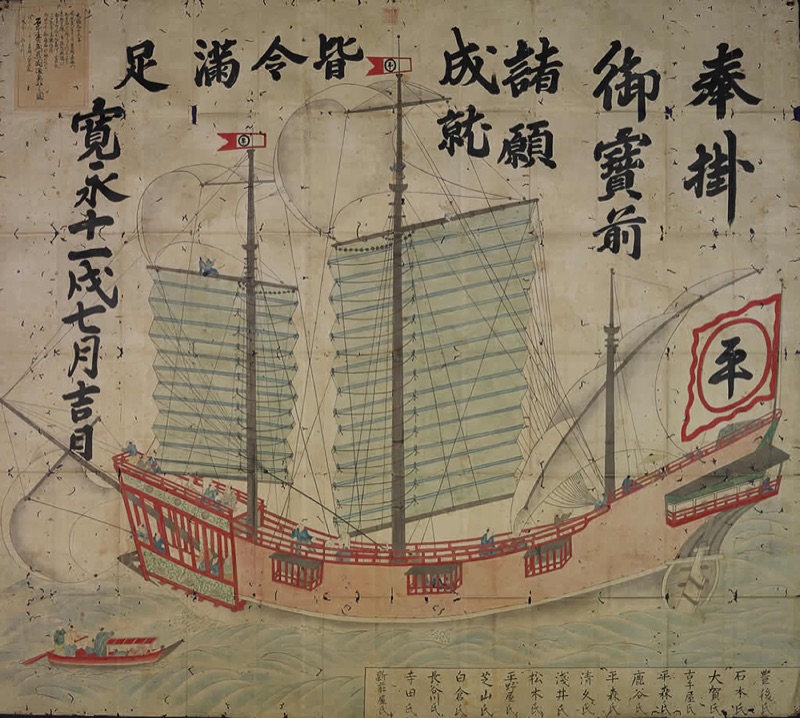
Image: Unknown author / Wikimedia Commons (Public domain)
The Japanese traders set up a Japanese village outside Ayutthaya; the ThaiJO article places it west of the Portuguese village and south of the Dutch one. Both Ishii and Charnvit Kasetsiri (as cited by the Japanese embassy) put its peak at about 1,000–1,500 people; Ishii adds that a figure of eight thousand in some Japanese sources is an exaggeration.
The best-known Japanese of the village was Yamada Nagamasa. A 2023 message from Japan's foreign minister describes him as the village chief, given a high rank by the king of Ayutthaya for promoting trade between the two countries; the embassy speech gives his title as Okya Senaphimuk.
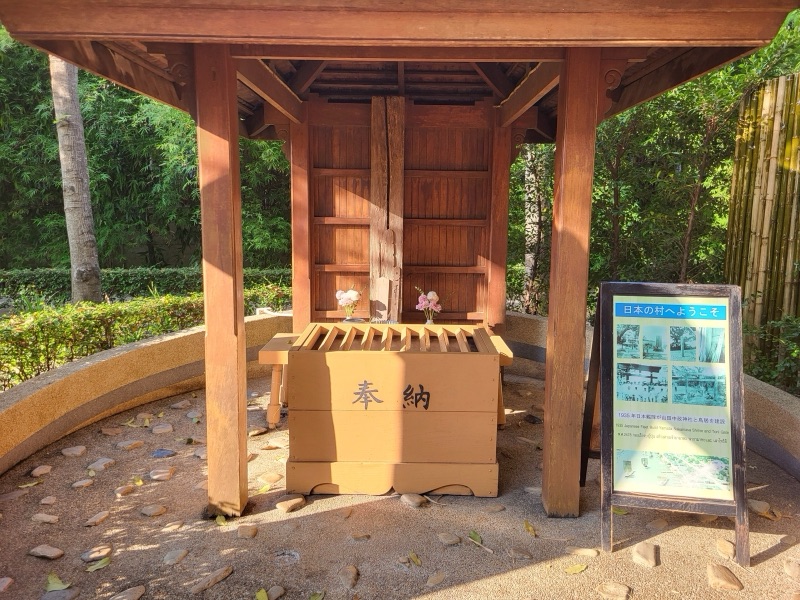
Image: Athulvis / Wikimedia Commons (CC BY-SA 4.0)
So where was Lanna in this story?
While the Japanese village flourished, Lanna had been under Burmese rule since 1558, and Chiang Mai was a city that Ayutthaya and Burma competed to influence; see Lanna under Burmese rule. The sources we read describe the Japanese at Ayutthaya and in the ports, but do not record Japanese going up to Lanna in that age. What links the two stories is Ayutthaya's trade, which was also the outlet for forest goods from the interior.
Trade went on even after Japan closed itself off. The embassy speech says Siam sent deer and shark skins, made into armour and samurai sword hilts, while Japan's main export to Ayutthaya was copper. The ThaiJO article counts about 130 Siamese ships at Nagasaki between 1647 and 1700.
The 1887 declaration and the first Japanese in Chiang Mai
After Japan closed its doors, official contact with Siam fell silent for a long time, until Japan went through the Meiji Restoration of 1868. On 26 September 1887 Siam and Japan signed a Declaration of Amity and Commerce, which Japan's Ministry of Foreign Affairs counts as the start of diplomatic relations. It was signed for Siam by the foreign minister, Prince Devawongse, on his way home from Britain. Lanna was then still a tributary state of Siam; read more in Lanna.
Before the war some Japanese already made their living in Chiang Mai. Boonserm Satrabhaya, a Chiang Mai photographer and chronicler of the city (published in Silpa Wattanatham), recalls that the city's first cinema was a Japanese cinema near the Pa Phraeng crossroads, set up by Mr Tanaka, who ran a photo studio at the foot of khua lek (khua lek, ข฿วฯเหัลฯก), the iron Nawarat Bridge. It showed Japanese and Chinese silent films before closing at a loss.
Two studies that interviewed people of that generation, by Walaiporn Kanjanakaroon and Teerat Panyo (2016) and by Satanan Panyain (2021), record more Japanese businesses, such as the Toyo Menka cloth shop, the Nakano dental clinic and the Yagi photo studio. In July 1941 Japan opened a consulate in Chiang Mai.
1941: Japan enters Thailand, and the Phayap Army at Lampang
On 8 December 1941, the same day as the attack on Pearl Harbor, Japanese forces entered Thailand by land and sea. There was fighting with Thai troops in several southern provinces before the government let them pass; on 21 December it signed an alliance with Japan, and on 25 January 1942 Thailand declared war on Britain and the United States (Silpa Wattanatham 2021; Walaiporn and Teerat 2016; Britannica).
The Thai army set up the Phayap (Northwestern) Army to hold the Burmese border. Silpa Wattanatham (citing Pratchayakorn Lakhonphon, 2021) says its headquarters was the former British consulate in Lampang (Lampang, ลำพางฯ). Walaiporn and Teerat cite a record by Sak Rattanachai that on 22 December Japanese troops reached Lampang by land and air; children and adults alike saw aircraft stunting over the town for the first time.
Chiang Tung, 1942: the Phayap Army in the Shan State
Japan wanted the Thai army as a right flank guarding the rear of its forces in Burma, so the Phayap Army moved up from Lampang and Chiang Rai into the Shan State. Silpa Wattanatham dates the 3rd Division's entry into Chiang Tung (Chiang Tung, ชยฯงตุง) to 5 June 1942; the dictionary explains the name as Kengtung, a town in the Shan State east of the Salween.
The hardest problem for soldiers in the hills was disease. Silpa Wattanatham says that soon 30 per cent of the division, and later about half, fell sick with khai pa (khai pa, ไข้ป่า), malaria, and dysentery, because ya (ya, อยฯา), medicine, reached them only slowly.
Britannica records that Thailand was given territory in the Shan states for supporting Japan in the war, and returned it to Burma after the war; Thai sources called the area "Saharat Thai Doem". Scholars look at this from several angles: Thippaphon In-khum's Chulalongkorn thesis (2008) counts it as one of several "Kengtung wars" in Thai history since 1849, and Eiji Murashima (2006) studies how Thai commemorative books tell the story of this campaign.
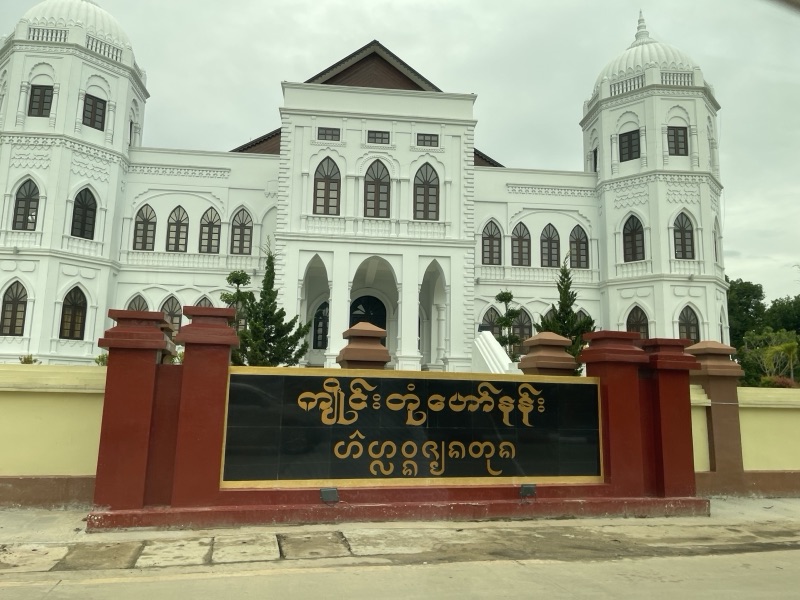
Image: EmeraldRange / Wikimedia Commons (CC0)
For Lanna people Chiang Tung was not far away. In the time of King Tilokarat Lanna's monastic lineages spread to Chiang Tung, Chiang Rung, Mueang Yong and Mueang Nai. Silpa Wattanatham says that in 1944, when Japanese forces in northern Burma were driven back, the Thai divisions at Chiang Tung were ordered back to Chiang Mai, Chiang Rai and Lampang, ending Thailand's fighting abroad.
Japanese troops in Chiang Mai
In August 1943 Japanese troops from Indochina were stationed in Chiang Mai (Chiang Mai, ชยฯงไห่มฯ) to guard the North and serve as a reserve for the Burma front. Walaiporn and Teerat say their headquarters was in the Borneo Company, a British mai sak (mai sak, ไม้สักฯ), teak, firm; its British owner was interned until the war ended.
Satanan (2021) lists camps in temples and schools in the old town, such as Wat Chedi Luang, Wat Muen Ngoen Kong, Wat Mueang Mang, Wat Muen San, Wat Chai Phra Kiat and Phuttha Sophon School. McCormick, a mission hospital, became a military hospital named "Seri Roengrit", and mission hospitals in Lampang and Chiang Rai were used the same way.
Markets, trade and paid work
Daily life changed a great deal. People interviewed by Walaiporn and Teerat remember high prices; kuea (kuea, เกิลฯอฯอ), salt, as well as sugar and oil were rationed by coupon, and a black market for trade with the soldiers was called "seng li". At the same time soldiers with money to spend brought income to traders in the kat (kat, กาดฯ), the markets, near the camps; one family split boxes of matches into small bundles and sold them to get by.
The Japanese army also hired and conscripted local people to enlarge Chiang Mai airfield and build roads. Satanan quotes a man conscripted to ham (ham, หามฯ), to carry between several people, bombs, as the Payap Archives recorded him in Kham Mueang:
"The Japanese brought the bombs … as long as half a man's height, four of us to carry one." — oral account in the Payap Archives, cited in Satanan Panyain (2021); our translation of the Kham Mueang
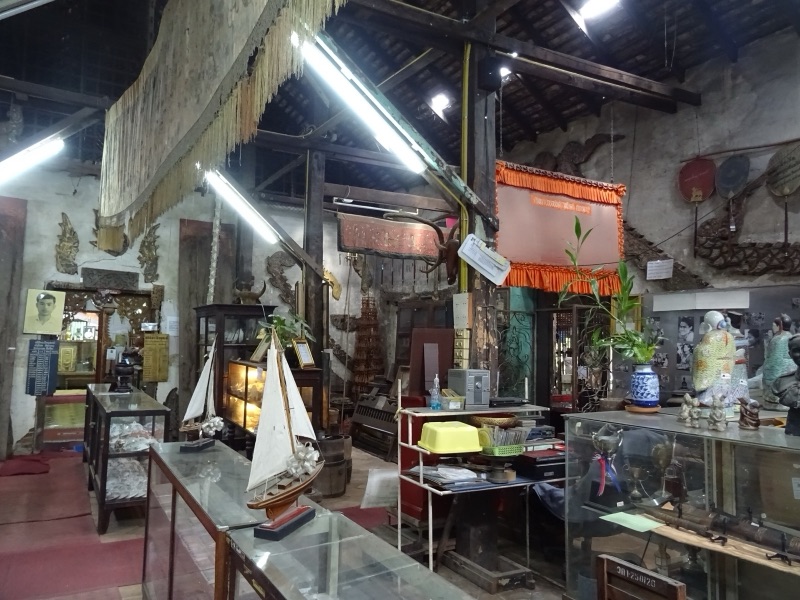
Image: Christophe95 / Wikimedia Commons (CC BY-SA 4.0)
Walaiporn and Teerat also found that Japanese was taught systematically in Chiang Mai in 1941–1943, at the Borneo Company and at Wat Ket Karam. Some learners kept in touch with Japanese friends for decades after the war.
The Japanese road to Mae Hong Son
The North had no Death Railway, but it had a hon tang (hon tang, ห฿นฯทาฯงฯ), a road, that the Japanese army cut through the doi (doi, ดอฯย), the mountains, west of Chiang Mai. Chewasit Boonyakiet (2013), citing Pol. Lt. Col. Choetchai Chomthawat, says it ran from Mae Malai through Pai, Mae Hong Son town and Khun Yuam into Burma, to meet a road built from Toungoo. Satanan, citing Boonserm, says most of the labour was local people, conscripted or hired.
The sources do not agree on the dates. The WW2 North Thailand website, citing the Japanese official history, says the work was ordered around August 1943 and largely stopped that November; the Sirindhorn Anthropology Centre's museum database says it began in late 1943, took about two years, and drew labour from Mae Hong Son, Chiang Mai, Lamphun, Lampang, Phrae and Nan. So we can only say it began around 1943.
Huea bin and la boet: Chiang Mai at the end of the war
Kham Mueang calls an aeroplane huea bin (huea bin, เริอฯอบินฯ), literally "a boat that flies". Late in the war the sound of aircraft became something people in Chiang Mai feared.
Boonserm Satrabhaya records that on 21 December 1943 Allied aircraft dropped la boet (la boet, รเบิดฯ), bombs, on Chiang Mai railway station. The station, warehouses and nearby homes were wrecked; he records that more than 300 people died. The station was closed for over a year, and passengers had to board trains at Pa Sao station in Lamphun.
People interviewed by Walaiporn and Teerat remember the station, a rice mill and the airfield being bombed often. Every household dug its own khum (khum, ขุม), a pit, as a shelter, schools closed, and small children were sent to the countryside. At night lights had to be shaded so no glow escaped.
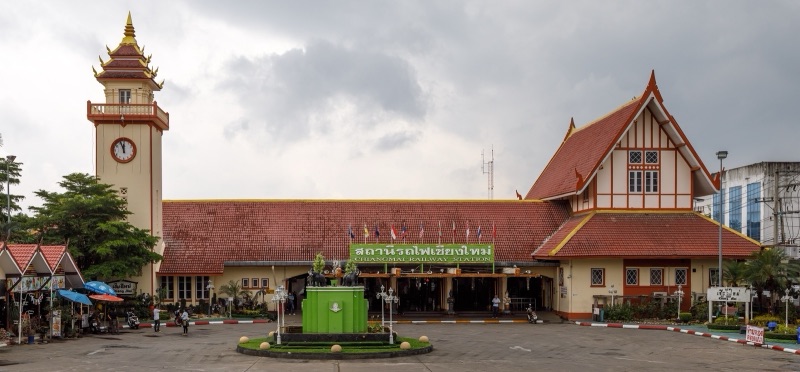
Image: CEphoto, Uwe Aranas / Wikimedia Commons (CC BY-SA 4.0)
The war also took things from Lanna quietly. Camille Notton's manuscript of the Mangraisat was destroyed in this war, though luckily it had been copied first, and some rites of the Sai Khan Dok festival that had been kept up for generations stopped during the war years.
1944–45: the retreat through Khun Yuam
As the war turned, Japanese forces in Burma fell back. Satanan notes that the North was both the road into Burma and the road of retreat from Burma into Mae Hong Son. Chewasit writes that Wat Muai To in Khun Yuam, a town of the Tai (Tai, ไท) people in Mae Hong Son (Mae Hong Son, แม่ฮ่อฯงสอฯร), served as a resting place and temporary infirmary for wounded and sick soldiers during the retreat.
During the war some Thais joined the Free Thai Movement, which worked against Japan, and as the war turned Field Marshal Phibunsongkhram's government fell in July 1944 (Britannica). Phrae has a Free Thai museum, which Chewasit counts among Thailand's war museums.
On 15 August 1945 Japan announced its surrender. The Shan lands went back to Burma, and Japanese soldiers were sent home; some left families and lasting ties behind, as people in Khun Yuam and Chiang Mai still recall.
What remains: the memorial at Khun Yuam
The Sirindhorn Anthropology Centre's museum database says that when Pol. Lt. Col. Choetchai Chomthawat became police chief of Khun Yuam in 1995, he found Japanese soldiers' belongings scattered in local homes, collected them and asked the elders about them. The next year (1996) he and the district chief opened a centre to tell the story of the war, opposite Wat Muai To. Thai people and Japanese veterans donated more items, and the display was redone in 2006. Today the municipality runs it as the Thai–Japanese Friendship Memorial.
On show are the remains of vehicles, supply chests, clothing, kitchen and rice-pounding tools, and weapons. In front stands a memorial plaque where visitors, especially the descendants of soldiers who died in the area, pay their respects. Visitors often wai (wai, ไห้วฯ), raising joined hands in respect, and kuet toeng (kuet toeng, คึดฯเทิงฯ), remember, those who died, whatever their nation.
Chewasit (2013) points out that each war museum tells a different memory. Kanchanaburi tells of the suffering of prisoners of war on the railway; Khun Yuam tells of friendship between villagers and soldiers. He sees museums as places where different stories meet, and reading both together gives a fuller picture of the war.
Common mix-ups: what the sources say
"The Death Railway ran through Chiang Mai and Mae Hong Son"
The Death Railway is in Kanchanaburi province. What the Japanese army built in the North was the road from Chiang Mai to Mae Hong Son and Khun Yuam, which some also call a "road of death" (Chewasit 2013; SAC museum database).
"The Japanese reached Lanna in the Ayutthaya period"
The sources we read describe the Japanese village at Ayutthaya and the sea trade, but do not record Japanese going up to Lanna in that age. The first Japanese on record in Chiang Mai are traders and photographers before the Second World War.
"Japan made the North a colony"
Thailand was Japan's ally from 21 December 1941, so Japanese troops were stationed in Thailand with the Thai government's consent. But the relationship was unequal: Walaiporn and Teerat cite Thamsook Numnonda's description of it as "friends, with one side in the lower position".
"Everyone in the North remembers the Japanese soldiers the same way"
Memories differ. Some people interviewed recall trade, help with medicine and friendships that lasted into old age; another said plainly that at the time they disliked the troops quartered in temples and schools, though they hold nothing against Japanese people today. Both are true accounts of people who lived through those years.
Summary
- Lanna and Japan met in two ways: indirectly through Ayutthaya's trade in the age of junks (sapao in Kham Mueang), and directly in the Second World War.
- In the 17th century about 1,000–1,500 Japanese had a village at Ayutthaya while Lanna was under Burmese rule; the sources do not say that Japanese reached Lanna then.
- In 1941–1945 the Phayap Army was based at Lampang and entered Chiang Tung, Japanese troops were stationed in Chiang Mai and built a road toward Mae Hong Son, and Chiang Mai station was bombed.
- The Thai–Japanese Friendship Memorial at Khun Yuam (1996) is a place to remember the dead, and local memories of the war are many-sided.
- Kham Mueang words that tell this story well include sapao, huea bin, la boet, khum, khai pa and kuet toeng.
Look up สะเปา and เฮือบิน in the Moradok Lanna dictionary, then read more about the places in this article in Mae Hong Son and Chiang Mai.
This article is one part of the series Lanna and the World. For the overview, a timeline comparing Lanna with human history and the list of the other parts, see Lanna and the World: Human History and Lanna's Place in It.
📚 Read more: Lanna under Burmese rule · Lanna · Lampang, Khelang Nakhon · King Tilokarat
Sources
- Moradok Lanna dictionary: สะเปา · เฮือบิน · เจียงตุ๋ง · ไข้ป่า · หละเบิด · กึ๊ดเติง
- Yoneo Ishii. (1971). Seventeenth Century Japanese Documents about Siam. Journal of the Siam Society 59(2)
- Embassy of Japan in Thailand. (2010). Thai-Japanese Relations: its future beyond six hundred years (speech by Ambassador Kyoji Komachi)
- Embassy of Japan in Thailand. (2023). Message from Japanese Foreign Minister KAMIKAWA Yoko
- Ministry of Foreign Affairs of Japan. Japan-Thailand Relations (Basic Data)
- Sakesit Paksee. (2015). มรดกญี่ปุ่นที่ซ่อนเร้นอยู่ในประเทศไทย (Japanese Hidden Heritage in Thailand). FEU Academic Review
- วลัยพร กาญจนการุณ และ ธีรัช ปัญโญ. (2016). ความสัมพันธ์ระหว่างชาวญี่ปุ่นและชาวไทยในจังหวัดเชียงใหม่ช่วงก่อนและระหว่างสงครามโลกครั้งที่สอง [Relations between Japanese and Thais in Chiang Mai before and during the Second World War]. Journal of Humanities and Social Sciences, Thaksin University 11(1)
- ศตนันท์ ปัญญาอินทร์. (2021). ภาพสะท้อนความสัมพันธ์ทางสังคมและเศรษฐกิจของ "คนเมืองเชียงใหม่" กับ "ทหารญี่ปุ่น" ในช่วงสงครามโลกครั้งที่ 2 [Social and economic relations of Chiang Mai people and Japanese soldiers in WWII]. HUSO Journal 38(3)
- เสมียนนารี. (2021). กองทัพไทยจัดกำลังพลไปรบในสงครามมหาเอเชียบูรพา [The Thai army in the Greater East Asia War] (citing Pratchayakorn Lakhonphon, 2021). Silpa Wattanatham
- บุญเสริม สาตราภัย. (online 2022). หน้าตาเมืองเชียงใหม่ ช่วงก่อน-หลังสงครามโลกครั้งที่ 2 [Chiang Mai before and after World War II]. Silpa Wattanatham
- ปิยวรรณ อัศวราชันย์. ความคิดของผู้นำและกิจกรรมของหญิงไทยในสมัยสงครามโลกครั้งที่ 2 ภายใต้เงากองทัพญี่ปุ่น [Thai women under the shadow of the Japanese army in WWII]. ThaiJO
- ทิพย์พาพร อินคุ้ม. (2008). สงครามเชียงตุงในประวัติศาสตร์ไทย พ.ศ. 2392–2488 [The Kengtung Wars in Thai History, 1849–1945]. MA thesis, Chulalongkorn University
- Eiji Murashima. (2006). The Commemorative Character of Thai Historiography: The 1942–43 Thai Military Campaign in the Shan States. Modern Asian Studies 40(4)
- ชีวสิทธิ์ บุณยเกียรติ. (2013). พิพิธภัณฑ์สงคราม บาดแผล และการเยียวยา [War museums, trauma and healing: two divergent narratives about Japanese soldiers in Thailand in WWII]. Journal of Sociology and Anthropology 32(1)
- Sirindhorn Anthropology Centre. Thai Museums Database: World War II Museum, Khun Yuam (in Thai)
- WW2 North Thailand. Khun Yuam Airstrip (citing Senshi Sōsho, the Japanese official history)
- Britannica: Thailand (1932 to World War II) · History of Myanmar · Free Thai Movement · World War II
- Moradok Lanna articles (each with its own sources): Lanna and the World · Lanna under Burmese rule · Lanna · King Tilokarat · Mangraisat · Sai Khan Dok · Mae Hong Son
Practise the words from this article
Flip through 23 flashcards of the Lanna words used in this article.


