
Photo: Tang2bar / Wikimedia Commons (CC BY-SA 4.0)
Lanna and Britain: Teak, Treaties and Burma Next Door
The story of Lanna and Britain starts with one plain fact: Lanna was never a British colony. Yet through the nineteenth century Britain was closer than many people imagine. After its war with Burma in 1824–1826, Britain held land along the Salween River on Lanna's south-western border, and what drew the two sides together was teak (mai sak, ไม้สักฯ). The teak forests of the Lanna lords, loggers from Burma, the rupee that the Khon Mueang (Northern Thai people) called ngoen thaep, lawsuits, and two Chiang Mai treaties all grew out of this one tree.
This article is part of the series Lanna and the World, which sets Lanna's story on the same timeline as world history. It tells how Britain came to live next door, how one teak log travelled from the forest to the sawmill, how the treaties changed which court heard a case, and why teak is bound up with Lanna's entry into the modern Siamese state.
How Britain came to live next door to Lanna
It began in Burma. In 1824–1826 Britain and Burma fought their first war, and Burma lost Assam, Arakan and Tenasserim to Britain, as Britannica and the National Army Museum both record. Tenasserim is the coastland south of the mouth of the Salween, the river that runs along Lanna's western border. The people of Lanna called it the Mae Nam Khong, as the dictionary notes under หินคง (in Thai).
Araya Fahrungsang (2021), in the Chiang Mai University Journal of Humanities, explains that after taking southern Burma the British built up Moulmein, at the mouth of the Salween, as a teak export and shipbuilding port. Teak was in great demand while ships were still the main vehicles of trade and war, because it is durable, flexible and slow to burn. Araya adds that British agents began surveying the Lanna forests from about 1829, and from about 1842–1847 began asking the Lanna lords for teak concessions.
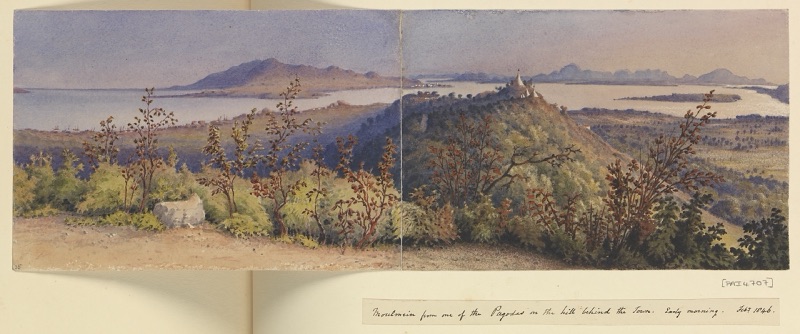
Image: Edward Gennys Fanshawe / Wikimedia Commons (Public domain)
In 1855 Siam (sayam, สๆยฯามฯ), under King Rama IV, signed the Bowring Treaty with Britain. It opened free trade and let British subjects be tried in British consular courts, a right called extraterritoriality. Lanna was then a tributary state of Siam, so the agreement reached the northern teak forests too.
Most "British subjects" in Lanna were not farang (falang, ระฯฝั่งฯ), Westerners. Brailey (1974) calls the loggers "mainly British Burmese", and Laohachaiboon and Takeda (2007), in the Journal of the Siam Society, describe Tai Yai (Shan) lessees who borrowed capital from British firms to lease forests. The Khon Mueang call the Burmese man (man, ม่านฯ), which the dictionary defines simply as "the Burmese people".
The lords' forests, palm leaves and the stump fee
Before the Siamese state took charge of the forests, Lanna's teak belonged to the ruling prince and the lords of each town. The chao luang (chao luang, เจั้าหลฯวฯง), the dictionary explains, was "the head of all the princes" in the main towns of Chiang Mai, Lamphun, Lampang, Phrae and Nan. Silpa Wattanatham (2024), drawing on the work of Suree Bhumibhamon, names Chiang Mai lords who owned the forests of Mueang Pai, Khun Yuam and Tha Song Yang.
Anyone who wanted to log had to agree terms with the forest owner and write the contract on a palm leaf (bai lan, ไบลานฯ). The Journal of the Siam Society and Silpa Wattanatham agree that such contracts named only the area, not how many trees could be cut, and that the same forest was sometimes leased to more than one party. Disputes followed again and again.
The money a logger paid the forest owner was counted by the stumps left behind. In Kham Mueang it is ka to (ka to, ค่าฯตํอฯ), the stump fee. Silpa Wattanatham gives about 3–5 rupees a tree in the early days, paid in Indian money.
Lawsuits, a royal visit to Moulmein, and the deadlock of 1873
Because British subjects' cases had to go to the consular court in Bangkok, forest disputes from Chiang Mai had to travel all the way to Bangkok. Araya, citing Saraswadee Ongsakul, counts 42 cases taken to Bangkok before 1874, with Lanna lords fined in 11. Brailey describes the British consular court in Bangkok awarding heavy damages against several lords, while the Siamese side did not enforce payment, until relations between the British consul and the Siamese chief minister reached deadlock in early 1873.
Meanwhile King Rama V travelled to Singapore, Batavia, British Burma and India in 1871–1872. Araya notes that he visited the teak sawmills at Moulmein, and Owart Suthiwartnarueput records that during the visit to India the Viceroy and the Chief Commissioner of British Burma asked him to deal with banditry on the Chiang Mai frontier. The next year Siam itself proposed an agreement directly with the British government of India.
The first Chiang Mai treaty: Calcutta, 14 January 1874
A Siamese mission led by Phraya Charoen Ratchamaitri reached Calcutta on 22 December 1873 and signed a treaty with the Government of India on 14 January 1874, according to Owart. This matches the text of the second treaty, which refers to "a special Treaty … bearing date the 14th January, 1874" (printed in the appendix of Thamsook Numnonda's study). Its full name states its aims: to promote trade between British Burma and Chiang Mai, Lampang and Lamphun, and to prevent banditry in those territories.
Owart sums up its main points:
- The ruler of Chiang Mai was to keep guard posts and police on the Siamese bank of the Salween.
- People crossing between Burma and the three towns needed passes.
- Bandits caught where they struck could be tried by local courts whatever their nationality. Owart notes this was the first time since 1855 that a Siamese court could try subjects of a treaty power in a criminal case.
- The King of Siam would appoint judges at Chiang Mai to decide claims of British subjects against Siamese subjects. In claims against British subjects, a defendant holding a pass could choose whether to accept the Chiang Mai court.
What Lanna people saw most clearly was a commissioner from Bangkok stationed in Chiang Mai. The dictionary has a word for this very post, the commissioner of the three towns (kha luang sam hua mueang, ข้าหลฯวฯงสามฯห฿วฯเมิอฯง), and explains that the central government sent him to oversee Chiang Mai, Lamphun and Lampang so that the rulers would keep the Chiang Mai treaty. Brailey and Silpa Wattanatham agree that the first commissioner was Phra Narin Ratchaseni, who, Brailey notes, was close to King Rama V.
1873 or 1874?
The dictionary and our article Lanna give the first treaty's year as B.E. 2416, while Araya (2021) gives B.E. 2417. Both have a basis. The signing date, 14 January 1874, falls early in the Western year, but before 1941 the Thai year did not begin in January (the government moved New Year's Day to 1 January from 1941). In the calendar of the time, January 1874 still belonged to B.E. 2416; counted the modern way it is B.E. 2417. Some studies, Brailey's among them, also speak of the "1873 treaty", because the negotiations began late that year.
The new system did not run smoothly. Owart notes that within three years the Government of India complained that cases involving British subjects were slow, and proposed a resident vice-consul in Chiang Mai.
The second treaty of 1883: a British vice-consul and the International Court in Chiang Mai
The second Chiang Mai treaty was signed in Bangkok on 3 September 1883 and abrogated the 1874 treaty in its first article. Owart tells the backstory: a version had already been signed on 10 January 1883, but London disavowed it, because the instruction to wait reached the consul four hours too late, and negotiations began again. The second treaty was ratified and came into force on 7 May 1884.
Two things changed. First, Britain stationed a vice-consul in Chiang Mai to look after British subjects in Chiang Mai, Lampang and Lamphun. Second, every case involving British subjects had to go first to a court at Chiang Mai, later called the International Court. Despite the name, Amnuayvit Thitibordin's thesis (2016) points out that its judges were Siamese and its cases were heard in Thai; the "international" part was only the nationality of the parties. This court (san, ศาลฯฯ) let the British vice-consul attend hearings and take a case over to his own court, but Owart found that between 1884 and 1902 he did so only three times.
The court's reach was widened twice by exchanges of notes between the two governments: in 1884–1885 to Nan and Phrae, and in 1896 to Thoen, Raheng, Sawankhalok, Sukhothai, Uttaradit and Phichai, as Owart and Thitibordin both record.
Try being the judge: decide which court heard each forest or trade case, from before the treaties, through the first treaty, to the International Court. Every answer comes with its sources.
1885: all of Burma becomes British
Teak also lit the fuse of the biggest event in Burma. King Thibaw's court at Mandalay fined the Bombay Burmah Trading Corporation, a British teak firm, for under-reporting the timber it had cut. Britain sent an ultimatum, and when it did not get the answer it wanted, a British army crossed the border on 14 November 1885, took Mandalay about two weeks later, and annexed Upper Burma on 1 January 1886, ending the Konbaung dynasty, as Britannica and the National Army Museum record. Britannica also notes British concern about French influence in Burma as a further cause.
From then on Britain was Lanna's neighbour along the whole western side. To the east, France formed French Indochina in 1887 and took the left bank of the Mekong in 1893. The map below opens at 1885; step back and forward to see the eras before and after.
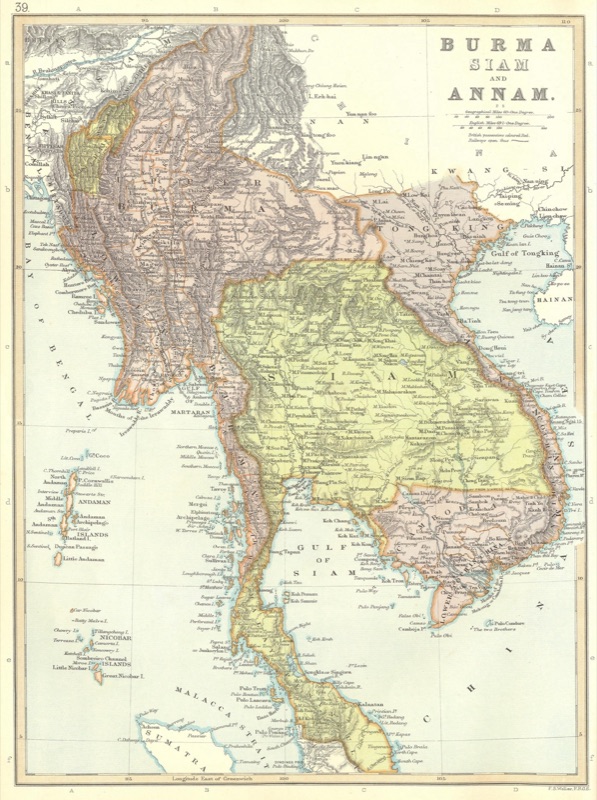
Image: Francis Sidney Weller / Wikimedia Commons (Public domain)
Lanna's western edge had a life of its own. The dictionary records that Mae Hong Son was made a town in 1874 by King Inthawichayanon of Chiang Mai. The forests of the Pai and Yuam valleys drain into the Salween, so their logs had to float through British Burma to Moulmein. The Journal of the Siam Society notes that before 1909 local lords worked these forests themselves, and that the forest workers on the Salween side were Pgaz K'Nyau, Tai and Khmu.
From stump to sawmill: the life of one teak log
Amnuayvit Thitibordin's 2016 PhD thesis at the University of Hamburg, built on the British Chiang Mai consular reports and the National Archives of Thailand, describes the teak work in detail. The first step was girdling. Around March–April a team set up a forest camp (pang, ปางฯ) and cut a ring through the bark round the trunk. The tree slowly died and dried over one to three years, because green teak is too heavy to float.
When the wood was dry, workers felled the tree with a two-man saw, and the elephant (chang, ช้างฯ) and its mahout (kwan chang, ควฯาฯนฯช้างฯ) came to haul the timber (lak mai, ลากฯไม้) and lay it along a stream bed. A log weighed about 2–3 tonnes; an elephant could move up to about 5. Elephants suffer in the heat, so the main working season ran from the rains into the cool season.
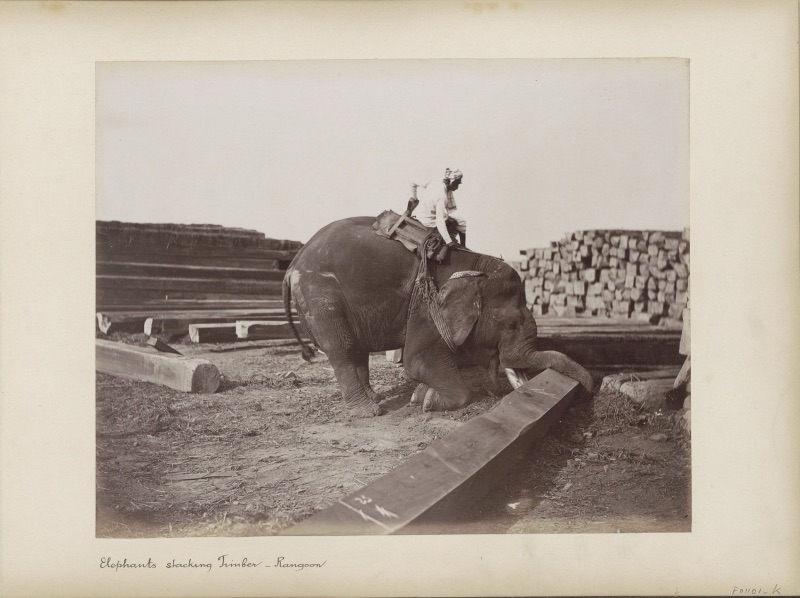
Image: Rijksmuseum / Wikimedia Commons (CC0)
At the stream the firm's agent, a forest officer and the contractor measured the logs together and hammer-marked each log end. After the Forest Department was founded, every log carried four marks: the firm, the year, the assistant and the class. Then came the wait for rain. When the water rose, the logs (mai thung, ไม้ธุง) floated off one by one. The dictionary has the very picture under loi fon (loi fon, ลอฯยฯ): many large things afloat are "loi fu loi fun", as in "mai thung loi fu loi fun", logs bobbing on the water.
A log did not reach Bangkok in one year. Thitibordin found that logs from the northern forests took on average about 5–8 years to arrive, and in dry years some took 12. On the way they stranded, jammed or were stolen. At the rafting station the raftsmen drilled a hole at each end of the log, which Kham Mueang calls the log nose (dang sung, ดังฯซุง); drilling it is cho hu deng (cho hu deng, โจอฯะรูเดังฯ). They tied about 150 logs into a raft and floated it down (long pae, ล่อฯงแพ) past the duty station at Paknampho (Nakhon Sawan) to the sawmills of Bangkok.
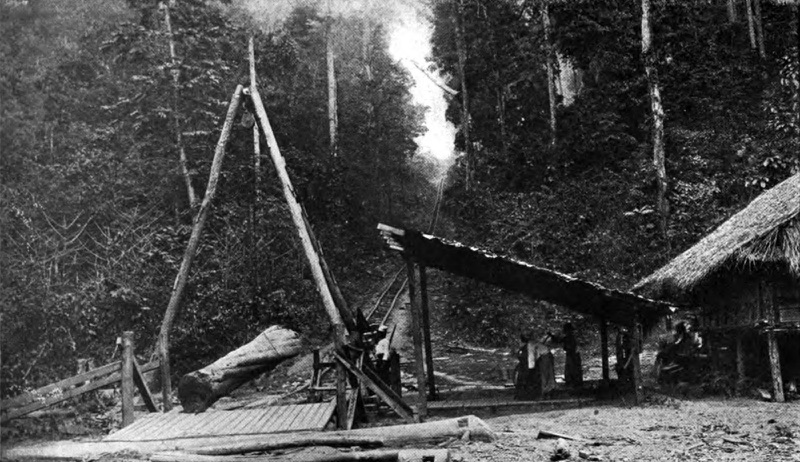
Image: G. P. Putnam's Sons / Wikimedia Commons (Public domain)
Follow one log yourself in the tool below. Pick a forest in one of five river basins, step from girdling to the sawmill, switch between "good rains" and "dry year", and see which way a log from Mae Hong Son had to go. Under the map are the figures for where Lanna teak ended up, and how far dry years cut the number of logs reaching Bangkok.
Figures in the Journal of the Siam Society (citing Suehiro) show that in 1896–1925 about 81 per cent of the teak cut in Lanna floated down the Chao Phraya to Bangkok, 16 per cent down the Salween to Moulmein, and 3 per cent down the Mekong to Saigon.
Timber firms, the "nai hang", the Forest Department and the rupee
In the 1880s and 1890s Western firms began logging themselves instead of financing local merchants. The Journal of the Siam Society counts six large firms: four British, namely the Borneo Company (logging from 1888), the Bombay Burmah Trading Corporation (from the 1890s), the Siam Forest Company and the Louis T. Leonowens company; one Danish (the East Asiatic Company) and one French. European firms held 85 per cent of the leases granted in 1896–1930 and local lessees 14 per cent, although Thitibordin shows that in the 1890s most timber merchants in Lanna were still Tai and Burmese, working on credit from firms in Bangkok and Moulmein.
Thamsook Numnonda lists British agencies at Mueang Yuam, Mae Hong Son, Chiang Mai, Lampang, Phrae, Nan, Sawankhalok and Raheng, each with a community of Asian British subjects around it. The Western managers were known as "nai hang pa mai", forest bosses, as in the title of Kittichai Wattananikorn's book Nai Hang Pa Mai: Sisan Chiwit Adit Lanna (2015). The word nai hang (nai hang, นาฯยฯห้างฯ) is defined in the dictionary as the owner of a firm or shop. Burmese who grew rich from timber in Lampang became pho liang (pho liang, พํอฯล้ยฯง), wealthy patrons, and built Burmese-style temples such as Wat Si Chum, as told in Lampang, Khelang Nakhon.
The Siamese state took a growing hand in the forests. Silpa Wattanatham relates that King Rama V wrote on 18 September 1896 approving a Forest Department, following the advice of H. A. Slade, a British forester who became its first head. The Journal of the Siam Society confirms that the department was set up in Chiang Mai on Slade's recommendation, and that it set a minimum girth for felling in 1897 and 1899.
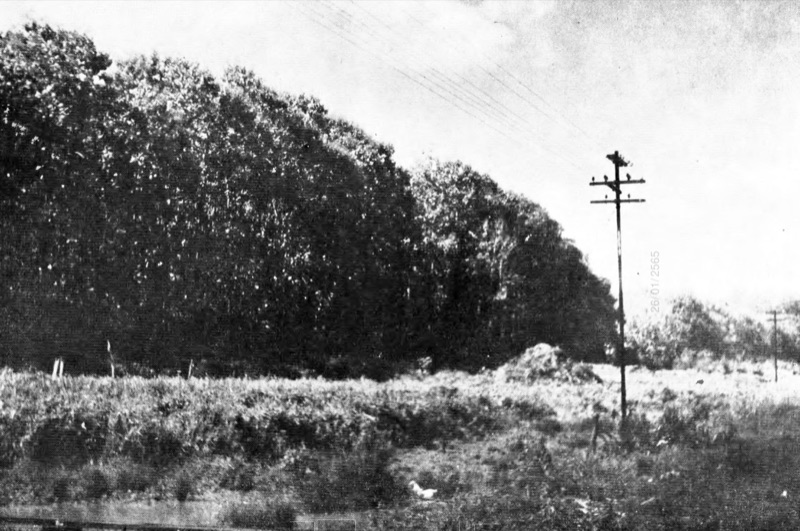
Image: Office of the Prime Minister / Wikimedia Commons (Public domain)
The money moving through the timber trade was mostly rupees, which the Khon Mueang called ngoen thaep (ngoen thaep, เงินฯแถปฯ). The dictionary explains it as "currency that the British brought in for trade in Lanna, arriving with the teak trade". Thitibordin found that logging contractors preferred to be paid in rupees rather than baht, and that firms could still pay royalties in rupees until 1924. Read about ngoen thaep, silverware and the saying "khon ba tem thaep" in Ngoen thaep.
From tributary state to Monthon Phayap: teak and the transition
While the treaties and the Forest Department arrived, Lanna was moving from tributary status into Siam's monthon system. In 1892 the Lanna towns were organised as Monthon Lao Chiang, and in 1899 tributary status ended and they became Monthon Phayap. The full sequence is in our article Lanna.
Scholars explain this change in different ways. Araya (2021) summarises a body of work holding that Western imperial pressure and teak disputes forced Siam to tighten its hold on Lanna, and Brailey describes King Rama V's anxiety about British ambitions in those years. Araya herself offers another view: that the profits of teak were a key reason for Siam to take direct control, and that Britain supported Siam doing so, wanting one clear authority responsible for forest boundaries and lawsuits. Reading both views gives a fuller picture.
In Phrae, the rule of Chao Phiriya Thepphawong, the last chao luang, ended with the events of 1902, as told in Phrae (Mueang Pae).
In 1909 Siam and Britain signed another treaty: Siam transferred its rights over Kedah, Kelantan, Terengganu and Perlis to Britain, and Britain gave up extraterritorial rights for its subjects in Siam. As for ngoen thaep, the dictionary records that it slowly lost its place after the northern railway reached Chiang Mai, where trains began running in 1921.
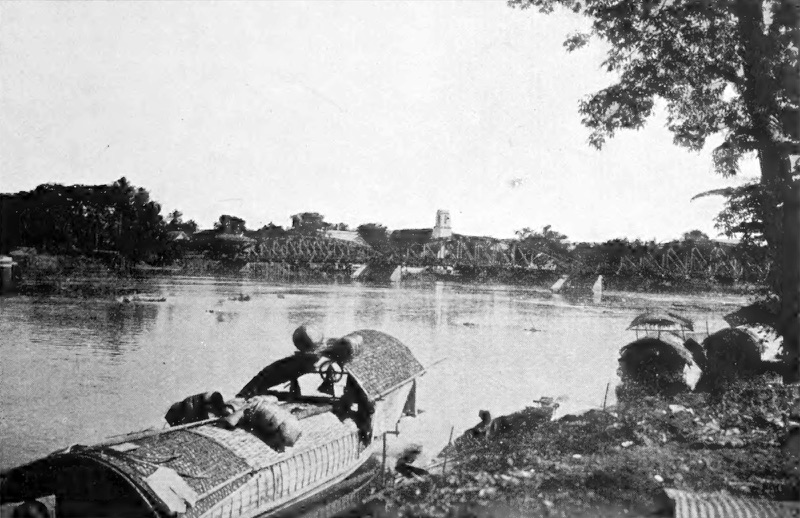
Image: Houghton Mifflin Harcourt / Wikimedia Commons (Public domain)
Traces of the era live on in Kham Mueang. People call the first bridge over the Ping at Chiang Mai the iron bridge (khua lek, ข฿วฯเหัลฯก). The dictionary tells how the Nawarat Bridge was first built entirely of teak in 1890, then rebuilt in iron and opened in 1923. More on the bridge and the riverside is in Chiang Mai (Jiang Mai), and the teak houses of the lords of Phrae and Lampang can still be visited today.
Common mix-ups: what the sources say
"Lanna was once a British colony"
None of the sources used here says so. Both treaties were made between Siam and Britain (the first with the British government of India), treating Chiang Mai, Lampang and Lamphun as Siamese territory. British firms logged under forest leases and permits. The place actually under Britain was the neighbour, Burma.
"The British subjects in Lanna were Westerners"
Most were Asian. Brailey calls the loggers British Burmese, Thamsook speaks of British Asian subjects, and Owart quotes the British minister in Bangkok in 1897: those claiming British protection in Siam were "of Burmese, Chinese, Malay, or some other Asiatic race".
"The Chiang Mai treaties were signed in Chiang Mai"
The name comes from the territory the treaties covered. The first was signed in Calcutta, the second in Bangkok.
Summary
- Britain came to live next door to Lanna after taking southern Burma in 1826 and the whole of Burma in 1885–1886. What linked the two sides was teak (mai sak) and the port of Moulmein.
- The teak forests belonged to the Lanna lords, leased on palm-leaf contracts with a stump fee (ka to) per tree. Disputes with loggers who were British subjects led to the first Chiang Mai treaty (Calcutta, 14 January 1874) and the commissioner of the three towns.
- The second treaty (Bangkok, 3 September 1883) brought a British vice-consul to Chiang Mai and an International Court with Siamese judges, later extended to Nan and Phrae.
- A single log took years to go from girdling, elephant hauling, floating and rafting to the sawmill, and Kham Mueang still keeps the words of this work, such as dang sung and long pae.
- The rupee, the timber firms and the Forest Department were part of Lanna's move from tributary state to Monthon Phayap, and scholars still explain the causes of that change differently.
Look up the full meanings of ไม้สัก, ก้าต๋อ and ข้าหลวงสามหัวเมือง in the Moradok Lanna dictionary (in Thai), then read the eras before this one in Lanna Under Burmese Rule and King Kawila.
📚 Read the whole story of Lanna: Lanna: where the name comes from, and 700 years of the land · Towns in this story: Phrae (Mueang Pae) · Lampang, Khelang Nakhon · Mae Hong Son · Nan
Sources
- Moradok Lanna dictionary: ไม้สัก · ก้าต๋อ · ข้าหลวงสามหัวเมือง · เงินแถบ · ดังซุง · หินคง · ขัวเหล็ก
- Owart Suthiwartnarueput. (2021). From Extraterritoriality to Equality: Thailand's Foreign Relations, 1855–1939. International Studies Center, Ministry of Foreign Affairs of Thailand (sections on the 1874 treaty with India and the 1883 Chiengmai Treaty)
- Thamsook Numnonda. The Anglo-Siamese Negotiations, 1900–1909. International Studies Center, Ministry of Foreign Affairs of Thailand (introduction, and appendix 1: text of the 1883 Chiengmai Treaty)
- Brailey, Nigel J. (1974). Chiengmai and the Inception of an Administrative Centralization Policy in Siam (II). Southeast Asian Studies 11(4), Kyoto University
- อารยา ฟ้ารุ่งสาง. (2021). ไม้สัก: ลัทธิจักรวรรดินิยม และบทบาทของอังกฤษในความสัมพันธ์ระหว่างสยาม–ล้านนา ก่อน พ.ศ. ๒๔๔๒ [Teak: Imperialism and the Role of Britain in Siamese–Lanna Relations before 1899]. CMU Journal of Humanities 22(3), 12–25
- Laohachaiboon, Suphawat & Takeda, Shinya. (2007). Teak Logging in a Trans-boundary Watershed: An Historical Case Study of the Ing River Basin in Northern Thailand. Journal of the Siam Society 95
- Thitibordin, Amnuayvit. (2016). Control and Prosperity: The Teak Business in Siam 1880s–1932. PhD thesis, University of Hamburg
- Silpa Wattanatham editors. (2024). "ไม้สัก" มีค่าถึงขั้นเป็น "ส่วย" แทนทองคำ ทั้งยังเกี่ยวพันกับการตั้ง "กรมป่าไม้" [Teak as tribute, and the founding of the Forest Department]. Silpa Wattanatham (after Suree Bhumibhamon, Phanphuet nai Prawattisat Thai)
- Britannica. Anglo-Burmese Wars · Thibaw · Bowring Treaty
- National Army Museum. First Burma War · Third Burma War
- Khaosod. น้าชาติ รู้ไปโม้ด: วันปีใหม่ ๑ มกราคม [New Year's Day, 1 January] · Silpa Wattanatham. เพลงขึ้นปีใหม่ "วันที่หนึ่งเมษายนตั้งต้นปีใหม่" [The old 1 April New Year song] (New Year moved to 1 January from 1941)
- The 1909 treaty, Monthon Phayap, the events in Phrae and the railway to Chiang Mai, with full references, are in Lanna and the World, Lanna and Phrae (Mueang Pae)
- Images from Wikimedia Commons, credited under each picture
Practise the words from this article
Flip through 22 flashcards of the Lanna words used in this article.


