
Photo: Marcel Fagin / Unsplash
Sai Jue: Naming a Child the Lanna Way
Giving a name in Kham Mueang (Northern Thai) is sai jue (ไส่ชื่, Kham Mueang reading sai jue). The Moradok Lanna dictionary defines it as to name, to give a name, and to enter a name in a register. The names of the grandparents' generation in Lanna say a lot: when a person was born, their place in the family, whether they once wore the robe, and even the names of ancestors kept alive in a surname.
This article walks through the Kham Mueang words about names, the palm leaf that recorded the time of birth, the birth-year animal and the Lanna name prefixes, and it says plainly where we have not yet found published evidence.
Jue, sai jue, jot jue: Kham Mueang words for names
A name in Kham Mueang is jue (ชื่, jue). The ch sound of central Thai becomes j, just as Khon Mueang (Northern Thai people) say Jiang Mai for Chiang Mai. The rule is explained in Ch becomes J in Kham Mueang.
From jue come several everyday words:
| Kham Mueang | Dictionary meaning |
|---|---|
| sai jue | to name, give a name, enter a name in a register |
| sai jue wa… (ไส่ชื่ว่าฯ...) | to name (someone) as… |
| jot jue (จ฿ดฯชื่) | to write a name down |
Note that sai jue works both for naming a baby and for signing a name into a register, while jot jue is the act of writing it down.
Want to see a word you might use in a name written in Lanna script? Try it in this tool. If the word is not in the dictionary yet, it says so and never guesses a spelling.
Ja-ta: the palm leaf that recorded a birth
Long before government birth certificates, Lanna people had the ja-ta (ชตา, ja-ta). The dictionary describes it as "a record of the time, day, month and year of birth, usually inscribed with a stylus on a palm leaf and rolled up for keeping". The same word also means chata, the horoscope an astrologer works out from the time of birth.
So the palm leaf (bai lan, ไบลานฯ) was not only for scriptures: it also kept the moment a person was born, for a whole lifetime.
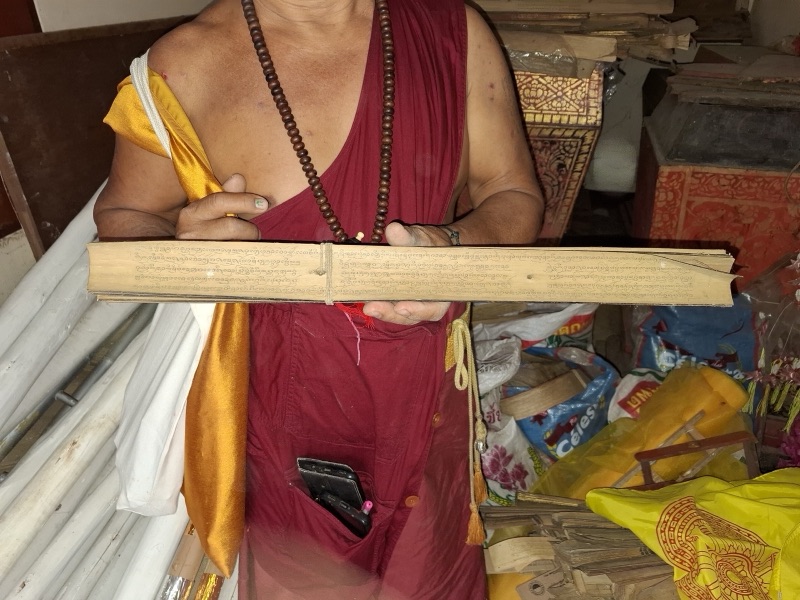
Photo: Lannafolium / Wikimedia Commons (CC0)
A Lanna birthday also has names of its own: the day of the week, called wan meng, and the name in the 60-day cycle, called wan tai. Find both for your own birthday in Your Lanna Birth Day Name; the Moradok Lanna calendar (in Thai) shows them for every day.
Tua poeng: the birth-year animal
Khon Mueang call the animal of their birth year tua poeng (ต฿วฯเพิ่งฯ, tua poeng) and the zodiac year pi tua poeng (ปีต฿วฯเพิ่งฯ, pi tua poeng). The dictionary notes that people in the past usually remembered their birth year by its animal rather than by a number.
Watch the new year, though. The dictionary explains that the zodiac year changes on Wan Phaya Wan, not on 1 January. Its example is 2022: a child born after the moment the new year began on Wan Phaya Wan had the tiger as tua poeng, while a child born before it was still in the year of the ox. Read more in Wan Phaya Wan.
The 12 Lanna year names and their animals
| Zodiac year | Lanna year name | Tua poeng |
|---|---|---|
| Chuat | jai | rat |
| Chalu | pao | ox |
| Khan | yi | tiger |
| Thao | mao | rabbit |
| Marong | si | great serpent (naga) |
| Maseng | sai | snake |
| Mamia | sa-nga | horse |
| Mamae | met | goat |
| Wok | san | monkey |
| Rakha | lao | rooster |
| Cho | set | dog |
| Kun | kai | elephant (central Thailand: pig) |
The year names and animals in this table come from the individual dictionary entries.
The last year is the most interesting. Kai (ไค้, kai) is the year of the pig, and the dictionary records that central Thailand uses the pig as its symbol "but Lanna prefers the elephant". A Khon Mueang born in that year has an elephant as tua poeng. Find your own Lanna birth year and its relic chedi in Birth-year relics.
Names that tell the story of a birth: Ai Fa Hong
Many old Lanna names record what happened on the day a child was born. A well-known example is Khruba Siwichai. Kritsana Hong-uthen (2021) writes that a thunderstorm broke on the day he was born, so his father named him "Ai Fa Hong", with a second name, "Inthafuean".
Take the words apart. Thunder in Kham Mueang is fa hong (ฟ้าร้อฯง, fa hong), and fuean (เฟิอฯร, fuean) means to shake, tremble or quake, as in paen din fuean, an earthquake. Inthafuean can therefore be heard as thunder shaking all the way up to the god Indra.
The dictionary records the name too, under ja-toek: as a novice, Khruba Siwichai was called Inthafuean (spelled slightly differently from Kritsana's work). Read his life in Khruba Siwichai.
Ai, i, ai, ba: words before a name
In daily life a Lanna name almost never stands alone. A word in front of it tells gender, age or closeness.
- Ai (อ้ายฯ, ai): the dictionary says it means the eldest brother, and a man older than oneself. The first child of a family is the luk kao (ลูกเคั้าฯ, luk kao).
- I (อี่, i): the word an older person or a friend puts before a woman's name; the dictionary's examples are i kaeo and i kham.
- Ai with a short falling tone (ไอ่, ai, written ไอ่): the same for a man's name, as in ai kaeo and ai kham.
- Ba (บ่าฯ, ba): before the name of a younger man or a close friend, as in ba saeng.
Notice the names the dictionary picks for its examples: kaeo and kham. Both carry good meanings in Kham Mueang. Kaeo (แก้วฯ, kaeo) means something precious, lovable and cherished; the dictionary's example is kaeo kaen ta, "a beloved child". Kham (ฅำ, kham) means gold.
More affectionate names for small children, such as ai noi, are in La-on.
Noi and nan: names that grow with a life
A Lanna man's name may gain a title as he grows older. The dictionary explains noi nan (น้อฯยฯหนฯานฯ, noi nan): a man who was a novice and has left the robe gets noi before his name, because he learned "little" (noi) of the teaching and the rites, while a man who was a monk and has left the robe is called nan (หนฯานฯ, nan).
The dictionary's example is a man named Si who was once a novice. After leaving the robe he is called noi si, pi noi si, lung noi si, po noi si and in old age po u-i noi si, depending on his age and standing. One name grows along with its owner. The novice ordination behind the word noi is told in Buat Luk Kaew.
From grandparents' names to Khon Mueang surnames
Siamese people only received surnames with the Surname Act of 1913; before that everyone had just a personal name given by parents or elders. Chuanphit Naphatasai (2016) studied Khon Mueang surnames in Chom Thong district, Chiang Mai, and found that when the state required everyone to have a surname, villagers often joined the names of their grandparents to make one.
| Surname | Origin, according to the study |
|---|---|
| Kanthakham | grandfather Kantha and grandmother Kham |
| Uppaeng | grandfather Up and grandmother Paeng |
| Piachanta | grandfather Pia and maternal grandfather Chanta |
| Chichommueang | grandmother Chi, maternal grandfather Chom and maternal grandmother Mueang |
A Khon Mueang surname is therefore a record of the grandparents' names that their descendants still carry today. The same study found surnames taken from official titles, places of residence and trades, and the words kaeo and kham appear in a great many Chom Thong surnames.
The author also notes that in recent years many people have changed their names and surnames to grand-sounding Pali and Sanskrit words, some to remove letters considered unlucky (kalakini) or to make the numbers of the name add up well. She worries that when Kham Mueang surnames disappear, a piece of the language's evidence disappears with them.
Taksa: the naming manual all Thailand knows
The naming manual best known across Thailand is the Tamra Taksa. Amnat Paksasuk (2013) explains that it divides the letters into eight groups linked to the eight planets, each with its own meaning: boriwan (companions), ayu (life), det (power), si (glory), mula (foundation), utsaha (effort), montri (support) and kalakini (misfortune). The person choosing a name looks at the child's day of birth, picks letters with good effects and avoids the kalakini group of that day.
The same author notes that in astrology a new day begins at six in the morning, not at midnight, and that someone born on a Wednesday after six in the evening counts as "Wednesday night", which uses different letters from Wednesday daytime.
Beliefs about lucky names differ from family to family. If you want to name a child by a manual, ask a knowledgeable elder or a monk your family respects.
Summary
- Sai jue means to give a name, jue is a name, and jot jue is to write a name down.
- The ja-ta was a palm leaf recording the time, day, month and year of birth: a Lanna birth certificate.
- The birth-year animal is the tua poeng; the year changes on Wan Phaya Wan, and a Khon Mueang born in the year of the pig (kai) has an elephant as tua poeng.
- Words before a name such as ai, i, ai (ไอ่) and ba show gender, age and closeness, while noi and nan show that a man was once a novice or a monk.
- Many of the first Khon Mueang surnames were made from the grandparents' names; the taksa manual is the naming system used all over Thailand.
Look up more words about names in the Moradok Lanna dictionary (in Thai), and read on about raising children in La-on.
📚 The whole series: see every Lanna rite from birth to death on one map in The Lanna Life Cycle: Customs from Birth to Death.
Sources
- Moradok Lanna dictionary (in Thai): ใส่จื้อ · จื้อ · จ๊ะต๋า · ตั๋วเปิ้ง · ไก๊ · น้อยหนาน · อี่
- ชวนพิศ นภตาศัย (Chuanphit Naphatasai). (2016). นามสกุลคนเมือง...ภาพสะท้อนการใช้ภาษาถิ่นที่กำลังจางหาย [Khon Mueang surnames: a reflection of a fading local language (a case study of Chom Thong, Chiang Mai)]. Khuang Phaya Journal, Chiang Mai Rajabhat University 11, 31–55
- อำนาจ ปักษาสุข (Amnat Paksasuk). (2013). ตำราทักษากับการตั้งชื่อของคนไทย [Tamra Taksa and Thai naming]. Vannavidas 13
- กฤษณา หงษ์อุเทน (Kritsana Hong-uthen). (2021). อนุสาวรีย์ครูบาศรีวิชัย ณ เชิงดอยสุเทพ จังหวัดเชียงใหม่ [The Khruba Siwichai monument at the foot of Doi Suthep]. Journal of Fine Arts, Chiang Mai University 12(2)
- Images from Unsplash and Wikimedia Commons, credited under each picture
Practise the words from this article
Flip through 22 flashcards of the Lanna words used in this article.


