
Photo: Photo Dharma from Sadao, Thailand / Wikimedia Commons (CC BY 2.0)
Who's Who in Lanna Tales: Giants, Hermits and Indra
Characters in Lanna tales include man-eating giants, hermits who foretell, devas who come down in disguise, and the beasts of the Himmaphan forest. This post gathers 30 Kham Mueang words from the Moradok Lanna dictionary that name them, such as yak (ยัก์ขฯ, Kham Mueang reading yak), la-si (รสี, la-si), Tao Pan Ta (ท้าฯวฯพันฯตา, tao pan ta) and Nang Tho-la-ni (นาฯงฯธํอฯรณี, nang tho-la-ni).
Every word links to the tales in this series where the character appears. Where the dictionary has no headword of its own, we write the word in Thai script only and say so plainly.
Yak, phi sue and guardian spirits: keepers of forest, cave and city
The dictionary explains yak as a non-human being of the Jataka tales, shaped like a person but very large, with long fangs and great power. A word that often walks beside it is phi sue, which in Kham Mueang is not an insect but a guardian spirit of a place: a village, a hill, a town.
Giants in Lanna tales are not always villains. In Pu Sae Ya Sae: Chiang Mai's Guardian Spirits the legend says a giant couple once seized people to eat, until they met the Buddha, took the five precepts and became protectors of Chiang Mai. In Hong Hin: the Stone Swan a giant who snatches townspeople is killed by the prince with Indra's sword. The storyteller can use a yak as villain or as guardian, depending on the tale.
| Kham Mueang | Lanna script | Meaning (per the dictionary) | Found in |
|---|---|---|---|
| yak | ยัก์ขฯ | a non-human being of the Jataka tales: huge, long fangs, powerful, fond of raw flesh | Hong Hin · Pu Sae Ya Sae |
| yak yen | ยัก์ขฯเยนฯ | a non-human being said to arise from a person of strong spells, able to take the shape of a fierce beast | Ghost and spirit words |
| phi sue | ผีเสิ้อฯอ | a guardian spirit of a place, such as a village, hill, town or temple spirit | Chao Luang Kham Daeng |
| phi sue yak | ผีเสิ้อฯอยัก์ขฯ | a guardian spirit that looks after a place, with great power and sanctity | Ghost and spirit words |
| phi chao nai | ผีเจั้านาฯยฯ | a guardian spirit, often a figure of legend who did good and was honoured as a deva, such as the spirit of Chao Luang Kham Daeng | Chao Luang Kham Daeng |
| phi pu sae ya sae | ผีปู่แสะย่าแสะ | the guardian spirit of Chiang Mai, now with a shrine at Wat Doi Kham | Pu Sae Ya Sae |
| phi khun nam | ผีขุรนาฯ | the guardian spirit of each river source | Ghost and spirit words |
| sue mueang | เสิ้อฯอเมิอฯง | a guardian spirit that protects the city | Liang phi pu ya |
In Chao Luang Kham Daeng the temple's legend sign calls Nang In Lao a "cave giant phi sue". By the dictionary, phi sue here means the spirit that guards the cave, not an insect.
La-si: the hermit who foretells and raises
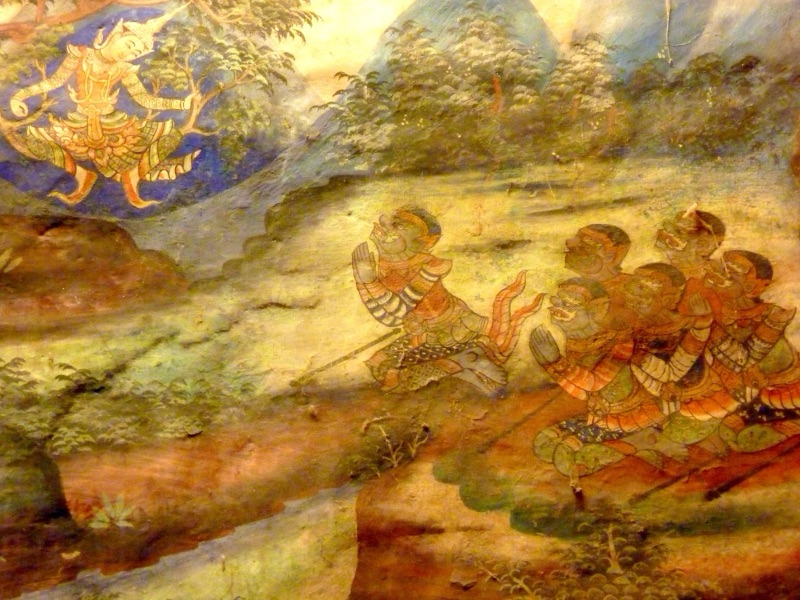
La-si means a hermit (rue-si). The dictionary describes an ascetic who lived before the Buddha's time and gave up home to practise in forest, mountain or cave. The Pali word is "isi", meaning one who seeks the good. Kham Mueang has several forms: la-si, phra ra-si and i-si, and the dictionary notes that Lanna writers prefer "rasi".
Hermits tend to arrive when a tale needs someone who knows. In the Wiang Chet Lin version of Chao Luang Kham Daeng the deer leads the prince south until he meets a la-si. In another version a hermit reads the seven lotus clumps as a good omen for founding a city. In The White Crow, Mother of Five Buddhas the five boys raised by foster mothers go forth as hermits, and in Pu Sae Ya Sae the giant's son who ordained and then left the robes becomes Suthep the hermit in a cave behind Doi Suthep.
| Kham Mueang | Lanna script | Meaning (per the dictionary) | Found in |
|---|---|---|---|
| la-si | รสี | a hermit; an ascetic from before the Buddha's time who gave up home for forest and mountain | Chao Luang Kham Daeng |
| phra ra-si | ระฯพรสี | a hermit (also pha-i-si) | The White Crow |
| i-si | ±สิ/±สี | a hermit, one who seeks the good, a renunciant (Pali) | Pu Sae Ya Sae |
Tao Pan Ta and the devas: who come down when people are in trouble
Tao Pan Ta is Indra, literally "Lord of a Thousand Eyes". The dictionary says he rules the Tavatimsa heaven and has many names, such as Tao Sakka Thewathirat. Another word is In (±น์ทฯ, Kham Mueang reading in).
Indra appears in many Lanna tales. In Hong Hin he takes the prince up to be raised in heaven, then turns a stone into a swan to carry him back to his mother. In Maeng Si Hu Ha Ta one version says the strange beast is Indra in disguise. And in the legend of the Emerald Buddha told in The Emerald Buddha in Lanna, Indra sends Vishnukam to fetch the gem to make the image.
| Kham Mueang | Lanna script | Meaning (per the dictionary) | Found in |
|---|---|---|---|
| tao pan ta | ท้าฯวฯพันฯตา | Indra, ruler of the Tavatimsa heaven | Hong Hin · Maeng Si Hu Ha Ta |
| in | ±น์ทฯ | Indra, king of the devas of Tavatimsa and Catummaharajika (Pali) | The Emerald Buddha in Lanna |
| te-wa-da | เทวดา | a deva, a being of heaven who did good, with Indra as chief | Chao Luang Kham Daeng |
| tao tang si | ท้าฯวฯทังฯสี่ | the four guardian kings who watch the four directions | not yet in a tale of this series |
Nang Tho-la-ni: Mother Earth, the witness
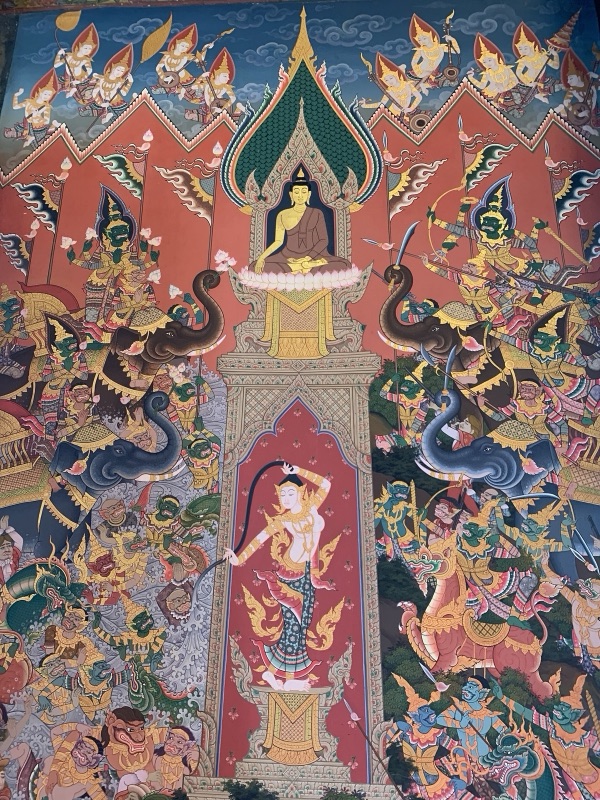
The dictionary explains Nang Tho-la-ni in a few words: "the goddess who guards the earth", also called Mae Thorani. In daily life the dictionary records an old custom: when eating outdoors, shape a small bite of food as an offering to the spirit of the place and say "Please, Mother Earth, spirit of this place, come and eat first" (see Eating Like a Local).
In the story of the Buddha's life, the Thai newspaper Naewna (2026) tells that on the night of the enlightenment Mara claimed the Buddha's seat. The Buddha "called on the earth as his witness". Mother Earth wrung her hair, and the water the Buddha had poured out in dedication over many lives rose and swept Mara's army away. A mural of this scene is shown below.
Naga, lions, swans and beasts of the Himmaphan forest
The Himmaphan forest is, per the dictionary, the forest around the Himalayas, and the name of a great forest often met in Jataka literature such as the Vessantara Jataka. Its fabulous animals appear in tales and in temple art.
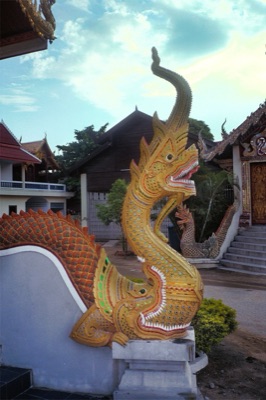
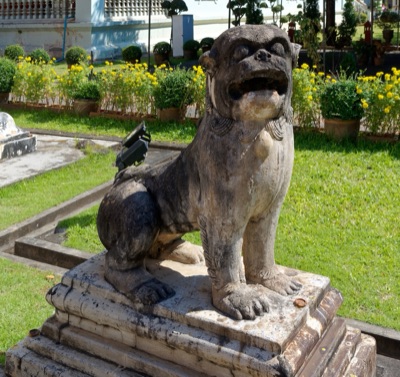
Nak has several meanings in the dictionary: a great serpent, a noble one, and a man about to be ordained. In The White Crow five eggs are taken in by five creatures: a hen, a nak (some sources say a snake), a turtle, a cow and a ratchasi (the mythical lion), which the dictionary calls a beast of legend from the Himmaphan forest, king of the animals. At the gates of northern temples a ratchasi or sing often sits on the wall.
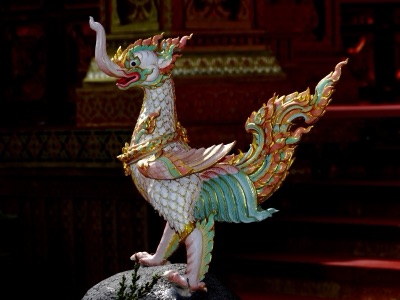
The hong (swan) is the mount of Brahma in Brahmin belief, and in Hong Hin it is the bird that carries the prince back to his mother. The hatsadiling is a bird of legend with an elephant's head, trunk and tusks and a bird's body. Lanna people use it on the funeral castles of senior monks; read more in Lanna Funeral Castles. It also appears in the Madri chapter of the Vessantara Jataka, where Madri laments her lost children (read on in Thai: a grand word).
| Kham Mueang | Lanna script | Meaning (per the dictionary) | Found in |
|---|---|---|---|
| nak | นาฯคฯ | a great serpent; a noble one; a man about to be ordained | The White Crow |
| rat-cha-si | ราชสีห์ | the king of lions, a beast of legend in the Himmaphan forest, lord of all animals | The White Crow · Thai: a grand word |
| sing | สิง์หฯ | another name for the ratchasi | the stone singha at Wat Phra Singh (photo below) |
| hong | ห฿ง์สฯฯ | a swan, the mount of Brahma in Brahmin belief | Hong Hin |
| nok hat-sa-di-ling | น฿กฯหัสีดฯลิง์คฯ | a bird of legend with an elephant's head, trunk and tusks and a bird's body | Lanna Funeral Castles |
| pa him-ma-pan | ป่าหิมมฯพานฯ | the forest around the Himalayas; a great forest in Jataka literature | Tang Tham Luang |
Kings, princes and bodhisattvas: the heroes of the Jataka
Many Lanna tales take their heroes from the Jataka. The word for a ruler is pha-ya (พญา, Kham Mueang reading pha-ya), which the dictionary glosses as sovereign, and which also names the chief of other things, as in phaya nak. Tao (ท้าฯวฯ, tao) means a lord, or the title before a man of princely descent.
The Jataka that Lanna people know best is the Vessantara Jataka, preached at Tang Tham Luang. The dictionary explains that Phra Wet-san-don (Vessantara) is the bodhisattva of the tenth of the ten last lives, perfecting generosity before becoming the Gotama Buddha, and Mat-ri (Madri) is Queen Madri of the same tale. Read verses from her chapter in Thai: a grand word.
Another tale whose characters are Buddhas is The White Crow, where the dictionary holds the group name Phra Chao Ha Ton.
| Kham Mueang | Lanna script | Meaning (per the dictionary) | Found in |
|---|---|---|---|
| pha-ya | พญา | sovereign, lord of the land, or chief of something, such as King Mangrai, phaya nak | King Mangrai |
| tao | ท้าฯวฯ | a lord, a ruler, the title of a man of princely descent | Hong Hin |
| phra wet-san-don | ระฯพเวสสฯันดฯอฯร | the bodhisattva of the tenth of the ten last lives, who perfected generosity | Tang Tham Luang |
| ma-thi | มัระฯที | Queen Madri in the Vessantara Jataka | Thai: a grand word |
| phra chao ha ton | ระฯพเจั้าห้าต฿นฯ | the five Buddhas who attained enlightenment in this aeon | The White Crow |
Creatures and a star with a tale of their own
Some characters are named in only one tale, and the dictionary keeps them as headwords of their own.
- Pa yian pon (ปลฯาอยฯยฯรพอฯร, pa yian pon) is the white eel that the townspeople caught in the legend of the city that sank into a swamp. Read Wiang Nong Lom.
- Kwang (กวฯางฯ, kwang) is a deer. In Chao Luang Kham Daeng the golden deer leads the prince into the cave.
- Maeng si hu ha ta (แมงฯสี่หูห้าตา, maeng si hu ha ta) is the beast that eats hot coals and passes gold. Read Maeng Si Hu Ha Ta.
- Dao wi kai noi (ดาวฯวีไก่ห้นฯอฯ, dao wi kai noi) is the Pleiades, and a tale that teaches gratitude. Read Lanna Pleiades Legend.
Summary
- Yak is a huge non-human being of the tales, sometimes villain, sometimes guardian; phi sue in Kham Mueang means a guardian spirit, not a moth.
- La-si is the hermit who foretells and raises; Tao Pan Ta is Indra, who comes down when people are in trouble.
- Nang Tho-la-ni is Mother Earth, the goddess who guards the earth and the witness on the night of the enlightenment.
- Nak, ratchasi, hong and nok hatsadiling are beasts of the Himmaphan forest, seen in tales and on Lanna temples.
- Words the dictionary does not yet hold are written in Thai script and flagged openly.
Look up the full meaning of each word in the Moradok Lanna dictionary (in Thai) and start reading the tales with Pu Sae Ya Sae or Hong Hin.
📚 Whole series: see every tale and legend on one map at Lanna Folk Tales and Legends: A Story Map
Sources
- Moradok Lanna dictionary (in Thai): ยักข์ · หละสี · ต๊าวปันต๋า · นางธอหละณี · นาค · ราชสีห์ · หงส์ · นกหั๋สดีลิงค์ · ป่าหิมหมะปาน · พระเวสสันดร
- The story of each tale, with its original sources, is in the posts linked above.
- แนวหน้า. (8 April 2026). แม่พระธรณี มงคลสัญลักษณ์กับความเชื่อในสังคมไทย [Mother Earth, an auspicious symbol and belief in Thai society]. In Thai. Naewna
Practise the words from this article
Flip through 32 flashcards of the Lanna words used in this article.


